
A reliable fiber tester can turn a confusing home-office network problem into a quick, identifiable fix. The right tool helps you locate breaks, verify light levels, check connectors, and confirm whether a fiber link is ready for service.
This roundup covers 10 fiber-testing options, from simple visual fault locators and optical power meters to advanced OTDRs with built-in light sources and event mapping. Choose based on the fiber types you use, the faults you need to diagnose, and how much testing capability you actually need.
Best 10 Fiber Optic Testers for Home Offices Picks for 2026
Quick Signal Checker

- Detects 850–1625 nm optical signals
- Non-contact testing for ports and patch cords
- Simple light and sound alerts
Best For: Fast signal-presence checks on home-office fiber links
Advanced Fiber Diagnostics

- OTDR testing from 5 m to 60 km
- Measures length, loss, and breakpoints
- Adds power meter, VFL, and RJ45 tools
Best For: Experienced users diagnosing longer fiber runs
Portable Fault Locator Kit

- Locates breaks, bends, and poor connections
- Works with ST, SC, FC, and LC setups
- Includes five adapters and three patch cords
Best For: Connector-flexible visual fault troubleshooting
Power-and-Light Test Set
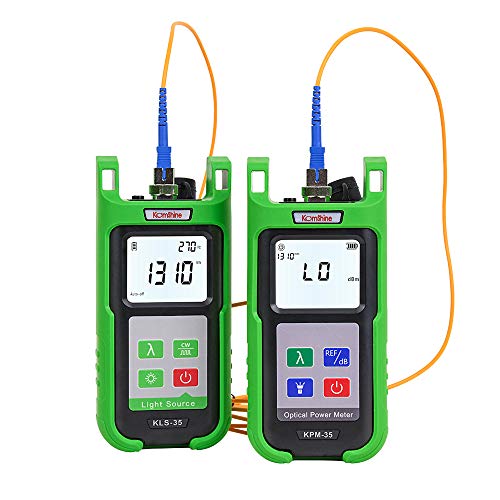
- Seven-wavelength power meter
- Includes 850–1550 nm light source
- Measures from -70 to +6 dBm
Best For: Power measurement and source-based fiber-link verification
Best Pocket-Friendly Pick

- Tests 10 wavelengths from -70dBm to +10dBm
- Adds VFL, RJ45 testing, and LED lighting
- Stores 500 readings in a compact body
Best For: Portable home-office fiber and network checks
Best Rechargeable Value
USB-Charged Fiber Cable Tester
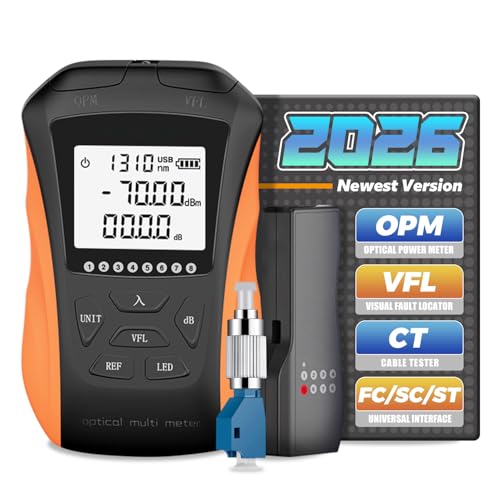
- Combines OPM, VFL, and LAN cable testing
- Supports wavelengths from 850nm to 1625nm
- Includes a 1100mAh Li-ion battery and USB charging
Best For: Mixed fiber and Ethernet troubleshooting
Best Advanced Analyzer
Touchscreen OTDR Network Tester

- Performs 1310/1550nm OTDR testing with 26dB/24dB range
- Adds event mapping, OPM, VFL, OLS, and RJ45 tools
- Supports stored reports in PDF and Excel formats
Best For: Advanced singlemode-link inspection and documentation
All-in-One Network Tester
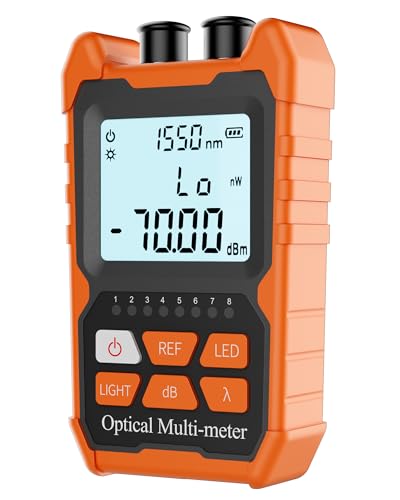
- Combines optical power meter and VFL
- Supports up to eight wavelengths
- Adds RJ45 testing for copper networks
Best For: Mixed fiber-and-Ethernet home-office diagnostics
Simple Maintenance Pen

- Supports SC, ST, FC, and LC connectors
- One-button operation for quick checks
- Includes pouch and aluminum housing
Best For: Beginner-friendly fiber continuity and fault checks
Quick Signal Checker – Fluke FiberLert-125
For home offices that need a simple way to check whether a fiber line is carrying a signal, the Fluke FiberLert-125 is a compact choice among fiber optic testers for home offices. It uses light and sound alerts rather than requiring setup or result interpretation.
Best For: Quickly checking active single-mode or multimode fiber ports and patch cords.
Pros:
- Detects optical signals from 850 to 1625 nm across single-mode and multimode fiber.
- Non-contact detection helps reduce the risk of damaging ports, patch cords, UPC, or APC connections.
- Compact, battery-powered design includes operation and battery-status flashes, plus automatic shutoff.
- Includes two alkaline batteries and a two-year warranty.
Cons:
- Provides signal presence detection rather than detailed loss, length, or breakpoint measurements.
- Uses two AAA batteries, so replacements are needed over time.
The FiberLert-125 is best when your troubleshooting task is simply determining whether optical light is present. Its straightforward alerts make it more approachable than a full measurement instrument.
Advanced Fiber Diagnostics – Mini-Pro YD-3000 OTDR
For technically experienced users managing longer fiber runs, the Mini-Pro YD-3000 is a more advanced option among fiber optic testers for home offices. Its OTDR, power-meter, cable-length, event-map, VFL, and RJ45 functions support detailed troubleshooting and documentation.
Best For: Professional-level evaluation of FTTx and access-network fiber runs up to 60 km.
Pros:
- Tests at 1310 and 1550 nm with a 5 m to 60 km range and 24/22 dB dynamic range.
- Identifies breakpoints, measures cable length, and calculates relative optical-power loss.
- Combines OTDR, event map, power meter, cable tracker, VFL, and RJ45 sequencer functions.
- Supports internal storage, micro-USB transfer, TF-card storage, and included analysis software.
Cons:
- Its feature set and analysis workflow are intended for professional users rather than casual testing.
- Cannot test splitters with its listed dynamic range.
- At about 1 kg, it is less portable than compact signal detectors.
The YD-3000-UPC can provide substantially more diagnostic information than a basic tester, but its complexity and stated use limitations make accuracy requirements and operator experience important buying considerations.
Portable Fault Locator Kit – Fiber Troubleshoot VFL Kit
This visual fault locator kit is a practical option for home-office troubleshooting when you need to find breaks, bends, cracks, or poor connections. Its adapters and patch cords make it easier to work with different panel and connector arrangements.
Best For: Portable visual fault checks on single-mode and multimode cables with varied connector types.
Pros:
- Helps locate fiber breaks, bends, cracks, and poor connections.
- Supports ST, SC, and FC interfaces through its 2.5 mm universal connector; LC testing is supported with the included adapter.
- Includes five adapters and three short patch cords for troubleshooting at distribution panels.
- Compact, lightweight design and 24-month after-sales service support field use.
Cons:
- Two AA batteries are required but are not included.
- It is a visual fault locator, not a power meter or OTDR for quantified loss and distance measurements.
For home offices with mixed connector types, the included accessories add useful flexibility. Choose it when locating a visible fault is more important than generating detailed optical measurements.
Power-and-Light Test Set – Komshine KPM-35/KLS-35
The Komshine KPM-35/KLS-35-MS set combines a calibrated optical power meter with a fiber light source, making it a capable choice among fiber optic testers for home offices that need to measure and verify fiber links. It covers both single-mode and multimode wavelengths.
Best For: Users who need power readings and a matching light source for FTTH and general fiber-link testing.
Pros:
- Power meter supports seven calibrated wavelengths from 850 to 1625 nm.
- Measures from -70 to +6 dBm and includes self-calibration and a qualified certificate.
- Light source covers 850/1300 nm and 1310/1550 nm with stated output stability.
- Includes automatic shutdown, backlighting, a silicone jacket, and claimed 2 m drop resistance.
Cons:
- It is a two-device kit, so it requires carrying and managing more equipment than a single detector.
- The supplied notes specify FC/SC interface details but do not list a full adapter assortment for every connector type.
- Battery power means ongoing battery replacement is part of ownership.
This set is a stronger fit than a basic presence detector when you need actual dBm readings and a dedicated source for link verification. Its broad wavelength coverage also suits mixed single-mode and multimode setups.
Best Pocket-Friendly Pick – Compact OPM and VFL Tester
For home offices that need practical fiber optic testers for home offices, this compact 4-in-1 unit combines optical power measurement, visual fault locating, RJ45 wiring checks, and an LED light. Its broad wavelength coverage and pocket-friendly design make it useful for basic fiber and network troubleshooting.
Best For: Home-office users and occasional technicians who want a portable, multifunction tester.
Pros:
- Measures 10 standard wavelengths across an impressive -70dBm to +10dBm range.
- Combines OPM, a 10mW VFL, RJ45 testing, and LED lighting.
- Stores up to 500 readings and supports user calibration.
- Compact, lightweight, and supplied with an FC-LC adapter.
Cons:
- Requires two AAA batteries, which are not included.
- Its 2.5mm universal interface may require adapters for some setups.
This is a sensible choice when you want several basic diagnostic functions without carrying a larger instrument. It is less suited to users who need OTDR-style event mapping or advanced fiber-link analysis.
Best Rechargeable Value – USB-Charged Fiber Cable Tester
This rechargeable option is one of the more convenient fiber optic testers for home offices, pairing optical power measurement with a visual fault locator and LAN cable testing. The USB-chargeable battery and readable LCD make it practical for routine troubleshooting around a home network.
Best For: Home-office users who test both optical fiber and Ethernet cables.
Pros:
- Provides OPM, VFL, and cable-tester functions in one device.
- Supports multiple wavelengths from 850nm through 1625nm.
- Uses a 1100mAh Li-ion battery with USB charging.
- LCD shows power-loss data, wavelength, frequency, and battery status.
Cons:
- The supplied notes do not specify data storage or reporting features.
- Its VFL is listed as 5mW, offering less output than some higher-powered fault locators.
Choose this model if convenience matters and your testing includes both fiber and LAN cabling. Its FC/SC/ST compatibility and built-in flashlight add flexibility for everyday checks, though advanced link analysis is outside its stated feature set.
Best Advanced Analyzer – Touchscreen OTDR Network Tester
For demanding home labs or small-office installations, this OTDR-based unit is the most advanced of these fiber optic testers for home offices. It combines 1310/1550nm OTDR testing with OPM, VFL, light-source, optical-loss, event-map, and network-testing functions in a touchscreen handheld platform.
Best For: Experienced users inspecting singlemode links and documenting fiber or network faults.
Pros:
- Offers 26dB/24dB dynamic range OTDR testing at 1310nm and 1550nm.
- Provides event maps, curve viewing, data storage, and PDF/Excel reporting.
- Includes OPM, VFL, light source, optical-loss testing, and RJ45 tools.
- Has a 5.55-inch touchscreen, 4000mAh battery, and multiple adapters.
Cons:
- This model cannot test live fiber.
- The package does not include a charging adapter.
- Its advanced feature set may be more than needed for simple home-office checks.
This is the strongest fit for users who need measurements, fault locations, and documented link results rather than a basic power reading. Its broad toolkit is valuable, but the larger, more technical design makes it a substantial investment for occasional troubleshooting.
Long-Range Fault Finder – 50KM VFL Kit
For home offices that need a straightforward way to troubleshoot fiber links, this visual fault locator kit uses a bright 650nm red light to reveal breaks, bends, cracks, and poor connections. Its 2.5mm universal connector, included adapters, and patch cords make it a flexible option among fiber optic testers for home offices.
Best For: Home-office users and installers who need a portable visual fault locator with adapters and patch cords for common fiber connections.
Pros:
- Long-distance detection rated up to 50 km.
- Works with ST, SC, and FC interfaces, with an included adapter for LC cables.
- Includes multiple couplers and three short patch cords for troubleshooting connected panels.
- Offers constant output power, low-battery warning, and a 24-month after-sales service guarantee.
Cons:
- Primarily provides visual fault detection rather than optical power measurements.
- Requires batteries and may need adapters for some LC connections.
This is a well-equipped choice when your priority is tracing faults and checking continuity rather than measuring signal strength. The included accessories add practical value for home-office maintenance tasks.
All-in-One Network Tester – OPM-VFL Fiber Meter
This combination tester is a practical pick for home offices that use both fiber and copper networking. It pairs an optical power meter for measuring signal strength in dBm or mW with a 2mW visual fault locator, while also supporting RJ45 testing.
Best For: Home-office network setups where fiber signal measurements, visual fault finding, and RJ45 diagnostics are useful in one portable tool.
Pros:
- Combines optical power measurement and visual fault locating in one device.
- Supports up to eight wavelengths for varied fiber-network environments.
- Includes FC, SC, and ST interfaces.
- Adds RJ45 testing for copper-network diagnostics.
Cons:
- Uses non-rechargeable batteries.
- Does not list LC connectivity among its supported interfaces.
Compared with a VFL-only pen, this model offers broader diagnostic coverage for a mixed home-office network. Choose it when measuring optical signal strength and checking RJ45 connections matter as much as locating visible fiber faults.
Simple Maintenance Pen – Compact VFL Fiber Tester
For routine home-office troubleshooting, this compact visual fault locator uses visible red light to trace fiber paths and identify breaks, sharp bends, damaged connectors, and routing problems. Its one-button operation and broad connector compatibility make it approachable for beginners as well as experienced users.
Best For: Home-office users who want a simple, portable VFL for checking continuity and tracing single-mode or multimode fiber cables.
Pros:
- Compatible with SC, ST, FC, and LC connectors through its universal 2.5mm interface.
- Works with both single-mode and multimode fiber.
- Simple one-button operation requires little setup.
- Includes a carrying pouch and has a durable aluminum-alloy housing.
Cons:
- Provides visual fault locating rather than optical power measurement.
- Its supplied notes do not specify a maximum detection range.
This is a sensible low-complexity option for continuity checks, patch-cord inspection, and locating visible faults. Its compact build and included pouch also suit users who want an easy tool to keep with their home-office networking supplies.
How We Picked These Fiber Optic Testers for Home Offices
We focused on tools that address common home-office fiber tasks: finding visible breaks, checking optical power, identifying continuity problems, testing connectors, and troubleshooting longer runs. The selection includes compact VFL pens, OPM-and-VFL combinations, light-source kits, multifunction testers, and OTDRs for users who need more detailed fault location.
We also considered wavelength support, connector compatibility, stated measurement range, portability, battery convenience, and whether a product is practical for occasional troubleshooting rather than only professional field work. Specifications can vary by seller and configuration, so verify the included adapters and supported fiber type before buying.
Quick Comparison
| Tester type | Best for | Typical capability |
|---|---|---|
| Visual fault locator | Basic continuity and break finding | Red laser light reveals visible faults |
| Optical power meter | Checking signal strength | Measures received optical power at selected wavelengths |
| OPM/VFL combination | General home-office troubleshooting | Combines power readings with visible fault detection |
| Light-source and power-meter kit | End-to-end link testing | Tests loss using a known optical source |
| OTDR | Long or complex fiber runs | Estimates fault distance and shows events along the link |
Key Buying Factors
Match the Tool to Your Fiber
Singlemode and multimode networks may use different wavelengths and testing methods. For singlemode links, 1310nm and 1550nm support is especially useful; multimode installations commonly use shorter wavelengths. If your office has mixed equipment, choose a meter or kit that supports the wavelengths you actually need.
Check Connector and Adapter Support
FC, SC, and ST connectors are common, while LC is especially prevalent in compact network hardware. An inexpensive tester is less useful if it requires adapters you do not have. Confirm whether UPC or APC connections are supported and whether adapters are included.
Know When You Need an OTDR
A VFL can identify many obvious breaks near accessible cable ends, while an optical power meter can confirm whether signal reaches the destination. An OTDR is the better choice for longer, buried, patched, or difficult-to-access runs because it can estimate the location of loss events. It is also more expensive and has a steeper learning curve.
Prioritize Usability
For occasional home-office work, a compact rechargeable tester with a clear display, simple controls, protective cap, and automatic shutdown may be more valuable than advanced features. Check battery type, charging method, measurement units, calibration information, and the claimed operating range.
Who Should Buy Which Fiber Optic Testers for Home Offices?
Choose a VFL pen or basic visual fault locator if you mainly need to check continuity, identify a damaged patch cable, or find an obvious bend or break. These are the simplest and most affordable options.
Choose an optical power meter or OPM/VFL combination if you manage an active fiber link and need to confirm received signal levels as well as locate basic faults. This is the most practical category for many home offices.
Choose a power-meter and light-source kit if you want more repeatable link-loss checks across installed cabling, especially when testing both ends of a run.
Choose an OTDR or multifunction tester if your network includes long runs, multiple splice points, patch panels, or recurring faults whose location is unknown. It offers the deepest diagnostics, but buy it only if you are prepared to learn the settings and interpret its results.