
Finding the right fiber test equipment can save technicians significant time when diagnosing link failures, verifying installations, or locating breaks. The best choice depends on whether you need a quick red-light check, accurate optical power readings, or full event-distance analysis.
This roundup compares 10 fiber optic testers for technicians across those use cases, including compact VFL pens, OPM combinations, test kits, and touchscreen OTDR platforms.
Best 10 Fiber Optic Testers for Technicians Picks for 2026
Quick Signal Check

- Detects signals from 850–1625 nm
- Non-contact light and sound indication
- Compact battery-powered design
Best For: Fast signal-presence checks on SM and MM fiber
Calibrated Power Testing
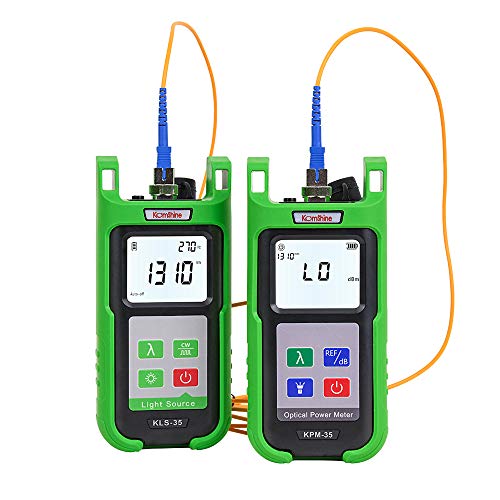
- Seven calibrated meter wavelengths
- Includes a compatible fiber light source
- Ruggedized for outdoor field use
Best For: Paired source-and-meter fiber testing
Multifunction Pocket Tester

- Supports ten wavelengths and -70 to +10 dBm
- Adds VFL, RJ45, and LED functions
- Stores up to 500 test records
Best For: Portable mixed fiber and Ethernet troubleshooting
Rechargeable Fiber and LAN Tester
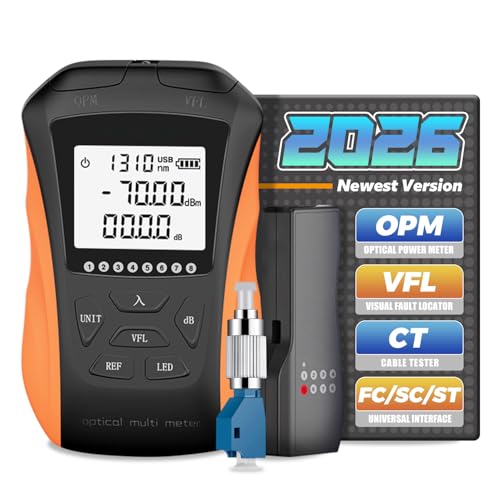
- Tests fiber power across nine wavelengths
- Adds VFL and LAN continuity testing
- 1100 mAh battery with USB charging
Best For: Mixed fiber and LAN service calls
Most Versatile Field Tester
Multi-Function OTDR & IP Camera Tester

- 28/26 dB 1310/1550nm OTDR with event mapping
- Tests fiber, RJ45 cabling, IP cameras, PoE, and networks
- Includes OPM, VFL, light source, and optical-loss functions
Best For: Mixed fiber, copper, IP camera, and network service calls
Best Compact Fault Locator
Portable VFL Troubleshooting Kit

- Finds fiber breaks, bends, cracks, and poor connections
- Includes adapters for common ST, SC, FC, and LC connections
- Compact kit includes three patch cords for panel testing
Best For: Quick portable fiber fault checks and connector troubleshooting
Best for Test Reporting
OTDR with Event Map and Cable Diagnostics

- 26/24 dB 1310/1550nm OTDR with saved event maps
- Creates SOR, PDF, and Excel test reports
- Adds OPM, VFL, optical-loss, RJ45, and network testing
Best For: Installation and maintenance work requiring documented fiber results
All-in-One Fiber Meter
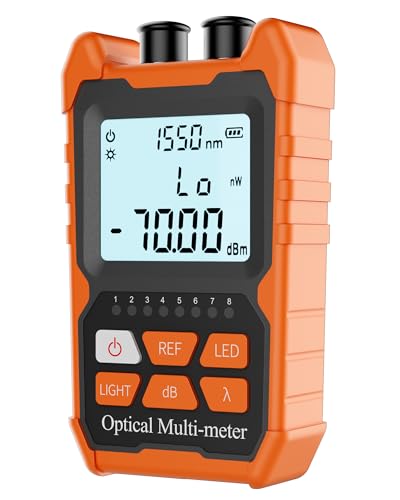
- Measures dBm and mW across up to eight wavelengths
- Combines power meter and visual fault locator
- Adds RJ45 testing for copper networks
Best For: Mixed fiber-and-copper network diagnostics
Field-Ready VFL Pen

- Supports SC, ST, FC, and LC connectors
- One-button red-light fault identification
- Lightweight aluminum housing with pouch
Best For: Routine installation and fiber maintenance checks
Quick Signal Check – Fluke FiberLert-125
For technicians who need a fast fiber check, the Fluke Networks FiberLert-125 is a simple option among fiber optic testers for technicians. It detects optical signals across near-infrared wavelengths from 850 to 1625 nm and uses light and sound rather than a display that requires interpretation.
Best For: Quickly confirming whether optical power is present at ports and patch cords on single-mode or multimode fiber.
Pros:
- Detects single-mode and multimode signals from 850 to 1625 nm.
- Non-contact detection helps reduce the risk of fiber damage.
- LightBeat operation indicator and automatic five-minute shutoff help conserve the included AAA batteries.
- Compact design and two-year warranty support field use.
Cons:
- Indicates signal presence but does not provide detailed optical power readings.
- Requires batteries rather than USB charging.
This is a focused signal detector rather than a full loss-testing kit. Choose it when speed and simplicity matter more than recording dBm measurements.
Calibrated Power Testing – Komshine KPM-35/KLS-35 Kit
The Komshine KPM-35/KLS-35-MS combination gives technicians both an optical power meter and a fiber light source. With seven calibrated meter wavelengths, self-calibration, and support for common single-mode and multimode testing wavelengths, it is a more complete choice among fiber optic testers for technicians.
Best For: Technicians who need paired power measurement and light-source testing for FTTH, field, or outdoor fiber work.
Pros:
- Power meter covers 850, 980, 1300, 1310, 1490, 1550, and 1625 nm.
- Includes a light source for 850/1300 nm and 1310/1550 nm testing.
- Self-calibration, a qualified certificate, and a -70 to +6 dBm meter range support repeatable measurements.
- Waterproof keys, silicone jacket, and stated two-meter drop resistance suit field environments.
Cons:
- It is a two-piece kit, so it takes more room than a single multifunction tester.
- The supplied notes do not specify a rechargeable battery system.
For technicians who regularly test insertion loss or need a controlled source and meter together, this kit offers broader capability than a signal detector. Its paired design is less convenient for quick pocket checks.
Multifunction Pocket Tester – M70-10 OPM & VFL
The M70-10 combines an optical power meter with a 10 mW visual fault locator, RJ45 wiring test, and LED lighting. For technicians comparing fiber optic testers for technicians, its broad feature set, ten supported wavelengths, and pocket-friendly format make it useful when several basic checks are needed from one tool.
Best For: Field technicians who want fiber power, fault-location, Ethernet wiring, and basic lighting functions in one compact tester.
Pros:
- Measures ten standard wavelengths from 850 to 1650 nm with a -70 to +10 dBm range.
- Combines OPM, 10 mW VFL, RJ45 wiring test, and LED lighting.
- Stores up to 500 data sets and supports user calibration.
- Displays linear mW and dBm readings, with backlight selection and automatic shutdown.
Cons:
- The two AAA batteries are not included.
- Its many functions may be more than needed for simple optical signal checks.
This tester is a strong general-purpose option for technicians who value portability and data storage. It is especially practical when fiber and copper troubleshooting happen on the same job.
Rechargeable Fiber and LAN Tester – Y8 OPM, VFL & Cable Tester
The Y8 is a rechargeable multifunction tester for technicians who handle both optical fiber and LAN cabling. It combines optical power measurement, a 5 mW visual fault locator, cable continuity testing, and an LED flashlight, making it a practical all-in-one entry in the fiber optic testers for technicians category.
Best For: Technicians testing FC, SC, or ST fiber alongside LAN cables and needing USB charging in the field.
Pros:
- Supports nine listed wavelengths from 850 to 1625 nm and a -70 to +10 dBm range.
- Includes OPM, continuous or flashing VFL, and LAN cable continuity testing.
- 1100 mAh Li-ion battery recharges through USB.
- LCD shows power loss, wavelength, frequency, and battery status; the LED flashlight helps in dark work areas.
Cons:
- The supplied notes do not specify data-storage capacity or user calibration.
- It is a relatively broad troubleshooting tool rather than a dedicated paired light-source and power-meter kit.
If avoiding disposable batteries is important, the Y8 is a convenient choice for mixed network work. Its cable tester and flashlight add useful everyday functions beyond optical measurements.
Most Versatile Field Tester – Multi-Function OTDR & IP Camera Tester
For technicians who need fiber optic testers for technicians that also cover network and security work, the WANLUTECH MT-5500 combines OTDR testing with optical power, visual fault locating, optical loss, cable tracing, RJ45 diagnostics, and IP camera testing. Its 28/26 dB dynamic range and 5.4-inch touchscreen suit installation and maintenance workflows, but this model is not intended for testing live fiber.
Best For: Field technicians handling singlemode fiber, 4K IP cameras, PoE equipment, and copper network troubleshooting.
Pros:
- Combines 1310/1550nm OTDR testing with OPM, VFL, light-source, optical-loss, and event-map functions.
- Supports testing of up to 4K 12MP IP cameras and includes network tools, Wi-Fi analysis, and up to 30W PoE output.
- Provides RJ45 TDR, UTP fault detection, and cable-tracing functions in one handheld unit.
- Offers Quick Setup and professional parameter controls for different testing situations.
Cons:
- The 1310/1550nm model cannot test live fiber.
- Its broad feature set may be more than needed for technicians seeking only basic fault location.
This is the strongest all-in-one option in the group for mixed fiber, copper, IP camera, and network service calls. Choose it when minimizing the number of tools matters more than keeping the tester simple.
Best Compact Fault Locator – Portable VFL Troubleshooting Kit
Technicians who need fiber optic testers for technicians on quick service calls may prefer this compact visual fault locator kit. It is designed to find breaks, poor connections, bends, and cracks, and its included adapters and patch cords help test connections at distribution panels without removing the fiber.
Best For: Portable singlemode and multimode cable fault checks involving ST, SC, FC, or LC interfaces.
Pros:
- Locates common fiber faults including breaks, bends, cracks, and poor connections.
- Works with ST, SC, and FC interfaces through its 2.5mm universal connector, with an adapter for LC cables.
- Includes five adapters and three short patch cords for panel-side troubleshooting.
- Compact, lightweight design is convenient for field testing.
Cons:
- AA batteries are not included.
- As a visual fault locator kit, it does not provide OTDR traces, optical power measurements, or event-map reporting.
This kit is a practical choice when the main task is quickly locating visible fiber faults rather than documenting link performance. Its adapter and patch-cord selection adds useful flexibility for basic field troubleshooting.
Best for Test Reporting – OTDR with Event Map and Cable Diagnostics
For technicians who need fiber optic testers for technicians with traceable documentation, the WANLUTECH MOT-51 combines 26/24 dB OTDR testing with event mapping, curve storage, and report creation. It also adds OPM, VFL, light-source, optical-loss, RJ45, cable-length, and network-test functions, although its 1310/1550nm testing does not support live fiber.
Best For: Fiber installation and maintenance teams that need event details, saved traces, and PDF or Excel test reports.
Pros:
- Supports 1310/1550nm OTDR testing with Quick Setup and adjustable professional parameters.
- Event Map displays fiber length, connectors, fusion points, and breaks in a graphical format.
- Can create reports with curve graphs, settings, event information, and link information in SOR, PDF, or Excel formats.
- Also handles optical power, VFL, optical-loss, RJ45, cable-length, and network testing.
Cons:
- The 1310/1550nm model cannot test live fiber.
- The package does not include a charging adapter.
- Its 26/24 dB dynamic range is lower than the 28/26 dB range of the other WANLUTECH tester listed here.
The MOT-51 is a good fit when test records matter as much as fault finding. Its reporting features make it especially useful for commissioning, maintenance documentation, and sharing results with customers or supervisors.
Long-Range VFL Kit – 50KM Visual Fault Locator
For technicians who need a portable addition to their fiber optic testers for technicians, this visual fault locator kit provides a bright 650nm red light for tracing breaks, bends, cracks, and poor connections. Its included adapters and patch cords also support troubleshooting around distribution panels.
Best For: Field technicians who need extended-range visual fault detection and a versatile accessory kit.
Pros:
- 50KM-rated detection range with bright 650nm output.
- Works with ST, SC, and FC interfaces and supports LC use with the included adapter.
- Includes five adapters, three patch cords, and a 24-month after-sales service guarantee.
Cons:
- It is primarily a visual fault locator rather than an optical power meter.
- Requires batteries and weighs 0.36 kg.
This kit is a practical choice when fast fault tracing and connector flexibility matter more than quantitative signal measurement. The included patch cords can simplify work at panels without disconnecting the installed cable.
All-in-One Fiber Meter – OPM-VFL with RJ45 Testing
This combination unit stands out among fiber optic testers for technicians by pairing optical power measurement with visual fault detection. It measures dBm and mW, supports up to eight wavelengths, and adds RJ45 testing for technicians working across fiber and copper networks.
Best For: Network installers and service technicians who want one portable tester for optical signal checks, fault finding, and RJ45 diagnostics.
Pros:
- Combines an Optical Power Meter with a 2mW Visual Fault Locator.
- Supports up to eight wavelengths for varied network environments.
- Includes FC, SC, and ST interfaces plus RJ45 testing support.
Cons:
- Uses non-rechargeable batteries.
- Its listed fiber interfaces do not specifically include LC.
Choose this model when measurable optical signal strength is as important as locating visible faults. Its RJ45 support broadens its usefulness for mixed fiber and copper installation work.
Field-Ready VFL Pen – Compact Fiber Cable Tester
For routine installation and maintenance, this compact visual fault locator is one of the straightforward fiber optic testers for technicians. Its visible red light helps identify breaks, sharp bends, connector damage, routing issues, and continuity problems on single-mode and multimode cables.
Best For: Installers and maintenance professionals who want a simple, rugged VFL pen for everyday cable checks.
Pros:
- Compatible with SC, ST, FC, and LC connectors through its universal 2.5mm interface.
- One-button operation supports quick continuity and fault checks.
- Aluminum-alloy housing, carrying pouch, two-year limited warranty, and lifetime technical support.
Cons:
- Provides visual fault locating rather than optical power measurement.
- The supplied notes do not specify a detection range or included adapter count.
This is a sensible maintenance tool when ease of use and connector coverage are priorities. Its compact 165g construction makes it convenient to carry between installation, repair, and inspection tasks.
How We Picked the Best Fiber Optic Testers for Technicians
We organized these tools around the jobs technicians perform most often: identifying visible faults, measuring optical power, checking singlemode and multimode links, and locating events at specific distances. We also considered connector compatibility, wavelength support, portability, controls, charging options, and the difference between basic field checks and advanced certification work.
Because specifications vary widely, a compact visual fault locator should not be judged by the same criteria as an OTDR. The right tester is the one that provides the measurements you actually need without adding unnecessary cost or complexity.
Quick Comparison
| Tester type | Best for | Typical strengths | Important limitation |
|---|---|---|---|
| Visual fault locator | Fast fault tracing | Simple red-light inspection, low cost, portable | Does not provide precise loss or distance data |
| Optical power meter | Power and loss checks | Useful readings across multiple wavelengths | May require a separate light source for complete loss testing |
| OPM/VFL combination | General field troubleshooting | Combines power measurement and visible fault detection | Usually less capable than dedicated professional instruments |
| OTDR | Network characterization and fault location | Event maps, distance readings, splice and break analysis | Higher price, larger size, and greater learning curve |
Key Buying Factors for Fiber Optic Testers for Technicians
Test Method and Measurement Range
Choose a VFL when you mainly need to identify breaks, bends, or incorrect patching. For insertion-loss and live-link checks, look for an optical power meter with the wavelengths used by your network. An OTDR is the better option when you need to locate faults by distance or document the condition of a longer fiber run.
Connector and Fiber Compatibility
Check whether the tester supports FC, SC, and ST connections or requires adapters. If you work with both singlemode and multimode cable, verify that the stated wavelength range and accessories fit both types. Universal connectors are convenient, but dedicated adapters may provide a more secure connection.
Portability, Durability, and Power
Technicians working on ladders, in cabinets, or outdoors should prioritize a protected housing, readable display, one-handed controls, and a battery that lasts through a service call. USB charging can be useful, while replaceable batteries may be preferable for remote work.
Accuracy and Documentation
For routine troubleshooting, straightforward readings may be sufficient. Installation contractors and network owners may need calibrated measurements, saved traces, event maps, or report export. Confirm the instrument’s accuracy, storage features, and calibration support before relying on it for acceptance testing.
Who Should Buy Which Fiber Optic Testers for Technicians?
Choose a visual fault locator if you need the fastest and least expensive way to find obvious faults. Select an OPM or OPM/VFL combination for everyday technicians who need both power readings and basic fault detection in one handheld tool. A kit with a light source and power meter is more suitable when you regularly perform end-to-end loss testing.
Choose an OTDR when your work involves long links, buried or hard-to-access cable, splice verification, service-provider networks, or precise fault localization. These instruments cost more and require more training, but they can reveal information that a simple VFL or power meter cannot. For most buyers, matching the tester to the required measurement—not choosing the most advanced specification—is the best way to control cost and improve field efficiency.