
Choosing among fiber optic testers for small businesses can be difficult when compact power meters, visual fault locators, network testers, and full OTDRs all serve different jobs. The right choice depends on your fiber types, testing frequency, required measurement range, and budget.
This roundup compares 10 options ranging from simple handheld testers to multifunction OTDR platforms. Use the guide below to match the tester’s capabilities with your team’s everyday installation and troubleshooting needs.
Best 10 Fiber Optic Testers for Small Businesses Picks for 2026
Portable All-in-One

- OPM, VFL, and RJ45 functions in one unit
- Eight wavelengths with -70 to +6 dBm range
- FC/SC/ST interface support
Best For: Routine fiber power, fault, and RJ45 checks
Signal Detection Specialist

- Non-contact optical signal detection
- Works with SM and MM fiber from 850–1625 nm
- Light and sound alerts require no setup
Best For: Fast live-signal checks on ports and patch cords
Advanced Trace Testing

- 1310/1550 nm OTDR testing up to 60 km
- Includes OPM, VFL, event map, and RJ45 tools
- USB, TF-card storage, and analysis software
Best For: Professional FTTx maintenance and breakpoint analysis
Network Cabling Multitasker

- Optical power meter, VFL, and seven wavelengths
- PoE, RJ45, continuity, scan, and length testing
- Up to 10 hours of battery life with Type-C charging
Best For: Mixed fiber and copper network troubleshooting
Portable Multi-Function Pick

- 10-wavelength OPM range
- OPM, VFL, RJ45 tester, and LED
- Stores up to 500 measurements
Best For: Portable routine fiber and network checks
Rechargeable Service Pick
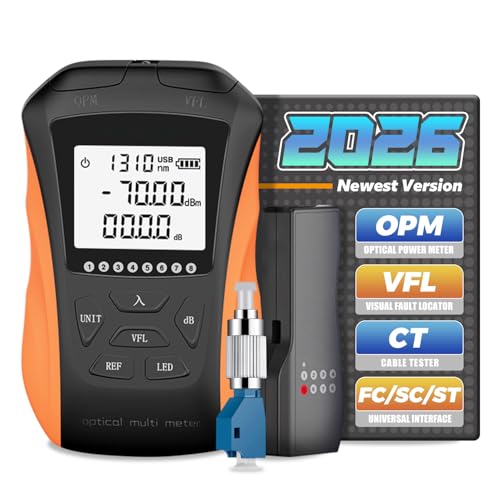
- OPM, VFL, and LAN cable testing
- 1100mAh Li-ion USB charging
- LCD with loss and battery data
Best For: Fiber and LAN maintenance work
Advanced Network Toolkit

- 1310/1550nm OTDR with event map
- IP camera, RJ45 TDR, and PoE tools
- 5.4-inch touchscreen and network diagnostics
Best For: Professional fiber, camera, and network installation
Compact Choice
Mini 4-in-1 Optical Power Meter

- Measures -70 to +6 dBm across multiple wavelengths
- Adds 650 nm visual fault locating
- Lightweight 200 g battery-powered design
Best For: Portable power checks and basic fiber troubleshooting
All-in-One Workstation

- 26/24 dB singlemode OTDR testing
- Adds OPM, VFL, light source, and loss testing
- Supports event maps and PDF/Excel reports
Best For: Fiber and copper-network service teams
Live-Fiber Specialist

- 24 dB OTDR testing at 1550 nm
- Supports 1310–1625 nm live testing
- Includes event maps and integrated network tools
Best For: Singlemode maintenance involving live-fiber checks
Portable All-in-One – OPM-VFL-1 Fiber Tester
For small businesses comparing fiber optic testers, the OPM-VFL-1 combines optical power measurement, visual fault locating, and RJ45 testing in one portable unit. It supports eight standard wavelengths, a broad -70 dBm to +6 dBm test range, and FC/SC/ST interfaces, making it a practical general-purpose choice for routine link checks.
Best For: Small-business technicians who need one compact tester for optical power, visible fault checks, and RJ45 testing.
Pros:
- Combines OPM, VFL, and RJ45 functions in a single device.
- Measures eight wavelengths from 850 nm through 1650 nm.
- Supports FC, SC, and ST interfaces, backlight selection, wavelength memory, and automatic shutdown.
Cons:
- Two AA batteries are required but are not included.
- Its maximum measurement range is +6 dBm, which may be limiting for higher-power signals.
The OPM-VFL-1 is a versatile value option when portability and multiple basic functions matter more than advanced fiber-trace analysis.
Signal Detection Specialist – Fluke FiberLert-125
Among fiber optic testers for small businesses, the Fluke Networks FiberLert-125 is focused on fast signal detection rather than detailed measurements. Its non-contact design detects optical power on single-mode and multimode fiber from 850 to 1625 nm, using simple light and sound indicators with no setup or interpretation required.
Best For: Installers and support staff who need to quickly verify whether an optical signal is present at ports or patch cords.
Pros:
- Detects signals on both single-mode and multimode fiber.
- Non-contact operation helps reduce the risk of damaging fiber connections.
- Compact design includes LightBeat status indication, automatic shutoff, included AAA batteries, and a two-year warranty.
Cons:
- Provides signal presence detection rather than detailed optical power readings or fault distance.
- Does not offer the multifunction capabilities of larger testers.
The FiberLert-125 is a straightforward troubleshooting tool for confirming live fiber quickly, especially when simplicity and portability are priorities.
Advanced Trace Testing – Mini-Pro YD-3000-UPC OTDR
For small businesses handling fiber installation or maintenance, the Mini-Pro YD-3000-UPC adds OTDR analysis to a broad set of testing tools. It measures at 1310/1550 nm across 5 m to 60 km, while also providing an optical power meter, event map, cable-length measurement, VFL, cable tracker, and RJ45 sequencer.
Best For: Professional technicians evaluating FTTx and access networks, locating breakpoints, and analyzing cable length or relative loss.
Pros:
- OTDR test range spans 5 m to 60 km with 24/22 dB dynamic range.
- Combines OTDR, event mapping, OPM, VFL, cable tracking, and RJ45 testing.
- Includes a color display, Micro USB data interface, TF-card storage, and analysis software.
Cons:
- Its notes state that it is intended for professional users and requires suitable testing scenarios.
- It cannot test splitters with the listed dynamic range.
- At about 1 kg, it is less lightweight than basic handheld testers.
The YD-3000-UPC is the strongest fit here for businesses that need trace-level diagnostics, but its broader capabilities and professional workflow may be unnecessary for occasional checks.
Network Cabling Multitasker – NOYAFA NF-8508 Cable Tester
The NOYAFA NF-8508 is a useful option among fiber optic testers for small businesses that also manage copper network cabling. Alongside a seven-wavelength optical power meter and VFL, it provides cable scanning, length measurement, port flashing, PoE testing, continuity checks, and non-contact voltage detection.
Best For: Network teams troubleshooting mixed fiber, Ethernet, telephone, and BNC cabling in business facilities.
Pros:
- Measures seven wavelengths from 850 to 1650 nm with a -70 to +10 dBm range.
- Supports FC/SC/ST connections and includes VFL, cable scanning, and optical power measurement.
- Adds PoE testing, port flashing, cable-length measurement up to 200 m, and up to 10 hours of battery life.
Cons:
- Its extensive feature set may be more than needed for fiber-only work.
- It does not provide the long-distance OTDR trace analysis offered by the Mini-Pro.
- The listed weight is approximately 0.59 kg, making it less pocket-sized than signal detectors.
The NF-8508 makes sense when one field tool must cover both optical links and everyday network cabling, particularly for maintenance teams working across varied infrastructure.
Portable Multi-Function Pick – Pocket Fiber Tester
For small businesses seeking fiber optic testers for small businesses, this compact model combines optical power measurement, visual fault locating, RJ45 testing, and LED lighting in one pocket-friendly tool. It covers 10 standard wavelengths and measures from -70dBm to +10dBm.
Best For: Technicians who need a lightweight, versatile tester for routine fiber and basic network checks.
Pros:
- Tests 10 standard wavelengths with a -70dBm to +10dBm range.
- Combines OPM, 10mW VFL, RJ45 sequence testing, and LED lighting.
- Stores up to 500 data sets and supports user calibration.
- Compact, lightweight, and designed to resist falling.
Cons:
- Requires two AAA batteries, which are not included.
- Includes an FC-LC adapter, while the listed interface is a 2.5mm universal connection.
This is a practical general-purpose choice when portability and multiple basic functions matter more than advanced fiber-event mapping or OTDR analysis.
Rechargeable Service Pick – USB-Charge Fiber Meter
Among fiber optic testers for small businesses, this rechargeable unit stands out for combining optical power measurement, a visual fault locator, and LAN cable testing. Its LCD shows measurement details and battery status, while the 1100mAh Li-ion battery charges through USB.
Best For: Small-business installers and maintenance technicians working across both fiber and LAN cabling.
Pros:
- Supports fiber testing across listed wavelengths from 850nm through 1625nm.
- Combines OPM, VFL, and cable continuity testing in one device.
- Rechargeable 1100mAh battery with USB charging.
- LCD displays power loss, wavelength, frequency, and battery information.
Cons:
- Its VFL uses a 5mW red light source, which is less powerful than some dedicated fault locators.
- The supplied notes identify the device as a standard model without advanced OTDR functions.
Choose this model if reducing battery replacement and carrying separate LAN and fiber testers is a priority. It offers a straightforward feature set for everyday troubleshooting.
Advanced Network Toolkit – OTDR Fiber Tester
For small businesses that need more than basic meter readings, this OTDR platform adds event mapping, optical loss testing, network diagnostics, and IP camera support. It offers 1310/1550nm OTDR testing with 28/26dB dynamic range, plus extensive RJ45 and PoE tools.
Best For: Professional installers and network technicians handling fiber links, IP cameras, PoE equipment, and structured cabling.
Pros:
- Provides 1310/1550nm OTDR testing with event-map visualization.
- Includes OPM, VFL, light source, and optical loss test functions.
- Supports up to 4K 12MP IP camera testing and RJ45 TDR analysis.
- Adds PoE output up to 30W, Wi-Fi analysis, and professional network tools.
Cons:
- This model does not support testing live fiber.
- Its 12V DC operation and broad feature set make it less pocket-oriented than basic meters.
- May be more capability than needed for simple power or continuity checks.
This is the most comprehensive option in the group, but its advanced functions and larger touchscreen format make sense primarily for technicians who will use OTDR, camera, PoE, and network diagnostics regularly.
Compact Choice – Mini 4-in-1 Optical Power Meter
For small businesses looking for fiber optic testers for small businesses, this compact 4-in-1 meter covers everyday power checks, visible fault tracing, and basic network-cable testing without the size of a full OTDR. It measures in dBm or milliwatts and supports a broad range of calibrated wavelengths.
Best For: Small installations, maintenance calls, and technicians who need a portable optical power meter with VFL and cable-testing functions.
Pros:
- Measures optical power from -70 dBm to +6 dBm across an 800–1700 nm detector range.
- Includes a 650 nm, 2 mW visual fault locator for identifying breaks, bends, and other visible faults.
- Supports SC, FC, and ST connectors, with an adapter option for LC connections.
- Compact 200 g, battery-powered design uses two AA batteries.
Cons:
- It is a power meter and VFL rather than a full OTDR, so it does not provide event maps or distance-to-fault analysis.
- LC testing requires the specified SC-male-to-LC-female connector.
- Its stated power range may not suit higher-power optical links.
This is a practical entry-level option when portability and routine troubleshooting matter more than detailed fiber-link characterization. Businesses needing documented traces or precise fault distances should consider an OTDR instead.
All-in-One Workstation – MOT-51 1310/1550nm OTDR
For small businesses that need fiber optic testers for small businesses with broader diagnostic coverage, this MOT-51 combines 1310/1550 nm OTDR testing with power, loss, fault-location, and copper-network tools. Its touchscreen event map and report support make it suited to technicians who need more than a basic meter.
Best For: Fiber installers and service teams inspecting singlemode links while also troubleshooting RJ45, RJ11, BNC, and related network cabling.
Pros:
- Offers 26 dB at 1310 nm and 24 dB at 1550 nm for singlemode OTDR testing.
- Combines OPM, VFL, light source, optical-loss testing, and event-map views in one handheld unit.
- Supports saved curves and SOR, PDF, and Excel test reports.
- Includes RJ45 TDR, UTP, cable-length, IP-scan, ping, LLDP, PPPOE, and FTP tools.
Cons:
- This model cannot test live fiber.
- The package does not include a charging adapter.
- At approximately 0.8 kg, it is less compact than a simple optical power meter.
The MOT-51 is a strong fit for teams wanting one instrument for fiber certification-style diagnostics and network troubleshooting. Confirm that non-live testing meets your workflow before choosing this model.
Live-Fiber Specialist – MOT-51 1550nm OTDR
Among fiber optic testers for small businesses, this 1550 nm MOT-51 stands out for supporting live testing at 1310, 1490, 1577, and 1625 nm. It also combines OTDR analysis, optical power and loss measurements, fault locating, event maps, and copper-network tools in one touchscreen unit.
Best For: Small-business fiber teams maintaining singlemode networks where live-fiber checks and multi-function field testing are important.
Pros:
- Provides 24 dB OTDR testing at 1550 nm and supports live testing at four additional wavelengths.
- Includes OPM, VFL, light source, and optical-loss testing functions.
- Displays event maps and stores curves, with SOR, PDF, and Excel report support.
- Adds RJ45 TDR, UTP, cable-length, and basic IP/network diagnostic tools.
Cons:
- The primary OTDR wavelength is 1550 nm with a 24 dB dynamic range, rather than a dual-wavelength 1310/1550 nm OTDR configuration.
- The package does not include a charging adapter.
- Its multiple functions and approximately 5.55-inch touchscreen design may be more equipment than occasional users need.
This version is the more targeted choice for teams that must work around active singlemode links. Its live-test support adds flexibility, while the integrated reporting and network tools can reduce the number of devices carried to service calls.
How We Picked the Best Fiber Optic Testers for Small Businesses
We grouped these testers by the work they are designed to handle: basic continuity and light-level checks, visual fault locating, copper network testing, and advanced fiber characterization. We also considered connector compatibility, supported wavelengths, portability, battery and charging convenience, operating range, display usability, and whether the tester can identify events such as loss, reflections, splices, and breaks.
For small teams, multifunction equipment can reduce the number of tools technicians must carry. However, advanced OTDR features are worthwhile only when your work requires detailed fault location or certification-style analysis.
Quick Comparison
| Tester type | Best suited for | Typical strengths | Main limitation |
|---|---|---|---|
| OPM and VFL | Basic service calls | Low cost, compact, quick checks | Limited fault-distance analysis |
| OPM, VFL, and RJ45 tester | Mixed fiber and copper work | One tool for common network tasks | May lack advanced fiber diagnostics |
| OTDR with OPM and OLS | Installation and troubleshooting | Event maps, distance and loss analysis | Higher cost and learning curve |
| Touchscreen OTDR | Frequent professional testing | Broader functions and easier field viewing | More equipment than basic repairs require |
Key Buying Factors for Fiber Optic Testers for Small Businesses
Test Method and Diagnostic Depth
An optical power meter measures received light, while a visual fault locator helps reveal visible breaks, bad bends, or connector problems. An OTDR sends pulses through the fiber and helps estimate the location and severity of events. Choose the simplest method that answers your usual service questions.
Wavelengths, Range, and Fiber Compatibility
Verify whether the tester supports the wavelengths used by your network, such as 1310 nm and 1550 nm for many single-mode systems. Check dynamic range and minimum testing distance if you work on long links. Also confirm whether the included adapters fit FC, SC, ST, LC, or UPC connections; adapters may be required for other interfaces.
Workflow and Portability
Technicians who move between customer sites should prioritize a clear display, durable housing, rechargeable battery, simple controls, and useful onboard storage or reporting. RJ45 testing is valuable for businesses that maintain both copper Ethernet and fiber infrastructure.
Accuracy and Calibration
Look for stated measurement ranges, resolution, test modes, and calibration information. Clean connectors before testing, use the correct reference method, and avoid treating an inexpensive indicator as a substitute for documented certification equipment.
Who Should Buy Which Fiber Optic Testers for Small Businesses?
Choose a compact OPM/VFL model if your team mainly checks light levels, polarity, continuity, and obvious physical faults. Select a multifunction fiber-and-RJ45 tester if technicians regularly service mixed network cabling and need a lightweight all-in-one tool.
Choose an OTDR with optical power meter and light-source functions when you install or maintain longer single-mode links, need event maps, or must locate faults by distance. A touchscreen OTDR is the better fit for frequent professional testing, multiple wavelengths, live-fiber work, or technicians who benefit from on-screen results. Before buying, confirm connector adapters, wavelength support, dynamic range, warranty coverage, and whether the model’s reporting features match your documentation requirements.