
A reliable encoder can turn an HDMI or SDI camera feed into a professional livestream for YouTube, Facebook, IPTV, or custom streaming platforms. Models in this roundup range from compact HDMI units to 4K production encoders with advanced protocols and recording.
If you need internet access away from a fixed broadband connection, focus on cellular support, SIM compatibility, network failover, video quality, and the streaming protocols your platform requires.
Best 10 Streaming Encoder with Sim Picks for 2026
Best 4K Multi-Protocol Pick

- 4K input and output at 30fps
- Up to four protocol-based streams
- Custom overlays and lifetime support
Best For: 4K multi-platform broadcasting and IPTV
Best Portable Cellular Encoder

- 4G, Wi-Fi, and Ethernet connectivity
- 1080p60 H.265/H.264 encoding
- Standalone streaming after setup
Best For: Mobile broadcasts and locations without reliable wired internet
Best Professional SDI Streamer
Blackmagic Streaming Encoder HD

- 12G-SDI input and loop output
- H.264 and H.265 support
- 1080p60 HD encoding
Best For: SDI-based broadcast and production systems
Best AV-over-IP Distribution Encoder

- 1080p HDMI-over-IP distribution
- Video walls up to 8×8
- App-based multi-screen routing
Best For: Multi-room AV, video walls, and managed display networks
Best 4K SDI Encoder with Mobile Failover
Blackmagic Streaming Encoder 4K
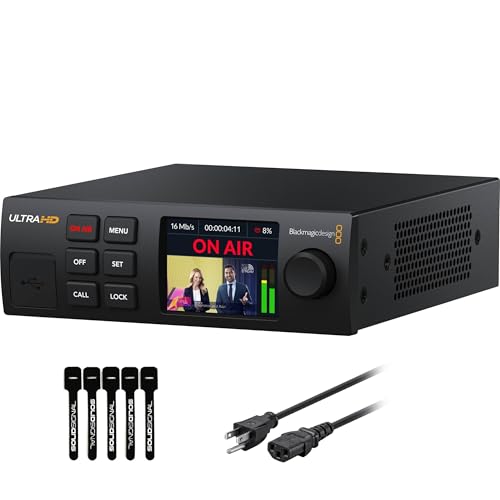
- 4K60 H.264/H.265 encoding
- 12G-SDI with standards conversion
- Ethernet and mobile auto-failover
Best For: Professional SDI streaming with backup connectivity
Best Portable NDI Encoder/Decoder

- 4K60 HDMI input and loop-out
- NDI|HX2/HX3 with PTZ control
- Standalone RTMP, SRT, and RTSP
Best For: Portable NDI and IP video production
Best Multi-Input Production Encoder

- HDMI and SDI input mixing
- Streams to up to six destinations
- Live recording with overlays
Best For: Flexible multi-source live production
Best Value 1080p Encoder
Compact H.265 Streaming Encoder

- 1080p60 H.265/H.264 hardware encoding
- Broad RTMP, RTSP, SRT, HLS, and WebRTC support
- Browser setup with audio and OSD overlays
Best For: Compact 1080p streaming, IPTV, monitoring, and signage
Best Premium Option
Magewell Ultra Encode HDMI Plus 4K Encoder

- 4K HDMI encoding with loop-through output
- Streams and records simultaneously
- NDI|HX, PoE, Wi-Fi, and 128 GB storage
Best For: Professional live production and flexible 4K IP workflows
Best for PoE Installations

- PoE power and data over one Ethernet cable
- 4K60 HDMI input with lossless loop-out
- ONVIF plus 1080p60 H.265/H.264 streaming
Best For: Installed LAN, NVR, IPTV, and event streaming systems
Best 4K Multi-Protocol Pick – URayCoder UHE265-1L-4K
If you need a flexible streaming encoder with sim capabilities for HDMI-to-network broadcasting, the URayCoder UHE265-1L-4K stands out for its 4K input support, broad protocol compatibility, and customizable stream overlays. It is suited to users who want to send video to several platforms without adding another encoder.
Best For: 4K streaming, multi-platform broadcasts, IPTV, and custom-branded live video.
Pros:
- Supports 4K at 30fps and up to 120fps at 2K or lower resolutions.
- Handles RTMP(S), RTSP, SRT, HLS, UDP, WebRTC, and other protocols.
- Can output up to four streams and add logos, captions, timestamps, or text.
Cons:
- Its extensive configuration options may be more than casual users need.
- Only one HDMI input is listed.
This is the most feature-rich option here for users who value 4K capability and protocol flexibility. The lifetime warranty and technical support are additional advantages for more demanding installations.
Best Portable Cellular Encoder – UNISHEEN BM3380G-H
The UNISHEEN BM3380G-H is a practical streaming encoder with sim connectivity for live production where wired internet is not always available. Its built-in 4G, Wi-Fi, and Ethernet options, along with one-button controls, make it convenient for mobile or event-based broadcasts.
Best For: Church services, education, gaming, surgical video, and portable live production.
Pros:
- Supports 1080p at 60fps with H.264 and bandwidth-saving H.265 encoding.
- Offers 4G LTE, Wi-Fi, and Ethernet networking with priority switching.
- Can stream without a computer after initial setup and push to two platforms.
Cons:
- Maximum listed video resolution is 1080p rather than 4K.
- Requires initial configuration through a computer or mobile phone.
- Includes a one-year limited warranty.
Choose this model when mobility and network redundancy matter more than ultra-high resolution. The dedicated start/stop button and standalone operation are useful for crews working away from a fixed studio.
Best Professional SDI Streamer – Blackmagic Streaming Encoder HD
The Blackmagic Design Streaming Encoder HD is a focused streaming encoder with sim-friendly simplicity for production setups built around professional SDI equipment. It supports 12G-SDI input and loop output while encoding 1080p video in H.264 or H.265.
Best For: Professional HD workflows using SDI cameras, switchers, and broadcast equipment.
Pros:
- Provides 12G-SDI input and loop output for broadcast-style integration.
- Supports both H.264 and H.265 codecs.
- Handles 1080p video at up to 60fps.
Cons:
- It is limited to 1080p output resolution.
- SDI connectivity is less suitable for basic HDMI-only setups.
- The supplied notes do not specify built-in cellular, Wi-Fi, or Ethernet features.
This is the straightforward choice for buyers already using SDI infrastructure. It avoids unnecessary consumer-focused features while covering the core HD encoding requirements for a professional signal chain.
Best AV-over-IP Distribution Encoder – AV Access HDIP100E
The AV Access HDIP100E is a streaming encoder with sim-style network distribution capabilities, designed to move HDMI video across standard Ethernet infrastructure rather than directly target public streaming platforms. It is a strong fit for multi-screen systems, video walls, and centrally managed AV installations.
Best For: Sports bars, churches, conference spaces, control rooms, and multi-room display systems.
Pros:
- Supports 1080p HDMI-over-IP distribution over standard network switches.
- Scales to dozens of displays and video walls up to 8×8 when paired with compatible decoders.
- Allows routing and monitoring through the VDirector app on phone, tablet, or PC.
Cons:
- This listing includes the encoder only; a compatible decoder is required.
- It is intended for AV distribution rather than a clearly specified social-platform streaming workflow.
- Maximum listed video output resolution is 1080p.
Consider this model when your priority is distributing one or more HDMI sources around a building. Its scalable routing and video-wall features are more relevant to managed AV systems than to solo content creators.
Best 4K SDI Encoder with Mobile Failover – Blackmagic Streaming Encoder 4K
If you need a streaming encoder with sim-style connectivity for demanding live production, the Blackmagic Design Streaming Encoder 4K combines 12G-SDI input, 4K60 H.264/H.265 encoding, and automatic failover between Ethernet and tethered mobile data. It streams directly without a separate encoding computer.
Best For: Broadcast, event, and remote-production workflows that need 4K SDI input, standards conversion, and backup internet connectivity.
Pros:
- Supports H.264 and H.265 streaming up to Ultra HD 2160p60 through SRT or RTMP.
- 12G-SDI input, loop output, and Teranex standards conversion accommodate varied source formats.
- Automatic Ethernet-to-USB-C mobile failover helps keep streams online.
- Includes webcam outputs, closed-caption support, REST API control, tally, and talkback features.
Cons:
- Its SDI-focused design may be more capability than a basic HDMI streaming setup requires.
- Mobile failover requires a compatible smartphone and available mobile data.
Choose this model when uninterrupted, broadcast-oriented streaming matters as much as resolution. Its compact 1/3 RU form factor and extensive control features make it especially suitable for installed or professional production systems.
Best Portable NDI Encoder/Decoder – Zowietek ZowieBox Pro
The Zowietek ZowieBox Pro is a compact streaming encoder with sim-style flexibility for portable and IP-based production. It accepts 4K60 HDMI, supports NDI|HX, RTMP, SRT, and RTSP, and can operate as either an encoder or decoder without a PC.
Best For: Portable productions, NDI networks, gaming, education, events, and setups requiring HDMI loop-out or integrated PTZ control.
Pros:
- Small 6.9-ounce design includes a 1/4-inch mounting thread and built-in touchscreen.
- Supports 4K60 HDMI input and zero-latency HDMI loop-out for monitoring.
- Provides NDI|HX2/HX3 encoding and decoding with PTZ control and tally over Ethernet.
- Standalone RTMP, RTMPS, SRT, and RTSP support enables PC-free streaming.
Cons:
- It does not support Full NDI or NDI|HB.
- Encoding and decoding cannot be performed simultaneously.
- Some AI tracking features depend on supported PTZ cameras.
This is a strong fit when portability and network-video compatibility are priorities. The touchscreen, loop-out, and optional AI PTZ features add practical flexibility, while the NDI limitations should be checked against your existing workflow.
Best Multi-Input Production Encoder – Magewell Ultra Encode AIO
For buyers comparing a streaming encoder with sim-style multi-source flexibility, the Magewell Ultra Encode AIO offers HDMI and SDI inputs, 4K encoding, and simultaneous delivery to multiple platforms. It also combines live streaming, recording, overlays, and input mixing in one unit.
Best For: Live production teams that need HDMI/SDI mixing, multi-destination streaming, recording, and flexible network options.
Pros:
- Accepts HDMI and SDI sources individually or together in picture-in-picture or side-by-side layouts.
- Supports up to 4K60 HDMI encoding and up to 4K30 SDI encoding with H.264 or HEVC.
- Can stream to as many as six destinations using RTMP, SRT, NDI|HX, HLS, and other protocols.
- Records to SD card, USB storage, or network drives while streaming.
Cons:
- Its 3.6-pound rack-mountable design is less portable than compact encoder options.
- SDI input support is limited to 4096×2160p30, below its HDMI 4K60 capability.
The Ultra Encode AIO is geared toward organized production environments rather than simple one-camera streaming. Its input mixing, overlays, recording, and six-destination capability make it a versatile central encoder for live events and broadcast workflows.
Best Value 1080p Encoder – Compact H.265 Streaming Encoder
If you need a streaming encoder with simple browser setup and broad protocol support, this compact UNISHEEN model covers common 1080p60 workflows without requiring PC software. Its H.265/H.264 hardware encoding, HDMI audio support, and compatibility with RTMP, RTSP, SRT, HLS, WebRTC, and other protocols make it a flexible option for streaming, IPTV, monitoring, and digital signage.
Best For: Buyers who want an affordable, compact 1080p60 encoder for browser-configured streaming and network video distribution.
Pros:
- Hardware H.265/H.264 encoding supports 1080p60 output and can reduce bandwidth use compared with H.264-only workflows.
- Supports a wide range of protocols, including RTMP(S), RTSP, SRT, HLS, WebRTC, UDP, and HTTP.
- Browser-based setup requires no dedicated software or drivers.
- Includes HDMI embedded audio, external 3.5mm audio input, and OSD overlays for text, logos, or timestamps.
Cons:
- It accepts HDMI input but does not offer the 4K input or loop-through features found on more advanced models.
- Advanced configurations may require basic networking knowledge.
- The listed warranty is one year.
This is a practical choice when 1080p60 is sufficient and you value a small enclosure, extensive protocol support, and straightforward web configuration. It is less suited to 4K production or setups requiring local HDMI pass-through.
Best Premium Option – Magewell Ultra Encode HDMI Plus 4K Encoder
For a streaming encoder with simultaneous recording, loop-through monitoring, and professional IP workflow support, the Magewell Ultra Encode HDMI Plus is the most feature-rich option here. It handles HDMI sources up to 4096×2160p30, supports multi-destination streaming, and adds NDI|HX, PoE, Wi-Fi, storage, and production-focused processing tools.
Best For: Live production teams, event operators, educators, and corporate AV users who need 4K input, recording, and flexible network integration.
Pros:
- Encodes HDMI video up to 4096×2160p30 and provides HDMI loop-through for local monitoring or pass-through.
- Supports RTMP, RTMPS, SRT, NDI|HX, HLS, and TS over UDP/RTP, including simultaneous multi-destination streaming.
- Can record while streaming to its 128 GB internal storage, USB drives, or network locations.
- Offers Gigabit Ethernet with PoE, dual-band Wi-Fi, web/API control, overlays, scaling, cropping, and de-interlacing.
Cons:
- It is likely more capability than needed for basic 1080p streaming.
- 4G/5G modem support requires a USB modem, which is not supplied.
- The listed software update status is unknown.
The Ultra Encode HDMI Plus stands out when a single device needs to manage capture, monitoring, network distribution, recording, and IP production workflows. Its added capabilities make it a strong professional choice, though simpler streaming setups may not need its broader feature set.
Best for PoE Installations – 4K60 Input HDMI Encoder
This streaming encoder with simple single-cable deployment is designed for installations where clean wiring and local monitoring matter. It accepts 4K60 HDMI, provides lossless loop-out, and simultaneously produces a 1080p60 H.265/H.264 stream. PoE, ONVIF support, and broad protocol compatibility also make it useful for NVR, IPTV, and LAN distribution systems.
Best For: Rack, wall, surveillance, and event installations that benefit from PoE power, 4K60 pass-through, and 1080p streaming.
Pros:
- PoE carries power and network data over one Ethernet cable, simplifying deployment.
- Accepts 4K60 HDMI and provides lossless loop-out while encoding a 1080p60 stream.
- Supports RTMP(S), RTSP, SRT, HLS, WebRTC, UDP, HTTP, and additional streaming protocols.
- ONVIF integration allows the encoder to appear in compatible NVR systems like an IP camera.
Cons:
- The encoded stream is limited to 1080p60 even though the input and loop-out support 4K60.
- PoE operation requires compatible network equipment or a suitable PoE setup.
- The supplied details list a one-year warranty, despite the product bullet mentioning a three-year warranty; verify coverage before purchase.
This model is a strong fit for professional-looking installations that need one-cable PoE wiring and full-quality local HDMI pass-through. Choose it over the compact 1080p model when ONVIF, 4K60 input, or loop-out is important.
How We Picked the Best Streaming Encoder with Sim
We compared these encoders by looking at input compatibility, maximum resolution and frame rate, supported codecs, streaming protocols, network options, latency, recording features, and ease of deployment. We also considered whether each unit is better suited to mobile broadcasting, fixed installations, houses of worship, IPTV, remote production, or professional live events.
Because “SIM” can mean different things across products, verify the exact cellular arrangement before buying. Some encoders include built-in 4G connectivity, while others require a USB modem, phone hotspot, external router, or separate cellular bonding device. A SIM-ready setup is only useful if it supports your carrier’s bands and data plan.
Quick Comparison
- Best for simple HDMI streaming: Choose a compact H.264/H.265 encoder with RTMP, RTSP, or SRT support.
- Best for 4K production: Look for 4K60 input, HDMI or SDI compatibility, loop-through, and efficient H.265 encoding.
- Best for mobile events: Prioritize integrated 4G, SIM compatibility, Wi-Fi, Ethernet, and reliable reconnection.
- Best for professional workflows: Consider NDI, SRT, WebRTC, dual inputs, recording, and protocol flexibility.
- Best for installations: PoE, low-latency transport, centralized management, and AV-over-IP support can simplify deployment.
Key Buying Factors for a Streaming Encoder with Sim
Cellular Connectivity and Carrier Support
Check whether the encoder has a built-in SIM slot, an eSIM, or only an external modem connection. Confirm supported 4G or 5G bands, carrier compatibility, antenna requirements, and whether the device can switch between cellular, Wi-Fi, and Ethernet. For important broadcasts, automatic failover is more valuable than peak download speed alone.
Resolution, Codec, and Bandwidth
H.264 offers broad compatibility, while H.265 can deliver similar quality at a lower bitrate when the receiving platform supports it. A 4K encoder is not automatically better if your camera, network, or streaming service is limited to 1080p. Match the encoder to your actual production resolution and available upload bandwidth.
Protocols and Latency
RTMP remains common for social platforms, while SRT is useful for dependable contribution over unpredictable networks. RTSP, HLS, WebRTC, and NDI may matter for IPTV, monitoring, interactive streams, or production networks. Confirm that the encoder supports the protocol required by your destination.
Inputs, Outputs, and Control
HDMI is convenient for cameras and consumer equipment; SDI is often preferable for longer cable runs and professional systems. Loop-through outputs, audio support, PoE, local recording, web management, and remote monitoring can reduce extra hardware and simplify operation.
Who Should Buy Which Streaming Encoder with Sim?
Content creators and small venues should choose an easy HDMI encoder with RTMP and H.264. Churches and event teams should prioritize cellular backup, low latency, simple controls, and automatic reconnect. Professional producers will benefit from SDI, 4K, SRT, NDI, recording, and dual-input features. Installers and IPTV operators should focus on PoE, AV-over-IP compatibility, centralized management, and long-term protocol support.