
When dozens of phones, laptops, TVs, game consoles, cameras, and smart-home gadgets are online at once, an ordinary router can slow to a crawl.
This roundup highlights the best options for larger, busier households that need stable performance, broad coverage, and enough capacity to handle heavy everyday use.
Best 10 Wi-Fi Router for Many Connected Devices Picks for 2026
Wi-Fi 7 Multidevice Pick
TP-Link BE6500 Dual-Band WiFi 7 Router

- Supports up to 90 devices
- Covers up to 2,400 sq. ft.
- Includes dual 2.5Gbps ports
Best For: Busy homes wanting Wi-Fi 7 and multi-gig wired speed
Power User Router
GL.iNet Flint 2 Wi-Fi 6 Gaming Router

- 8-stream Wi-Fi 6 up to 6 Gbps
- Dual 2.5G ports and 4 Gigabit LAN ports
- Supports over a hundred devices
Best For: Gamers and DIY users who want customization and VPN tools
Device-Heavy Home Pick
Linksys AC3200 Tri-Band Smart Wi-Fi Router

- Tri-band Wi-Fi with up to 3.2 Gbps
- Built for device-heavy homes
- Smart Wi-Fi app control from anywhere
Best For: Families wanting tri-band coverage and easy remote management
Tri-Band Capacity Pick
TP-Link AXE5400 WiFi 6E Router

- Tri-band WiFi 6E up to 5400 Mbps
- OFDMA increases capacity for many devices
- OneMesh support for future expansion
Best For: Busy homes needing high-capacity WiFi 6E coverage
Value Coverage Pick
NETGEAR Nighthawk AX5400 Router

- Coverage up to 2,500 sq. ft. for up to 25 devices
- AX5400 WiFi 6 for streaming and gaming
- 4 Ethernet ports plus USB 3.0
Best For: Medium-size homes wanting easy setup and reliable coverage
Future-Ready Multi-Device Pick
TP-Link Archer BE230 Wi‑Fi 7 Router

- Wi-Fi 7 with MLO and 4K-QAM
- Supports up to 60 devices
- Two 2.5G ports plus three 1G ports
Best For: Busy homes wanting Wi-Fi 7 and multi-gig wired ports
Multi-Device Heavy Hitter
TP-Link Archer AX80 AX6000 Wi-Fi 6 Router
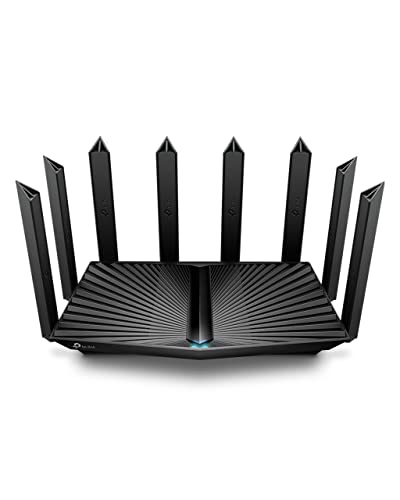
- Wi‑Fi 6 with MU-MIMO and OFDMA
- Eight antennas with beamforming
- 2.5 Gbps multi-gig WAN/LAN port
Best For: Larger homes with many connected devices and faster wired internet
Budget-Friendly Capacity Boost

- Wi‑Fi 6 with MU-MIMO and OFDMA
- Subscription-free AiProtection Classic security
- Five Gigabit ports for wired devices
Best For: Budget-minded homes wanting Wi‑Fi 6 and basic security
Balanced All-Rounder
TP-Link Archer AX55 Dual-Band Wi-Fi 6 Router

- Wi‑Fi 6 with OFDMA and MU-MIMO
- Four antennas with beamforming
- VPN client/server plus USB 3.0
Best For: Families wanting a balanced router for coverage, speed, and features
Wi-Fi 7 Multidevice Pick – TP-Link BE6500 Dual-Band WiFi 7 Router
If you need a Wi-Fi router for many connected devices, this TP-Link BE6500 is built for busy homes that want newer Wi-Fi 7 performance plus strong coverage. It combines dual-band operation, multi-link technology, and multi-gig ports, so it can handle streaming, gaming, smart home gear, and remote work without feeling overloaded.
Best For: Households that want Wi-Fi 7, multi-gig wired ports, and support for up to 90 devices.
Pros:
- Wi-Fi 7 features like MLO, Multi-RUs, and 4K-QAM for newer compatible devices
- Covers up to 2,400 sq. ft. and supports up to 90 devices
- Dual 2.5Gbps ports plus 3 additional Gigabit LAN ports for faster wired connections
- HomeShield, parental controls, Private IoT, and VPN client/server support
Cons:
- Dual-band design may not suit buyers specifically looking for tri-band routing
- Best speeds depend on Wi-Fi 7-capable devices and a suitable internet plan
This is a strong all-around choice for a crowded network, especially if you want modern wireless features and security tools in one router. It looks especially practical for homes that need both broad wireless coverage and flexible wired connectivity.
Power User Router – GL.iNet Flint 2 Wi-Fi 6 Gaming Router
The GL.iNet Flint 2 is a practical Wi-Fi router for many connected devices if you also want lots of control. It pairs Wi-Fi 6 speed with dual 2.5G ports, pre-installed OpenWrt, and VPN support, making it a fit for households or advanced users who want a router that can handle heavy use and customization.
Best For: Power users, gamers, and DIY network tinkerers who want a fast, customizable router.
Pros:
- 8-stream Wi-Fi 6 with speeds up to 6 Gbps
- Dual 2.5G multi-gig ports plus 4 Gigabit LAN ports
- Pre-installed OpenWrt with OpenVPN and WireGuard support
- Supports over a hundred devices and includes AdGuard Home support
Cons:
- Firmware update is strongly recommended at initial setup
- Best suited to users comfortable with router settings and web admin setup
If you want more than a basic home router, the Flint 2 stands out for flexibility and speed. Its device capacity, VPN performance, and plugin-friendly platform make it especially appealing for people who like to tune their network.
Device-Heavy Home Pick – Linksys AC3200 Tri-Band Smart Wi-Fi Router
The Linksys AC3200 is a straightforward option if you want a Wi-Fi router for many connected devices and prefer tri-band Wi-Fi. With Smart Wi-Fi app control, gigabit Ethernet, and a penta-core processing setup, it is aimed at busy homes that need broad, stable coverage for everyday connected gear.
Best For: Device-heavy homes that want tri-band Wi-Fi and simple app-based management.
Pros:
- Tri-band Wi-Fi with up to 3.2 Gbps wireless speed
- Smart Wi-Fi app support for network control from anywhere
- Gigabit Ethernet and USB connectivity for wired devices and sharing
- Designed for device-heavy homes with strong and widespread signal
Cons:
- Wi-Fi 5 era hardware, so it lacks newer Wi-Fi 6 or Wi-Fi 7 features
- Security protocol listed is WPA rather than newer WPA2/WPA3
This router makes sense for buyers who prioritize tri-band capacity and easy app management over the latest wireless standard. It is a solid fit for homes that want a familiar, stable setup for lots of devices.
Compact Wi-Fi 7 Option – NETGEAR Nighthawk Dual-Band RS90
The NETGEAR Nighthawk RS90 is a compact Wi-Fi router for many connected devices when you want Wi-Fi 7, simple setup, and multi-gig internet support. It is designed for smaller homes or apartments that still need strong performance for streaming, conferencing, smart home devices, and general everyday use.
Best For: Smaller homes that want a Wi-Fi 7 router with easy setup and strong security.
Pros:
- Wi-Fi 7 dual-band speeds up to 3.6 Gbps
- 2.5 Gig WAN port plus 4 Gigabit LAN ports
- Supports up to 50 devices and covers up to 2,000 sq. ft.
- Includes WPA3, NETGEAR Armor, Smart Connect, and guest WiFi
Cons:
- Lower device rating than some routers aimed at larger households
- Router-only design requires a separate modem with Ethernet port
For buyers who want newer Wi-Fi 7 features without moving to a larger mesh system, this is a practical middle-ground choice. It offers a balanced mix of speed, security, and easy management for everyday connected living.
Tri-Band Capacity Pick – TP-Link AXE5400 WiFi 6E Router
If you need a Wi-Fi router for many connected devices, the TP-Link Archer AXE75 is built to add capacity without sacrificing speed. Its tri-band WiFi 6E design, 6 GHz band, and OFDMA support are aimed at smoother multitasking for streaming, gaming, browsing, and video calls at the same time.
Best For: Busy homes that want strong multi-device performance, WiFi 6E support, and room to expand with mesh extenders.
Pros:
- Tri-band WiFi 6E with up to 5400 Mbps total throughput
- OFDMA and 6 GHz band help increase capacity and reduce latency
- 1.0 GHz dual-core CPU and 512 MB memory for reliable performance
- OneMesh support for adding compatible extenders later
Cons:
- Requires a separate modem for most internet providers
- Mesh expansion depends on compatible TP-Link OneMesh extenders
Overall, this router makes the most sense if your main concern is handling many active devices at once while keeping latency low for responsive use. The security features and 2.5Gbps WAN port add value, but the standout here is its high-capacity tri-band design.
Value Coverage Pick – NETGEAR Nighthawk AX5400 Router
The NETGEAR Nighthawk RAX50 is a practical Wi-Fi router for many connected devices when you want broad coverage and simple wired expansion. With coverage rated up to 2,500 sq. ft. and support for up to 25 devices, it fits households that need stable WiFi for streaming, gaming, and video conferencing.
Best For: Medium-size homes that want a straightforward WiFi 6 router with solid range and security.
Pros:
- Coverage up to 2,500 sq. ft. with support for up to 25 devices
- AX5400 WiFi 6 speeds for streaming, gaming, and conferencing
- 4 Ethernet ports plus a USB 3.0 port for wired and storage needs
- NETGEAR Armor security with a 30-day free trial
Cons:
- Dual-band design offers less capacity than tri-band alternatives
- Includes a 1-year limited warranty
This is a sensible pick if you want a well-rounded router with decent device handling and easy setup around an existing modem. It is not the most advanced option here, but it covers the basics well for homes that do not need WiFi 6E or WiFi 7 features.
Future-Ready Multi-Device Pick – TP-Link Archer BE230 Wi‑Fi 7 Router
The TP-Link Archer BE230 is a strong Wi-Fi router for many connected devices if you want newer Wi-Fi 7 features and plenty of wired flexibility. Its dual-band BE3600 design, Multi-Link Operation, and 4K-QAM are meant to improve speed and reliability across busy homes with phones, TVs, consoles, and smart devices.
Best For: Households that want Wi-Fi 7 performance, fast wired ports, and support for lots of active devices.
Pros:
- Wi-Fi 7 with MLO, Multi-RUs, and 4K-QAM for improved performance
- Supports up to 60 devices with coverage up to 2,000 sq. ft.
- Two 2.5G ports plus three 1G ports for fast wired connections
- EasyMesh, HomeShield, VPN support, and a quad-core processor
Cons:
- Dual-band only, so it does not include a 6 GHz band
- Coverage is rated lower than some larger-home routers
For a busy home network, this model stands out because it combines high device capacity with newer Wi-Fi 7 technology and multi-gig ports. If you want a router that feels more future-ready than standard Wi-Fi 6 models, this one is easy to justify.
Multi-Device Heavy Hitter – TP-Link Archer AX80 AX6000 Wi-Fi 6 Router
If you need a Wi-Fi router for many connected devices, the TP-Link Archer AX80 is built to handle busy homes with Wi‑Fi 6, MU-MIMO, and OFDMA. Its high overall bandwidth, eight antennas, and beamforming are designed to keep coverage strong while helping multiple devices share the network more efficiently.
Best For: Larger households that want strong coverage, multi-device efficiency, and a faster multi-gig wired port.
Pros:
- Wi‑Fi 6 with MU-MIMO and OFDMA for better handling of many active devices
- Eight high-gain antennas with beamforming for broad coverage
- 2.5 Gbps multi-gig WAN/LAN port for faster wired connections
- Supports OneMesh, AP mode, WPA3, and Alexa control
Cons:
- Dual-band design may not suit users specifically looking for tri-band Wi‑Fi
- A modem is required for most internet service providers
Overall, this is the most feature-packed choice here for crowded networks and speed-focused homes. The combination of Wi‑Fi 6 efficiency and a multi-gig port makes it a strong fit when lots of devices are online at once.
Budget-Friendly Capacity Boost – ASUS RT-AX1800S WiFi 6 Router
The ASUS RT-AX1800S is a practical Wi‑Fi router for many connected devices if you want Wi‑Fi 6 efficiency without a complicated setup. MU-MIMO and OFDMA help it communicate with multiple devices at the same time, while the dual-band design and four external antennas are aimed at everyday home coverage.
Best For: Smaller households or budget-conscious buyers who want Wi‑Fi 6 capacity and basic built-in security.
Pros:
- Wi‑Fi 6 with MU-MIMO and OFDMA for improved multi-device efficiency
- AiProtection Classic powered by Trend Micro for subscription-free security
- Built-in VPN support and ASUS Instant Guard for secure remote access
- Five Gigabit ports for wired home connections
Cons:
- Lower 1800 Mbps class speed than the faster options in this roundup
- Fewer antennas and less emphasis on long-range coverage than higher-end models
This router makes sense if your priority is handling a modest number of devices efficiently at a lower spec level. It offers a solid mix of security, VPN features, and Wi‑Fi 6 capacity for typical home use.
Balanced All-Rounder – TP-Link Archer AX55 Dual-Band Wi-Fi 6 Router
The TP-Link Archer AX55 is a well-rounded Wi‑Fi router for many connected devices, combining Wi‑Fi 6, OFDMA, and four high-gain antennas with beamforming. It is designed to keep streaming, gaming, and video feeds responsive while still offering the practical extras many homes want, including VPN support and USB 3.0.
Best For: Households that want a balanced mix of device handling, coverage, security, and extra features.
Pros:
- Wi‑Fi 6 with OFDMA and MU-MIMO for smoother use across many devices
- Four external antennas and beamforming for expanded coverage
- VPN client and server support for flexible remote access
- USB 3.0, HomeShield, and Alexa compatibility add useful convenience
Cons:
- Dual-band design may not be ideal for the busiest households
- Not as fast on paper as higher-tier AX6000-class routers
For most homes, this model hits a useful middle ground between speed, coverage, and ease of use. It is a sensible pick if you want a reliable router that can keep up with many connected devices without moving into premium territory.
How We Picked the Best Wi-Fi Router for Many Connected Devices
We focused on routers that are built to handle more than just fast speeds on paper. For a Wi-Fi Router for Many Connected Devices, the real test is how well it manages multiple streams of traffic without dropping performance when the network gets crowded.
Our shortlist prioritizes multi-band designs, newer Wi-Fi standards, multi-gig ports, strong CPU performance, and features that help with traffic management, security, and coverage.
Quick Comparison: What Matters Most
For busy homes, Wi-Fi 7 models offer the newest features and the best long-term headroom. Wi-Fi 6 and 6E options can still be excellent values if you want dependable performance for streaming, gaming, video calls, and smart-home devices without paying top-tier prices.
Also pay attention to port selection and coverage ratings. A router with 2.5Gbps WAN/LAN support, tri-band or quad-stream architecture, and enough square-foot coverage for your home will usually deliver a better experience than a higher-speed model with weaker hardware behind the scenes.
Key Buying Factors for a Wi-Fi Router for Many Connected Devices
Wi-Fi Standard
Wi-Fi 7 is best if you want the most future-proof setup and your devices can take advantage of it. Wi-Fi 6E adds the 6GHz band, which can reduce congestion. Wi-Fi 6 remains a smart choice for most homes and often offers the best value.
Band Count and Network Capacity
Dual-band routers can work well in smaller homes, but tri-band or Wi-Fi 7 models usually handle many simultaneous connections more gracefully. More bands can mean less competition between devices.
Coverage and Placement
Check the manufacturer’s coverage estimate, but treat it as a starting point. Wall materials, floor plans, and interference can change real-world performance. If your home is large or oddly shaped, mesh compatibility may matter more than raw speed.
Ports and Wired Backhaul
Multi-gig ports are a major advantage if you have fast internet service, a NAS, a gaming PC, or wired access points. For a crowded household, wired connections can offload traffic from Wi-Fi and improve overall consistency.
Security and Management
Look for app-based controls, guest networks, parental controls, VPN support, and subscription-free security features if you want easier day-to-day management.
Who Should Buy Which Wi-Fi Router for Many Connected Devices?
If you want the newest tech and expect lots of connected devices, choose a Wi-Fi 7 model. If you need strong performance for gaming, streaming, and work-from-home use, a well-equipped Wi-Fi 6 or 6E router may be the smarter buy. For homes with many smart devices and broad coverage needs, prioritize stability, band capacity, and mesh expandability over headline speed alone.
The best Wi-Fi Router for Many Connected Devices is the one that fits your home size, internet plan, and device load without forcing you to compromise on reliability.