
If you edit video on multiple machines, collaborate with a team, or need a faster way to store large project files, a NAS can make your workflow far smoother.
This roundup focuses on NAS options that balance transfer speed, expansion, and reliability for modern editing demands.
Best 10 NAS for Video Editors Picks for 2026
Creator-Friendly 2-Bay NAS

- Up to 80TB capacity
- 2.5GbE with dual M.2 NVMe
- 4K HDMI and easy sharing
Best For: Solo video editors and creators wanting simple, local storage
Production-Ready Shared Storage

- 1,181 MB/s and 10GbE ready
- Expands up to 300TB
- Built for multi-user editing
Best For: Small teams and post-production setups
Entry-Level 4-Bay Private Cloud

- Up to 128TB capacity
- 2.5GbE, 8GB RAM, 4K HDMI
- Beginner-friendly setup and access
Best For: Home users and beginners building a private media library
Compact Personal Media NAS

- Intel CPU with hardware transcoding
- 282 MB/s transfer speed
- Automated backups and snapshots
Best For: Solo creators needing compact storage and media streaming
Creator-Grade NAS
TERRAMASTER F6-425 Pro 6-Bay Creator NAS

- Intel Core i3-1315U with 8GB DDR5
- Dual 10GbE plus three M.2 NVMe slots
- USB 4.0 direct-connect editing support
Best For: Editors and creative teams needing fast shared storage
High-Capacity NAS
UGREEN DXP4800 GT 4-Bay 10GbE NAS

- AMD Ryzen Embedded CPU with expandable RAM
- Dual 10GbE and two M.2 NVMe slots
- Supports local 4K/8K editing and apps
Best For: Teams needing fast shared storage with flexible apps
Compact NAS
TERRAMASTER F2-425 Quiet 2-Bay NAS
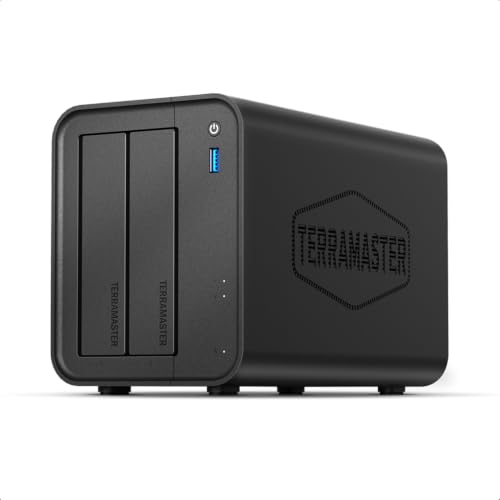
- Intel x86 quad-core with 4GB RAM
- 2.5GbE and 4K H.265 decoding
- Quiet 19dB(A) operation with mobile setup
Best For: Solo editors wanting a quiet, compact NAS
AI Storage Workhorse
MINISFORUM N5 Pro 5-Bay Desktop AI NAS

- Ryzen AI 9 HX PRO 370 with 12 cores / 24 threads
- Up to 188TB with 5 bays and flexible RAID options
- 10GbE + 5GbE networking with link aggregation support
Best For: Editors and creator teams needing power, speed, and expansion
All-Flash Speed Pick
Asustor FLASHSTOR 6 Gen2 FS6806X

- Six PCIe 4.0 NVMe slots for all-flash performance
- 10GbE for large media transfers and collaboration
- DDR5 ECC memory and silent operation for studios
Best For: Editors and studios wanting quiet, low-latency SSD storage
Balanced Creator NAS

- 10GbE and 2.5GbE ports for fast shared access
- Dual M.2 NVMe slots plus 4-bay storage
- Intel Pentium Gold 8505 with 8GB DDR5 RAM
Best For: Small studios and solo editors wanting strong value and speed
Creator-Friendly 2-Bay NAS – UGREEN DXP2800
If you’re looking for a NAS for video editors that balances ease of use with practical performance, the UGREEN DXP2800 is a straightforward way to centralize footage, backups, and project files. It offers 2.5GbE networking, dual M.2 NVMe slots, and 4K HDMI output, making it a flexible desktop NAS for solo creators moving off external drives or cloud storage.
Best For: Solo editors, content creators, and enthusiasts who want a simple, local storage hub with room to grow.
Pros:
- Supports up to 80TB for large video, photo, and backup libraries.
- 2.5GbE plus dual M.2 NVMe slots add useful speed and storage flexibility.
- Easy file sharing across Windows, macOS, mobile devices, browsers, and smart TVs.
- AI photo album features help organize images and remove duplicates.
Cons:
- Diskless model means you still need to buy and install drives separately.
- 2-bay design is less scalable than larger NAS systems.
The DXP2800 is a strong fit if you want a user-friendly NAS that can handle creative storage without the complexity of a heavier pro system. Its value comes from combining creator-focused features with local control and no subscription fees.
Production-Ready Shared Storage – Synology DS1525+
The Synology DS1525+ is built for teams that need a NAS for video editors working on shared projects, especially when 4K and 8K timelines must stay accessible over the network. With 10GbE readiness, 1,181 MB/s transfer speeds, and expansion up to 300TB, it is aimed at more serious post-production storage workflows.
Best For: Small production teams and multi-user edit bays that need fast shared access and room for major library growth.
Pros:
- Designed for direct 4K and 8K editing over the network.
- 10GbE-ready for faster post-production workflows.
- Expandable from 100TB up to 300TB with DX525 units.
- Supports multiple editors and media management with AI tagging and version control.
Cons:
- Diskless unit requires separate drive purchases.
- Best features are geared toward teams, so it may be more than a solo editor needs.
For studios that need shared access, high capacity, and a path to professional networking, the DS1525+ is the most production-oriented option here. Its strength is not just storage size, but the workflow support around collaborative editing.
Entry-Level 4-Bay Private Cloud – UGREEN DH4300 Plus
The UGREEN DH4300 Plus is a beginner-friendly NAS for video editors who want a private cloud and media storage without jumping into a more advanced system. Its 4-bay design, 2.5GbE port, 8GB RAM, and 4K HDMI output give it enough headroom for home media libraries, automatic backups, and general multi-device access.
Best For: Beginners and home users who want affordable private storage for videos, photos, and backups.
Pros:
- 4-bay enclosure supports up to 128TB of storage.
- 2.5GbE networking and 8GB RAM help with multitasking and transfers.
- Easy setup with NFC and guided instructions.
- Remote access, automatic backups, and AI album features add convenience.
Cons:
- Supports Docker but not virtual machines.
- Diskless design means drives are extra.
If you want a simple way to build a private media library and back up video files, the DH4300 Plus gives you a lot of capacity for the money. It is less of a workstation NAS and more of an approachable storage hub for growing home collections.
Compact Personal Media NAS – Synology DS225+
The Synology DS225+ is a compact NAS for video editors who mainly need reliable personal storage, backup, and media streaming in a small footprint. With Intel CPU hardware transcoding, 282 MB/s transfer speeds, and support for automated backups, it is a practical choice for a creator-focused home server.
Best For: Solo creators and households that want a small, dependable media server for files, backups, and streaming.
Pros:
- Intel CPU supports hardware transcoding for media playback.
- Streams 4K movies, shows, and photos to devices without monthly fees.
- Fast 282 MB/s transfer speeds for everyday file access.
- Automated backups and snapshot tech improve data protection.
Cons:
- 2-bay design limits expansion compared with larger models.
- Diskless unit requires separate drives.
The DS225+ is best when you want dependable private cloud features without needing a large or complex chassis. For individual editors, it offers enough media and backup capability to support daily work while staying compact and easy to place.
Creator-Grade NAS – TERRAMASTER F6-425 Pro 6-Bay Creator NAS
If you need a NAS for video editors that can keep up with demanding timelines, the TERRAMASTER F6-425 Pro is built around speed-focused hardware and creator workflows. Its Core i3 CPU, dual 10GbE ports, three M.2 NVMe slots, and USB 4.0 support make it a strong fit for fast transfers, local editing, and shared media projects.
Best For: Editors, creative teams, and small studios that want high-speed shared storage with AI-assisted NAS features.
Pros:
- Dual 10GbE ports support up to 2090 MB/s with SMB Multichannel.
- Two USB 4.0 Host ports enable direct PC-to-NAS editing without a switch.
- Three M.2 NVMe slots with Hyper Cache help keep performance responsive.
- TOS 7 adds AI-native controls, global search, and online office editing.
Cons:
- Diskless design means you must supply your own drives.
- Advanced features may be more than casual home users need.
Overall, this is a feature-rich choice for creators who care more about throughput, expansion, and workflow tools than basic file storage. If your editing setup benefits from direct-connect speed and multi-user access, it stands out as a serious NAS platform.
High-Capacity NAS – UGREEN DXP4800 GT 4-Bay 10GbE NAS
For buyers comparing a NAS for video editors, the UGREEN DXP4800 GT focuses on sustained multitasking, fast networking, and flexible expansion. With an AMD Ryzen Embedded CPU, dual 10GbE, NVMe slots, and support for local 4K/8K editing, it is designed to move footage quickly and handle other creator or office workloads at the same time.
Best For: Creators, small teams, and prosumers who want high-speed storage plus app and surveillance flexibility.
Pros:
- AMD Ryzen Embedded R2514 and 8GB RAM support demanding multitasking.
- Dual 10GbE networking is built for fast transfers and local editing.
- Two M.2 NVMe slots add SSD expansion for performance and caching.
- UGOS Pro supports Docker, virtual machines, and broad app workflows.
Cons:
- Diskless configuration requires separate drive purchases.
- Many advanced features may be more than basic storage users need.
This model makes sense if your editing setup also needs backup, media serving, or other self-hosted tools. It offers a strong balance of speed, capacity, and ecosystem features for users who want the NAS to do more than store files.
Compact NAS – TERRAMASTER F2-425 Quiet 2-Bay NAS
If you want a smaller NAS for video editors without giving up practical performance, the TERRAMASTER F2-425 is a straightforward 2-bay option. Its Intel x86 quad-core CPU, 2.5GbE port, and hardware-level 4K H.265 decoding make it useful for lighter editing setups, media libraries, and backup-focused workflows.
Best For: Home creators and solo editors who want quiet, simple, and affordable network storage.
Pros:
- Intel x86 quad-core CPU handles 4K transcoding and multitasking.
- 2.5GbE supports faster file transfers than standard gigabit NAS units.
- Very quiet at 19dB(A), which suits bedrooms and small offices.
- TNAS Mobile enables setup, backups, and sync from a phone.
Cons:
- Only two bays, so expansion is more limited than larger models.
- Lower network speed than 10GbE systems for heavier editing workloads.
For editors who do not need a large shared workspace, this NAS keeps the experience simple and quiet while still covering core media and backup tasks. It is a sensible choice when space, noise, and ease of use matter as much as speed.
AI Storage Workhorse – MINISFORUM N5 Pro 5-Bay Desktop AI NAS
If you want a NAS for video editors that can also handle AI-heavy workflows, the MINISFORUM N5 Pro stands out with a Ryzen AI 9 HX PRO 370, 10GbE plus 5GbE networking, and flexible high-capacity storage. Its mix of HDD bays, NVMe/U.2 options, and ZFS-focused MinisCloud OS makes it a strong fit for teams moving large media files and editing from shared storage.
Best For: Editors and creator teams who need fast networking, big expandable storage, and room for future upgrades.
Pros:
- Ryzen AI 9 HX PRO 370 processor with 12 cores, 24 threads, and up to 80 TOPS for demanding multitasking.
- 5-bay design with support for up to 188TB and RAID options including RAID 0, 1, 5, 6, and mixed drive strategies.
- 10GbE + 5GbE ports with link aggregation support for up to 15Gbps network bandwidth.
- ECC DDR5 memory support up to 96GB for better stability in data-heavy workflows.
Cons:
- Diskless configuration means you must budget separately for drives.
- Advanced features like OCuLink and multiple drive options may be more than casual users need.
- Best value depends on using the high-end expansion and networking features it offers.
This is the most ambitious option in the group, blending workstation-grade compute with serious storage and networking. For editors who want a NAS that can grow with larger projects, it offers a lot of headroom.
All-Flash Speed Pick – Asustor FLASHSTOR 6 Gen2 FS6806X
The Asustor FLASHSTOR 6 Gen2 FS6806X is built for a NAS for video editors who care more about responsiveness than spinning-disk capacity. With six PCIe 4.0 NVMe slots, 10GbE, and an AMD Ryzen Embedded processor, it is designed for low-latency media access, smooth collaboration, and quiet operation in studio spaces.
Best For: Editors, studios, and creators who want all-flash performance for 4K/8K workflows.
Pros:
- Six M.2 NVMe slots deliver all-flash storage with low latency and fast file access.
- 10GbE networking suits large media transfers and collaborative editing.
- 8GB DDR5 ECC memory adds stability and error correction for professional use.
- Silent all-flash design helps keep noise and vibration down in studios.
Cons:
- NVMe-only storage can be more expensive than HDD-based NAS setups.
- 8GB of memory is solid, but power users may want to plan for workload demands.
- Diskless design means storage drives still need to be purchased separately.
If your editing workflow benefits from SSD-level responsiveness, this model is the most performance-focused choice here. It trades raw bulk storage flexibility for speed, silence, and a polished fit for creative workspaces.
Balanced Creator NAS – UGREEN NAS DXP4800 Plus 4-Bay
The UGREEN NAS DXP4800 Plus is a practical NAS for video editors who want fast shared storage without jumping straight to an all-flash system. Its 10GbE port, 2.5GbE port, dual M.2 NVMe slots, and Intel Pentium Gold 8505 processor give it a balanced spec sheet for backups, collaboration, and media access on a small creative team.
Best For: Small studios and solo editors who want a fast, flexible NAS with strong value.
Pros:
- 10GbE plus 2.5GbE networking supports quick transfers and flexible deployment.
- Dual M.2 NVMe slots add room for faster cache or storage.
- Intel Pentium Gold 8505 CPU and 8GB DDR5 RAM support Docker and virtual machines.
- Up to 144TB capacity gives plenty of room for video archives and backups.
Cons:
- Diskless model means you must supply your own drives.
- It uses a 4-bay design, so expansion is more limited than 5-bay alternatives.
- Actual transfer speeds depend on your network and drive configuration.
This is the most balanced pick if you want faster-than-typical NAS performance without paying for a fully NVMe-based enclosure. It should suit editors who need reliable central storage, remote access, and room to grow.
How We Picked These NAS for Video Editors
We prioritized models that make a real difference in editing workflows: fast network options, NVMe or SSD support, multi-bay expandability, and CPUs/RAM capable of handling file serving under load. We also looked for features that matter in day-to-day use, such as easy remote access, app support, and strong upgrade paths for growing libraries.
Quick Comparison: What Matters Most
For solo creators, a 2-bay unit may be enough if you mainly need shared storage and backup. For heavier timelines, multi-camera projects, or team collaboration, a 4-bay or 5-bay system gives you more room for RAID flexibility and future growth. If maximum responsiveness is the priority, all-flash or NVMe-equipped systems can deliver excellent scratch-style performance, especially over 10GbE.
Key Buying Factors for NAS for Video Editors
Network Speed
2.5GbE is a solid baseline, but 10GbE is the better target for serious NAS for Video Editors. Faster networking reduces waiting during large transfers and helps multiple users access footage without bottlenecks.
Drive Bays and Expansion
More bays usually mean better storage efficiency, easier RAID choices, and more room for archive growth. If you work with 4K, 6K, or larger raw files, capacity adds up quickly.
NVMe and SSD Support
NVMe slots can be useful for cache, scratch space, or high-speed project storage. SSD-based NAS setups are especially attractive when low latency matters more than sheer capacity.
CPU and Memory
A stronger processor helps with indexing, file services, and multitasking. More RAM improves responsiveness when several users, services, or background tasks are running at once.
Workflow Features
Look for snapshots, remote access, robust backup tools, and easy permissions management. These features help protect projects and keep collaboration organized.
Who Should Buy Which NAS for Video Editors?
Solo editors and content creators should lean toward compact 2-bay or value-oriented 4-bay units if they need dependable shared storage and backups. Small teams should favor 4-bay or 5-bay NAS models with 10GbE and room for RAID redundancy. Power users, finishing editors, and studios that need the fastest shared access should consider higher-end systems with 10GbE, NVMe, or all-flash designs. The best NAS for Video Editors is the one that matches your resolution, team size, and storage growth plan without forcing an upgrade too soon.