
If you work across multiple PCs, the right KVM switch can simplify your desk fast. It lets you share monitors, keyboard, mouse, and USB devices without constant cable swapping.
Below, we focus on the best kvm switches for different setups, from basic single-monitor stations to high-resolution multi-display rigs.
Best 10 Kvm Switches Picks for 2026
Compact Dual-PC 4K Switch
Hearvo USB 3.0 HDMI KVM Switch for 2 Computers

- Shares 1 monitor between 2 computers
- 4 USB 3.0 ports include USB-A and USB-C
- Up to 4K@60Hz with button or remote switching
Best For: A simple dual-PC desk with shared peripherals and 4K display support
Triple-Display Docking Hub
AV Access 8K KVM Switch 3 Monitors 2 Computers

- Shares up to 3 monitors between laptop and desktop
- USB-C cable handles video, data, and 100W charging
- Adds 10Gbps USB, SDXC, audio, and Ethernet
Best For: A high-performance laptop-and-desktop workstation with three displays
Easy Dual-PC 4K Switcher
HDMI KVM Switch 1 Monitor 2 Computers 4K@60HZ
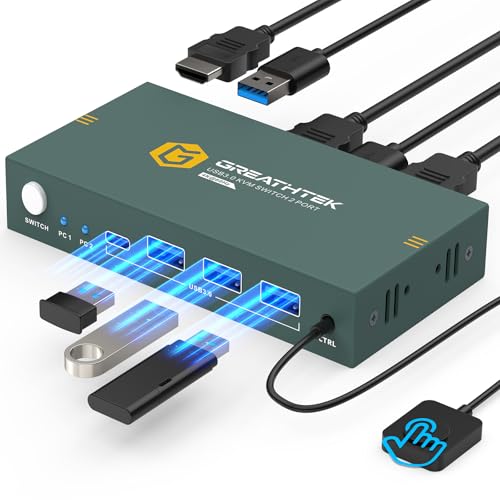
- 2 computers share 1 monitor and USB devices
- Supports 4K@60Hz with Adaptive EDID
- Button and wired remote switching included
Best For: A simple 2-PC workstation with 4K HDMI and shared USB devices
Four-PC Shared Display Switch
HDMI KVM Switch 4 Computers EDID 4K@60Hz

- 4 computers share 1 monitor and 4 USB 3.0 devices
- Up to 4K@60Hz with EDID support
- Switch by remote or front-panel buttons
Best For: A 4-PC shared desk that needs one monitor and USB peripheral switching
Compact 4K HDMI KVM

- Up to 4K@60Hz video
- Button and wired-controller switching
- No external power supply needed
Best For: Simple two-PC single-monitor desks
High-Resolution 8K HDMI KVM

- 8K@60Hz single-monitor support
- 3 USB 3.0 sharing ports
- Button or desktop-controller switching
Best For: High-resolution HDMI desks with USB 3.0 sharing
Editor’s Pick
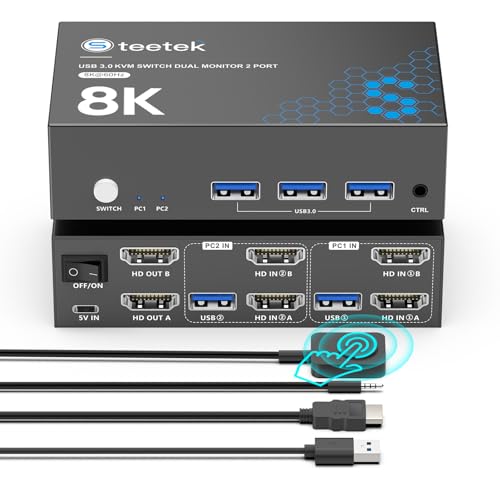
- Two computers share two monitors
- 8K@60Hz with HDCP 2.3 support
- 3 USB 3.0 ports plus wired remote
Best For: Dual-monitor users who want 8K support and simple switching
Budget Friendly
4-Port HDMI KVM for Everyday Offices

- Shares one monitor across four computers
- 4K@60Hz with button or remote switching
- 3 USB 3.0 ports plus 1 USB-C port
Best For: Teams and home offices needing a simple 4-computer switch
Premium Choice

- 8K@60Hz support for four computers
- 4 USB 3.0 ports with USB-C included
- Aluminum build with desktop controller
Best For: Power users needing premium 4-PC switching and high resolution
Compact Dual-PC 4K Switch – Hearvo USB 3.0 HDMI KVM Switch for 2 Computers
If you need one of the more straightforward kvm switches for a simple dual-computer desk, this Hearvo model keeps the setup focused: two computers, one monitor, and shared keyboard/mouse control. It also adds four USB 3.0 ports, so it can handle common peripherals without turning your desk into a cable mess.
Best For: Users who want a simple 2-computer, 1-monitor KVM with 4K output and shared USB 3.0 peripherals.
Pros:
- Supports 2 computers sharing 1 monitor plus keyboard and mouse
- Includes 4 USB 3.0 ports with 3 USB-A and 1 USB-C
- Supports up to 4K@60Hz and HDCP 2.2
- Offers button switching and a wired remote for flexible placement
Cons:
- Only covers a 2-computer setup
- Requires standard HDMI and USB cabling for full use
- No hotkey switching is mentioned
For a practical everyday workstation, this is a clean plug-and-play option with useful USB expansion and solid 4K support. The adaptive EDID and included remote make it easier to integrate into a tidy desk layout.
Triple-Display Docking Hub – AV Access 8K KVM Switch 3 Monitors 2 Computers
Among kvm switches, this AV Access unit stands out because it is built like a docking station as much as a switch. It is designed for one USB-C laptop and one desktop PC to share up to three monitors, along with network, audio, card access, and USB peripherals, making it a strong choice for complex multi-display workspaces.
Best For: Power users who want a triple-monitor KVM docking station for a laptop-and-desktop setup.
Pros:
- Supports one USB-C laptop and one desktop PC sharing up to 3 monitors
- Single USB-C cable can handle video, data, and up to 100W charging
- Desktop PC supports up to 8K@60Hz and 4K@165Hz
- Includes 10Gbps USB ports, SDXC reader, headset jack, and 1Gb Ethernet
Cons:
- MacBooks are limited to mirrored display behavior
- Requires a USB-C port with video output on the laptop
- Triple-monitor features depend on MST support for Windows laptops
This is a strong all-in-one option if you want to reduce desk clutter without giving up high-end display performance. Just be sure your laptop and monitor setup match the stated compatibility requirements before buying.
Easy Dual-PC 4K Switcher – HDMI KVM Switch 1 Monitor 2 Computers 4K@60HZ
This HDMI KVM switch is a practical pick for anyone who wants a basic 2-computer setup with one monitor and shared USB peripherals. It keeps the feature set focused on the essentials, with 4K@60Hz support, plug-and-play setup, and two easy switching methods for everyday desk use.
Best For: Buyers who want a straightforward 2-port HDMI KVM switch for sharing one monitor and USB devices.
Pros:
- Shares 1 monitor and 1 set of USB 3.0 keyboard/mouse between 2 computers
- Supports 4K@60Hz and is backward compatible with lower resolutions
- Includes button switching and wired remote switching
- Plug-and-play design with Adaptive EDID and HDCP 2.2 support
Cons:
- Does not support hotkey switching
- Requires you to provide the three HDMI cables needed for setup
- Only has 3 USB 3.0 ports for peripherals
If you only need a clean shared desk for two systems, this model covers the basics well without adding complexity. The included cables and lifetime warranty are nice extras, but the lack of hotkey switching is worth noting.
Four-PC Shared Display Switch – HDMI KVM Switch 4 Computers EDID 4K@60Hz
If your workspace needs to move between multiple systems, this is one of the more practical kvm switches for a four-computer setup. It lets four PCs share one monitor and four USB 3.0 peripherals, with either panel buttons or a remote-style switching method to keep the desk organized.
Best For: Users who need to switch one monitor and USB peripherals across four computers.
Pros:
- Supports 4 computers sharing 1 monitor and 4 USB 3.0 devices
- Offers remote control switching and front-panel button switching
- Supports up to 4K@60Hz for sharp display output
- Plug-and-play design works with Windows, Mac OS, Linux, and Unix
Cons:
- Hotkey switching is not supported
- Requires the necessary video cables for your full setup
- Best suited to standard shared-workstation use rather than advanced docking needs
This model makes the most sense when the main requirement is simple access to four systems from one desk. It offers solid resolution support and broad compatibility, but it stays closer to a classic KVM layout than a full docking station.
Dual-Display 8K DP KVM – 2 PCs, 2 Monitors
If you need kvm switches for a dual-monitor workstation, this DisplayPort model is built for sharing two PCs across two displays. It supports both extended and copy modes, so it fits setups where you want either more screen space or mirrored output, as long as your computers support multi-screen output.
Best For: Users who want one keyboard and mouse to control 2 PCs on 2 monitors with high-resolution DisplayPort output.
Pros:
- Supports up to 8K@60Hz or 4K@240Hz for very high-resolution use cases.
- Includes 4 USB 3.0 ports for keyboards, mice, printers, scanners, and other USB devices.
- Two switching methods: front button and included wired controller.
- Works in extend display mode or copy display mode for flexible workstation layouts.
Cons:
- Dual-display use requires HDMI + DP connections per computer.
- Must use the correct DP/graphics-card setup for multi-screen output.
- For best signal stability, shorter 8K DP cables are recommended.
Overall, this is a strong pick if you want a feature-rich dual-monitor KVM and already have compatible video hardware. It favors higher-end desktop setups where resolution, USB expansion, and flexible display modes matter.
Compact 4K HDMI KVM – 2 PCs, 1 Monitor
This HDMI option is a practical choice for kvm switches when you only need to share one monitor between two computers. It keeps the setup simple, supports 4K@60Hz, and uses a front button or the included desktop controller to switch without constantly swapping cables.
Best For: Budget-friendly single-monitor setups that need simple 2-PC switching with HDMI.
Pros:
- Supports up to 4K@60Hz for sharp single-monitor output.
- Two switching methods: body button and included wired controller.
- Plug-and-play design with no external power supply required.
- 2 USB 2.0 ports handle keyboards, mice, and other USB 2.0 devices.
Cons:
- Does not support hotkey switching.
- Requires HDMI ports on both computers and the monitor.
- Not recommended for Mac devices according to the notes.
For a straightforward desk setup, this KVM does the essentials well without adding complexity. It makes the most sense if you want an easy 2-in-1-out HDMI switch and do not need advanced shortcut controls or USB 3.0 speeds.
High-Resolution 8K HDMI KVM – 2 PCs, 1 Monitor
If you want kvm switches with higher-end video support, this HDMI model is designed for two PCs sharing one monitor at up to 8K@60Hz. It also adds USB 3.0 ports for common peripherals and offers both a push-button and a wired remote for switching.
Best For: Users who want a single-monitor HDMI KVM with 8K support and USB 3.0 device sharing.
Pros:
- Supports up to 8K@60Hz, with backward compatibility to 4K modes.
- Includes 3 USB 3.0 ports for keyboards, mice, scanners, printers, and more.
- Two switching methods: one-button operation or desktop controller.
- Comes with USB cables, a wired controller, and a 12V power adapter.
Cons:
- Designed for one monitor only, not dual-display setups.
- Requires compatible HDMI 2.1/HDMI setup for the highest resolution claims.
- Uses a powered design, so it is less minimal than some basic KVMs.
This is a good fit if you want more headroom on resolution and USB sharing than a basic 4K switch provides. It is especially sensible for productivity setups where fast peripheral sharing and flexible switching are more important than keeping the device as simple as possible.
Editor’s Pick – Hearvo 8K Dual-Monitor KVM
If you’re comparing kvm switches for a dual-monitor desk, this Hearvo model combines video switching and USB sharing in one box. It’s built for two computers and two HDMI displays, with USB 3.0 support for common peripherals and a wired remote for easy switching.
Best For: Dual-monitor users who want 8K support, USB 3.0 sharing, and a tidy wired remote setup.
Pros:
- Supports 2 computers sharing 2 monitors with keyboard and mouse control
- Offers 8K@60Hz output, plus 4K@240Hz and HDCP 2.3 support
- Includes 3 USB 3.0 ports for devices like printers, drives, and scanners
- Two switching options: front button or wired remote
Cons:
- Designed for two computers, so it won’t suit larger setups
- Needs the correct cabling for dual-monitor use
This is a strong pick if you want a feature-rich dual-monitor KVM with modern resolution support and flexible placement. The plug-and-play design and Adaptive EDID help keep setup straightforward.
Budget Friendly – 4-Port HDMI KVM for Everyday Offices
For shoppers browsing kvm switches for a four-PC workspace, this HDMI model focuses on practical sharing and easy control. It lets four computers use one monitor, keyboard, and mouse, while also sharing USB 3.0 devices through a simple button or wired remote setup.
Best For: Offices and home workstations that need a straightforward 4-computer KVM with 4K support.
Pros:
- Lets 4 computers share 1 monitor and 1 set of keyboard and mouse
- Supports up to 4K@60Hz with Adaptive EDID
- Includes 3 USB 3.0 ports and 1 USB-C port for shared devices
- Two switching methods: front buttons or wired remote keypad
Cons:
- Hotkey switching is not supported
- Best suited to HDMI-based setups only
This is a sensible option if you want a basic, multi-computer KVM without extra complexity. The included cables and labeled remote make it easier to get running quickly.
Premium Choice – UGREEN 4-PC 8K Aluminum KVM
If you need kvm switches for a high-resolution shared desk, this UGREEN unit is built around 4-computer HDMI switching with 8K@60Hz support. It also adds four USB 3.0 ports, an aluminum body, and both one-button and desktop-controller switching for a cleaner setup.
Best For: Power users who want an 8K-capable 4-computer KVM with multiple USB ports and a metal build.
Pros:
- Supports 4 computers sharing 1 monitor
- Up to 8K@60Hz, with backward compatibility for lower resolutions
- 4 USB 3.0 ports including 3 USB-A and 1 USB-C
- Aluminum design with desktop controller switching
Cons:
- Requires HDMI and USB A-to-C cables for normal use
- Needs external power for stable operation
- Not compatible with docking stations
This model makes sense when image quality and peripheral sharing matter most. The tradeoff is a more involved setup, but the feature set is strong for multi-PC desks that want 8K-class output.
How We Picked These Kvm Switches
We prioritized display support, USB connectivity, switching convenience, and compatibility with common desktop and laptop setups. We also looked for practical features such as EDID support, wired remotes, and controller buttons, since these can make daily use more reliable.
Because Kvm Switches vary widely by resolution and number of connected machines, we grouped options that make sense for different desk layouts rather than chasing one-size-fits-all performance.
Quick Comparison: What Matters Most
The fastest way to narrow your choice is by matching three basics: how many computers you need to share, how many monitors you use, and the highest resolution you want to maintain. Single-monitor 2-port models suit most home offices, while dual-monitor and triple-monitor units are better for creators, traders, and power users.
If you use peripherals like webcams, external drives, or card readers, check the number of USB 3.0 ports too. For mixed-device workspaces, a kvm switch with strong USB support can be just as important as video resolution.
Key Buying Factors for Kvm Switches
Number of Computers and Displays
Start with the size of your setup. A 2-port, 1-monitor switch is the simplest and most affordable option. If you run two displays, choose a dual-monitor model that supports the same layout on both computers. For larger workstations, make sure the switch is built for multi-monitor use rather than assuming one extra port will be enough.
Resolution and Refresh Rate
For standard office work, 4K at 60Hz is the most common target and usually the safest compatibility choice. If you need smoother motion, sharper text, or higher-end creative workflows, look for 8K support or higher refresh-rate dual-display options where available.
USB and Device Sharing
Most buyers want more than keyboard and mouse sharing. Check whether the switch supports USB 3.0 peripherals, and whether it includes a controller, wired remote, or dedicated buttons for easier switching. These small details can make a big difference in everyday use.
Cables, Power, and Compatibility
Some Kvm Switches include cables, while others require separate purchases. Confirm what is in the box and whether the unit needs external power for stable performance. Also verify support for your input types, whether HDMI, DisplayPort, or mixed workstation hardware.
Who Should Buy Which Kvm Switches?
If you just need a simple shared workspace, choose a compact 2-computer, 1-monitor model. If you use a dual-display desk, a dual-monitor KVM is the better long-term fit. Multi-PC users who run several peripherals should look at 4-port options with USB 3.0. For demanding users, such as streamers, designers, or traders, premium 8K or multi-monitor Kvm Switches are usually worth the extra cost because they reduce bottlenecks and keep the desk cleaner.