
The best audio equalizers for home studios help you shape frequency balance, correct room-related problems, and monitor mixes more confidently. The right model depends on your signal chain, available connections, preferred control style, and how much precision you need.
This roundup compares 10 options spanning compact stereo EQs, Bluetooth-equipped home-audio units, and professional-style dual-channel rack models. Use the guide below to narrow the choices by features, setup, and budget.
Best 10 Audio Equalizers for Home Studios Picks for 2026
Compact Analog Control
Douk Audio T7 7-Band Balanced Equalizer

- Seven adjustable bands from 64Hz to 8kHz
- XLR and RCA inputs and outputs
- Compact aluminum enclosure with plug-and-play operation
Best For: Small home-studio and stereo setups needing simple tonal adjustment
Rackmount Precision
dbx 231s Dual-Channel 31-Band Equalizer

- Dual 31-band, 1/3-octave constant-Q controls
- Selectable ±6dB or ±12dB boost/cut ranges
- XLR and 1/4-inch TRS connectivity with LED meters
Best For: Detailed dual-channel EQ work in rack-based home studios
Connected Visualizer
Decibelvibe TNZ SGE6 15-Band Home Audio EQ

- 15-band EQ for two channels
- Bluetooth 5.0, USB, RCA, and 3.5mm connectivity
- 31-band spectrum display with adjustable visual settings
Best For: Feature-rich home audio and studio systems with multiple sources
Noise-Control Rack EQ
EQ-215 15-Band Stereo Equalizer
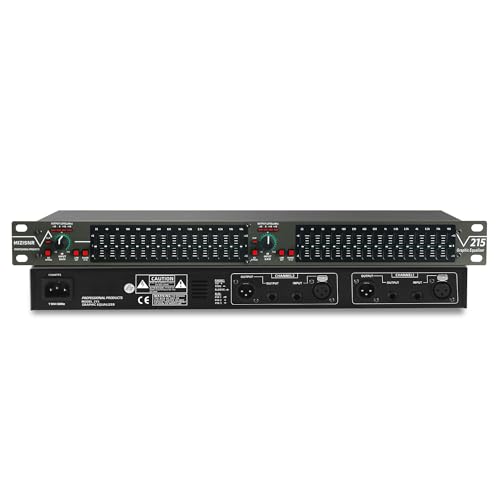
- Dual 15-band stereo EQ with ±12dB adjustment
- Low-cut switch targets rumble, hum, and wind noise
- XLR and 1/4-inch TRS inputs and outputs
Best For: Rack-based studios needing noise reduction and dual-channel control
Compact Wireless Tuning

- Five-band tone shaping with independent op-amp processing
- Bluetooth 5.0 and adjustable dual VU meters
- Compact all-metal design with bypass and balance controls
Best For: Desktop home studios and compact stereo systems
Full-Band Digital Control
31-Band Stereo Audio Equalizer

- 31-band adjustment across 32Hz–16kHz with ±12dB control
- Bluetooth 5.4, USB, optical, coaxial, RCA, and XLR connectivity
- LED spectrum display with rhythm modes and preset auto-save
Best For: Flexible home studios and multi-source audio systems
Dual-Channel Rack Control
EQ-231 31-Band Stereo Equalizer

- 31 bands per channel with up to ±12dB adjustment
- Low-cut filter reduces rumble, hum, and other low-frequency noise
- XLR and 1/4-inch TRS I/O with bypass and LED level monitoring
Best For: Stereo studios, DJ rigs, and live audio systems
Feature-Rich Spectrum Hub
EQ8100 20-Band Graphic Equalizer
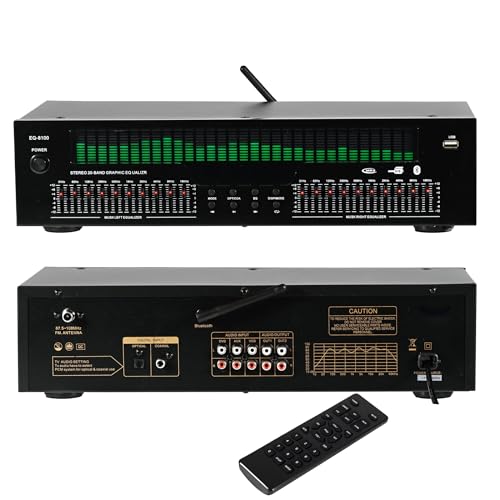
- 20-band EQ plus 31-band spectrum display
- Bluetooth, USB, optical, coaxial, and RCA connectivity
- Rack-ready aluminum chassis with presets
Best For: Home studios and hybrid audio systems needing visual monitoring
Precision Dual-Channel Control

- 15 adjustable bands per channel
- XLR and 1/4-inch TRS connectivity
- Low-cut control and dedicated bass output
Best For: Rack-based studios needing hands-on stereo control
Visual Digital Tuning

- 31-segment real-time LED spectrum display
- 10 presets, bypass, and high/mid/bass adjustment
- Bluetooth 5.2, USB, XLR, and TRS connectivity
Best For: Studios wanting visual feedback and flexible source connections
Compact Analog Control – Douk Audio T7 7-Band Balanced Equalizer
For home studios and stereo systems that need straightforward tonal shaping, the Douk Audio T7 is one of the more compact audio equalizers for home studios. Its seven adjustable frequency bands, XLR and RCA connectivity, and plug-and-play operation make it practical for refining a system without adding a complicated control surface.
Best For: Home-studio users and audiophiles who want compact, balanced or RCA connectivity with basic seven-band adjustment.
Pros:
- Seven bands cover key low, mid, and high frequencies from 64Hz to 8kHz.
- Provides both XLR and RCA inputs and outputs simultaneously.
- Specified 104dB-plus SNR, 0.003% distortion, and 20Hz–20kHz response.
- Compact aluminum-alloy enclosure helps suit space-conscious setups.
Cons:
- No volume control knob; it outputs at the rated level.
- Offers fewer adjustment bands than professional 15- or 31-band units.
The T7 is a sensible choice when connection flexibility and a small footprint matter more than extensive frequency-by-frequency control. Its fixed-level, plug-and-play design is simple, but users wanting detailed room or mix correction may prefer a higher-band-count equalizer.
Rackmount Precision – dbx 231s Dual-Channel 31-Band Equalizer
The dbx 231s is built for users who need detailed, rack-based control from their audio equalizers for home studios. Dual 31-band, 1/3-octave controls provide much finer adjustment than a compact seven-band unit, while balanced-style XLR and 1/4-inch TRS connections support more involved audio setups.
Best For: Home studios, installations, and audio users who need extensive dual-channel EQ control in a 1U rack-format component.
Pros:
- Provides dual 31-band, 1/3-octave constant-Q equalization.
- Switchable ±6dB or ±12dB boost/cut ranges support different correction needs.
- Front-panel bypass switch makes A/B checking and troubleshooting easier.
- LED output meters and a 12dB input-gain range aid level monitoring.
Cons:
- At 19 inches wide and 7.9 pounds, it is less suitable for compact desktop systems.
- Its rack-style design may be more control than casual home listeners need.
Choose the 231s when precision and hands-on control are priorities. Its 31-band layout is well suited to careful system shaping, though the larger rack format requires appropriate space and supporting equipment.
Connected Visualizer – Decibelvibe TNZ SGE6 15-Band Home Audio EQ
The Decibelvibe TNZ SGE6 combines equalization, playback inputs, and a visual display in a single component. For home studios and versatile listening systems comparing audio equalizers for home studios, its 15-band, two-channel EQ is complemented by RCA and 3.5mm connections, Bluetooth 5.0, USB, and a built-in microphone.
Best For: Flexible home-audio or studio setups that value multiple source options, spectrum visualization, and preamp functionality.
Pros:
- Offers 15-band EQ for two channels and a 31-band music spectrum display.
- Supports rear RCA and 3.5mm auxiliary inputs and outputs.
- Adds USB, Bluetooth 5.0, DSP processing, and a built-in microphone.
- Provides adjustable display colors, brightness, speed, gain, and output volume.
Cons:
- The visualizer and multiple input features may be unnecessary for users seeking only EQ.
- Its feature-rich design introduces more functions to configure than a basic equalizer.
The SGE6 is a strong fit for a central, feature-heavy home-audio component rather than a minimalist studio EQ. It is especially appealing if wireless playback and an animated spectrum display are part of the desired setup.
Noise-Control Rack EQ – EQ-215 15-Band Stereo Equalizer
The EQ-215 offers a practical middle ground for audio equalizers for home studios: more control than a basic seven-band design without the 31-band layout of the dbx unit. Its dual 15-band channels, low-cut switch, bypass control, and rack-mount format make it suitable for studio, live, and installed audio applications.
Best For: Home studios and rack-based systems needing dual-channel EQ, low-frequency noise reduction, and flexible analog connections.
Pros:
- Dual 15-band stereo design provides ±12dB adjustment per band.
- Low-cut switch helps attenuate wind noise, floor rumble, and electrical hum.
- Bypass switch simplifies comparison and machine debugging.
- Supports XLR balanced and 1/4-inch TRS unbalanced inputs and outputs.
Cons:
- Its 1U rack-mount form requires suitable installation space.
- Fifteen bands provide less fine-grained control than a 31-band equalizer.
The EQ-215 makes sense when low-end cleanup is as important as tonal shaping. It delivers useful studio-oriented controls and connection flexibility, while its rack design favors organized installations over casual desktop use.
Compact Wireless Tuning – Douk Audio EQ5 Tone
The Douk Audio EQ5 Tone is a compact choice among audio equalizers for home studios and desktop listening setups. Its five frequency bands provide straightforward tone shaping, while Bluetooth 5.0 adds convenient wireless playback.
Best For: Home studio desks, computer speakers, compact stereo systems, and listeners who want visual VU monitoring.
Pros:
- Five independently processed bands at 75Hz, 400Hz, 800Hz, 4kHz, and 10kHz for practical sound adjustment.
- Bluetooth 5.0 supports wireless streaming from compatible devices.
- Includes bypass and balance controls plus adjustable VU meter speed, brightness, and gain.
- Compact all-metal housing with aluminum knobs and gold-plated I/O interfaces.
Cons:
- Five bands offer less detailed correction than a 31-band studio equalizer.
- Its 5V compact design may be better suited to desktop and small-system use than full rack installations.
The EQ5 Tone is a practical pick when you want basic frequency control, Bluetooth convenience, and prominent metering without a large rack unit. Choose a more extensively adjustable model if detailed room or mix correction is the priority.
Full-Band Digital Control – 31-Band Stereo Audio Equalizer
This digital unit is one of the more versatile audio equalizers for home studios, offering 31-band adjustment from 32Hz to 16kHz. It combines independent frequency control with Bluetooth, optical, coaxial, USB, RCA, and XLR connectivity.
Best For: Home studios, home theaters, recording setups, DJ systems, and users who need broad connection options.
Pros:
- 31 bands with up to ±12dB control per band for detailed sound shaping.
- Supports Bluetooth 5.4, optical, coaxial, USB, RCA, and XLR connections.
- Dynamic 31-segment LED spectrum display provides real-time visual feedback.
- Preset auto-save helps store and recall custom equalizer settings.
Cons:
- The 1U-style chassis is larger and heavier than compact desktop equalizers.
- Its many controls and connection options may be more than a simple two-channel setup requires.
This model stands out for users who want detailed graphic control and flexible integration with studio or entertainment equipment. Its broad connectivity makes it adaptable, while the rack-style form favors a more permanent setup.
Dual-Channel Rack Control – EQ-231 31-Band Stereo Equalizer
The EQ-231 is a dual-channel option for audio equalizers for home studios, live rigs, and installed audio systems. Its 31 bands per channel allow detailed adjustments, while balanced XLR and 1/4-inch TRS connections support varied signal paths.
Best For: Stereo studio systems, DJ setups, live applications, and users who need balanced connections and low-frequency filtering.
Pros:
- Two channels with 31 bands each and adjustable ±12dB range per band.
- Low-cut switch helps attenuate wind noise, floor rumble, electrical hum, and other low-frequency interference.
- Bypass switch simplifies A/B checking and system troubleshooting.
- XLR balanced and 1/4-inch TRS unbalanced inputs and outputs provide installation flexibility.
Cons:
- It lacks the supplied notes’ Bluetooth or USB connectivity.
- The approximately 19-inch-wide chassis requires suitable rack or shelf space.
The EQ-231 is a focused analog-style choice for users who prioritize detailed dual-channel shaping, low-cut filtering, and conventional audio connections. It is especially suitable when reliable hands-on control matters more than wireless features.
Feature-Rich Spectrum Hub – EQ8100 20-Band Graphic Equalizer
For home studios that need both hands-on tone shaping and flexible playback, the EQ8100 is one of the more versatile audio equalizers for home studios. Its 20-band graphic EQ, 31-band spectrum display, Bluetooth 5.4, USB, optical, and coaxial connectivity make it suitable for a range of studio and listening setups.
Best For: Home studios, hybrid recording and playback systems, mobile DJ rigs, and users who want visual spectrum monitoring.
Pros:
- 20-band graphic equalizer with real-time 31-band spectrum analysis.
- Supports Bluetooth, USB, optical, coaxial, and RCA connections.
- Offers 12 customizable modes, auto-save presets, and dual 10-segment EQ displays.
- 1U aluminum chassis is suited to rack installation or portable setups.
Cons:
- The feature set may be more than necessary for a simple stereo system.
- Its listed 19-inch dimensions should be checked against your available rack space.
The EQ8100 stands out when visual feedback and broad connectivity matter as much as basic EQ adjustment. It is a practical choice for users building a flexible home studio or multi-purpose audio system.
Precision Dual-Channel Control – EQX-215S 15-Band Stereo EQ
The EQX-215S is a straightforward option for home studios seeking traditional, hands-on audio equalizers for home studios. Its dual 15-band layout provides separate control for each channel, while balanced XLR and unbalanced 1/4-inch TRS connections support integration with professional and semi-professional equipment.
Best For: Rack-based home studios, stereo monitoring chains, live setups, and users who need dedicated low-cut and bass-output controls.
Pros:
- Provides 15 adjustable bands per channel with a ±12 dB range.
- Includes low-cut control for reducing unwanted low-frequency noise.
- Offers XLR balanced and 1/4-inch TRS unbalanced inputs and outputs.
- Features a dedicated adjustable bass output and standard 1U rack-mount design.
Cons:
- It lacks the spectrum display and wireless playback features found on some digital models.
- Its controls are focused on manual adjustment rather than extensive preset management.
Choose the EQX-215S if connection flexibility and conventional channel-by-channel EQ control are your priorities. The low-cut feature and dedicated bass output add useful control for studio monitoring and larger audio systems.
Visual Digital Tuning – EQ315 31-Band Audio Equalizer
The EQ315 combines detailed frequency adjustment with a real-time LED spectrum display, making it a useful candidate among audio equalizers for home studios. It adds Bluetooth 5.2 and USB playback to conventional XLR and 1/4-inch TRS connections, giving users several ways to incorporate it into a studio, home theater, or DJ system.
Best For: Home studios and audio installations where visual frequency feedback, preset modes, and multiple connection types are useful.
Pros:
- 31-segment LED spectrum indication shows frequency changes in real time.
- Includes 10 preset modes, EQ bypass, and independent high, mid, and bass adjustment.
- Supports Bluetooth 5.2 and USB playback for wireless or lossless-source use.
- Provides XLR and 1/4-inch TRS inputs and outputs plus an adjustable bass output.
Cons:
- The product details do not specify the adjustment range for each EQ band.
- Its multiple operating modes may require more setup than a basic analog equalizer.
The EQ315 is a strong fit for users who prefer to see how their adjustments affect the signal. Its combination of 31-band visualization, presets, noise reduction, and broad connectivity makes it adaptable across studio and home audio applications.
How We Picked the Best Audio Equalizers for Home Studios
We focused on the features that matter most in a home-studio signal chain: usable frequency control, stereo or dual-channel operation, connection flexibility, noise performance, physical format, and ease of setup. The selection includes graphic equalizers with multiple band counts, compact preamp-style units, and models with Bluetooth, USB, auxiliary, microphone, spectrum-display, or subwoofer features.
Because specifications and included accessories can vary by seller or revision, confirm the current input and output types, rack dimensions, power requirements, and frequency range before ordering.
Quick Comparison
| Type | Best For | What to Look For |
|---|---|---|
| 5- to 7-band EQ | Simple tone shaping | Easy controls, preamp functionality, RCA or XLR connectivity |
| 15- to 20-band EQ | Home stereo and basic studio correction | Independent channels, low noise, rack or desktop placement |
| 31-band EQ | Detailed tuning and live-style control | Accurate sliders, bypass, channel flexibility, reliable metering |
| Digital or Bluetooth EQ | Modern playback systems | Display readability, wireless stability, USB or auxiliary support |
Key Buying Factors for Audio Equalizers for Home Studios
Band Count and Control Precision
More bands allow narrower adjustments, which can help tame resonances or refine monitors. Fewer bands are quicker to operate and may be preferable for broad tonal changes. A 31-band design offers detailed control, but it also requires more careful adjustment.
Connections and Signal Flow
Match the equalizer to your interface, mixer, amplifier, speakers, or stereo receiver. RCA is common in consumer systems, while XLR is useful with balanced studio equipment. Check whether the unit provides independent left and right channels, pass-through or bypass, and the correct input and output level.
Noise, Headroom, and Bypass
An EQ should improve control without adding noticeable hiss, hum, or distortion. Look for noise-reduction features where offered, sensible gain structure, and a true or clearly labeled bypass mode so you can compare processed and unprocessed sound.
Format and Extra Features
Rack-mount models suit permanent studio or equipment-rack installations; compact preamps work better on a desktop. Bluetooth, USB, built-in microphones, VU meters, LED spectrum displays, and subwoofer outputs can be useful, but prioritize clean signal routing and essential controls over decorative extras.
Who Should Buy Which Audio Equalizers for Home Studios?
- Choose a 5- or 7-band model if you want straightforward tonal adjustment for powered speakers, a computer setup, or a home stereo.
- Choose a 15- or 20-band model if you need more control for stereo listening, basic room correction, or a flexible desktop system.
- Choose a 31-band dual-channel EQ if you mix, run monitors, or need precise frequency shaping across a broader range.
- Choose a Bluetooth or digital model if wireless playback, visual spectrum feedback, or modern source compatibility is central to your setup.
For any of these Audio Equalizers for Home Studios, make small adjustments, level-match before judging changes, and avoid boosting multiple bands aggressively. Good speaker placement and room treatment should support—not be replaced by—equalization.