
Infrared repeaters make it easier to control hidden, enclosed, or distant entertainment components without pointing a remote directly at each device. The right kit can simplify a media cabinet, connect equipment in another location, or extend control across a larger room.
These 10 options vary in range, emitter count, wireless capability, device capacity, and installation style. Use the guide below to match the repeater to your equipment and layout.
Best 10 Infrared Repeaters Picks for 2026
Comprehensive Control

- Controls up to 10 devices, expandable to 12
- Includes five dual 10-foot IR emitters
- Supports concealed equipment and multi-location control
Best For: Large home-theater cabinets with many IR components
Dual-Frequency Pick
TNP Dual-Frequency IR Repeater Kit
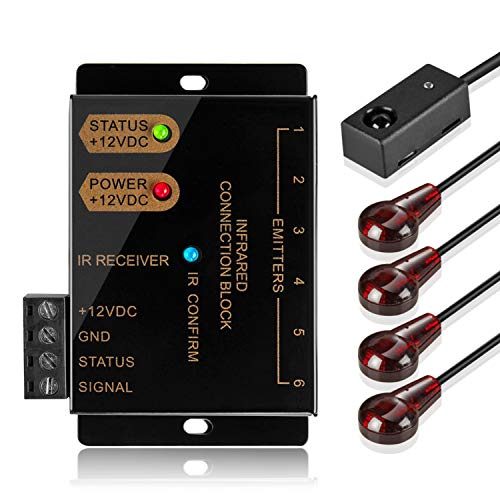
- Supports 38 kHz and 56 kHz signals
- Includes four 10-foot emitter leads
- Offers up to six emitter output connections
Best For: Cabinet installations with mixed-frequency IR remotes
Simple Room-to-Room Setup
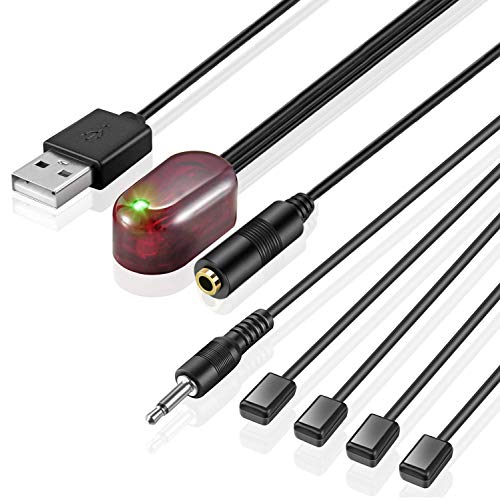
- Controls up to four IR devices
- Works across a 34–60 kHz range
- Includes one receiver and four emitters
Best For: Small home-theater systems and basic cabinet control
Long-Distance Choice

- Wireless link rated up to 200 meters
- Supports up to 10 devices and multi-zone control
- Includes flexible power, mounting, and extension accessories
Best For: Large homes and separated multi-room IR setups
Simple USB IR Extension

- 6-foot USB-powered IR extension cable
- Blue LED confirms signal transmission
- For IR-equipped A/V devices, not RF systems
Best For: Wall-mounted TV and home theater setups with one concealed A/V source
Long-Range Wireless IR

- Wireless emitter-to-receiver design
- 20–60KHz compatibility range
- Claimed range of up to 700 feet
Best For: Large or multi-room installations using IR-controlled equipment
Multi-Device IR Hub
Herfair Repeater for 10 Devices

- Controls up to 10 devices, expandable to 12
- Includes five IR emitters and a receiver
- Plug-and-play 20–60KHz system
Best For: Multi-component home theater cabinets and hidden A/V racks
Best USB-Powered Option

- Controls multiple IR devices with one transmitter
- Supports 20–60 kHz signals and over 7 m reception
- Includes practical cables for cabinet or theater setups
Best For: USB-powered home theater and TV cabinet installations
Best for Multiple Components
DMIR1116 1x6 IR Repeater System

- Supports up to 18 devices with expandable emitters
- Works with common AV gear across 20–60 kHz
- Offers up to 100 feet of range
Best For: Multi-component home theater cabinets
Best Wireless Range
MWIRR-B 500-Foot Wireless IR Repeater

- Offers up to 500 feet of stated wireless range
- Uses adjustable channels to avoid cross-control
- Includes AC and USB power options plus mounting accessories
Best For: Long-distance IR control between rooms or cabinets
Comprehensive Control – Multi-Device IR Repeater Kit
This infrared repeaters kit is designed for larger home-theater setups where several components are concealed behind cabinet doors or located elsewhere in the room. It supports up to 10 devices out of the box, with expansion to 12, and includes five dual IR emitters.
Best For: Managing multiple hidden A/V components across locations up to 10 meters.
Pros:
- Supports up to 10 devices and can expand to 12.
- Includes five dual emitters with 10-foot cables.
- Broadband compatibility covers common receivers, players, cable boxes, and televisions.
- Real-time transmission and CFL-friendly operation help support responsive use.
Cons:
- Plasma displays may cause interference if the receiver is placed too close.
- Receivers should be spaced at least 6 meters apart when using multiple receiver connections.
- The listed range is 10 feet, despite support for appliances at various locations up to 10 meters.
Choose this model when device capacity and included emitter leads matter most. Its distribution block and multi-emitter design make it a practical option for a sizable concealed equipment cabinet.
Dual-Frequency Pick – TNP Dual-Frequency IR Repeater Kit
Among infrared repeaters, the TNP kit stands out for dual-frequency support at 38 and 56 kHz. It is built to let you keep cable boxes and home-theater components behind cabinet doors while retaining remote control access.
Best For: Concealing A/V equipment that may use either 38 kHz or 56 kHz infrared signals.
Pros:
- Dual-frequency receiver supports a wider range of IR remotes.
- Includes four 10-foot emitter leads and supports up to six emitter outputs.
- Confirmation LED provides visual feedback when signals are received.
- Emitter cables can be extended with compatible adapters and a 3.5mm stereo extension cable.
Cons:
- Only two dual emitter blasters are included, even though the system supports six outputs.
- Additional emitter blasters are sold separately.
- The notes do not specify a maximum device count.
This is a sensible choice for buyers concerned about remote-frequency compatibility rather than maximum device capacity. Its dual-frequency receiver and expandable output design add flexibility to a concealed entertainment setup.
Simple Room-to-Room Setup – USB-Powered IR Extender Kit
This infrared repeaters kit provides a straightforward way to control A/V components between two rooms or from outside a closed cabinet. It includes one receiver, four emitters, and USB-powered operation for broadly convenient installation.
Best For: Smaller entertainment systems needing control of up to four IR devices.
Pros:
- Supports control of up to four devices simultaneously.
- Wide 34–60 kHz operating range suits many IR components.
- USB 5V power offers convenient connectivity.
- Includes a 2-meter receiver cable and 1-meter emitter cables for flexible placement.
Cons:
- Supports fewer devices than the larger multi-device kits.
- The remote should be aimed at the receiver for optimal performance.
- Emitter cables are 1 meter long, which may limit placement in larger cabinets.
For a modest setup, this URWOOW model keeps the installation uncomplicated while covering common components such as cable boxes, receivers, DVD players, and Blu-ray players. Its USB power supply is especially useful where standard USB power is readily available.
Long-Distance Choice – Sewell BlastIR Wireless Pro
The Sewell BlastIR Wireless Pro is the long-distance option among these infrared repeaters, using a wireless link rated up to 200 meters under suitable conditions. It supports up to 10 devices and includes both USB and AC power cables for installation flexibility.
Best For: Extended-distance or multi-zone control of IR equipment in large homes or separated spaces.
Pros:
- Wireless distance is rated up to 200 meters, though obstacles may reduce it.
- Supports up to 10 devices and multi-zone control.
- Includes receiver and emitter cables, mounting adhesive, rubber feet, and USB and AC power cables.
- Optional cables can position emitters directly over the IR receivers of up to two devices.
Cons:
- Works only with IR devices, not remotes or equipment using RF control.
- The directional receiver requires careful positioning toward the remote-use area.
- Listed incompatibilities include Yamaha HTR 6140, Arris DCX 3520E-M, and OSD ATM-7 Speaker Selector.
This model makes the most sense when ordinary cabinet-range extension is not enough. Verify that your devices use IR and check the listed incompatibilities before choosing it for a large or multi-room installation.
Simple USB IR Extension – 6-Foot Cable Matters Repeater
If you need straightforward infrared repeaters for a wall-mounted TV setup, this Cable Matters kit extends remote signals to a concealed Blu-ray player, cable box, receiver, or other IR-controlled A/V source. Its 6-foot Y-cable uses 5V USB power, while the blue receiver LED helps confirm signal transmission.
Best For: Home theaters and TV installations where one hidden IR device needs reliable control from the viewing area.
Pros:
- 6-foot cable helps connect a visible receiver to concealed equipment.
- Works with most A/V devices using infrared sensors.
- Adhesive backing supports secure mounting, and the blue LED verifies reception.
- USB-powered design is convenient with a 5V wall charger.
Cons:
- Does not work with RF-controlled devices.
- A separate 5V USB wall charger is recommended because a TV USB port may turn off with the TV.
- Its stated signal range is up to 15 feet, so it is less suited to very large installations.
This is a practical, compact choice when you want to hide a single A/V source without adding a complex distribution system. Keep the receiver facing forward and position the transmitter close to the source sensor for best results.
Long-Range Wireless IR – Fourair 700-Foot Repeater
Among infrared repeaters, the Fourair wireless kit stands out for installations that need substantial separation between the remote receiver and hidden equipment. It supports 20–60KHz infrared devices and is designed for DVD players, cable or satellite boxes, and audio systems, with a claimed 700-foot emitter-to-receiver range.
Best For: Large homes, offices, hotels, or entertainment cabinets where a wireless link can keep equipment out of sight.
Pros:
- Wireless design helps conceal A/V components without routing a long signal cable.
- Supports a broad 20–60KHz frequency range for mainstream IR equipment.
- Claims up to 700 feet between the emitter and receiver.
- Built-in LED indicates received remote signals, and a 12-month warranty is included.
Cons:
- Compatibility depends on an active IR receiver and excludes Bluetooth- or app-controlled devices.
- The emitter should remain within 2 inches and in line of sight of the source sensor for best performance.
- The long-range specification may be more than needed for a typical single-room setup.
The Fourair is a flexible option when distance and clean cable management matter most. Verify that every device uses infrared before buying, particularly if your setup includes newer streaming players or smart TVs.
Multi-Device IR Hub – Herfair Repeater for 10 Devices
For a cabinet packed with components, this Herfair system offers a more centralized approach to infrared repeaters. The console box works with the included receiver and five emitters to control up to 10 devices, expandable to 12, including receivers, cable boxes, DVD players, Blu-ray players, and amplifiers.
Best For: Organized home theater cabinets containing several hidden IR-controlled components.
Pros:
- Controls up to 10 devices and can expand to 12.
- Includes one receiver, five emitters, a console box, and a 12V power adapter.
- Broad 20–60KHz frequency support suits many A/V appliances.
- Plug-and-play operation requires no programming, with status lights for power and signal activity.
Cons:
- The system is more involved than a simple single-device IR cable.
- Multiple receivers should be spaced at least 20 feet apart to avoid interference.
- It is intended for IR-controlled devices and will not replace Bluetooth or app-based control.
This kit makes the most sense when you need to manage several hidden components from one viewing position. Its included emitters and centralized console reduce the need to buy separate repeaters, though installation requires thoughtful emitter placement and receiver spacing.
Best USB-Powered Option – SU101AH USB IR Repeater Kit
If you want a straightforward way to control hidden cable boxes, amplifiers, or other AV equipment, this USB-powered infrared repeater is a practical choice. It supports 20–60 kHz IR signals, offers more than 7 meters of receiving distance, and uses a wide ±45° pickup angle.
Best For: Home theaters, TV cabinets, and office AV setups that have a convenient USB 5V power source.
Pros:
- One transmitter can control multiple infrared devices simultaneously.
- Supports a broad 20–60 kHz IR frequency range.
- Includes 1-meter transmitter, 2-meter receiver, and 0.5-meter power cables.
- USB 5V power makes installation simple.
Cons:
- It is intended for indoor use and requires USB power.
- The supplied notes do not specify an exact maximum number of devices.
The SU101AH focuses on simple placement and broad compatibility rather than a complex installation. It is a good fit when you need to hide AV equipment while keeping remote control access convenient.
Best for Multiple Components – DMIR1116 1×6 IR Repeater System
This infrared repeater system is designed for setups with several hidden AV components. Its 1×6 configuration supports up to 18 devices depending on the emitter arrangement, while the included receiver and emitters let you control equipment inside a cabinet or from a remote location.
Best For: Multi-device home theaters using cable boxes, receivers, disc players, game consoles, and other standard IR-controlled equipment.
Pros:
- Supports up to 18 devices with expandable emitter configurations.
- Works with many common AV components and a 20–60 kHz frequency range.
- Supports up to 100 feet of range and can use Ethernet extension for receiver placement up to 100 meters with additional hardware.
- Includes a connecting block, four IR emitters, receiver, power supply, screws, and manual.
Cons:
- Additional emitters and terminal-block hardware may be required for expanded installations.
- The Ethernet extension setup requires separately sold equipment.
- Its multi-device wiring is more involved than a basic one-device extender.
With its expandable emitter layout and dual-sensor receiver, the DMIR1116 is the more capable choice for a crowded equipment cabinet. Choose it when device count and flexible receiver placement matter more than minimal wiring.
Best Wireless Range – MWIRR-B 500-Foot Wireless IR Repeater
For installations where a wired connection is inconvenient, this wireless infrared repeater uses a 433 MHz radio link with a stated range of up to 500 feet. Its receiver captures IR commands within a 45-degree angle and sends them to compatible hidden AV equipment.
Best For: Long-distance control of cable boxes, televisions, Blu-ray players, DVD players, and home audio equipment in cabinets or separate locations.
Pros:
- Provides a stated wireless range of up to 500 feet, or up to 984 feet in open air.
- Uses adjustable channel switches to help prevent cross-control between paired units.
- Includes receiver, emitter, two IR extension cables, AC and USB adapters, stickers, and manual.
- LED indicators and a one-year manufacturer warranty support setup and troubleshooting.
Cons:
- Works only with IR remotes, not RF remotes.
- It is not compatible with Bluetooth, Wi-Fi, or app-controlled streaming boxes.
- The advertised range can vary with walls and other obstacles.
The MWIRR-B stands out among infrared repeaters for its wireless reach and channel-pairing controls. Verify that your remote uses IR before buying, especially if your setup includes newer smart or app-controlled devices.
How We Picked These Infrared Repeaters
We focused on the features that most affect real-world compatibility and convenience: signal range, wired or wireless transmission, number of supported devices, emitter design, installation flexibility, and likely use cases. We also considered whether a kit is suited to a single hidden component, a crowded media cabinet, or a larger multi-room setup.
Because infrared systems can vary in connector design and transmitter layout, practical compatibility matters as much as advertised range. A repeater should have a clear path from the receiving sensor to the remote and reliable emitters positioned over each component’s IR window.
Quick Comparison
| Best For | Look For | Typical Advantage |
|---|---|---|
| One hidden device | Simple wired extender | Easy setup and low cost |
| Several components | Multiple emitters | Controls multiple devices in one cabinet |
| Long-distance installations | Wireless transmission and extended range | More placement flexibility |
| Large media systems | High device capacity | Supports cable boxes, receivers, players, and amplifiers |
Key Buying Factors for Infrared Repeaters
Wired Vs. Wireless Design
Wired repeaters are generally straightforward and dependable when the receiver and controlled equipment are close together. Wireless models are better when cabling would be difficult or when the signal must cross a room, cabinet, or wall. Check the stated transmission range and remember that walls, interference, and placement can reduce practical performance.
Emitter Count and Device Capacity
Choose a single-emitter kit for one concealed component, but select four or more emitters if you need to control a receiver, streaming box, Blu-ray player, cable box, or amplifier at the same time. Device-capacity claims are useful only when the kit includes enough emitters and compatible connections for your setup.
Installation and Compatibility
Look for adhesive-backed emitters, compact receivers, and cables long enough to reach each component. Confirm that the system uses standard IR control rather than radio-frequency-only remotes. Some components have unusually positioned IR sensors, so movable or visible emitters can make alignment easier.
Range and Signal Reliability
Long-range specifications are best treated as maximums under favorable conditions. A strong receiver, accurate emitter placement, and an unobstructed remote path usually matter more than the headline distance. Avoid placing the receiver behind dense furniture or near sources of electrical interference.
Who Should Buy Which Infrared Repeaters?
Choose a basic wired IR repeater when you only need to hide one device or tidy a small cabinet. A multi-emitter kit is the better choice for a conventional home theater with several components. Pick a wireless or long-range system when the controlled equipment is across the room, inside a remote cabinet, or part of a larger expansion installation.
For the most demanding setups, prioritize device capacity, emitter quantity, receiver placement options, and clear range specifications over the lowest price. If your remotes use RF, Bluetooth, or Wi-Fi instead of infrared, verify compatibility before buying, since an IR repeater cannot extend signals it cannot receive.