
A good indoor antenna can deliver free local channels without adding another monthly bill, but compact designs vary widely in reception, placement flexibility, and setup.
We compared 10 compact TV antennas across amplification, cable length, mounting options, portability, and compatibility to help you find the right fit for your room and signal conditions.
Best 10 Compact TV Antennas Picks for 2026
Best Flexible Placement
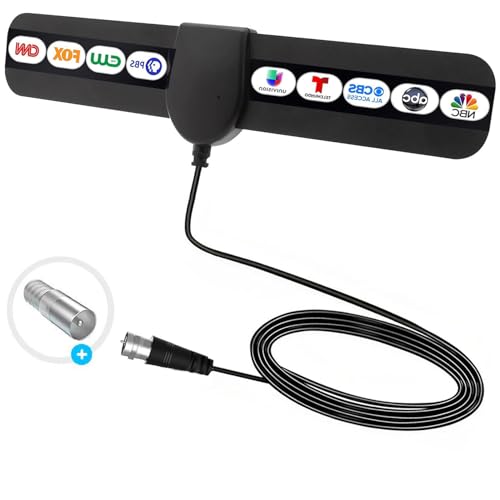
- 360° reception design
- 10-foot coaxial cable
- Slim, USB-powered amplifier setup
Best For: Flexible indoor placement near windows or away from the TV
Best Top-of-TV Design
Philips Hover Amplified Antenna

- Mounts on top of flat-screen TVs
- Built-in amplifier with LTE filter
- Supports 4K, 8K, and NextGen TV
Best For: Neat indoor setups with elevated antenna placement
Best Long-Cable Option

- 16.5-foot coaxial cable
- Indoor or outdoor installation
- Switchable signal booster
Best For: Flexible placement when the TV is far from a window
Best Simple Tabletop Pick
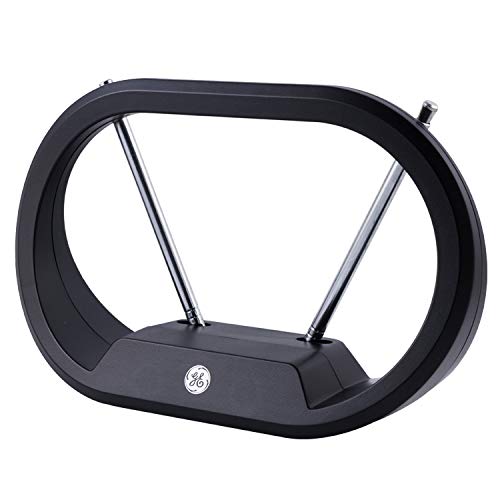
- Compact tabletop loop design
- Adjustable loop and dipoles
- Includes 4-foot coaxial cable
Best For: Simple indoor use with a nearby TV and local towers
Best Travel Pick

- Magnetic base for stable placement
- Compact design for RVs and travel
- 360° VHF/UHF reception; ATSC 3.0 compatible
Best For: Travel, camping, boating, and tailgating
Best Tabletop Option
Philips Rabbit Ears Indoor TV Antenna

- Adjustable VHF/UHF reception
- Includes a 5-foot coaxial cable
- Tabletop setup with up to 30-mile listed range
Best For: Shelves, tables, cord cutting, and backup TV
Best Discreet Mount
UltraPro Hover Digital TV Antenna

- Mounts neatly on top of a TV
- Up to 40-mile listed reception range
- Flexible tabletop, wall, or TV placement
Best For: Clean-looking smart TV setups and flexible mounting
Long-Cable Value Pick

- 9.8-foot coaxial cable
- Supports 4K and 1080p broadcasts
- Compact wall, window, or behind-TV placement
Best For: Flexible indoor setup with extra cable reach
Magnetic-Base Choice

- Magnetic base for tool-free setup
- 360-degree reception design
- Supports 4K, UHD, and 1080p HDTV
Best For: Quick placement on compatible metal surfaces
Simple 4K Reception Pick

- 360-degree reception design
- Supports 4K, UHD, and 1080p broadcasts
- Includes a coaxial cable for placement flexibility
Best For: Flexible indoor access to local over-the-air channels
Best Flexible Placement – 360° Indoor Digital Antenna
For shoppers comparing compact TV antennas, this thin indoor model stands out for flexible placement. It includes a detachable signal amplifier, 360° reception, and a 10-foot coaxial cable to help position it near a window or farther from the television.
Best For: Homes that need flexible indoor placement and extra cable reach.
Pros:
- 360° reception design supports signals from different directions.
- 10-foot coaxial cable makes placement easier when the TV is far from a window.
- Thin, lightweight design can be placed on a wall, shelf, or other non-metallic surface.
- Supports 4K and 1080p formats and includes a detachable amplifier.
Cons:
- Actual reception depends on broadcast-tower distance, terrain, foliage, and installation.
- The amplifier requires USB power and may not be necessary in strong-signal areas.
This is a practical compact TV antenna for shoppers who value installation flexibility. Its long cable and slim profile are useful, but the advertised range should not replace checking local signal availability.
Best Top-of-TV Design – Philips Hover Amplified Antenna
This Philips model is one of the more distinctive compact TV antennas because it sits on top of a flat-screen TV. Its built-in amplifier, LTE filter, and flexible mounting options make it a tidy choice for indoor over-the-air reception.
Best For: Viewers who want an elevated, clutter-conscious antenna setup.
Pros:
- Top-of-TV design keeps the antenna elevated and entertainment areas tidy.
- Built-in TruAmp amplifier and 4G/5G LTE filter are designed to support clearer reception.
- Includes a removable bracket for wall mounting or flat-surface placement.
- Supports 4K, 8K, and NextGen TV broadcasts where available.
Cons:
- Its stated reception range is up to 50 miles, but real results vary by location.
- The top-of-TV format may be less suitable for TVs without a stable flat upper surface.
Choose this compact TV antenna when design and placement matter as much as reception features. Philips adds useful mounting flexibility and support coverage, though local broadcast conditions still determine the channels you receive.
Best Long-Cable Option – Indoor/Outdoor HDTV Antenna
For compact TV antennas that need to reach beyond the entertainment center, this model includes a 16.5-foot coaxial cable and supports indoor or outdoor placement. A switchable booster is included for situations where the signal source is farther away.
Best For: Homes needing extended cable reach or the option to mount an antenna near a window or outdoors.
Pros:
- 16.5-foot coaxial cable allows flexible placement throughout the home.
- Supports indoor and outdoor installation.
- Includes a signal booster that can be activated when distance exceeds 35 miles.
- Supports 4K and 1080p formats and receives common local broadcast channels.
Cons:
- Outdoor installation and weather exposure may require additional mounting considerations.
- Reception depends heavily on local signal coverage and surrounding obstructions.
- The booster must be switched on and the TV rescanned after changing settings or placement.
This is a useful compact TV antenna for buyers prioritizing cable length and placement options. Its indoor/outdoor flexibility is appealing, but the stated range is not a guarantee of reception in every location.
Best Simple Tabletop Pick – GE Modern Loop Antenna
This GE model keeps the compact TV antenna concept simple with a small tabletop loop, adjustable dipoles, and a 4-foot coaxial cable. It is designed for indoor use and can be adjusted to help optimize reception.
Best For: Nearby TVs in areas within the antenna’s stated 30-mile reception range.
Pros:
- Compact tabletop design measures 7.5 by 2.12 by 5.5 inches.
- Adjustable loop and dipoles provide placement flexibility.
- Simple setup includes a 4-foot coaxial cable and channel scan.
- Supports 4K, 8K, and NextGen TV broadcasts where available.
Cons:
- Its 4-foot cable offers less placement reach than the longer-cable alternatives.
- The stated range is up to 30 miles, making it less suited to distant broadcast towers.
Pick this compact TV antenna if you want a straightforward tabletop design without a large installation footprint. The adjustable elements are helpful, but homes farther from broadcast towers may need a longer-range or more flexible placement option.
Best Travel Pick – GE Portable HD TV Antenna
If you need compact TV antennas for an RV, boat, vehicle, or temporary setup, the GE Portable HD TV Antenna is built for portability. Its magnetic base, 360° reception, and support for VHF and UHF channels make it a practical choice for flexible indoor or travel use.
Best For: RV travelers, campers, boaters, tailgaters, and anyone who wants a small antenna that stores easily.
Pros:
- Compact design stands just under 7 inches tall and fits in a glove box or drawer.
- Magnetic base helps keep the antenna in place on most metal surfaces.
- Supports HDTV, 1080p, and 4K/8K-ready broadcasts, with ATSC 3.0 compatibility.
- Provides 360° signal reception and includes U.S.-based technical support.
Cons:
- Its listed maximum range is 20 feet, which may limit placement flexibility.
- A magnetic base is most useful when a suitable metal surface is available.
The GE model stands out among compact TV antennas for travel-friendly storage and a secure magnetic base. It is a sensible option when portability matters more than extended range.
Best Tabletop Option – Philips Rabbit Ears Indoor TV Antenna
The Philips Rabbit Ears antenna is a straightforward choice for shoppers comparing compact TV antennas for a shelf, table, or other indoor location. Adjustable dipoles and a circular UHF loop help it receive both VHF and UHF broadcasts, while the included 5-foot coaxial cable simplifies setup.
Best For: Tabletop use, cord cutters, backup TVs, and viewers who want adjustable indoor reception without tools.
Pros:
- Adjustable rabbit ears and a circular loop support VHF and UHF reception.
- Sets up without tools using the included 5-foot coaxial cable.
- Supports 1080p viewing and is compatible with 4K/8K TVs and ATSC 3.0 broadcasts.
- Listed maximum range is up to 30 miles, with a limited-lifetime replacement warranty.
Cons:
- The rabbit-ear and loop design takes more visible tabletop space than a low-profile antenna.
- Reception can require adjusting the dipoles or loop for the best available signal.
Choose this Philips antenna if you prefer a traditional tabletop design with adjustable elements. Its simple setup and broad VHF/UHF coverage make it a practical indoor option.
Best Discreet Mount – UltraPro Hover Digital TV Antenna
For a clean-looking setup, the UltraPro Hover is one of the more discreet compact TV antennas. It can attach directly to the top of a TV, sit on a flat surface, or mount to a wall, giving you several placement options while supporting VHF and UHF local broadcasts.
Best For: Smart TV owners who want a low-profile antenna with flexible mounting and a listed range of up to 40 miles.
Pros:
- Hover design mounts discreetly on top of the TV and swivels horizontally.
- Can also be placed on a flat surface or mounted to a wall with included tape.
- Supports VHF/UHF reception, 1080p, 4K/8K TVs, and ATSC 3.0 broadcasts.
- Tool-free push-on coax connection and limited-lifetime replacement pledge.
Cons:
- The top-mounted design may not suit TVs with limited space above the screen.
- Included mounting tape may not be ideal for every wall or surface.
The UltraPro Hover is a strong fit when appearance and placement flexibility are priorities. Its swivel design lets you fine-tune positioning, while the listed 40-mile range supports a broader indoor setup than the GE model.
Long-Cable Value Pick – HD Indoor TV Antenna
For shoppers comparing compact TV antennas, this indoor model stands out for its 9.8-foot coaxial cable, which gives you more flexibility when testing locations around a bedroom, living room, or game room. It supports 4K and 1080p broadcasts and is designed for local over-the-air channels without an included amplifier.
Best For: Buyers who want a compact indoor antenna with extra cable length for flexible placement.
Pros:
- Includes a long 9.8-foot coaxial cable for easier positioning.
- Supports 4K and 1080p HD broadcasts.
- Compact black design can be hidden behind a TV or mounted on a wall or window.
- Noise-filtering technology is designed to improve picture and sound clarity.
Cons:
- An amplifier is not included.
- Channel availability depends on local reception and antenna placement.
- You need to rescan channels after moving the antenna.
This is a practical choice when cable reach matters more than built-in amplification. Plan to test several positions and check local channel availability before relying on its advertised reception range.
Magnetic-Base Choice – 360° Indoor TV Antenna
This compact TV antenna is aimed at quick indoor setup, with a magnetic base that can attach to metal surfaces such as a TV stand. Its upgraded chip is designed for 360-degree reception and filtering of cellular and FM signals, while the included coaxial cable supports placement experiments.
Best For: Viewers who prioritize tool-free installation and flexible placement on or near a TV.
Pros:
- Magnetic base supports quick installation on compatible metal surfaces.
- 360-degree reception is designed to capture signals from multiple directions.
- Supports 4K, UHD, and 1080p HDTV broadcasts.
- Includes a coaxial cable with stronger copper wiring, according to the product notes.
Cons:
- The magnetic base is most useful on or near metal surfaces.
- Reception can require repositioning and another channel scan.
- Indoor signal performance varies with obstructions and location.
The magnetic base makes this a convenient option for renters or anyone who wants a low-effort installation. For the best results, place it in an open area and rescan whenever you change its position.
Simple 4K Reception Pick – Digital Indoor Antenna
For a straightforward compact TV antenna setup, this indoor model combines 360-degree reception with a built-in smart chip intended to filter cellular and FM signals. It supports 4K, UHD, and 1080p broadcasts and includes a coaxial cable for positioning the antenna where reception is strongest.
Best For: Households seeking a compact antenna for free local broadcasts and flexible indoor placement.
Pros:
- Designed for 360-degree signal reception.
- Supports 4K, UHD, and 1080p HDTV picture quality.
- Smart chip is intended to filter cellular and FM interference.
- Includes a coaxial cable with stronger copper wiring, according to the notes.
Cons:
- Actual channel selection depends on local broadcast conditions.
- The antenna may need repositioning to improve reception.
- A channel rescan is required after moving it.
This model is a sensible fit for buyers who want broad-direction reception without a complicated installation. Its performance still depends on placement, so use the included cable to test open areas and rescan channels as needed.
How We Picked These Compact TV Antennas
We focused on compact indoor antennas designed for smart TVs and digital broadcasts, giving priority to practical features rather than inflated channel-count claims. The lineup includes amplified and passive models, traditional rabbit-ear designs, loop antennas, low-profile units, and options with longer cables or flexible mounting.
Our comparisons emphasize setup simplicity, placement options, included accessories, signal adjustment, and value. Because indoor reception depends heavily on distance from broadcast towers, walls, building materials, and local terrain, no antenna performs identically in every home.
Quick Comparison
| Type | Best For | Main Advantage | Potential Limitation |
|---|---|---|---|
| Amplified indoor antenna | Homes needing extra signal assistance | Built-in boost and flexible placement | Amplification cannot fix severe obstruction or interference |
| Rabbit-ear antenna | Nearby stations and easy adjustment | Extendable dipoles help tune VHF signals | Less discreet on a shelf or TV stand |
| Loop antenna | Compact, simple installations | Small footprint and clean appearance | May require more positioning experimentation |
| Low-profile or hover design | Minimal visual clutter | Easy placement on or near a TV | Fewer positioning choices in some rooms |
Key Buying Factors for Compact TV Antennas
Reception and Placement
Check your approximate distance from local broadcast towers before choosing an antenna. Place it near a window or exterior wall when possible, and keep it away from routers, large metal objects, and other electronics. A long cable can make a bigger practical difference than a claimed maximum range because it lets you test better locations.
Amplification
An amplifier may help compensate for signal loss through cable runs or weak indoor conditions, but it is not automatically better. In areas with strong signals, excessive amplification can introduce interference. Choose an amplified model when you need placement flexibility or have a marginal signal, and consider a passive antenna when towers are nearby.
VHF and UHF Support
Local channels can use different broadcast bands. Rabbit-ear dipoles are useful for VHF reception, while loop elements commonly target UHF signals. A versatile design that supports both bands is generally the safer choice when you want broad local-channel coverage.
Size, Cable, and Setup
Measure the space around your television before buying. Consider whether the antenna can sit on a stand, attach to a wall, or rest on top of the TV. Also verify the cable length and whether the included power adapter or amplifier suits your setup.
Who Should Buy Which Compact TV Antennas?
Choose an amplified model if your TV is far from a window, your cable run is lengthy, or reception is inconsistent. Choose rabbit ears if you want hands-on adjustment and live near local transmitters. Choose a low-profile loop or hover design if appearance and a small footprint matter most. Choose a portable antenna for dorm rooms, guest rooms, RV-style use, or occasional setups.
Whichever of these Compact TV Antennas you choose, scan for channels after every major placement change. If reception remains unreliable, check a local coverage map and test another window or room before assuming the antenna is defective.