
If you need a faster, more reliable wired connection, a fiber optic network adapter for PC can be the right upgrade. The best options depend on whether you need direct SFP+ connectivity, a media converter, or a simple fiber-to-Ethernet bridge.
Below, we focus on practical choices for home labs, office desktops, and small business networks, with an eye on speed, compatibility, and ease of setup.
Best 10 Fiber Optic Network Adapter for PC Picks for 2026
10G SFP+ Expansion
TRENDnet PCIe 10 Gigabit Adapter

- PCIe 3.0 x4 to 10Gbps SFP+ port
- Includes standard and low-profile brackets
- Supports VLAN, RSS, and checksum offloading
Best For: Desktop users adding a 10G fiber/SFP+ connection
Fiber-to-Copper Bridge
10Gtek Dual SC Media Converter

- Converts single-mode fiber to RJ45 Ethernet
- Gigabit speeds with auto-negotiation
- UL certified 2-pack converter
Best For: Gigabit fiber-to-Ethernet bridging over single-mode fiber
M.2 10GbE Upgrade

- Intel 82599 chipset with one SFP+ port
- Supports PXE, UEFI, DPDK, and SR-IOV
- Works with Windows, Linux, ESXi, and FreeBSD
Best For: Advanced builders using an M.2 slot for 10GbE
Plug-and-Play Converter
TP-Link MC220L Gigabit Fiber Adapter
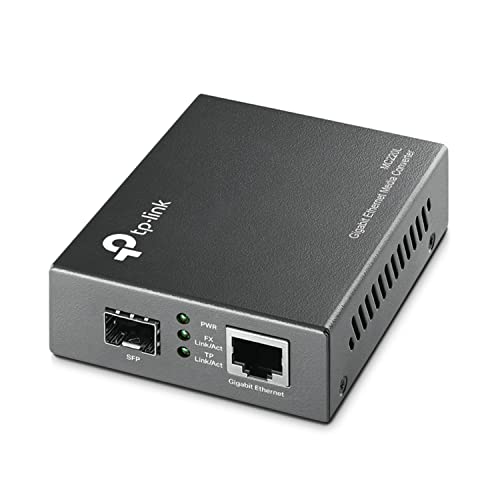
- Converts fiber to 1000Base-T copper
- Plug and play with no configuration
- Supports single-mode and multi-mode SFPs
Best For: Simple gigabit fiber-to-Ethernet conversion
Open SFP Long-Run Converter
StarTech Gigabit Fiber Media Converter

- Open SFP slot for custom MM/SM transceivers
- Gigabit RJ45 auto-negotiates 10/100/1000 Mbps
- Supports VLAN pass-through and 9K jumbo frames
Best For: customizable copper-to-fiber links in IT and server-room deployments
Mini 20Km Link Extender
Gigabit Fiber Optical Media Converter

- Single-mode fiber support up to 20Km
- Auto-negotiates 100/1000Mbps Ethernet
- Mini size with LED status indicators
Best For: compact long-distance single-mode fiber-to-Ethernet links
Dual LC Pack Converter
10Gtek Gigabit Ethernet Media Converter

- Includes 550m multimode 850-nm SFP
- 10/100/1000Mbps RJ45 with auto-negotiation
- Sold as a UL-certified 2-pack
Best For: paired multimode fiber-to-Ethernet conversions with included transceivers
Budget-Friendly Fiber Media Converter
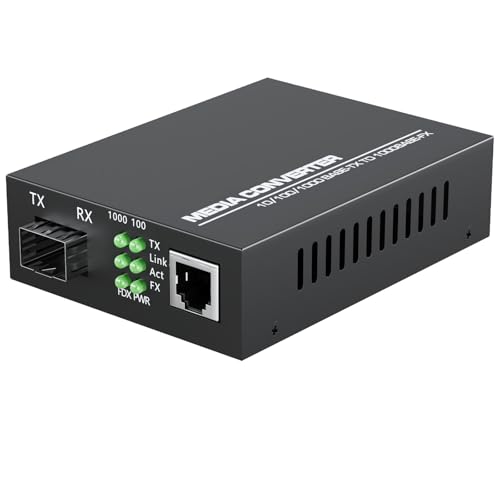
- Plug-and-play setup
- Auto-negotiation Ethernet port
- LED status indicators
Best For: Simple fiber-to-Ethernet bridging for PC, router, or small network setups
Included-SFP Value Pick
Gigabit SFP to RJ45 20km Converter

- Includes single-mode SFP module
- Supports jumbo frames and auto crossover
- Plug-and-play with warranty support
Best For: Buyers who want an all-in-one fiber-to-Ethernet converter package
Trusted Brand Choice
TP-Link TL-MC200 Gigabit Fiber Converter

- Works with single- and multi-mode SFP modules
- Plug-and-play with auto-negotiation
- Durable metal casing and UL certified
Best For: Buyers wanting a dependable brand-name gigabit fiber converter
10G SFP+ Expansion – TRENDnet PCIe 10 Gigabit Adapter
If you need a fiber optic network adapter for PC that turns a free expansion slot into a 10G uplink, this TRENDnet card is built for that job. It uses a PCIe 3.0 x4 interface and provides a single 10Gbps SFP+ port, making it a straightforward option for desktops that already have the right slot and compatible SFP+ networking gear.
Best For: Desktop users who want a PCIe-based 10G SFP+ adapter with bracket flexibility and Windows support.
Pros:
- 1 x 10Gbps SFP+ port for high-speed fiber networking
- Includes standard and low-profile brackets for more install options
- Supports VLAN tagging, RSS, MSI, and checksum offloading
- Compatible with Windows 11/10 and Windows Server editions
Cons:
- Requires a PCIe 3.0 x4 slot and SFP+ network equipment
- Not a copper RJ45 adapter, so it is aimed at fiber/SFP+ setups
- Windows-focused compatibility may narrow use for some builds
This is a solid pick if your priority is adding a true 10G SFP+ connection to a PC without relying on a media converter. Its included brackets and broad Windows server support make it especially practical for workstation or small business installs.
Fiber-to-Copper Bridge – 10Gtek Dual SC Media Converter
For a fiber optic network adapter for PC setup that needs to bridge fiber and Ethernet, this 10Gtek media converter is designed to translate single-mode fiber into a standard RJ45 connection. It supports 1000Base-LX to 10/100/1000Base-T and is intended for users who need to connect Ethernet devices across fiber runs without changing the network card in the computer itself.
Best For: Users who want a simple fiber-to-Ethernet converter for gigabit networking over single-mode fiber.
Pros:
- Converts 1000Base-LX fiber to 10/100/1000Base-T Ethernet
- Supports single-mode fiber with dual SC fiber ports
- Auto-negotiation and auto-MDI/MDIX on the RJ45 side
- UL certified and sold as a 2-pack
Cons:
- Limited to gigabit speeds, not 10GbE
- Requires compatible fiber modules and external power
- Not an internal PC adapter, but an external media converter
This is best viewed as a practical bridge rather than a high-speed internal upgrade. If your goal is to link a PC or Ethernet device to a single-mode fiber run at gigabit speeds, it keeps the setup simple and hardware-driven.
M.2 10GbE Upgrade – Vogzone Intel 82599 SFP+ NIC
If your build has an open M.2 slot, this Vogzone card is a compact fiber optic network adapter for PC setups that want 10GbE SFP+ connectivity without a standard PCIe card format. It uses an Intel 82599 chipset, comes with an M.2 to SFF-8087 connection and cable, and is aimed at systems that can support its M.2 installation and external SATA power requirement.
Best For: Advanced PC builders with an M.2 slot who need a 10GbE SFP+ adapter and broad OS support.
Pros:
- Intel 82599 chipset for low latency and high performance
- Single SFP+ port with 10GbE support
- Supports PXE, UEFI, DPDK, Jumbo Frame, FCoE, iSCSI, and SR-IOV
- Broad OS compatibility including Windows, Linux, VMware ESXi, and FreeBSD
Cons:
- Requires an available M.2 slot and compatibility with motherboard layout
- Needs a SATA hard drive power connection; power supply is not included
- Installation and Windows 11 use may require careful driver setup
This is a specialized choice for users who want 10GbE from an M.2-based install rather than a standard expansion card. The extra platform requirements matter, but the feature set is strong for demanding networking and virtualization tasks.
Plug-and-Play Converter – TP-Link MC220L Gigabit Fiber Adapter
When you need a fiber optic network adapter for PC use without complex setup, the TP-Link MC220L offers a simple way to convert between 1000BASE-SX/LX fiber and 1000Base-T copper. It is a plug-and-play media converter with auto-negotiation on the RJ45 side, making it a practical pick for straightforward fiber-to-Ethernet links.
Best For: Users who want an easy plug-and-play gigabit fiber-to-Ethernet converter for home or office networking.
Pros:
- Converts 1000BASE-SX/LX fiber to 1000Base-T copper or vice versa
- Plug and play with no software setup required
- Supports both single-mode and multi-mode SFP modules
- Auto-negotiation and auto-MDI/MDIX on the Ethernet port
Cons:
- Limited to 1,000 Mbps, not 10GbE
- Requires compatible SFP modules for fiber connectivity
- Uses an external power adapter rather than an internal PC slot
This is the easiest option in the group if your goal is simply to bridge fiber and copper at gigabit speed. It favors convenience and compatibility over raw speed, which makes it a sensible everyday network utility.
Open SFP Long-Run Converter – StarTech Gigabit Fiber Media Converter
If you need a fiber optic network adapter for PC or a broader Ethernet-to-fiber link, this StarTech media converter is built for straightforward Gigabit extension over long distances. Its open SFP slot lets you choose the transceiver that matches your run, while the RJ45 port auto-negotiates between 10/100/1000 Mbps devices for flexible integration.
Best For: IT and server-room setups that need a reliable, customizable copper-to-fiber conversion path.
Pros:
- Open SFP slot supports MSA-compliant multi-mode or single-mode transceivers.
- Gigabit RJ45 port auto-negotiates 10/100/1000 Mbps connections.
- Supports VLAN pass-through and 9K jumbo frames.
- Compact design can mount in compatible media chassis for cleaner installs.
Cons:
- Requires a separate compatible SFP module to define the fiber link.
- Designed for network conversion rather than direct PC expansion.
This is a practical pick if you want a durable, low-config media converter for edge or on-prem deployments. The flexibility of the open SFP design makes it easier to match the unit to your network distance and fiber type.
Mini 20Km Link Extender – Gigabit Fiber Optical Media Converter
For buyers looking for a fiber optic network adapter for PC-style Ethernet bridging, this mini media converter focuses on simple long-range single-mode conversion. It supports 100/1000Mbps auto-negotiation, a 1.25Gbps fiber port, and SC/UPC or SC/APC to RJ45 compatibility, making it a compact way to extend a wired network.
Best For: Small installations that need a compact single-mode fiber-to-Ethernet bridge up to 20Km.
Pros:
- Supports single-mode transmission up to 20Km.
- Auto-negotiates 100/1000Mbps on the electrical side.
- Includes LED indicators for power, fiber link, and Ethernet activity.
- Low 1.5W full-load power use and compact mini size.
Cons:
- Single-mode focused, so it is not the right fit for every fiber setup.
- Positioned as a media converter rather than a direct PCIe adapter for a PC.
This is a good choice when you want a small, energy-efficient converter for a long fiber run and quick troubleshooting. The bundled power adapter and easy-to-read status lights make it especially practical for basic deployments.
Dual LC Pack Converter – 10Gtek Gigabit Ethernet Media Converter
If you need a fiber optic network adapter for PC networking over multimode cabling, this 10Gtek media converter offers a simple way to bridge 10/100/1000Base-Tx to 1000Base-SX. It includes a 550-meter multimode SFP module, supports auto-negotiation and MDI/MDIX auto-crossover, and is sold as a two-pack for paired deployments.
Best For: Multimode fiber users who want an included SFP-based Ethernet conversion kit in a 2-pack.
Pros:
- Includes a 550m multimode 850-nm SFP transceiver.
- RJ45 port supports 10M/100M/1000Mbps auto-negotiation.
- MDI/MDIX auto-crossover helps simplify cabling.
- UL certified and includes a 5V-1A power supply.
Cons:
- Limited to multimode fiber and the included transceiver specification.
- Best suited to Ethernet conversion rather than direct PC internal installation.
This model stands out if you want an out-of-the-box converter with the SFP already included. The 2-pack format can be useful when you need matching units for a link on both ends.
Budget-Friendly Fiber Media Converter – 1.25G Single-Mode SFP to RJ45
If you need a fiber optic network adapter for PC use that simply bridges fiber and Ethernet, this 1.25G media converter is a straightforward option. It supports plug-and-play setup, auto-negotiation on the RJ45 side, and visual LED status lights, making it easy to drop into a home or small office network without extra configuration.
Best For: Users who want a simple SFP-to-RJ45 adapter for plugging a PC or router into an existing fiber-based network.
Pros:
- Plug-and-play setup with no software installation needed
- Auto-negotiation with Half-Duplex/Full-Duplex and auto-MDI/MDIX support
- Supports 10/100/1000 Base-T Ethernet connections
- LED indicators make network status easy to monitor
Cons:
- Requires compatible SFP module for fiber-side use
- Designed as a media converter, not a direct internal PC adapter
Overall, this is a practical choice if you want a basic fiber-to-Ethernet bridge with simple operation and solid everyday compatibility. Its single-mode fiber range depends on the SFP module you install, so it works best when you already know your fiber requirements.
Included-SFP Value Pick – Gigabit SFP to RJ45 20km Converter
For buyers looking for a fiber optic network adapter for PC networking, this gigabit converter stands out because it includes a single-mode SFP module in the box. It is built for quick fiber-to-Ethernet conversion, supports plug-and-play operation, and adds useful features like jumbo frame support and front-panel status LEDs.
Best For: Anyone who wants a ready-to-use fiber converter package with the SFP module included.
Pros:
- Includes a single-mode 1000Base-LX SFP module
- Gigabit RJ45 port with 10/100 Mbps backward compatibility
- Supports Full/Half Duplex, auto crossover, and 9K-byte jumbo frames
- Plug-and-play operation with no configuration required
Cons:
- Indoor-use converter rather than a direct PCIe or USB PC adapter
- Best suited to fiber conversion tasks, not general networking hardware
This is a strong value if you need the fiber side included and want a reliable gigabit bridge without extra setup steps. The 3-year warranty and lifetime tech support also add peace of mind for a long-term installation.
Trusted Brand Choice – TP-Link TL-MC200 Gigabit Fiber Converter
If you want a fiber optic network adapter for PC-related networking and prefer a familiar brand, the TP-Link TL-MC200 is a clean plug-and-play converter for 1000BASE-SX/LX fiber to 1000Base-T copper. It works with both single-mode and multi-mode SFP modules, supports auto-negotiation, and uses a durable metal casing for a more solid installation.
Best For: Users who want a reputable, easy-to-use SFP-to-RJ45 converter for a stable gigabit link.
Pros:
- Works with both single-mode and multi-mode fiber SFP modules
- Plug and play with no software or configuration needed
- Durable metal casing and UL certification
- Front-panel LEDs help monitor activity
Cons:
- Requires separate SFP module for fiber-side operation
- As a media converter, it is not a direct internal PC expansion card
This model is a good fit if you value compatibility, a sturdy build, and straightforward installation over extra features. It’s especially appealing for simple network conversions where reliability and brand support matter.
How We Picked the Best Fiber Optic Network Adapter for PC
We prioritized real-world compatibility, port type, speed class, and installation simplicity. For a Fiber Optic Network Adapter for PC, the biggest question is whether you need an internal PCIe or M.2 solution, or an external media converter that bridges fiber to standard Ethernet. We also favored models with clear standards support, durable housings, and broad use-case flexibility.
Quick Comparison: Adapter Vs. Media Converter
An adapter installs inside the PC and is the better choice when you want the system itself to connect directly to a fiber network, especially for 10GbE SFP+ setups. A media converter is more versatile if your PC already has Ethernet and you just need to connect a fiber line to copper networking gear. In short, choose an adapter for direct PC networking and a converter for network bridging.
Key Buying Factors for a Fiber Optic Network Adapter for PC
Port Type and Form Factor
Check whether your motherboard supports PCIe, M.2, or only standard RJ45. Internal cards are best for clean desktop builds, while standalone converters work well when you need flexibility across multiple devices.
Speed and Fiber Standard
Match the adapter to your network speed: 1GbE remains common and cost-effective, while 10GbE is the better pick for file transfers, NAS access, and workstation use. Confirm whether the product supports single-mode, multi-mode, SFP, or SFP+ modules and cabling.
Compatibility and Transceiver Support
Some products are sold as open SFP designs, while others expect specific optics or built-in media conversion. Make sure the adapter or converter matches your switch, cable type, and distance requirements before buying.
Build Quality and Environment
Metal enclosures, NDAA/TAA compliance, and plug-and-play operation are useful extras for business and lab environments. For a Fiber Optic Network Adapter for PC used in a permanent setup, reliability matters more than minor feature differences.
Who Should Buy Which Fiber Optic Network Adapter for PC?
If you want direct high-speed PC connectivity, choose a PCIe or M.2 fiber card with 10GbE support. If your goal is to connect fiber infrastructure to an existing Ethernet-only PC or router, a media converter is usually the smarter, simpler choice. For casual upgrades, a gigabit converter is enough; for creative work, backups, virtualization, or NAS traffic, step up to 10GbE.
Ultimately, the best pick depends on your network, not just your PC. Match the hardware to your fiber type, speed target, and installation style, and you’ll get a much smoother upgrade.