
The right mixer can make a live performance easier to control, cleaner to hear, and faster to troubleshoot. This roundup compares 10 options across analog, digital, DJ, rehearsal, and small-venue setups.
We focused on practical features such as input capacity, preamp quality, effects, USB connectivity, monitoring, portability, and control flexibility so you can match a console to your stage and workflow.
Best 10 Audio Mixer for Live Performance Picks for 2026
Best Digital Control
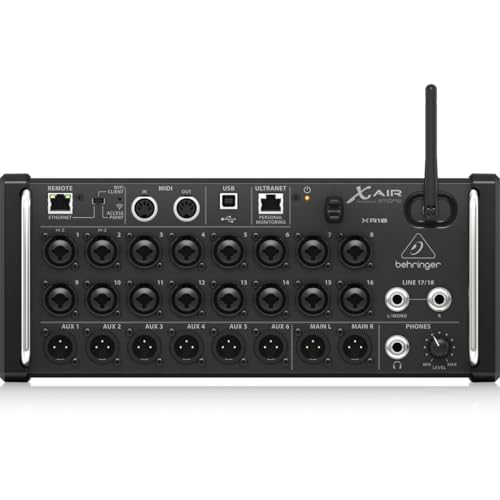
- Tablet-controlled 18-channel digital mixer
- 16 programmable MIDAS mic preamps
- 18 x 18 USB audio interface
Best For: Wireless live mixing and multichannel recording
Best Compact Analog Option

- Four mic/line combo inputs
- Built-in Lexicon effects
- USB recording and playback
Best For: Small gigs, streaming, and hands-on analog mixing
Best Effects Variety
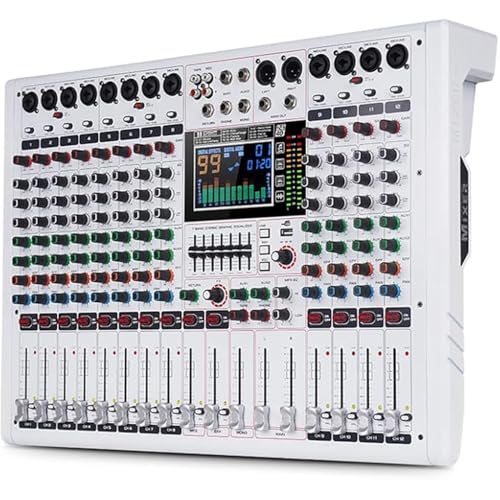
- 99 built-in DSP effects
- Bluetooth and USB playback connectivity
- Seven-stage equalizer with color LCD
Best For: Karaoke, DJs, and effects-focused live events
Best Traditional Pro Choice

- D-PRE mic preamps and one-knob compressors
- SPX effects and bidirectional USB
- Metal chassis with balanced XLR outputs
Best For: Small venues and musicians wanting physical controls
Best Premium Analog Choice

- 24 channels for larger live setups
- 96kHz/24-bit USB multitrack recording
- Onyx preamps, sweepable EQ, effects, and Bluetooth
Best For: Bands and venues needing extensive inputs and recording flexibility
Best Effects-Focused Value

- 16 channels with 14 combo inputs
- 99 DSP effects, Bluetooth, and USB recording
- 48V phantom power on every channel
Best For: Performers and small production teams wanting built-in processing
Best Compact Mackie Option

- Compact 12-channel analog design
- USB connectivity for recording workflows
- Onyx preamps and built-in GigFX effects
Best For: Smaller live setups, recording, and content creation
Best Slim-Build Pick

- 12 channels with 48V phantom power
- Bluetooth, MP3/USB, and USB recording
- Ultra-thin 1.57-inch design
Best For: Bands, karaoke, conferences, and compact live setups
Best Feature-Rich Control
Pyle PMXU128BT 12-Channel Mixer

- USB soundcard and PC/Mac recording
- Bluetooth streaming and 16 DSP effects
- 7-band EQ with 12-segment LED meter
Best For: Live performers, podcasters, and flexible recording setups
Best Compact DSP Option
CT-12 12-Channel Bluetooth Mixer
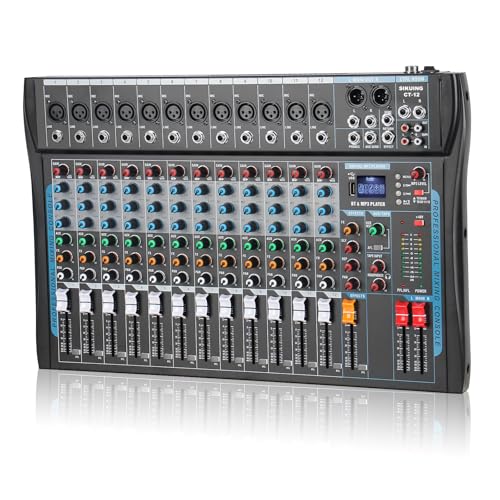
- 12 inputs with balanced XLR and line connections
- Bluetooth and USB for streaming and recording
- 16-bit DSP effects and +48V phantom power
Best For: Compact live, streaming, karaoke, and studio setups
Best Digital Control – Behringer X AIR XR18
The Behringer X AIR XR18 is a flexible audio mixer for live performance when you want tablet control, extensive routing, and multichannel recording. Its 18-channel design, programmable MIDAS preamps, built-in Wi-Fi router, and USB interface suit both stage and studio workflows.
Best For: Live performers and small production teams that prefer wireless tablet-based mixing and multichannel USB recording.
Pros:
- Control from iPad or Android tablets
- 16 programmable MIDAS-designed mic preamps
- Built-in tri-mode Wi-Fi router
- 18 x 18 bidirectional USB audio interface
Cons:
- Requires a compatible tablet for its primary control workflow
- Firmware-supported features may vary over time
The XR18 is a strong choice for performers who value compact digital control and recording flexibility over traditional physical faders. Its connectivity and programmable inputs make it especially adaptable for live setups with multiple microphones.
Best Compact Analog Option – Soundcraft Notepad-12FX
Soundcraft Notepad-12FX Small-format Analog Mixing Console with USB I/O and Lexicon Effects
Check Price On AmazonThe Soundcraft Notepad-12FX is a practical audio mixer for live performance, home recording, and streaming. It combines four mic/line combo inputs, stereo line inputs, USB I/O, three-band EQ, and built-in Lexicon effects in a small-format analog console.
Best For: Small live setups, creators, and musicians who want familiar analog controls with USB connectivity and onboard effects.
Pros:
- Four mic/line combo inputs plus two stereo line inputs
- USB recording and playback integration
- Built-in Lexicon reverb, chorus, and delay
- Three-band EQ on mic inputs
Cons:
- Fewer inputs than larger live-performance mixers
- Analog design offers less remote control than a digital mixer
The Notepad-12FX keeps operation straightforward while adding useful digital conveniences. It is a sensible fit when hands-on mixing, basic channel shaping, and onboard effects matter more than advanced routing.
Best Effects Variety – GF12 PRO 12-Channel Mixer
The GF12 PRO is an audio mixer for live performance that emphasizes accessible effects and playback options. Its 12 channels include individual gain, balance, EQ, effects-send, and volume controls, while Bluetooth, USB, a color LCD, and 99 DSP effects broaden its event-ready versatility.
Best For: Small to medium performances, karaoke venues, DJs, and users who want plentiful built-in effects and wireless playback.
Pros:
- 99 selectable DSP effects
- Seven-stage master equalizer
- Bluetooth and USB connectivity
- Color LCD display and isolated channel mute
Cons:
- Limited to 12 channels
- Warranty information lists a 30-day return and exchange policy
The GF12 PRO is geared toward convenience and variety rather than a minimal control surface. Its extensive effects library and Bluetooth support can be useful for entertainment-focused performances and flexible playback setups.
Best Traditional Pro Choice – Yamaha MG12XU
The Yamaha MG12XU is a 12-input audio mixer for live performance with a durable metal chassis, XLR balanced outputs, and a built-in SPX effects processor. Its D-PRE mic preamps, one-knob compressors, and bidirectional USB make it suitable for straightforward stage mixing and computer-based audio work.
Best For: Musicians and small venues seeking a conventional mixer with reliable construction, onboard effects, compression, and USB connectivity.
Pros:
- D-PRE mic preamps with inverted Darlington circuitry
- Built-in SPX digital effects
- Bidirectional USB connectivity
- Metal chassis with XLR balanced outputs
Cons:
- Provides 12 inputs rather than the capacity of larger consoles
- Uses corded power and a traditional physical-mixer workflow
The MG12XU offers a balanced set of live-sound essentials in a familiar format. It is a strong match for users who want physical controls, integrated effects, and USB connectivity without moving to a tablet-controlled system.
Best Premium Analog Choice – Mackie Onyx24
The Mackie Onyx24 is a strong audio mixer for live performance when you need 24 channels, dependable analog controls, and recording flexibility. Its Onyx mic preamps, sweepable British-style EQ, USB multitrack recording, and built-in effects make it suitable for larger setups that may also feed a studio or content workflow.
Best For: Bands, venues, and creators needing extensive inputs plus multitrack recording.
Pros:
- 24-channel layout accommodates larger live setups.
- USB supports 96kHz/24-bit multitrack recording to Mac or PC, with stereo recording and playback via SD card.
- Onyx preamps offer up to 60dB of gain, while the sweepable midrange EQ adds tone-shaping control.
- Includes Bluetooth streaming and a customizable digital effects engine.
Cons:
- At 28.6 pounds, it is less convenient to transport than a compact mixer.
- The 24-channel design may be more mixer than small acts require.
Choose the Onyx24 if your priority is input capacity and recording capability in one analog console. Its size and weight make it better suited to permanent or larger touring setups than highly portable rigs.
Best Effects-Focused Value – W IN-MIX DX16
The W IN-MIX DX16 is a flexible audio mixer for live performance with 16 channels, 14 combo inputs, two stereo channels, and a broad selection of built-in processing. Its 99 DSP effects, Bluetooth, USB recording, and metal construction make it a practical option for performers and small production teams that want many features without adding external processors.
Best For: Live bands, DJs, karaoke hosts, churches, and home studios needing versatile inputs and effects.
Pros:
- Offers 14 XLR/6.35mm combo inputs plus two stereo channels for flexible connections.
- Includes 99 DSP effects, Bluetooth playback, and USB recording.
- Provides 48V phantom power on every channel for condenser microphones.
- Features a 7-band master EQ, illuminated mute buttons, and rugged metal construction.
Cons:
- Its 16-channel footprint is relatively large at 21.85 inches wide.
- XLR cables are sold separately.
- The listed output connectivity is auxiliary, so verify your intended system connections before buying.
The DX16 stands out when onboard effects, phantom power, and flexible source connections matter more than a minimalist setup. It is a feature-rich choice for users who want to manage live sound, recording, and playback from one console.
Best Compact Mackie Option – Mackie ProFX12v3
The Mackie ProFX12v3 is a compact audio mixer for live performance that combines 12 channels, USB connectivity, and built-in effects. It is a practical fit for smaller bands, presenters, and content creators who want a straightforward analog mixer with Onyx preamps and Mackie’s GigFX engine.
Best For: Smaller live setups, recording, and content creation where a compact mixer is useful.
Pros:
- 12-channel format provides useful capacity without the footprint of a larger console.
- USB connectivity supports recording and computer-based workflows.
- Built-in GigFX effects engine adds processing without requiring separate effects hardware.
- Onyx preamps and XLR/TRS/USB outputs support varied live and recording connections.
Cons:
- It offers fewer channels than the 16- and 24-channel mixers in this roundup.
- The supplied notes do not specify the included effects count or detailed control options.
- It is corded electric rather than battery powered.
The ProFX12v3 is the sensible middle ground for users who want Mackie preamps, effects, and USB recording in a smaller console. Consider a higher-channel model if your live setup regularly uses many microphones or instruments.
Best Slim-Build Pick – CT-120S 12-Channel Mixer
For shoppers comparing an audio mixer for live performance, the CT-120S combines 12 channels with Bluetooth, USB playback and recording, reverb support, and 48V phantom power. Its 1.57-inch-thin body may also suit setups where portability and desk space matter.
Best For: Bands, karaoke setups, campus events, conferences, and home KTV users who want broad connectivity in a slim console.
Pros:
- 12-channel layout with 48V phantom power for compatible microphones.
- Bluetooth 5.0, MP3/USB input, and USB recording support.
- Built-in reverb support, LED display, and XLR/TRS outputs.
Cons:
- Listed for 110V power with an American plug.
- The supplied warranty description is limited to 35 days.
The CT-120S is a practical choice when you need an audio mixer for live performance with modern wireless and USB features without a bulky chassis. Confirm your power requirements and warranty expectations before buying.
Best Feature-Rich Control – Pyle PMXU128BT 12-Channel Mixer
The Pyle PMXU128BT is a versatile audio mixer for live performance with Bluetooth streaming, a USB soundcard, multiple input and output options, and hands-on channel controls. Its 16 DSP effects and 7-band EQ add flexibility for stage, recording, and content applications.
Best For: Performers, beginner-to-studio users, podcasters, and small live rigs needing extensive connectivity and onboard adjustment controls.
Pros:
- 12-channel design with XLR/combo inputs and +48V phantom power.
- Bluetooth streaming works with phones, tablets, and MP3 players.
- USB audio interface, 16 DSP effects, 7-band EQ, and LED level metering.
Cons:
- Its listed dimensions and 10.6-pound weight may be less convenient for frequent transport.
- The feature-rich control layout may take time to learn.
Choose the PMXU128BT if you want an audio mixer for live performance that can also support recording and podcast workflows. It is especially appealing when detailed level monitoring and broader I/O are priorities.
Best Compact DSP Option – CT-12 12-Channel Bluetooth Mixer
The CT-12 offers a practical mix of 12-channel control, Bluetooth and USB connectivity, 16-bit DSP effects, and +48V phantom power. For an audio mixer for live performance, its slim chassis and sealed rotary controls are aimed at compact stage, streaming, studio, and karaoke setups.
Best For: Live performers, streamers, interviewers, home karaoke users, and small production setups that need effects and device connectivity.
Pros:
- 12 mic inputs with gold-plated XLR and balanced line input jacks.
- Bluetooth and USB connections support streaming, mixing, and recording.
- 16 DSP effects, 3-band EQ, headphone monitoring, and +48V phantom power.
Cons:
- The supplied notes do not specify dimensions, weight, or voltage.
- Its 16-bit DSP specification may be less appealing to buyers seeking higher-resolution processing.
The CT-12 is a well-rounded option for buyers who want an audio mixer for live performance with built-in effects and a compact, rugged control surface. Verify the product’s physical and electrical specifications if those details affect your installation.
How We Picked the Best Audio Mixer for Live Performance
We evaluated these mixers by looking at the features that matter during rehearsals, gigs, events, and installations. Input count was a starting point, but we also considered the number and type of microphone preamps, line inputs, buses, auxiliary sends, stereo channels, and outputs. A mixer with plenty of channels is not automatically the best choice if its routing or monitoring options are limited.
We also compared analog and digital workflows, onboard effects, USB recording and playback, Bluetooth support, phantom power, EQ flexibility, and control methods. For live use, straightforward operation and dependable signal management are especially important, so practical layout and connectivity received priority alongside headline specifications.
Quick Comparison
| Best For | Recommended Type | Features to Prioritize |
|---|---|---|
| Small bands and speakers | Compact analog mixer | Simple controls, built-in effects, USB I/O |
| Mobile performers and venues | Digital mixer | Remote control, scene recall, flexible routing |
| Large bands or productions | Higher-channel console | More preamps, buses, monitor sends, and outputs |
| DJs and karaoke hosts | Feature-focused DJ mixer | Bluetooth, media playback, effects, easy source switching |
| Live recording and streaming | USB-equipped mixer | Multitrack or stereo USB connectivity and stable drivers |
Key Buying Factors for an Audio Mixer for Live Performance
Inputs, Outputs, and Headroom
Count the microphones, instruments, playback devices, and spare channels you expect to use, then leave room for expansion. Check whether the mixer has enough main, monitor, auxiliary, subgroup, and headphone outputs for your system. Good gain controls and adequate headroom help prevent clipping when performers become louder than expected.
Analog or Digital Control
Analog mixers provide immediate hands-on control and are often quick to understand. Digital mixers can offer scene recall, deeper routing, compression, effects, remote tablet control, and a smaller physical footprint, but they may require more setup and familiarity with menus or apps.
Effects, Monitoring, and Phantom Power
Built-in reverb and other effects can reduce the need for external processors. Confirm that the mixer provides useful auxiliary sends for monitors and effects, plus 48V phantom power when using condenser microphones or active direct boxes. Apply phantom power carefully when connecting devices that may not support it.
USB, Bluetooth, and Recording
USB can support playback, streaming, or recording, but capabilities vary widely. Determine whether the connection offers simple stereo I/O or multitrack recording. Bluetooth is convenient for background music and breaks, but it should complement—not replace—wired connections for critical performance sources.
Who Should Buy Which Audio Mixer for Live Performance?
Choose a compact analog console if you value tactile controls, quick setup, and uncomplicated operation for small bands, presentations, or community venues. A USB-equipped analog model is particularly useful when you also record rehearsals or send a stereo mix to a computer.
Choose a digital Audio Mixer for Live Performance when you need remote control, repeatable settings, extensive effects, or flexible routing in a compact rack or stage setup. It is a strong fit for bands with several monitor mixes and venues that regularly host different acts.
Higher-channel models make sense for larger bands, production teams, and installations where multiple microphones, instruments, playback sources, and monitor mixes must remain connected. DJ-oriented and budget consoles are best for mobile entertainment, karaoke, and casual events where Bluetooth, media playback, and accessible controls matter more than advanced recording or routing.