
Choosing among audio equalizers for beginners can be confusing when models range from compact tone controls to full rack-mount graphic EQs. The right option depends on your system, available connections, and how much hands-on adjustment you want.
This roundup compares 10 options across home audio, headphones, recording, streaming, DJ use, and car systems, with practical guidance to help you match features to your setup.
Best 10 Audio Equalizers for Beginners Picks for 2026
Best Balanced-Connection Pick
Douk Audio T7 7-Band Equalizer

- Seven adjustable frequency bands
- RCA and XLR input/output connections
- Compact aluminum-alloy housing
Best For: Beginners needing flexible home stereo connectivity
Best Compact 3.5mm Option

- Seven-band ±12dB adjustment
- 3.5mm two-channel interface
- Headphone and microphone support
Best For: Compact streaming, podcasting, and headphone setups
Best Wireless Beginner Pick

- Five-band independent tone control
- Bluetooth 5.0 wireless playback
- VU meters with adjustable settings
Best For: Compact Bluetooth home stereo and computer audio
Best Advanced Preset System

- Twenty independent adjustment bands
- 31-band spectrum display
- Bluetooth, USB, optical, and coaxial inputs
Best For: Flexible home theater, recording, and streaming systems
Best Portable Pick

- Simple three-band bass, midrange, and treble controls
- Functions as a headphone amp, preamp, or instrument equalizer
- Portable battery-powered design with up to six hours of use
Best For: Beginners needing portable headphone and instrument tone control
Best Detailed Control
15-Band Stereo Graphic Equalizer
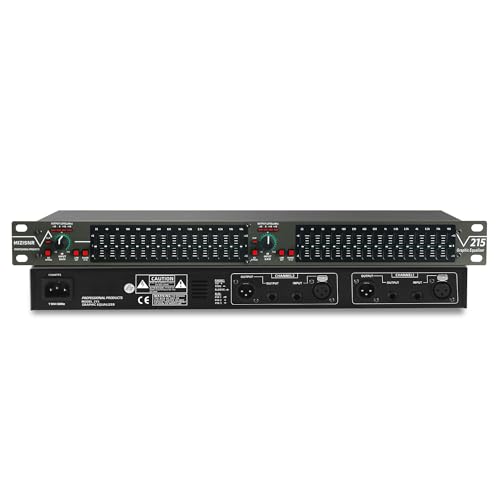
- 15 adjustable bands on each stereo channel
- Low-cut switch helps reduce rumble, wind noise, and hum
- Rack-mount design with XLR and 1/4-inch connections
Best For: Beginners learning detailed EQ in a rack-based audio system
Best Compact Desktop Option

- Seven frequency bands with ±12 dB adjustment
- 14 dB preamp gain supports low-output audio devices
- 3.5mm TRS/TRRS support works with headsets and microphones
Best For: Compact headphone, desktop, gaming, and voice-chat setups
Versatile Beginner Pick
31-Band Bluetooth Graphic Equalizer

- 31 adjustable bands with real-time spectrum monitoring
- Bluetooth, optical, coaxial, and USB connectivity
- Auto-save presets and noise reduction
Best For: Beginners building a flexible home or live audio setup
Rack-Mount Control Choice
15-Band Dual-Channel Equalizer

- 15 adjustable bands per stereo channel
- Low-cut filter and dedicated subwoofer output
- XLR and 1/4-inch TRS connections in a 1U rack design
Best For: Beginners entering rack-based DJ, studio, or live audio
Visual Learning Option
31-Band Digital Spectrum Equalizer

- 31-segment LED display shows frequency activity
- Ten presets, EQ bypass, and separate tone adjustment
- Bluetooth 5.2, USB, XLR, and 1/4-inch TRS support
Best For: Beginners learning EQ through visual feedback and presets
Best Balanced-Connection Pick – Douk Audio T7 7-Band Equalizer
For beginners exploring audio equalizers, the Douk Audio T7 offers straightforward seven-band control with both RCA and XLR connectivity. Its adjustable -6dB to +6dB range makes it practical for correcting speaker or room-character differences without an overly complicated interface.
Best For: Beginners with home stereo systems that need flexible RCA and XLR connections.
Pros:
- Seven frequency bands cover bass, midrange, and treble adjustments.
- RCA and XLR inputs and outputs support varied stereo setups.
- Offers a reported signal-to-noise ratio above 104dB and distortion as low as 0.003%.
- Compact aluminum-alloy housing is designed for durability and interference shielding.
Cons:
- No volume control knob; it outputs at the rated level.
- Its balanced XLR connectivity may be unnecessary for simpler beginner systems.
The T7 is a sensible choice when connection flexibility and clean, hands-on frequency adjustment matter more than extra features. Its plug-and-play operation keeps the learning curve manageable, although volume control must be handled elsewhere in the system.
Best Compact 3.5mm Option – 7-Band Sound Equalizer
Among audio equalizers for beginners, this two-channel model is aimed at compact setups using 3.5mm connections. It provides seven bands with a ±12dB adjustment range, plus headphone compatibility and a stated five-times preamp gain.
Best For: Beginners building recording, streaming, podcasting, or headphone setups around 3.5mm equipment.
Pros:
- Seven bands span 60Hz through 15kHz for broad tonal adjustment.
- ±12dB control range allows more pronounced changes than a narrower EQ range.
- 3.5mm input supports a four-pin plug and microphone-equipped headphones.
- Aluminum-alloy construction and dual-channel operation suit compact installations.
Cons:
- Requires a DC power supply between 5V and 12V.
- Its 3.5mm-focused design is less suitable for RCA- or XLR-based home stereo systems.
- The supplied notes do not specify a power adapter or detailed setup accessories.
This equalizer makes the most sense for users who already work with 3.5mm audio gear. The controls are approachable, but buyers should confirm their power arrangement and connector compatibility before purchasing.
Best Wireless Beginner Pick – Douk Audio EQ5 Tone
The Douk Audio EQ5 Tone is a friendly entry point for audio equalizers for beginners who want wireless playback alongside physical controls. Its five independent bands, bypass function, balance control, and Bluetooth 5.0 connectivity cover the essentials without requiring a large rack-style unit.
Best For: Beginners who want a compact Bluetooth-enabled equalizer for a home stereo or computer speaker system.
Pros:
- Five frequency bands provide independent tone adjustment from 75Hz to 10kHz.
- Bluetooth 5.0 enables wireless music streaming from compatible devices.
- Bypass and balance controls make it easy to compare processed and unprocessed sound.
- Large VU meters provide real-time visual feedback and adjustable speed, brightness, and gain on the upgraded version.
Cons:
- Five bands offer less detailed control than seven- or 20-band designs.
- Its DC 5V requirement may add power-planning considerations.
- The VU meters and styling may be unnecessary if the priority is a minimal setup.
EQ5 Tone balances useful beginner controls with an engaging visual design. Choose it when Bluetooth and easy bypass comparison are priorities; choose a more extensively banded model if you expect to make highly specific corrections.
Best Advanced Preset System – 20-Band Home Audio Equalizer
For beginners who want room to grow, this home audio equalizer combines 20 independent bands with preset modes and auto-memory. It also adds Bluetooth 6.0, USB, optical, and coaxial digital inputs, making it a broad-featured option for home theater, recording, and streaming systems.
Best For: Beginners who want extensive control, visual feedback, and multiple digital connection options.
Pros:
- Twenty independent bands allow detailed tonal shaping.
- Thirty-one-band spectrum display provides real-time visual feedback.
- Twelve customizable modes and auto-save memory simplify repeat use.
- Supports Bluetooth, USB, optical, coaxial, and dual-RCA output connections.
Cons:
- The 16.9-inch-wide chassis is substantially larger than compact equalizers.
- The extensive controls may feel more complex for someone seeking basic tone adjustments.
- Its feature set may be more than needed for a simple analog stereo setup.
This model is the strongest fit for buyers who want a beginner-friendly interface now but do not want to outgrow their equalizer quickly. Presets and auto-memory reduce routine effort, while the 20-band layout offers considerable scope for experimentation.
Best Portable Pick – Fosi Audio SK01
The Fosi Audio SK01 is a practical starting point for anyone exploring audio equalizers for beginners, especially if you want a compact unit for headphones or an electric guitar. Its three tone controls keep adjustments simple while adding useful amplifier features.
Best For: Beginners who want portable headphone amplification and straightforward bass, midrange, and treble control.
Pros:
- Three-band analog control makes basic tone shaping easy.
- Works as a headphone amp, preamp, or instrument equalizer.
- Includes gain adjustment, tone defeat, loudness, and dual headphone jack sizes.
- Battery-powered aluminum body provides up to six hours of use.
Cons:
- Its three-band design offers less detailed control than a graphic equalizer.
- Battery life is limited to up to six hours.
- Its 3.5mm and 6.35mm connections may require adapters for some equipment.
The SK01 is an approachable choice when ease of use and portability matter more than extensive frequency-by-frequency adjustment. It is particularly versatile for headphone listeners and guitar users.
Best Detailed Control – 15-Band Stereo Graphic Equalizer
This 15-band stereo graphic equalizer suits beginners who are ready to move beyond basic tone controls and learn more precise frequency shaping. Its rack-mount format is intended for home audio, DJ, live, installation, or studio setups.
Best For: New users building a rack-based stereo system who want detailed control over two audio channels.
Pros:
- Provides 15 adjustable bands per channel for more precise tuning.
- Offers up to ±12 dB adjustment on each band.
- Low-cut filtering helps reduce wind noise, floor rumble, and electrical hum.
- Includes bypass functionality and XLR and 1/4-inch connectivity.
Cons:
- The 1U rack-mount design is less convenient for casual or portable use.
- Its larger control set may have a steeper learning curve than a three-band equalizer.
- It weighs 4.64 pounds and measures 18.9 inches wide.
This model is a strong learning platform for beginners who want hands-on graphic EQ control, but its size and connections make it better suited to a fixed audio setup than a simple desktop system.
Best Compact Desktop Option – EQ 7 Band Stereo Equalizer
The EQ 7 Band Stereo Equalizer is a compact option for audio equalizers for beginners who want more control than a simple tone knob. Seven frequency bands, preamp gain, and flexible headphone and speaker routing make it useful for home, car, gaming, and voice-chat setups.
Best For: Beginners tuning headphones, desktop speakers, gaming audio, or low-output sources in a compact setup.
Pros:
- Seven bands cover bass, mids, and treble from 60Hz to 15kHz.
- Provides up to ±12 dB adjustment for each listed frequency.
- Offers 14 dB of preamp gain to support low-output devices.
- TRS/TRRS 3.5mm support preserves headset microphone functionality.
Cons:
- RCA and 3.5mm inputs cannot be selected simultaneously.
- It does not provide the same frequency-level detail as a 15-band equalizer.
- The gain boost may be more capability than some basic headphone users need.
With its small footprint and familiar seven-slider layout, this unit offers a useful middle ground between simple tone control and professional rack EQ. Its headset support is a notable advantage for gaming and voice applications.
Versatile Beginner Pick – 31-Band Bluetooth Graphic Equalizer
For beginners comparing audio equalizers for beginners, this 31-band model offers plenty of room to learn while keeping everyday controls approachable. Its real-time spectrum analyzer, customizable modes, noise and echo reduction, Bluetooth connectivity, USB playback, and auto-saving presets make it adaptable for music, movies, and live audio.
Best For: Beginners building a flexible home audio, KTV, studio, or entertainment setup.
Pros:
- 31 independently adjustable bands cover bass through treble.
- Real-time frequency monitoring helps beginners see how sound changes.
- Bluetooth, optical, coaxial, and USB connectivity support multiple devices.
- Auto-save presets simplify switching between music, movies, and live use.
Cons:
- The many bands and connection options may feel overwhelming at first.
- The supplied notes do not specify detailed frequency ranges or dimensions.
This is the most feature-rich choice of the group for a beginner who expects to expand beyond basic stereo listening. Its visual feedback and saved presets can shorten the learning curve, while the broad connectivity keeps it useful as a system grows.
Rack-Mount Control Choice – 15-Band Dual-Channel Equalizer
Among audio equalizers for beginners, this rack-mount unit is a practical option for users who want straightforward dual-channel control and conventional pro-audio connections. Each channel provides 15 adjustable bands, while the low-cut filter, bypass mode, and subwoofer output support more controlled system tuning.
Best For: Beginners moving into rack-based home audio, DJ, live-event, or studio systems.
Pros:
- Dual-channel design provides 15-band control for each stereo channel.
- Low-cut control helps reduce unwanted low-end noise.
- XLR and 1/4-inch TRS connections offer flexible system integration.
- 1U rack-mount form factor and bypass switch simplify installation and testing.
Cons:
- It lacks the Bluetooth and USB playback features listed for some competing models.
- Rack-mount hardware may be less convenient for casual desktop use.
- Its pro-oriented controls may require more setup knowledge from a first-time user.
This model suits beginners who are specifically learning traditional rack-based signal chains rather than looking for an all-in-one wireless unit. The dedicated subwoofer output and balanced connections add useful flexibility as your system becomes more advanced.
Visual Learning Option – 31-Band Digital Spectrum Equalizer
This digital model stands out among audio equalizers for beginners because its 31-segment LED spectrum display makes frequency activity easy to observe. Ten preset modes, EQ bypass, Bluetooth 5.2, USB playback, and separate high, mid, and bass adjustment provide a useful balance between guided listening and hands-on control.
Best For: Beginners who want visual feedback and preset-based control for home theater, KTV, studio, or DJ use.
Pros:
- 31-segment LED indication shows real-time frequency changes visually.
- Ten presets and EQ bypass support quick comparisons and easier setup.
- Bluetooth 5.2 and USB playback add convenient source options.
- XLR and 1/4-inch TRS inputs and outputs support varied audio systems.
Cons:
- The rack-mount format may not suit compact or casual listening spaces.
- The supplied notes do not provide specific dimensions or detailed band frequencies.
- Its broad feature set may take time to learn despite the preset modes.
The LED display makes this a strong teaching-oriented choice: beginners can connect what they hear with visible frequency movement. Presets and bypass make experimentation safer, while the connectivity supports upgrades to more involved audio setups.
How We Picked These Audio Equalizers for Beginners
We selected models that cover the most common entry-level needs: straightforward frequency adjustment, useful input and output connections, manageable controls, and compatibility with typical home audio equipment. The list includes compact preamps, headphone-focused units, Bluetooth-enabled designs, and multi-band rack EQs.
We also considered whether each format suits a beginner’s likely setup. A five- or seven-band unit is generally easier to understand, while 15- and 31-band models provide finer control but require more patience and familiarity with room acoustics and frequency ranges.
Quick Comparison
| Type | Best For | What to Expect |
|---|---|---|
| 5–7-band EQ | Simple home tuning | Easy controls and broad adjustments |
| Headphone preamp EQ | Personal listening | Compact tone control and amplification |
| 15-band graphic EQ | DJ and stereo systems | More precise shaping and rack-style controls |
| 31-band digital EQ | Advanced system tuning | Detailed adjustment, analysis, and more setup complexity |
Key Buying Factors for Audio Equalizers for Beginners
Match the Connections
Check whether your source and amplifier use RCA, XLR, 3.5mm, Bluetooth, or another connection. An EQ must sit correctly in the signal chain, and adapters may introduce clutter or compatibility issues. Balanced XLR inputs and outputs can be useful with compatible pro audio equipment, while RCA is common in home stereo systems.
Choose the Right Number of Bands
Fewer bands make broad changes easier and reduce the chance of over-processing. More bands offer precision for room correction, live sound, or detailed recording work, but they can be overwhelming if you are still learning which frequencies affect bass, mids, and treble.
Consider Gain, Noise, and Controls
Look for an adjustment range that suits your needs and avoid extreme boosts, which can add distortion or noise. VU meters, spectrum analyzers, presets, and digital displays may improve visibility, but they are not substitutes for careful listening.
Think About Placement and Power
Confirm the unit’s dimensions, rack requirements, power supply, and ventilation needs. Portable headphone models work differently from rack-mount stereo processors, so select a form factor that fits your equipment and listening space.
Who Should Buy Which Audio Equalizers for Beginners?
Choose a compact five- or seven-band model if you want simple bass, midrange, and treble shaping for a home stereo, computer speakers, or streaming setup. A headphone amplifier EQ is the better fit for private listening and desktop systems.
Pick a 15-band unit if you need more control for DJ equipment or a larger stereo system without moving into highly complex digital processing. A 31-band digital equalizer is best for experienced users who need detailed system tuning, spectrum monitoring, or professional-style signal control.
For most first-time buyers, prioritize compatible connections, intuitive controls, and low-noise operation over the highest band count. Start with small adjustments, bypass the EQ regularly to compare results, and save advanced features for when your system and listening goals demand them.