
The right MIDI interface can make a live rig faster to control, easier to expand, and less vulnerable to connection problems. The best choice depends on how many instruments, controllers, computers, and audio devices you need to integrate.
We’ve selected 10 options ranging from portable MIDI hosts and compact audio/MIDI interfaces to high-port-count units for complex stage and studio systems.
Best 10 Midi Interfaces for Live Performances Picks for 2026
Best Routing Hub

- Six USB-C host ports for standalone MIDI routing
- Selectable TRS MIDI Type A/B connections
- Preset-based filtering, mapping, merging, and splitting
Best For: Complex hardware rigs and pedalboards
Best Compact Audio Option
PIYONE Q28 USB Audio Interface

- Two combo inputs for microphones and instruments
- 24-bit/192kHz audio resolution
- USB-C bus power and zero-latency direct monitoring
Best For: Mobile audio capture paired with a separate MIDI interface
Best Rack-Style MIDI Expansion

- 16-channel USB MIDI connectivity
- Class-compliant Mac and PC operation
- USB bus-powered computer setup
Best For: Computer-based live rigs needing higher MIDI channel capacity
Best Audio-and-MIDI Studio Hub
Focusrite Scarlett 4i4 4th Gen

- MIDI I/O plus four line inputs and outputs
- Two mic preamps and two Hi-Z instrument inputs
- Auto Gain, Clip Safe, Air mode, and 120dB dynamic range
Best For: Performers combining microphones, instruments, audio, and MIDI
Routing Powerhouse

- 8 MIDI inputs and 8 MIDI outputs
- Three standalone routing modes
- Front I/O with LED activity indicators
Best For: Complex live MIDI rigs needing extensive routing
Compact Performance Hub

- 5-pin MIDI input and output
- Two combo inputs with 48V phantom power
- Balanced outputs and headphone monitoring
Best For: Portable performers needing MIDI and audio in one unit
Expanded Audio Rig

- 18x20 USB audio interface
- ADAT I/O for expansion
- Eight MIDAS mic preamps with phantom power
Best For: Large performance rigs with extensive audio requirements
Studio-Scale Control

- 18 inputs and 16 outputs with MIDI I/O
- Four mic preamps plus Hi-Z and line inputs
- Includes XLR and MIDI cables
Best For: Large live rigs and hybrid performance setups
Portable DSP Performance

- Compact 2-in/2-out design with MIDI I/O
- Latency-free DSP effects for monitoring
- Rugged full-metal housing and iOS support
Best For: Solo performers and compact mobile rigs
Creative Hardware Hub
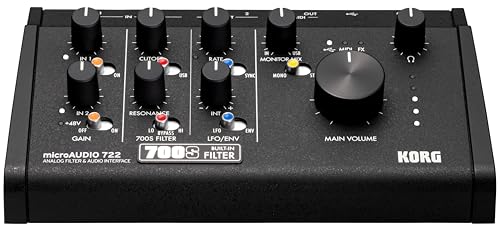
- 2-in/2-out interface with MIDI I/O
- Built-in analog filter for tonal shaping
- Includes a broad production software bundle
Best For: Keyboardists and electronic live performers
Best Routing Hub – CME H12MIDI Pro
For complex midi interfaces for live performances, the CME H12MIDI Pro is built to connect USB MIDI gear, TRS MIDI devices, and computers in one compact hub. Its standalone operation, routing tools, and flexible power options make it particularly suitable for pedalboards and hardware-heavy rigs.
Best For: Performers managing multiple USB MIDI devices, synths, pedals, sequencers, and hybrid computer setups.
Pros:
- Six USB-C host ports support up to 16-in/16-out virtual MIDI and can operate without a computer.
- Six TRS MIDI ports offer selectable Type A/B compatibility.
- Built-in routing, filtering, merging, splitting, mapping, and up to six presets support customized live setups.
- Compact aluminum housing supports 5V USB-C or 9V DC power and supplies up to 3A of USB host power.
Cons:
- Designed for class-compliant USB MIDI hardware, so compatibility should be checked for specialized devices.
- Advanced configuration requires the HxMIDI Tools software.
The H12MIDI Pro is the most versatile choice here for large, computer-free MIDI systems. Its broad connectivity and programmable routing are well suited to players who need to change signal paths quickly onstage.
Best Compact Audio Option – PIYONE Q28 USB Audio Interface
The PIYONE Q28 is primarily a two-channel audio interface rather than a dedicated MIDI interface, but it can complement midi interfaces for live performances when your setup also needs portable microphone or instrument recording. It combines USB-C bus power, combo inputs, and direct monitoring in a compact format.
Best For: Mobile performers and creators who need two-channel audio capture alongside a separate MIDI setup.
Pros:
- Two XLR/TRS combo inputs accommodate microphones and instruments.
- 24-bit/192kHz recording supports high-resolution audio capture.
- Class-compliant USB-C connection requires no drivers for Mac and PC use.
- Direct monitoring provides zero-latency tracking, with a built-in 3.5mm headphone output.
Cons:
- It does not list dedicated MIDI input or output.
- Supplied operating-system details specifically identify Windows, so broader compatibility should be confirmed.
Choose the Q28 when audio is the priority and MIDI will be handled by another device. Its simple USB-C setup and direct monitoring make it a practical add-on for small live or mobile recording systems.
Best Rack-Style MIDI Expansion – midiplus MIDI 16×16
The midiplus MIDI 16×16 is a straightforward USB MIDI interface for setups that need many channels connected to a computer. Among midi interfaces for live performances, it is best considered a larger, computer-based expansion unit rather than a standalone controller for hardware-only rigs.
Best For: Computer-centered live systems requiring 16-channel USB MIDI connectivity.
Pros:
- Provides 16-channel MIDI connectivity over USB.
- USB class-compliant operation works with Mac and PC systems.
- USB bus power simplifies computer-based setup.
- Works with MIDI software and supports USB 2.0 and USB 3.0 connections under the listed platform conditions.
Cons:
- The supplied notes describe USB connectivity but do not specify standalone hardware MIDI routing.
- Its 19-inch-wide, 5.1-pound design is less portable than compact interfaces.
- Operating-system support is not fully specified beyond the listed Mac and PC compatibility.
The MIDI 16×16 makes sense when channel count and computer integration matter more than portability. Confirm the exact routing and physical MIDI connections you need before choosing it for a stage rig.
Best Audio-and-MIDI Studio Hub – Focusrite Scarlett 4i4 4th Gen
The Focusrite Scarlett 4i4 4th Gen combines audio recording and MIDI I/O in one interface, making it a useful foundation for performers who run instruments and software together. It is a strong audio-focused companion to midi interfaces for live performances, especially when microphones, guitars, synths, or drum machines share the setup.
Best For: Live musicians who need four-in/four-out audio, MIDI I/O, and flexible connections for instruments and microphones.
Pros:
- Includes MIDI input and output alongside four line inputs and four line outputs.
- Two mic preamps and two Hi-Z inputs support microphones, guitars, and other instruments.
- 120dB dynamic range and up to 24-bit/192kHz operation target studio-quality sound.
- Auto Gain, Clip Safe, and Air mode provide useful performance and recording tools.
Cons:
- It provides MIDI I/O but is primarily an audio interface, not a multi-port standalone MIDI router.
- Its 2.2-pound enclosure is less minimal than a dedicated compact MIDI box.
The Scarlett 4i4 is a versatile choice when live performance involves both audio sources and MIDI hardware. Its multiple line connections and protective gain features help bridge rehearsal, recording, and stage workflows.
Routing Powerhouse – Black Lion Audio MIDI Eight
For performers managing several keyboards, controllers, or computers, the Black Lion Audio MIDI Eight is a capable choice among MIDI interfaces for live performances. Its 8-in/8-out design, front-mounted connections, and standalone routing modes are geared toward flexible stage setups.
Best For: Live rigs that need extensive MIDI connectivity and hardware-based routing.
Pros:
- Provides 8 MIDI inputs and 8 MIDI outputs.
- Offers three standalone routing modes for flexible operation.
- Front-mounted I/O and LED port activity indicators simplify monitoring.
- Works with Windows and macOS through USB and 5-pin MIDI.
Cons:
- Its 19-inch rack-style form factor may be excessive for compact setups.
- At 8.6 pounds, it is less portable than smaller interfaces.
The MIDI Eight is best suited to performers who value port count and routing flexibility over a lightweight footprint. A two-year warranty adds useful ownership support.
Compact Performance Hub – Arturia MiniFuse 2
The Arturia MiniFuse 2 combines USB audio and 5-pin MIDI in a compact interface suited to portable music-making. For MIDI interfaces for live performances, it offers a practical way to connect synths, controllers, microphones, and instruments while also providing balanced outputs and headphone monitoring.
Best For: Solo performers and mobile setups that need both MIDI and audio connectivity.
Pros:
- Includes 5-pin MIDI input and output connections.
- Provides two combo mic/instrument/line inputs with 48V phantom power.
- Offers two balanced 1/4-inch outputs and a headphone output with volume control.
- Compact 1.1-pound design and USB connectivity support portable use.
Cons:
- Its two MIDI connections provide less routing capacity than larger multi-port units.
- It is primarily a compact audio interface rather than a dedicated standalone MIDI router.
The MiniFuse 2 is a versatile option when a live performer wants MIDI connectivity alongside recording and monitoring features. Its five-year warranty and included software add value for creators building an all-in-one setup.
Expanded Audio Rig – Behringer UMC1820
The Behringer UMC1820 is built for performance and recording setups that require substantial audio I/O alongside MIDI. Its 18×20 USB interface, ADAT I/O, and eight MIDAS-designed mic preamps make it a strong consideration among MIDI interfaces for live performances involving multiple microphones and instruments.
Best For: Larger live or hybrid rigs requiring extensive audio inputs and outputs with MIDI connectivity.
Pros:
- Streams 18 inputs and 20 outputs over USB 2.0.
- Includes ADAT I/O for system expansion.
- Features eight MIDAS-designed mic preamps with 48V phantom power.
- Supports popular software including Ableton Live, Pro Tools, and Cubase.
Cons:
- Its larger 24.35-inch-wide chassis is less convenient for small mobile setups.
- The supplied details describe extensive audio I/O but do not specify the number of MIDI ports.
- Operating-system details are limited in the supplied specifications.
The UMC1820 makes the most sense when MIDI is part of a much larger audio system. It can accommodate microphones and instruments at scale, while ADAT support leaves room for expansion.
Studio-Scale Control – Scarlett 18i16 4th Gen Bundle
For performers who need extensive routing, the Focusrite Scarlett 18i16 is a powerful choice among MIDI interfaces for live performances. Its MIDI I/O, four mic preamps, eight line inputs, ADAT, and S/PDIF provide the connectivity needed for larger live rigs and hybrid setups.
Best For: Live performers and producers managing multiple microphones, instruments, synths, and external hardware.
Pros:
- Offers 18 inputs and 16 outputs with dedicated MIDI I/O.
- Includes four mic preamps, two Hi-Z inputs, and eight line inputs.
- Provides 24-bit/192kHz conversion, Air modes, Auto Gain, and Clip Safe.
- Bundle includes two XLR cables and two 10-foot MIDI cables.
Cons:
- Its extensive I/O may be more than a compact solo setup requires.
- The supplied notes do not specify a dedicated live-performance control surface.
The Scarlett 18i16 stands out when your performance setup depends on scale and flexible routing. Its broad I/O and included MIDI cables make it especially practical for complex stage or studio-to-stage systems.
Portable DSP Performance – Yamaha URX22C USB-C Interface
The Yamaha URX22C is a compact option for musicians seeking MIDI interfaces for live performances without carrying a large rack-style unit. Its two combo inputs, MIDI I/O, rugged metal housing, and latency-free DSP monitoring support a straightforward performance workflow.
Best For: Solo performers, vocalists, guitarists, and mobile setups using two audio inputs.
Pros:
- Provides 2-in/2-out audio with MIDI I/O in a compact interface.
- Two Class-A D-PRE combo inputs include phantom power and one Hi-Z input.
- DSP monitoring includes REV-X reverb, Channel Strip, and Guitar Amp Classics.
- Supports Windows, macOS, and iOS with a full-metal housing.
Cons:
- Two input channels limit larger ensembles and multi-microphone setups.
- The listed warranty is one year and has authorized-retailer conditions.
Choose the URX22C when portability and built-in monitoring effects matter more than extensive I/O. It is well suited to focused live rigs built around one or two sources and external MIDI gear.
Creative Hardware Hub – Korg microAUDIO 722 Interface
The Korg microAUDIO 722 combines a compact 2-in/2-out design with MIDI I/O and an integrated analog filter, making it an appealing choice among MIDI interfaces for live performances that involve expressive sound shaping. Its dual combo inputs accommodate microphones, instruments, and line-level sources.
Best For: Keyboardists and electronic performers controlling external synths and shaping tones during compact live sets.
Pros:
- Includes MIDI connectivity for syncing and controlling external hardware.
- Dual combo inputs support microphones, instruments, and line sources.
- Integrated miniKORG-style analog filter adds creative tonal shaping.
- Includes Ableton Live Lite, Komplete Select, and Ozone Elements.
Cons:
- Two inputs and two outputs may not suit larger live ensembles.
- The supplied details list Windows compatibility only.
- Warranty information must be confirmed with the seller or manufacturer.
The microAUDIO 722 is a strong fit for performers who want MIDI hardware control and hands-on tone shaping in a small package. Its analog filter and software bundle add creative value, though larger setups may need more I/O.
How We Picked the Best Midi Interfaces for Live Performances
We focused on practical live-use priorities: dependable connectivity, useful MIDI port counts, computer compatibility, monitoring options, portability, and the ability to expand a rig. Because several products in this roundup also include audio inputs and outputs, we considered recording quality, driver support, latency control, and routing flexibility where relevant.
Pure MIDI users may not need a full audio interface, while performers running vocals, instruments, backing tracks, and external hardware may benefit from an all-in-one device. Product selection also reflects different budgets and system sizes rather than assuming every performer needs the same feature set.
Quick Comparison
| Type | Best For | What to Look For |
|---|---|---|
| Portable USB MIDI host | Compact hardware rigs | Standalone operation, power options, and device compatibility |
| 2-in/2-out audio/MIDI interface | Solo performers and small setups | Low latency, direct monitoring, and simple I/O |
| 4-in/4-out interface | Growing hybrid rigs | Extra outputs, flexible routing, and reliable USB connectivity |
| 8×8 or 16×16 MIDI interface | Multiple synthesizers and controllers | Dedicated ports, filtering, and independent routing |
| Large audio/MIDI interface | Bands, production rigs, and rack systems | High input counts, expansion, monitoring, and stable drivers |
Key Buying Factors for Midi Interfaces for Live Performances
Port Count and Routing
Count the actual MIDI devices you plan to connect, including keyboards, drum machines, grooveboxes, lighting controllers, and external effects. A multi-port interface is often more reliable than relying on chains or multiple inexpensive adapters. Independent inputs and outputs are especially useful when several devices must run simultaneously.
Latency and Stability
Live performance requires predictable timing. Look for dependable drivers, current operating-system support, direct monitoring when audio is involved, and a connection standard suited to your computer or tablet. USB-C describes the connector, not necessarily the performance, so check compatibility and power requirements.
Audio I/O and Monitoring
If you perform with microphones, guitars, backing tracks, or software instruments, an audio/MIDI interface can reduce the number of boxes in your setup. Check preamp count, line outputs, headphone monitoring, MIDI synchronization, and whether the interface supports the sample rate and bit depth you actually need.
Portability and Power
Travel rigs benefit from compact construction, bus power, and straightforward cabling. Larger interfaces offer more connections but may need dedicated power and rack or desktop space. Confirm that a portable unit can power connected MIDI hardware if you intend to use it without a computer.
Who Should Buy Which Midi Interfaces for Live Performances?
Choose a Compact 2-In/2-Out Model If…
You are a solo performer, vocalist, keyboardist, or laptop musician with a small setup and need audio recording plus basic MIDI control.
Choose a Multi-Port MIDI Interface If…
Your rig includes several synthesizers, drum machines, or hardware controllers. Dedicated ports and flexible routing can simplify setup and prevent MIDI-chain bottlenecks.
Choose a Larger Audio/MIDI Interface If…
You need multiple microphone or line inputs, several monitor feeds, external expansion, or a central hub for a band or production system. These models are best when connectivity matters more than minimal size.
Choose a Portable MIDI Host If…
You want to connect MIDI controllers and instruments without depending on a computer. Verify power, USB host compatibility, and the exact devices you plan to use before buying.