
Studio monitors with a front bass port can make small rooms and desktop setups much easier to work with. They’re often more forgiving near walls while still delivering the detail you need for recording, editing, and mixing.
In this roundup, we focus on practical choices across different budgets and room sizes, with an emphasis on placement flexibility, balanced sound, and everyday studio use.
Best 10 Studio Monitors with Front Bass Port Picks for 2026
Studio Reference Pick
Neutral 5" nearfield monitors with response controls

- Bi-amped 70W design for detailed monitoring
- Response controls help match room acoustics
- Advanced port design helps reduce port noise
Best For: Mixing in small studios that need honest, controlled sound
Desktop Reference Pick
Compact studio monitors with front headphone output
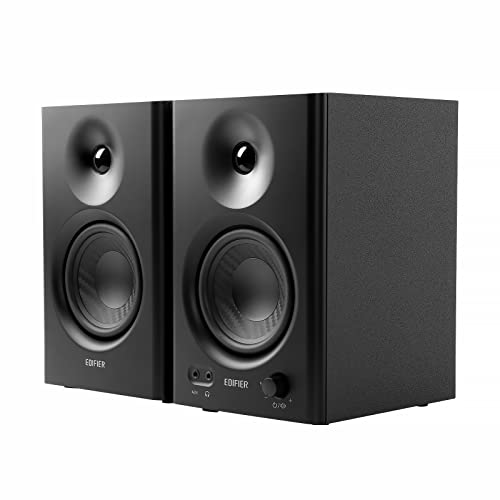
- Almost flat tuning for creator-focused listening
- Front headphone output for easy desktop use
- TRS, RCA, and AUX inputs add flexibility
Best For: Desktop recording and everyday music production
Front-Port Value Pick
5.25" nearfield monitor with front-firing port

- Front-firing port supports bass reproduction
- 80W Class AB bi-amplification for headroom
- Acoustic tuning controls help match your room
Best For: Small studios that need easier placement and stronger bass support
Compact Desktop Pick
Compact desktop monitors with bass reflex design

- Bi-amplified pair for studio-style desktop monitoring
- Bass reflex cabinet supports low-end response
- Multiple inputs and front headphone access
Best For: Desktop recording, streaming, and gaming setups
Front-Port Studio Pick

- Front-firing acoustic port for bass support
- EBM waveguide for a wide sweet spot
- XLR, TRS, and RCA inputs with tuning controls
Best For: Home studios needing accurate monitoring and flexible placement
Budget Multimedia Ported Pick

- 200W peak output with DSP tuning
- Bluetooth, optical, RCA, and 3.5mm inputs
- Compact 4-inch powered monitor pair
Best For: Desk setups that need versatile inputs and compact powered speakers
Compact Wireless Monitor Pick

- Compact 3.5-inch powered monitor pair
- Bluetooth for wireless streaming
- Woven woofer and textile dome tweeter
Best For: Small desks and creators who want compact Bluetooth monitors
Editor’s Choice
Edifier MR5 3-Way Studio Monitors

- 3-way active design with 5" woofer, mid driver, and tweeter
- Room compensation via knobs or EDIFIER ConneX app
- XLR, TRS, RCA, AUX, Bluetooth 6.0, and headphone output
Best For: Home studio users who want detailed sound and flexible tuning
Budget-Friendly Pick
Ortizan C7 Compact Studio Monitors

- 24-bit USB DAC with flat-response tuning
- Bluetooth 5.3, RCA, AUX, and 6.35mm TRS inputs
- 3.5" woofer and 0.75" silk dome tweeter
Best For: Budget buyers who want a compact near-field monitor pair
Best for Everyday Use
Edifier MR3 Desktop Studio Monitors

- Hi-Res Audio certified with 52Hz to 40kHz response
- Music, Monitor, and Custom modes with app EQ control
- Balanced TRS, RCA, AUX, Bluetooth, and headphone output
Best For: Desktop users who want accurate sound and easy controls
Studio Reference Pick – Neutral 5" nearfield monitors with response controls
If you want studio monitors with front bass port behavior that stays controlled at low to moderate levels, the Yamaha HS5 pair is built for straightforward nearfield monitoring. Its bi-amped design, 5-inch woofer, and response controls make it a practical choice for checking mix detail in smaller rooms.
Best For: Mixing and monitoring in compact studios where a flat, detailed response matters.
Pros:
- Bi-amplified design with separate amps for woofer and tweeter
- Response controls help adapt to different room acoustics
- 5-inch woofer is designed for low distortion and a defined bottom end
- Advanced port design is meant to reduce unwanted port noise
Cons:
- 5-inch woofer size may not deliver the deepest bass on its own
- Sold as a monitored pair, which may be more than a single-speaker buyer needs
The HS5 stays focused on accuracy and setup flexibility rather than exaggerated low end, which is useful when you need honest monitoring. It’s a solid pick if your priority is reliable translation and you want a compact system with controlled bass behavior.
Desktop Reference Pick – Compact studio monitors with front headphone output
The Edifier MR4 is a compact option for anyone comparing studio monitors with front bass port-style airflow and a desktop-friendly footprint. Tuned to an almost flat curve, it aims to give creators a clean reference sound while still offering flexible inputs and a front headphone output for everyday use.
Best For: Music creators and desktop users who want a simple, versatile nearfield setup.
Pros:
- Professionally tuned to an almost flat response curve
- Front headphone output adds convenient desktop monitoring
- Multiple inputs include TRS, RCA, and AUX
- Dual mode design lets you switch between monitor and music listening
Cons:
- 4-inch woofer is compact, so bass output is naturally limited
- Best suited to tabletop use rather than larger studio spaces
Overall, the MR4 is a practical all-around monitor for creators who need flexibility more than sheer output. It fits well on a desk, connects easily to common gear, and keeps the sound presentation aimed at accuracy.
Front-Port Value Pick – 5.25" nearfield monitor with front-firing port
The PreSonus Eris E5 is a strong pick if you’re shopping for studio monitors with front bass port placement and want a fuller low-end response in a nearfield setup. Its front-firing acoustic port, acoustic tuning controls, and 80-watt bi-amplification make it a straightforward monitor for small studios and home production spaces.
Best For: Producers who want a compact monitor with easy placement and stronger bass support.
Pros:
- Front-firing acoustic port supports bass-frequency reproduction
- 80W Class AB bi-amplification provides solid headroom
- Acoustic tuning controls help fit the monitor to the room
- Balanced XLR/1/4-inch and RCA inputs offer broad connectivity
Cons:
- 5.25-inch woofer still keeps it in the compact-monitor category
- Single monitor package may require buying a second unit for stereo use
This model makes sense when placement is tight and you want bass response that feels more supported without moving to a larger speaker. It combines practical connections, tuning options, and a front port layout that can work well on a desk or stand.
Compact Desktop Pick – Compact desktop monitors with bass reflex design
The M-Audio BX4 pair is aimed at users who want studio monitors with front bass port style bass reflex performance in a compact desktop format. With 4.5-inch Kevlar woofers, silk dome tweeters, and a bass reflex cabinet, it’s designed for clear playback across recording, gaming, streaming, and music work.
Best For: Desktop creators who want a small, wired monitor pair with flexible inputs.
Pros:
- Bi-amplified design delivers studio-style desktop monitoring
- Bass reflex cabinet is built for deeper low-frequency response
- Front panel headphone access is useful for silent late-night work
- 1/4-inch, 1/8-inch, and RCA inputs provide easy hookup options
Cons:
- 4.5-inch drivers are compact and not meant for large-room bass
- Separate left/right setup may take a little desk planning
The BX4 makes a lot of sense if you need a small pair that can handle everyday desktop audio without much fuss. It balances practical connectivity with a tuned bass reflex design, making it a flexible choice for mixed-use setups.
Front-Port Studio Pick – PreSonus Eris Studio 5
PreSonus Eris Studio 5 5.25-inch 2-Way Active Studio Monitors with EBM Waveguide
Check Price On AmazonIf you want studio monitors with front bass port design for a tighter placement setup, the PreSonus Eris Studio 5 is built to deliver accurate monitoring without giving up low-end support. Its 5.25-inch woven-composite woofer, front-firing acoustic port, and EBM waveguide make it a practical choice for small studios that still need a clear sweet spot and controlled bass response.
Best For: Producers and home studios that want a front-ported monitor with broad stereo imaging and flexible room tuning.
Pros:
- Front-firing acoustic port helps support bass reproduction and easier wall-friendly placement.
- EBM waveguide creates a wide sweet spot for improved stereo imaging.
- Multiple inputs include balanced XLR, balanced 1/4-inch TRS, and unbalanced RCA.
- Acoustic tuning controls let you adjust HF, midrange, highpass, and room placement settings.
Cons:
- Single monitor listing, so buyers may need to confirm pair sizing before purchase.
- No built-in wireless playback is highlighted in the supplied notes.
- Best suited to users who want accurate monitoring rather than a hyped sound.
Overall, the Eris Studio 5 is a strong front-port option if you value room flexibility, detailed highs, and a monitor tuned for practical studio work. It balances connectivity and acoustic controls in a way that should suit many desktop production setups.
Budget Multimedia Ported Pick – Rockville ASM4
The Rockville ASM4 is a compact option for buyers looking for studio monitors with front bass port-style bass support and lots of everyday connectivity. While the notes describe a rear-firing port, it still targets balanced monitoring with a DSP-tuned response, Bluetooth 5.0, and multiple analog and digital inputs for studio, computer, and TV use.
Best For: Budget-conscious users who want compact powered monitors for studio, computer, and TV setups with flexible inputs.
Pros:
- 200W peak output and 50W RMS provide strong power for a compact 4-inch pair.
- Bluetooth 5.0, optical, RCA, 3.5mm, and 1/4-inch TS inputs offer broad compatibility.
- DSP tuning aims for a flat, balanced response down to 50Hz.
- Compact MDF enclosure and front volume control make it easy to fit on a desk.
Cons:
- The supplied notes specify a rear-firing port, not a front bass port.
- 4-inch woofers are better for nearfield use than deeper bass demands.
- Best if you prioritize convenience and versatility over a larger monitoring footprint.
In practice, the ASM4 makes sense for mixed-use setups where connectivity matters as much as monitoring. It is compact, feature-rich, and tuned for balanced everyday listening, but it is not the closest match if front-port placement is your main requirement.
Compact Wireless Monitor Pick – KRK Kreate 3
The KRK Kreate 3 is a compact powered monitor pair for users who want a small desktop footprint with wireless convenience. It is not a front bass port model based on the supplied notes, but it does pair a woven glass fiber composite woofer with a textile dome tweeter for clear midrange, tight bass, and pristine highs in a compact studio setup.
Best For: Small studios, desktop creators, and music producers who want compact monitors with Bluetooth and universal connectivity.
Pros:
- 3.5-inch design keeps the speakers compact for desks and smaller workspaces.
- Bluetooth input supports wireless audio streaming.
- Woven glass fiber composite woofer and textile dome tweeter are aimed at clear mids, tight bass, and clean highs.
- Multiple audio inputs help with universal connectivity in studio environments.
Cons:
- The notes do not mention a front bass port.
- Smaller woofer size limits low-end output compared with larger studio monitors.
- Best suited to compact nearfield use rather than fuller-range monitoring.
For a small, flexible monitoring setup, the Kreate 3 offers a simple mix of size, wireless input, and broad compatibility. It is a good fit if you need compact monitors first and foremost, rather than a bass-port-focused design.
Editor’s Choice – Edifier MR5 3-Way Studio Monitors
If you want studio monitors with front bass port flexibility plus a compact footprint, the Edifier MR5 is built for accurate near-field listening and mixed-use desktop setups. Its 3-way active design, room compensation tools, and broad input selection make it easy to integrate into a home studio without giving up convenience.
Best For: Home studio users who want detailed sound, multiple connections, and easy room tuning.
Pros:
- 3-way active crossover with 5″ woofer, mid driver, and silk dome tweeter for detailed reproduction.
- Room tuning via rear knobs or the EDIFIER ConneX app for desktop and acoustic space adjustment.
- Wide connectivity: XLR, TRS, RCA, AUX, Bluetooth 6.0, and front headphone output.
- 110W RMS output and MDF cabinets for solid near-field performance.
Cons:
- Requires some setup to get the best room-compensated sound.
- Compact size helps placement, but it is still a powered bookshelf pair rather than a tiny desktop speaker.
The MR5 stands out as the most feature-rich option here, especially if you value tuning control and studio-style connectivity. It is a practical pick for users who need accurate monitoring and everyday listening in one package.
Budget-Friendly Pick – Ortizan C7 Compact Studio Monitors
The Ortizan C7 is a straightforward choice if you want studio monitors with front bass port-style placement benefits for a compact desk or gaming setup, plus simple wireless streaming. It focuses on clear, balanced monitoring with a flat response curve, while still offering practical inputs for everyday use.
Best For: Budget-conscious buyers who want a compact monitor pair for music, gaming, or casual production.
Pros:
- Built-in 24-bit DAC via USB for cleaner digital audio playback.
- Flat-response tuning aimed at accurate, true-to-source sound.
- Balanced 6.35mm TRS input plus RCA, AUX, Bluetooth 5.3, and front headphone output.
- 3.5″ carbon fiber woofer and 0.75″ silk dome tweeter for a compact monitor layout.
Cons:
- Smaller drivers mean less low-end authority than larger studio monitors.
- Best suited to near-field and compact spaces rather than larger rooms.
For a simple, affordable monitor pair, the C7 covers the essentials without overcomplicating the setup. It is especially appealing if you want wired and wireless options in one compact desktop-friendly package.
Best for Everyday Use – Edifier MR3 Desktop Studio Monitors
The Edifier MR3 is a compact option for people shopping for studio monitors with front bass port benefits in a desk-friendly speaker design, though its focus is really on balanced near-field listening. With Hi-Res Audio certification, multiple modes, and broad input support, it works well for everyday listening and light production tasks.
Best For: Desktop users who want accurate sound, simple controls, and flexible connectivity.
Pros:
- Hi-Res Audio certified with a flat 52Hz to 40kHz response.
- Music, Monitor, and Custom modes plus EDIFIER ConneX app EQ control.
- Balanced TRS, RCA, AUX, Bluetooth, and headphone output for flexible setup.
- MDF cabinet design helps reduce distortion for audio work and daily listening.
Cons:
- Lower power output than the MR5, so it is better for smaller spaces.
- Comes as a single pair-focused desktop speaker solution, not a larger-room system.
The MR3 is a sensible pick if you want a monitor speaker that can move between production, editing, and casual use without much fuss. Its tuning modes and connectivity make it easy to fit into a simple desktop audio chain.
How We Picked the Best Studio Monitors with Front Bass Port
We prioritized models that are easy to place on desks, shelves, or stands without the rear-wall bass buildup that can muddy low end. We also looked for consistent stereo imaging, usable low-frequency extension for the size, and the connections most buyers actually need.
For studio work, accuracy matters more than hype. That’s why we favored speakers that can help reveal mix issues without making everything sound artificially exciting.
Quick Comparison: Which Type Fits Your Setup?
Smaller 3- to 4-inch monitors are usually best for tight desks, casual production, and nearfield listening at lower volumes. 4.5- to 5.25-inch models offer a better balance of bass reach and detail for most home studios. If you need stronger output or more full-range playback for hybrid listening, larger powered options can make more sense.
Key Buying Factors for Studio Monitors with Front Bass Port
Placement and Room Size
A front port helps when you have to place monitors closer to a wall. That said, no speaker performs well in a bad acoustic environment, so room treatment and sensible placement still matter.
Woofer Size and Low-End Needs
Smaller woofers usually provide tighter, leaner bass, which can be helpful for editing. Larger drivers give more extension and volume, but they may need more space to sound balanced.
Inputs and Connectivity
Check whether you need balanced inputs for an audio interface, or if you’re connecting directly from a computer, mixer, or wireless source. Some Studio Monitors with Front Bass Port models add Bluetooth or optical input for convenience, but those extras should not replace proper wired monitoring for critical work.
Controls and Room Compensation
High/low trim controls, EQ presets, and room compensation features can help fine-tune the sound for your space. These tools are especially useful in untreated rooms where bass and treble can otherwise feel uneven.
Who Should Buy Which Studio Monitors with Front Bass Port?
If you want compact desktop monitors for recording or mixing, choose a smaller pair with a front port and balanced inputs. If you work in a home studio and want a little more bass confidence, a 5-inch class monitor is often the sweet spot. If your priority is flexible everyday listening as well as production, pick a powered set with extra connectivity and room-adjustment features.
For most buyers, the best choice is the one that matches your desk space, listening distance, and workflow—not the one with the biggest bass claim.