
Great film scoring depends on monitors that reveal detail, balance, and low-end truth without flattering the mix. The best choice for you depends on room size, listening distance, and how much bass accuracy you need.
This roundup of the best studio monitors for film scoring in 2026 focuses on practical options for composing, editing, and mixing everything from intimate cues to full orchestral mockups.
Best 10 Studio Monitors for Film Scoring Picks for 2026
Extended Low-End Reference
ADAM Audio T8V 8" Studio Monitor

- 33Hz bass extension for deep scoring cues
- U-ART tweeter reaches up to 25kHz
- Wide sweet spot from HPS waveguide
Best For: Composers who need strong bass extension and flexible monitoring
Compact Budget Reference
Edifier MR4 4" Powered Monitors
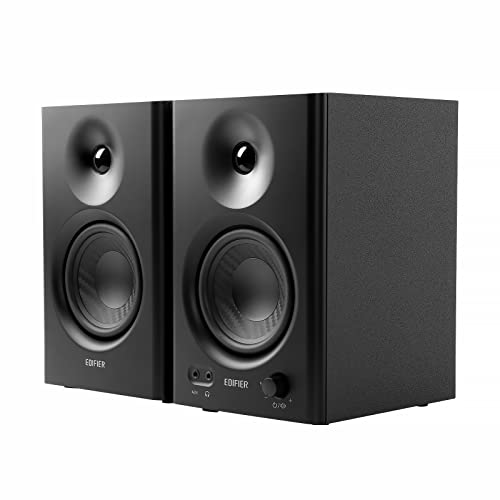
- Almost flat tuning for neutral reference
- TRS, RCA, AUX, and headphone output
- Compact 4-inch design for small rooms
Best For: Smaller studios and budget-conscious composers
Mix-Ready Wide Dispersion
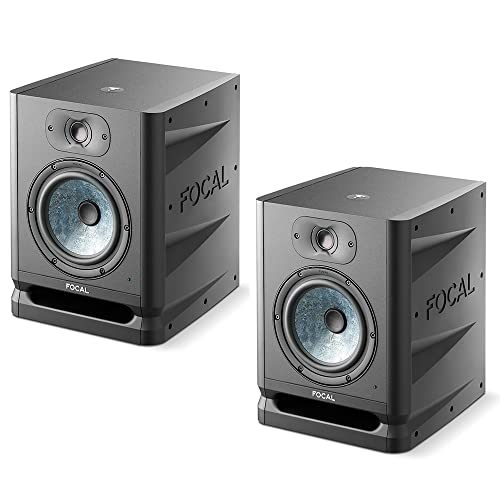
- 40Hz to 22kHz response for mix decisions
- Wide dispersion improves sweet-spot coverage
- 80W Class-D power for studio use
Best For: Mix-focused composers and post-production work
Classic Reference Style
Avantone Pro CLA-10 Active Monitors

- 2-way active design for monitoring
- 7-inch woofer in a stereo pair
- 200W Class AB amplification
Best For: Engineers wanting a focused classic-style monitor pair
Compact Nearfield Pair for Film Scoring
ADAM Audio T5V Studio Monitor Pair

- 5-inch powered two-way nearfield monitor pair
- XLR/TRS and RCA inputs for flexible hookups
- 45Hz–25kHz response for everyday scoring work
Best For: Composers needing a compact powered pair for desktop film scoring
Room-Tuning 7-Inch Pair
KRK Classic 7 Powered Studio Monitors

- 7-inch powered pair with 73 watts and bi-amped amps
- Front-firing port helps with placement near walls
- Low and high frequency controls for room matching
Best For: Scoring setups that need larger nearfield monitors with simple tuning
Desktop Scoring Monitor Pair
ADAM Audio D3V Active Desktop Speakers
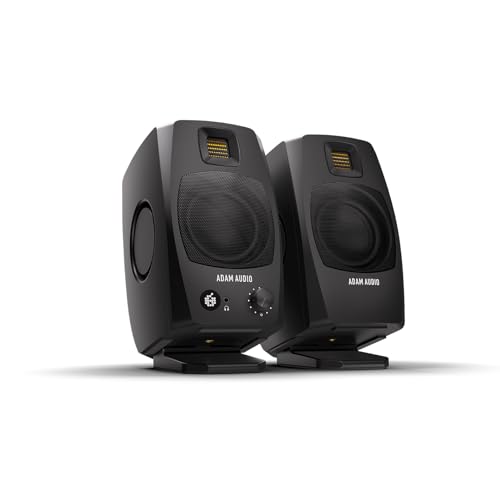
- USB-C desktop monitor pair with balanced 1/4-inch inputs
- 3.5-inch woofers plus passive radiators for compact use
- D-ART tweeter and headphone out for detailed close listening
Best For: Desktop composers and producers who want a compact USB-C monitor pair
Portable Reference Pick
IK Multimedia iLoud Micro Monitor Pro

- Flat, detailed tuning for translation checks
- ARC calibration adjusts to the room
- Compact pair with integrated stand
Best For: Composers needing portable, calibrated reference monitors
Bass-Heavy Room Pick
Adam Audio T8V Bundle for Bigger Rooms

- 35Hz–22kHz range reaches sub-bass detail
- 118dB SPL suits larger scoring setups
- Includes pads and balanced XLR cables
Best For: Scoring rooms needing strong bass extension and high output
Defined Low-End Choice

- 33Hz bass extension for low-end decisions
- ART tweeter helps keep highs clean
- HPS waveguide widens the sweet spot
Best For: Film scorers wanting an 8-inch monitor pair with strong bass reach
Extended Low-End Reference – ADAM Audio T8V 8" Studio Monitor
If you want studio monitors for film scoring that can handle deep low end without losing clarity, the ADAM Audio T8V is built for that job. Its 8-inch woofer, 33Hz bass extension, and U-ART ribbon tweeter give you a broad working range for dialogue beds, sub-driven cues, and full cinematic mixes.
Best For: Composers and producers who need strong bass extension and a wider sweet spot for scoring rooms.
Pros:
- 33Hz low-end extension helps reveal deep bass and impact in score-heavy arrangements.
- U-ART tweeter reaches up to 25kHz for detailed highs and reduced ear fatigue.
- HPS waveguide creates a more controlled, wider sweet spot for flexible listening positions.
- XLR and RCA inputs make it easy to connect to studio interfaces and desktop setups.
Cons:
- Large 8-inch design takes up more desk or stand space than compact monitors.
- More powerful than some small-room setups may need if you only work at low volumes.
For film scoring, the T8V stands out when low-end detail matters and you want a monitor that can stay clear as the arrangement gets dense. It is a strong fit for composers who need a fuller, more cinematic listening picture.
Compact Budget Reference – Edifier MR4 4" Powered Monitors
The Edifier MR4 is a practical entry point for studio monitors for film scoring when you want a compact, affordable setup for composing and editing. Its nearly flat tuning, 4-inch woofer, and easy input options make it a sensible choice for smaller rooms, desktop rigs, and draft scoring work.
Best For: Smaller studios, desktop composers, and budget-minded creators who need a simple reference monitor.
Pros:
- Professionally tuned to an almost flat curve for more neutral monitoring.
- 1-inch silk dome tweeter and 4-inch woofer deliver clear, smooth sound.
- Balanced TRS, RCA, AUX, and front headphone output support flexible connections.
- Monitor mode and music mode let you switch between work and casual listening.
Cons:
- 4-inch woofer is not as well suited to deep bass-heavy film cues as larger monitors.
- Less powerful than larger studio monitors for bigger rooms or high SPL needs.
The MR4 is best viewed as a straightforward, compact reference rather than a high-output scoring monitor. For smaller spaces and early composition stages, it offers a clean, practical monitoring foundation.
Mix-Ready Wide Dispersion – Focal Alpha 65 Evo 6.5" Pair
The Focal Alpha 65 Evo is a strong middle-ground option for studio monitors for film scoring, especially if you want accuracy and room coverage without moving to a very large cabinet. Its 6.5-inch woofer, 40Hz to 22kHz response, and wide dispersion are aimed at mix decisions that need a reliable sweet spot.
Best For: Mixing-focused composers and post-production users who want accurate monitoring with a wide sweet spot.
Pros:
- 40Hz to 22kHz frequency response supports detailed work across lows and highs.
- Wide dispersion helps maintain a broader sweet spot in the room.
- 80W Class-D power provides enough output for serious studio use.
- Pair format gives you a complete stereo monitoring setup out of the box.
Cons:
- Not as deep in the low end as larger 8-inch monitors for heavy bass scoring.
- XLR-only connectivity may be less convenient for some simple desktop setups.
If your scoring workflow leans toward balanced mix translation and dependable stereo imaging, the Alpha 65 Evo fits well. It is especially appealing for rooms where wide dispersion and accurate response matter more than maximum bass output.
Classic Reference Style – Avantone Pro CLA-10 Active Monitors
The Avantone Pro CLA-10 brings a familiar reference-style approach to studio monitors for film scoring, with a 7-inch woofer, active two-way design, and 200W Class AB amplification. It is a straightforward choice for engineers who want a dedicated monitoring pair for studio decision-making rather than casual listening.
Best For: Engineers and composers who want a classic-style active monitor pair for focused studio monitoring.
Pros:
- 2-way active design keeps the setup focused on monitoring tasks.
- 7-inch woofer provides a solid mid-size format for studio use.
- 200W Class AB amplification offers substantial output for a monitoring pair.
- Sold as a pair, so you get a complete stereo setup.
Cons:
- No detailed frequency response or connectivity specs were supplied.
- Bulky 45.9-pound pair may be less convenient for frequent repositioning.
For film scoring work that values a dedicated, no-frills monitoring pair, the CLA-10 is a compelling option. Its design centers on studio monitoring first, making it a sensible pick when you want a purpose-built reference.
Compact Nearfield Pair for Film Scoring – ADAM Audio T5V Studio Monitor Pair
If you’re shopping for studio monitors for film scoring, the ADAM Audio T5V is a practical nearfield option for small-to-mid desktop setups. Its 5-inch woofer, XLR/TRS and RCA connectivity, and 45Hz–25kHz response make it a straightforward pair for writing cues, editing orchestral layers, and checking balance at close range.
Best For: Composers and editors who want an affordable powered nearfield pair for desktop scoring work.
Pros:
- 5-inch powered two-way design suited to nearfield mixing and scoring work
- XLR/TRS and RCA inputs give flexible connection options
- 45Hz–25kHz response covers a useful range for everyday composing and balance checks
- Sold as a stereo pair for a ready-to-use setup
Cons:
- 5-inch woofer size is better for close listening than for deep low-end evaluation
- No built-in wireless or extra desktop features beyond the core monitor design
For film scoring workflows centered around a desk, the T5V keeps the setup simple while still offering the connectivity and powered design most composers need. It is a sensible choice if you value compact size and straightforward monitoring over larger-room output.
Room-Tuning 7-Inch Pair – KRK Classic 7 Powered Studio Monitors
When you need studio monitors for film scoring that can handle a larger desktop or project room, the KRK Classic 7 pair is built for practical monitoring. The 7-inch woofers, bi-amped powered design, and front-firing port make it easier to place the speakers in tighter rooms while still giving you room to shape the response with the low and high frequency controls.
Best For: Scoring setups that need a larger nearfield monitor with simple room adjustment controls.
Pros:
- 7-inch active design with 73 watts and bi-amped class A/B amplification
- Front-firing port supports more flexible placement near walls
- Low and high frequency adjustment controls help match the room
- Sold as a pair and intended for music production and critical listening
Cons:
- Larger size may be more than some small desk setups need
- Only basic control features are listed, with no extra digital or USB connectivity
The Classic 7 is a solid option if your film scoring work benefits from a bigger woofer and room-tuning controls without moving into a full midfield setup. It keeps the workflow conventional and gives you a bit more flexibility in placement than many rear-ported monitors.
Desktop Scoring Monitor Pair – ADAM Audio D3V Active Desktop Speakers
If you want studio monitors for film scoring on a tight desk, the ADAM Audio D3V is designed for exactly that kind of setup. It connects directly via USB-C and also supports balanced 1/4-inch inputs, while the compact 3.5-inch woofer pair, passive radiators, and D-ART tweeter are aimed at close-range monitoring and clear detail.
Best For: Desktop composers, writers, and producers who want a compact monitor pair with USB-C connectivity.
Pros:
- USB-C connection makes it easy to hook up to computers and mobile devices
- Compact 3.5-inch woofer pair with dual passive radiators for desktop use
- D-ART tweeter is designed for precise, unfatiguing high frequencies
- Includes balanced 1/4-inch inputs, volume control, headphone out, and angled stands
Cons:
- 3.5-inch woofers are best for close monitoring rather than larger-room output
- Power and low-end extension are geared toward desktop use, not bigger scoring spaces
The D3V stands out for film scoring workflows that live at the desk, especially if USB-C convenience matters. It is a compact, feature-rich choice for composers who want a modern monitoring setup with simple placement and direct connectivity.
Portable Reference Pick – IK Multimedia iLoud Micro Monitor Pro
If you need studio monitors for film scoring that can travel from room to room, the iLoud Micro Monitor Pro is built for practical reference work. Its compact footprint, flat tuning, and ARC room calibration make it easier to judge dialog, ambience, and orchestral layers without fighting your space.
Best For: Composers and editors who want a compact, portable monitor pair with calibration support for checking scores in different rooms.
Pros:
- Ultra-accurate, detailed sound designed to translate mixes well
- Built-in ARC calibration with included mic helps adapt to the room
- Compact, lightweight design with integrated stand for fast setup
- X-Monitor software lets you audition music on different playback systems
Cons:
- 3-inch drivers are compact, so they are not aimed at deep low-end monitoring
- Best suited to reference listening rather than filling a large scoring room
- RCA/XLR connectivity is flexible, but the overall format is still very small
For film scoring workflows where portability and room correction matter more than sheer size, this pair offers a focused, travel-friendly way to verify balances and translation.
Bass-Heavy Room Pick – Adam Audio T8V Bundle for Bigger Rooms
For studio monitors for film scoring in bigger rooms, the Adam Audio T8V bundle gives you the low-end reach that small nearfields cannot provide. With an 8.5-inch design, ART ribbon tweeter, and deep bass extension, it is a strong option when your cues rely on orchestral lows, impact hits, and cinematic sub energy.
Best For: Scoring rooms and production setups that need extended bass response, higher output, and a fuller monitoring picture.
Pros:
- 35Hz–22kHz response captures sub-bass and high-frequency detail
- 118dB SPL output supports larger mix positions and louder playback
- ART ribbon tweeter with HPS waveguide improves imaging and dispersion
- Bundle includes isolation pads and XLR cables for a ready-to-go setup
Cons:
- Larger cabinet takes more desk or floor space than compact monitors
- Deep bass response may need room treatment or EQ in untreated spaces
- Included accessories add value, but the speaker size is not ideal for very small desks
If your film scoring work depends on hearing the bottom end clearly, this T8V bundle is built to handle low-frequency decisions with more authority than smaller monitors.
Defined Low-End Choice – ADAM Audio T8V Black Pair
ADAM Audio AMS-T8V T8V 8-inch Studio Monitor Black Pair Bundle with OnStage 25ft XLR Cable 2 Pack
Check Price On AmazonThe ADAM Audio T8V pair is a straightforward pick for studio monitors for film scoring when you want defined bass reproduction and a wider sweet spot. Its 33Hz extension and controlled high-frequency behavior make it useful for balancing orchestral lows, percussion, and synth layers without losing clarity.
Best For: Composers and producers who want an 8-inch monitor pair with strong bass reach and a controlled listening area.
Pros:
- Reaches down to 33Hz for strong low-end monitoring
- ART tweeter helps reduce ear fatigue and high-frequency distortion
- HPS waveguide creates a more controlled, larger sweet spot
- Supports XLR, 1/4-inch TRS, and RCA connections
Cons:
- Large 8-inch format is less suited to tight desktop spaces
- Designed for studio use, so it is not a portable option
- May be more monitor than a very small room can comfortably handle
For film scorers who need better low-end confidence and a comfortable listening window, this T8V pair gives you the core ADAM Audio monitoring traits in a practical studio format.
How We Picked These Studio Monitors for Film Scoring
We focused on monitors that support critical composition and mix decisions: accurate mids for orchestral layers, controlled highs for strings and ambience, and enough low-end extension to judge percussion, synths, and sub-bass effects. We also considered dispersion, build quality, connectivity, and value for different studio sizes.
Quick Comparison
For smaller desks and nearfield setups, compact models can work well if your room is treated and your listening distance is short. For larger rooms or hybrid scoring setups, 6.5-inch and 8-inch monitors usually provide more confidence in the low end and a wider sweet spot. Desktop-oriented options are best when space is limited, while more powerful pairs suit dedicated composing rooms.
Key Buying Factors for Studio Monitors for Film Scoring
Frequency Balance and Low-End Reach
Film scoring often includes deep drums, trailers, impacts, drones, and orchestral bass. Look for monitors that reach low enough to help you judge those elements without exaggerating them. A tight, controlled low end matters more than extra hype.
Midrange Detail
The midrange is where strings, horns, woodwinds, piano, and dialogue-adjacent cues live. Clear mids help you balance dense arrangements and avoid masking important lines.
Room Size and Woofer Choice
In smaller rooms, 4-inch to 5-inch models can be easier to place and less likely to overload the space. In medium and larger rooms, 6.5-inch to 8-inch monitors often give better extension and headroom for Studio Monitors for Film Scoring.
Amplification, Inputs, and Placement
Balanced XLR or TRS inputs are ideal for clean connections. Features like room EQ switches, desktop tuning, and isolation accessories can make a noticeable difference if your studio is not fully treated.
Who Should Buy Which Studio Monitors for Film Scoring?
If you are building a compact composing setup, choose smaller monitors or desktop-focused models that fit nearfield use and controlled listening levels. If you work on cinematic mockups, hybrid scores, or bass-heavy cues, prioritize larger woofer sizes and higher SPL headroom. If portability matters, go with a smaller powered pair you can move between rooms. If your priority is translation, pick the most neutral option your room and budget can support.
For most composers, the best Studio Monitors for Film Scoring are the ones that help you hear arrangement problems early, judge dynamics confidently, and trust your mix outside the studio.