
Choosing studio monitors for electronic music is about more than loudness. You want accuracy, tight bass, and enough detail to hear synths, kicks, and stereo effects clearly.
This roundup highlights 10 strong options for different room sizes, budgets, and production setups, so you can find the right match faster.
Best 10 Studio Monitors for Electronic Music Picks for 2026
Desktop Starter Pick
PreSonus Eris 3.5 Powered Studio Monitors

- 50W powered pair for near-field desktop use
- 3.5-inch woofer and silk-dome tweeter for balanced sound
- TRS, RCA, and aux inputs with tone controls
Best For: Small desks, beginners, and flexible everyday production
Wide Sweet Spot Choice
Behringer Truth 3.5 Studio Monitors

- 64W reference-class monitors for near-field use
- Advanced Waveguide aims for a larger sweet zone
- 3.5-inch glass-fiber woofer with silk-dome tweeter
Best For: Home recording and compact setups needing wider dispersion
Feature-Rich Budget Pick
Edifier MR3 Powered Studio Monitors

- Hi-Res certified with 52Hz to 40kHz response
- TRS, RCA, AUX, Bluetooth, and headphone output
- App EQ plus Music, Monitor, and Custom modes
Best For: Multi-device home studios and flexible desktop monitoring
Reference Standard Pick

- 70W bi-amplified nearfield monitoring
- 5-inch woofer with flat, low-distortion response
- Response controls and XLR connectivity
Best For: Producers who want a trusted reference for mixing
Studio-Accurate Starter Pick
Edifier MR4 Powered Studio Monitors
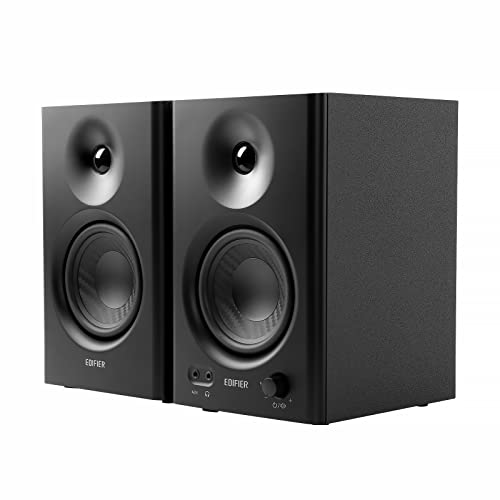
- Near-flat tuning for more honest monitoring
- Flexible TRS, RCA, AUX, and headphone connections
- Compact 4-inch design with tone controls
Best For: Bedroom producers and desktop setups
Compact Yamaha Precision
Yamaha HS3 Powered Studio Monitor Pair

- Small powered pair with XLR/TRS, RCA, and mini inputs
- Room control and high trim help shape the sound
- Includes cables and anti-slip pads for setup
Best For: Nearfield desktop producers needing a compact pair
Budget Desktop Beatmaker Option
M-AUDIO BX3 Wired Studio Monitors Pair

- Zero-latency wired monitoring for desktop work
- 3.5-inch Kevlar woofers with silk dome tweeters
- Rear inputs plus front headphone jack and EQ controls
Best For: Budget-minded producers and streamers
Editor's Pick
JBL 305P MkII 5" Active Studio Monitors

- Wide sweet spot from the Image Control Waveguide
- Dual 41W Class-D amps with 5-inch woofer
- Boundary EQ and HF Trim help room matching
Best For: Producers who want accurate imaging and flexible nearfield tuning
Budget-Friendly Wireless Option
KRK Kreate 3 Powered Studio Monitors Pair

- Compact 3.5-inch speakers for small desks
- Bluetooth input for wireless streaming
- Multiple inputs for flexible studio use
Best For: Small desktop setups that need simple wireless convenience
Most Feature-Rich
Edifier MR5 3-Way Studio Monitors

- 3-way active design with dedicated woofer, mid, and tweeter
- Room compensation controls plus app-based tuning
- XLR, TRS, RCA, AUX, and Bluetooth 6.0 inputs
Best For: Home studio producers who want detailed tuning and broad connectivity
Desktop Starter Pick – PreSonus Eris 3.5 Powered Studio Monitors
If you want studio monitors for electronic music that fit a small desk and still give you honest playback, the PreSonus Eris 3.5 is an easy entry point. This powered pair is built for near-field listening, with clear mids and adjustable high- and low-frequency controls to help tailor the sound to your room.
Best For: Compact home setups, beginner music production, gaming, and everyday desktop listening.
Pros:
- 50W built-in amplification for clean, distortion-free desktop listening
- 3.5-inch woven-composite woofers and 1-inch silk-dome tweeters for balanced sound
- High- and low-frequency controls help tune the response to your space
- TRS, RCA, and front aux input make it easy to connect to common gear
Cons:
- 3.5-inch woofers are better for close-range use than deeper bass-heavy monitoring
- Best suited to small rooms and desks rather than larger studio spaces
For electronic music work on a budget-friendly desktop setup, the Eris 3.5 focuses on flexibility and practical monitoring features. It is a solid pick when you need compact speakers that can plug into almost anything.
Wide Sweet Spot Choice – Behringer Truth 3.5 Studio Monitors
Behringer Truth 3.5 Audiophile 3.5" Studio Monitors with Advanced Waveguide Technology.
Check Price On AmazonThe Behringer Truth 3.5 is a compact option for studio monitors for electronic music when you want a wider listening area and a more reference-style presentation. Its Advanced Waveguide technology is designed to improve acoustic dispersion, while the 64-watt design and silk-dome tweeters aim for detailed playback in home recording and multimedia setups.
Best For: Home studios, desktop production, and users who want a broad sweet zone for near-field monitoring.
Pros:
- Ultra-linear 64-watt reference-class monitoring
- Advanced Waveguide technology creates a larger sweet zone
- 1-inch silk dome tweeters support high-resolution detail
- 3.5-inch glass-fiber woofers are built for low distortion
Cons:
- 3.5-inch woofer size limits deep bass extension
- Best suited to close-range monitoring rather than larger rooms
This model makes sense if you value a forgiving listening area for arrangement, editing, and casual mixing. It is a practical compact monitor for electronic music work where space is tight but clarity still matters.
Feature-Rich Budget Pick – Edifier MR3 Powered Studio Monitors
If you want studio monitors for electronic music with modern connectivity and tuning options, the Edifier MR3 brings a lot to a desktop setup. It offers Hi-Res Audio certification, multiple input types, Bluetooth V5.4, and app-based control, making it easy to switch between monitoring, creation, and casual listening.
Best For: Small home studios, creators who use multiple devices, and users who want app control with flexible inputs.
Pros:
- Hi-Res Audio certification with a flat 52Hz to 40kHz response
- Balanced TRS, RCA, AUX, Bluetooth, and headphone output support
- Music, Monitor, and Custom modes with EQ control in the EDIFIER ConneX app
- MDF cabinet helps reduce distortion for production and editing
Cons:
- 18W x 2 RMS output is modest for larger rooms
- Plastic cabinet construction is less substantial than wood-based designs
The MR3 is a smart choice if you want versatility more than brute force. For electronic music on a desk, it combines practical monitoring features with the convenience of wireless and app-based control.
Reference Standard Pick – Yamaha HS5 Studio Monitors
The Yamaha HS5 is a classic choice for studio monitors for electronic music when accuracy and translation matter most. Its 5-inch woofers, bi-amplified design, response controls, and XLR connectivity make it a well-known nearfield monitor for professional-style listening and room adjustment.
Best For: Mixing, monitoring, and producers who want a flat, detailed nearfield reference.
Pros:
- 70W bi-amplified design with separate amp sections for woofer and tweeter
- 5-inch woofer delivers low-distortion, well-defined sound
- Response controls help adapt to different room acoustics
- Noise-reduction port design is intended to reduce unwanted airflow noise
Cons:
- XLR-only connectivity is less flexible than models with multiple input types
- 5-inch woofer size is not ideal if you want strong sub-bass on its own
If your priority is a straightforward reference monitor for electronic production, the HS5 remains a dependable benchmark. It is especially useful when you need a clear, flat picture of your mix rather than flattering sound.
Studio-Accurate Starter Pick – Edifier MR4 Powered Studio Monitors
If you want studio monitors for electronic music that aim for a near-flat response without taking up much space, the Edifier MR4 is an easy desktop-friendly option. The 4-inch woofer, silk dome tweeter, and MDF cabinet are tuned to reveal detail while keeping the sound smooth for everyday production and listening.
Best For: Bedroom producers and creators who want an affordable, compact monitor with practical tone controls and flexible inputs.
Pros:
- Professionally tuned to an almost flat curve for more honest monitoring
- 1-inch silk dome tweeter and 4-inch woofer for clear highs and balanced mids
- TRS, RCA, AUX, and front headphone output make setup flexible
- Dual monitor/music modes plus separate high and low frequency controls
Cons:
- 4-inch woofer is better for nearfield use than bigger room-filling setups
- May need a subwoofer if you want deeper low-end for bass-heavy tracks
Overall, the MR4 is a practical choice if you want a straightforward pair of studio monitors for electronic music production and desktop use. It focuses on usable accuracy, simple controls, and broad connectivity rather than flashy extras.
Compact Yamaha Precision – Yamaha HS3 Powered Studio Monitor Pair
The Yamaha HS3 is a compact choice for studio monitors for electronic music when you want a small footprint and Yamaha’s familiar monitor-style voicing. With a 3.5-inch woofer, 0.75-inch tweeter, and room control/high trim adjustments, it is built for tabletop monitoring and studio recording work.
Best For: Producers who need a compact reference monitor pair for nearfield mixing, editing, and desktop studio setups.
Pros:
- Pair of powered monitors with XLR/TRS combo, RCA, and stereo mini inputs
- Room control and high trim response controls help tailor the sound to the space
- Includes speaker cable, stereo mini to RCA cable, and anti-slip pads
- Small 3.5-inch size fits easily on a desk or compact workspace
Cons:
- 3.5-inch woofer limits deep bass output compared with larger monitors
- Best suited to nearfield use rather than larger rooms
The HS3 makes sense if you need a compact, wired monitor pair with straightforward input options and simple room tuning. It is a focused desktop solution for electronic music creators who value size, control, and accurate nearfield listening.
Budget Desktop Beatmaker Option – M-AUDIO BX3 Wired Studio Monitors Pair
The M-AUDIO BX3 is a compact wired option for studio monitors for electronic music if you want desktop-friendly sound with easy connections. Its 3.5-inch Kevlar woofers, silk dome tweeters, and bass reflex design are aimed at punchy playback for beat-making, recording, and multimedia use.
Best For: Budget-conscious creators who want small, wired monitors for production, streaming, and general desktop listening.
Pros:
- Zero-latency wired monitoring suits recording and live desktop work
- 3.5-inch Kevlar woofers and silk dome tweeters provide clear stereo imaging
- Rear 1/4-inch, 1/8-inch, and RCA inputs offer broad compatibility
- Front headphone output and rear EQ controls add practical usability
Cons:
- Compact 3.5-inch design is not ideal for very deep bass on its own
- Focused more on desktop versatility than full-size studio monitoring
The BX3 is a sensible entry-level pick when desk space and connectivity matter more than brute force. It offers the kind of flexibility and clear wired performance that suits electronic music production on a budget.
Editor's Pick – JBL 305P MkII 5" Active Studio Monitors
If you want studio monitors for electronic music that can reveal mix details without making setup complicated, the JBL 305P MkII is a strong nearfield choice. Its Image Control Waveguide creates a wide sweet spot, while the 5-inch woofer and Slip Stream port help deliver a fuller low end for beatmaking, sound design, and everyday production.
Best For: Producers who want accurate imaging, room-tuning flexibility, and a familiar nearfield format for electronic tracks.
Pros:
- Patented Image Control Waveguide for precise imaging and a wide listening area
- Dual 41-watt Class-D amps with a 5-inch woofer for dynamic, detailed playback
- Boundary EQ and HF Trim help adapt the sound to your room
- XLR/TRS inputs make it easy to connect common studio gear
Cons:
- 5-inch design may not deliver the deepest sub-bass on its own
- Wired-only connectivity may be less convenient for casual listening
For electronic music production, the JBL 305P MkII stands out because it balances clear stereo imaging with practical tuning controls. It is a solid pick if you need dependable reference monitors that can translate synths, drums, and effects well across different rooms.
Budget-Friendly Wireless Option – KRK Kreate 3 Powered Studio Monitors Pair
The KRK Kreate 3 is a compact option for studio monitors for electronic music when desk space is limited and wireless playback is a plus. Its 3.5-inch Glass Aramid woofer and textile dome tweeter are aimed at clear mids, tight bass, and crisp highs, while Bluetooth input adds convenience for quick reference listening.
Best For: Producers who want a small, versatile monitor pair for desktop setups and casual wireless playback.
Pros:
- Compact 3.5-inch design fits small desks and tight studio spaces
- Textile dome tweeter and glass aramid woofer target clear, balanced playback
- Bluetooth input adds easy wireless streaming
- Multiple audio inputs support flexible studio connections
Cons:
- Smaller woofer size may limit low-end output for bass-heavy genres
- Less of a full-scale monitoring solution than larger 5-inch models
This pair makes sense if you value convenience and a smaller footprint more than maximum bass extension. For electronic music sketching, editing, and desktop production, the Kreate 3 offers a simple way to get nearfield monitoring with modern wireless support.
Most Feature-Rich – Edifier MR5 3-Way Studio Monitors
The Edifier MR5 is a strong choice for studio monitors for electronic music if you want a more advanced 3-way design in a compact format. With a dedicated woofer, mid driver, and silk dome tweeter, plus room compensation controls and high-resolution audio support, it is built to deliver detailed playback for mixing and critical listening.
Best For: Home studio producers who want extensive connectivity, room tuning, and a more detailed 3-way monitor design.
Pros:
- 3-way active crossover with woofer, mid driver, and silk dome tweeter for detailed sound
- Room acoustic tuning via rear knobs and EDIFIER ConneX app
- XLR, TRS, RCA, AUX, and Bluetooth 6.0 inputs for broad compatibility
- 110W RMS output with a compact MDF cabinet design
Cons:
- More features may be unnecessary if you only need a simple monitor pair
- Compact size and 5-inch woofer still place it in nearfield territory rather than full-range studio monitoring
If your workflow includes multiple devices and you want more control over how the speakers interact with your room, the MR5 is especially appealing. It combines flexible inputs, app-based tuning, and a detailed 3-way layout in a setup-friendly package.
How We Picked the Best Studio Monitors for Electronic Music
We focused on Studio Monitors for Electronic Music that offer reliable tonal balance, useful low-end extension for beat-driven tracks, and practical features for real-world home studios. Size, amplification, connectivity, and value all mattered, especially for producers working in small rooms or on desktop setups.
We also favored models that are commonly suited to nearfield listening, since that is often the most effective setup for writing, editing, and mixing electronic music.
Quick Comparison
If you want the simplest way to narrow the list, think in three buckets: compact 3.5-inch models for tight desks, 4-inch to 5-inch models for the best all-around balance, and feature-rich options for users who want more connectivity or room-shaping controls.
Smaller monitors can work well at close range, but larger drivers usually give you a fuller low end and more headroom. In most cases, the best choice depends on your room size and how much bass confidence you need while producing.
Key Buying Factors for Studio Monitors for Electronic Music
Driver Size and Bass Response
For electronic music, bass accuracy matters. Smaller monitors are more limited in sub-bass, while 5-inch-class models often provide a better compromise between desk-friendly size and low-end clarity.
Room Size and Listening Distance
Nearfield monitors are designed to be listened to up close. In a small room, a more compact pair can reduce boominess and make placement easier. In a larger room, a bigger monitor may help maintain fullness and detail.
Connectivity and Workflow
Look at the inputs you actually use. Balanced connections are preferable for cleaner signal paths, while Bluetooth and USB features may be convenient for casual listening but are less important for critical production.
Tuning Controls and Placement
Rear-panel EQ, boundary controls, and acoustic room compensation can make a meaningful difference. Even the best Studio Monitors for Electronic Music will sound better when placed properly on stands or isolation pads.
Who Should Buy Which Studio Monitors for Electronic Music?
Choose compact 3.5-inch models if you mainly produce at a desk, work in a dorm or bedroom studio, or need an affordable starter pair. Go with 4-inch monitors if you want a balanced step up for beat-making and general mixing. Pick 5-inch monitors if you want the most complete low-end picture from a nearfield setup without moving to a much larger speaker.
If you also use your monitors for casual playback, content creation, or multimedia, a more feature-rich model with extra connectivity may be the best fit. For pure production work, prioritize accuracy and placement flexibility over extras.