
Finding the right mouse for graphic designers can make everyday tasks feel faster, smoother, and far less tiring. The best options help with precise cursor control, shortcut-rich workflows, and long editing sessions.
In this roundup, we focus on models that offer strong ergonomics, dependable tracking, and features creative professionals actually use, from programmable buttons to multi-device switching.
Best 10 Mouse for Graphic Designers Picks for 2026
Editor’s Choice
Logitech MX Master 3S Wireless Mouse

- 8K DPI tracking works on glass
- MagSpeed scrolling is fast and precise
- Quiet clicks and 3-device support
Best For: Designers who multitask across devices
Mac Minimalist Pick

- Multi-Touch surface supports gestures
- Rechargeable battery lasts about a month
- Pairs automatically with Mac
Best For: Mac designers who want gesture control
Premium Productivity Pick

- Haptic feedback and customizable actions
- MagSpeed wheel with quiet precision
- Ergonomic right-hand design
Best For: Designers who want advanced workflow controls
Ergonomic Budget Pick

- Vertical shape supports a neutral grip
- 800/1200/1600 DPI settings
- 2.4 GHz wireless with USB receiver
Best For: Designers who want wrist-friendly comfort
Best for Easy Setup
Logitech MX Master 3S Bluetooth Mouse

- 8,000 DPI sensor tracks on glass
- Quiet clicks with MagSpeed scrolling
- App-specific customization and Flow support
Best For: Designers who want a comfortable Bluetooth mouse with strong workflow features
Power User Choice
Logitech G502 Hero Wired Mouse

- 25,600 DPI HERO sensor with precise tracking
- 11 programmable buttons and onboard memory
- Adjustable weights for custom balance
Best For: Designers who want a wired mouse with deep customization
Ergonomic Upgrade
Logitech MX Vertical Wireless Mouse

- 57° vertical angle for better wrist posture
- Handshake grip reduces muscle strain
- 4,000 DPI sensor with speed switch
Best For: Designers who want a vertical mouse for better long-session comfort
Multi-Device Productivity Pick
Logitech M720 Triathlon Wireless Mouse
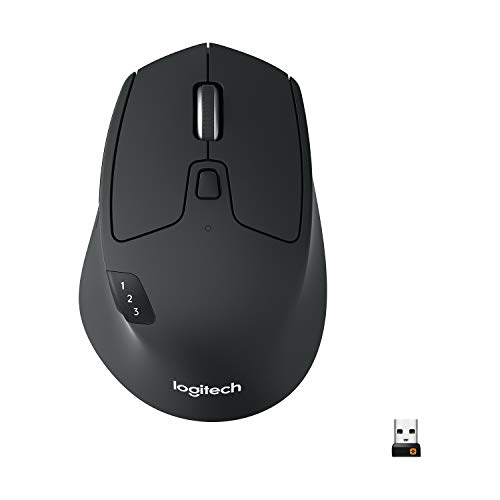
- Bluetooth or Unifying receiver connectivity
- FLOW supports up to 3 computers
- 6 programmable buttons and 24-month battery life
Best For: Designers who switch between multiple devices and want a comfortable, customizable mouse
Ergonomic Comfort Choice
ProtoArc EM11 NL Vertical Mouse

- Vertical shape helps keep the wrist straighter
- Up to 3-device Bluetooth and 2.4G connection
- Adjustable DPI up to 2400 with rechargeable battery
Best For: Designers with small to medium hands who want wrist relief
Precision Trackball Option
Nulea M501 Wireless Trackball Mouse

- Thumb trackball reduces wrist and arm movement
- Adjustable DPI for precise cursor control
- Connects to 3 devices with Bluetooth or USB dongle
Best For: Designers who want stationary control and less wrist motion
Editor’s Choice – Logitech MX Master 3S Wireless Mouse
If you want a mouse for graphic designers that balances speed, precision, and comfort, the Logitech MX Master 3S is a strong all-around pick. Its 8K DPI sensor, MagSpeed scrolling, and quiet clicks make it well suited to long creative sessions, while multi-device support helps streamline a busy workstation.
Best For: Designers who want a comfortable, highly capable mouse for multitasking across devices.
Pros:
- 8K DPI sensor tracks on glass and other surfaces for flexible desk setups.
- MagSpeed scrolling is fast, precise, and quiet for navigating large canvases and timelines.
- Quiet Clicks reduce noise without changing the feel of the buttons.
- Supports up to 3 devices via Bluetooth and works across multiple operating systems.
Cons:
- Logi Bolt receiver is not included despite the product listing mentioning it separately.
- Some advanced features depend on the Logi Options+ app.
Overall, the MX Master 3S stands out as a practical creative workhorse with strong performance and workflow-friendly features. It is especially appealing if you switch between computers or spend a lot of time scrolling and refining details.
Mac Minimalist Pick – Apple Magic Mouse Black
The Apple Magic Mouse is a straightforward mouse for graphic designers who prefer a simple, Mac-friendly setup. Its Multi-Touch surface and smooth-gliding design make it easy to handle everyday browsing, document work, and gesture-based control on a Mac.
Best For: Mac users who want a clean, rechargeable mouse with gesture support.
Pros:
- Multi-Touch surface supports gestures like swiping between pages and scrolling documents.
- Rechargeable battery lasts about a month or more between charges.
- Pairs automatically with Mac and is ready to use out of the box.
- Includes a woven USB-C Charge Cable for pairing and charging.
Cons:
- Designed around Mac use, so it is less versatile for mixed-platform setups.
- Gesture-based control may not suit every workflow.
In practice, the Magic Mouse is best viewed as a minimalist option for Mac-centric creative work. It is a good fit if you value a tidy desk, simple charging, and gesture navigation over extra productivity controls.
Premium Productivity Pick – Logitech MX Master 4 Graphite
For a mouse for graphic designers who want extra workflow control, the Logitech MX Master 4 adds haptic feedback and customizable shortcuts on top of the familiar MX ergonomics. The MagSpeed wheel, Actions Ring, and quiet clicks are aimed at faster, more focused creative work.
Best For: Designers who want advanced controls, haptics, and productivity features.
Pros:
- Haptic Sense Panel adds customizable feedback for supported actions and shortcuts.
- Actions Ring puts app-specific tools and shortcuts near the cursor.
- MagSpeed scrolling is fast, quiet, and precise.
- Ergonomic shape, thumb scroll wheel, and quiet clicks support long work sessions.
Cons:
- Advanced features are built around software customization and may take setup time.
- Right-hand design only.
The MX Master 4 is the most feature-rich option in this roundup, especially for designers who live in shortcuts and app-specific tools. If you want premium control and comfort in one mouse, it is a compelling choice.
Ergonomic Budget Pick – Anker Vertical Wireless Mouse
If comfort is your top priority in a mouse for graphic designers, the Anker 2.4G Wireless Vertical Ergonomic Mouse offers a very different shape from standard mice. Its vertical handshake design is meant to reduce wrist and arm strain, while the simple wireless connection and adjustable DPI keep it practical for everyday work.
Best For: Designers who want a vertical mouse to reduce strain during long sessions.
Pros:
- Vertical ergonomic shape encourages a neutral handshake wrist position.
- 800/1200/1600 DPI options provide adjustable sensitivity.
- Includes next and previous buttons for quick browsing navigation.
- Uses 2.4 GHz wireless with a USB receiver stored in the mouse.
Cons:
- Not Bluetooth, so it relies on the included USB receiver.
- Lower 1600 DPI maximum is less focused on precision-heavy creative work.
This is the most ergonomic-first pick in the group, and that makes it attractive for users who prioritize comfort over feature depth. For graphic designers with long desk sessions, it can be a sensible alternative to traditional mice.
Best for Easy Setup – Logitech MX Master 3S Bluetooth Mouse
If you want a mouse for graphic designers that feels polished and efficient, the Logitech MX Master 3S is built for precision-focused desktop work. It uses Bluetooth only, tracks on glass with an 8,000 DPI sensor, and adds quiet clicks plus ultra-fast MagSpeed scrolling for smoother movement through creative timelines and large canvases.
Best For: Designers who want a comfortable, highly customizable Bluetooth mouse for daily creative work across multiple devices.
Pros:
- 8,000 DPI sensor with any-surface tracking, including glass.
- Quiet Clicks reduce click noise while keeping a satisfying feel.
- MagSpeed scrolling is fast, precise, and ultra quiet.
- Supports app-specific button customization and cross-computer Flow control.
Cons:
- Bluetooth only; no USB receiver is included.
- No charging cable is included.
- Right-handed shape may not suit everyone.
For designers who move between apps, devices, and files all day, this is the most workflow-friendly option in the group. It emphasizes comfort, control, and customization over flashy extras.
Power User Choice – Logitech G502 Hero Wired Mouse
If your mouse for graphic designers needs maximum control, the Logitech G502 Hero is a wired option with a highly precise HERO sensor, adjustable weights, and 11 programmable buttons. It is clearly tuned for customization, making it a strong fit for users who want to tailor every click and movement.
Best For: Designers who prefer a wired mouse with lots of programmable controls and fine-tuned sensor performance.
Pros:
- HERO sensor delivers up to 25,600 DPI with zero smoothing or acceleration.
- 11 programmable buttons support highly customized workflows.
- Adjustable weights let you fine-tune balance and feel.
- Dual-mode scroll wheel and onboard memory add versatility.
Cons:
- Wired design limits desk flexibility.
- Gaming styling and RGB may not appeal to every creative workspace.
- More specialized than a simple everyday productivity mouse.
This is the most control-heavy mouse here, and it makes sense if you like a dense button layout and precise tracking. It is less about ergonomic comfort and more about customization and performance.
Ergonomic Upgrade – Logitech MX Vertical Wireless Mouse
For a mouse for graphic designers that prioritizes comfort, the Logitech MX Vertical uses a natural handshake position and a 57° angle to reduce wrist pressure and muscle strain. It also includes a 4,000 DPI sensor, cursor speed switch, and multi-computer support, so it stays practical for long work sessions.
Best For: Designers who want a more ergonomic mouse for longer sessions and reduced wrist strain.
Pros:
- 57° vertical angle is designed to improve wrist posture.
- Natural handshake grip reduces muscular activity versus a standard mouse.
- 4,000 DPI sensor and cursor speed switch help with precise control.
- Can move content between up to 3 computers and supports multiple platforms.
Cons:
- Vertical shape takes time to get used to.
- Only 4 buttons, so it is less configurable than some alternatives.
- Lower DPI than the MX Master 3S or G502 Hero.
If comfort is your top priority, this is the clearest ergonomic pick. It trades some flexibility and button count for a more wrist-friendly design that may help on long editing days.
Multi-Device Productivity Pick – Logitech M720 Triathlon Wireless Mouse
If you’re shopping for a mouse for graphic designers who also juggle multiple devices, the Logitech M720 Triathlon is built around speed and convenience rather than niche creative controls. Its sculpted right-hand shape, six programmable buttons, and FLOW support make it a practical choice for design work that moves between laptops, desktops, and tablets.
Best For: Designers who work across multiple computers and want a comfortable, customizable mouse with long battery life.
Pros:
- Connects via Bluetooth or the Unifying receiver for flexible setup.
- Supports Logitech FLOW to move cursor, text, and files across up to 3 computers.
- Six customizable buttons help tailor shortcuts to your workflow.
- 24-month battery life reduces charging and battery swaps.
Cons:
- 1000 DPI is modest if you want very high sensitivity.
- Right-handed sculpted design may not suit left-handed users.
- Focuses on productivity features, not specialized creative controls.
The M720 is strongest as a workflow mouse for designers who value comfort, multi-device switching, and dependable day-to-day use. It is less about precision extras and more about helping you work efficiently across setups.
Ergonomic Comfort Choice – ProtoArc EM11 NL Vertical Mouse
For a mouse for graphic designers who spend long sessions at a desk, the ProtoArc EM11 NL focuses on wrist-friendly ergonomics first. Its vertical shape keeps your wrist in a more natural position, while the 1000/1600/2400 DPI settings and multi-device connectivity make it a solid productivity tool for everyday design work.
Best For: Designers with small to medium hands who want a vertical mouse to reduce wrist strain.
Pros:
- Vertical design aims to reduce wrist discomfort during long sessions.
- Connects to up to 3 devices through Bluetooth and 2.4G USB-A.
- Rechargeable battery and included Type-C charging cable.
- Adjustable DPI up to 2400 for more precise cursor control.
Cons:
- There is a learning curve when switching to a vertical mouse.
- Forward/back buttons are not compatible with Mac OS.
- Buttons are not programmable.
This mouse is a good fit if comfort matters more than custom button mapping. It is especially appealing for smaller hands and users who want a quieter, more ergonomic desk setup.
Precision Trackball Option – Nulea M501 Wireless Trackball Mouse
If you want a mouse for graphic designers that keeps movement controlled and reduces wrist motion, the Nulea M501 trackball is worth a look. Instead of moving the whole mouse, you steer the cursor with your thumb, which can be useful on tight desks or when you want more stationary control during detailed work.
Best For: Designers who prefer trackball control for comfort, small spaces, and steady cursor movement.
Pros:
- Thumb-controlled trackball reduces the need to move your wrist and arm.
- Precise tracking with adjustable DPI supports accurate cursor work.
- Connects to up to 3 devices via Bluetooth or USB dongle.
- Rechargeable battery and 6-button layout add convenience.
Cons:
- Trackball control has a different feel and may take time to get used to.
- All buttons are not programmable.
- Best suited to right-handed users.
The M501 is a practical pick for designers who want a more stationary mouse style and easy switching between devices. It trades traditional mouse movement for comfort and control, which can be a good fit for long sessions.
How We Picked the Best Mouse for Graphic Designers
We prioritized mice that suit design work rather than generic office use. That means reliable sensors, comfortable shapes for extended sessions, and controls that can speed up common actions in creative apps. We also considered connectivity, battery convenience, and whether the mouse supports both desktop and laptop workflows.
Quick Comparison: What Matters Most
For most users, the biggest differences come down to shape and control style. A conventional ergonomic mouse is usually best for all-day desktop editing. A vertical mouse may help if wrist strain is a concern. A trackball can be a smart pick for tight desks or very precise pointer control. Multi-device support is especially useful if you move between a work laptop, tablet, and desktop setup.
Key Buying Factors for Mouse for Graphic Designers
Precision and Sensitivity
Look for a mouse with accurate tracking and adjustable DPI. Higher DPI is not automatically better, but it can help when working across large or high-resolution displays. What matters most is consistent tracking and smooth pointer movement.
Comfort and Ergonomics
Graphic designers often spend hours clicking, dragging, masking, and nudging. A shape that fits your hand naturally can reduce fatigue more than extra features can. If you prefer a relaxed palm grip, choose a sculpted ergonomic model. If wrist comfort is your priority, consider a vertical design.
Buttons and Workflow Shortcuts
Programmable buttons can save time in Photoshop, Illustrator, Figma, and similar tools. Even two well-placed side buttons can improve efficiency when mapped to undo, redo, or zoom. The best Mouse for Graphic Designers should support the way you actually work.
Connectivity and Device Switching
Bluetooth, USB receivers, and multi-device pairing all have value. If you use a shared studio setup or switch between systems, easy device switching can be a major advantage. Wired models still make sense if you want zero charging downtime and a consistent connection.
Who Should Buy Which Mouse for Graphic Designers?
If you want an all-around creative workhorse, choose a full-size ergonomic mouse with customizable controls. If you care most about portability, a compact multi-device mouse is usually the better fit. If wrist comfort is your top concern, go vertical. If you need extreme precision in a limited space, a trackball may be the smartest option. For designers who also game or want maximum button control, a feature-heavy wired mouse can be appealing.
In short, the best Mouse for Graphic Designers depends on your workspace, hand comfort, and shortcut needs. Match the form factor to your workflow first, then choose the feature set that makes your daily design tasks easier.