
If you’re adding multiple NVMe drives, an M.2 expansion card with active cooling can help keep speeds stable under sustained load. The right card depends on lane support, BIOS bifurcation, and the number of drives you plan to install.
This roundup focuses on practical options for desktops that need better airflow, more SSD capacity, and a simple upgrade path for gaming, content creation, and workstation builds.
Best 10 M.2 Expansion Card with Active Cooling Picks for 2026
Quad-Drive Active Cooling
SABRENT 4-Drive PCIe 4.0 x16 Adapter Card

- Holds four NVMe M.2 SSDs
- Optional active fan cooling
- Needs PCIe bifurcation support
Best For: Desktop users wanting four-drive NVMe expansion with optional fan cooling
Gen4 Quad Storage
ASUS Hyper M.2 X16 PCIe 4.0 Expansion Card
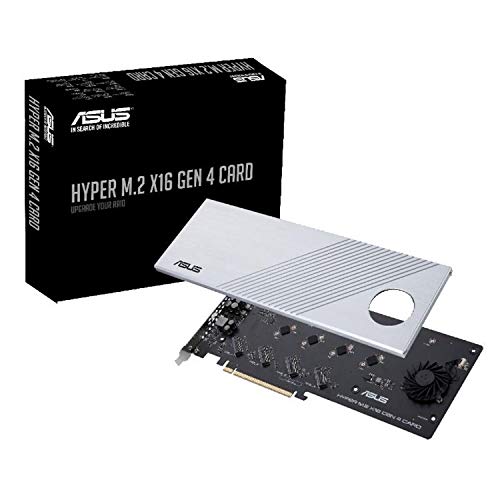
- Supports four NVMe drives
- Includes blower fan and heatsink
- Built for supported RAID platforms
Best For: Supported AMD and Intel users needing four-drive NVMe expansion with active cooling
Dual-Drive Heatsink Pick
10Gtek PCIe 4.0 x8 Dual M.2 NVMe Adapter

- Supports two NVMe drives
- Aluminum heatsink lowers temps
- Requires BIOS bifurcation support
Best For: Users wanting a two-drive NVMe expansion card with heatsink cooling
Gen5 Cooling RAID Card

- Supports four PCIe 5.0/4.0 NVMe drives
- Active fan plus heatsinks and pads
- Needs 6-pin PCIe power
Best For: High-end AMD or Intel builds needing Gen5 NVMe storage with active cooling
Quad NVMe RAID Expansion
PCIe 4.0 x16 to 4x M.2 2280 with Heatsink

- Supports four NVMe M.2 2280 SSDs
- Includes aluminum alloy heatsink cooling
- Needs PCIe bifurcation support
Best For: Users building a cooled quad-NVMe RAID setup on a compatible desktop motherboard
Fan-Cooled Quad NVMe Adapter
Gen4 x16 to 4 M.2 SSDs with Cooling Fan

- Supports four NVMe SSDs in multiple M.2 sizes
- Uses a quiet DC brushless cooling fan
- Can boot from NVMe with BIOS support
Best For: Desktop users wanting active cooling for a four-drive NVMe expansion card
RGB Heatsink NVMe Adapter
PCIe 3.0/4.0/5.0 x4/x8/x16 with Aluminum Heatsink

- Supports 2230/2242/2260/2280 NVMe SSDs
- Fits PCIe x4, x8, and x16 slots
- RGB lighting can be turned off
Best For: Users who want a cooled single-drive NVMe adapter with broad slot support and RGB
Quad Storage Expansion
4-Port NVMe PCIe Adapter with Heatsink

- Adds up to four NVMe SSDs from one PCIe x16 slot
- Includes a 0.32-inch heatsink and LED indicators
- Requires PCIe x16 bifurcation; no hardware RAID
Best For: Bifurcation-capable systems needing multi-drive NVMe expansion
Simple NVMe Upgrade
Sabrent M.2 to PCIe Adapter with Heatsink

- Single-drive NVMe adapter for PCIe x16/x8/x4 slots
- Includes aluminum heatsink and thermal pad
- Tool-free install; not for SATA or PCIe x1
Best For: Easy one-drive NVMe upgrades with included cooling
Mixed-Drive Flex
Dual M.2 PCIe Adapter with Heat Sink Solution

- Supports one NVMe and one SATA M.2 drive
- Includes two heat sinks and ventilation-focused PCB
- SATA drive needs a SATA cable connection
Best For: Mixed NVMe and SATA M.2 installations with cooling
Quad-Drive Active Cooling – SABRENT 4-Drive PCIe 4.0 x16 Adapter Card
If you want an M.2 expansion card with active cooling that can carry four NVMe drives, this SABRENT card is built for exactly that job. It fits a physical x16 slot, supports PCIe 4.0, and adds rear-switch fan cooling plus thermal padding to help keep high-speed SSDs from throttling.
Best For: Desktop builders who have PCIe bifurcation support and want a four-drive NVMe expansion card with optional fan cooling.
Pros:
- Holds up to four M.2 NVMe SSDs in 2230/2242/2260/2280 sizes
- Optional active cooling fan plus aluminum body and thermal padding
- PCIe 4.0 compliant and works with older 3.0/2.0 systems that support bifurcation
- Rear LED indicators help monitor drive status
Cons:
- Requires motherboard PCIe bifurcation support to use multiple drives properly
- Needs a physical x16 PCIe slot
- Only supports M.2 M-key NVMe SSDs
This is a strong pick if you want maximum internal storage density and cooling flexibility, but it makes sense only when your motherboard can split lanes for multi-drive use.
Gen4 Quad Storage – ASUS Hyper M.2 X16 PCIe 4.0 Expansion Card
This ASUS Hyper M.2 expansion card with active cooling is designed for building a high-capacity NVMe array on a PCIe 4.0 platform. It supports four M.2 SSDs, includes a blower-style fan and heatsink for thermal control, and is aimed at systems that can take advantage of PCIe lane splitting and RAID features.
Best For: Users on supported AMD TRX40/X570 or Intel VROC systems who want a four-drive PCIe 4.0 NVMe expansion card with built-in cooling.
Pros:
- Supports four NVMe M.2 drives in 2242/2260/2280/22110 sizes
- Blower-style fan and heatsink help prevent throttling
- PCIe 4.0 x16 interface with x8/x16 slot compatibility
- Supports Intel VROC NVMe RAID on compatible systems
Cons:
- Best suited to specific AMD and Intel platform support lists
- Requires the right system support to run multiple drives as intended
- Larger, more specialized card than a basic single- or dual-drive adapter
Overall, this is a capable storage expansion choice when you want four fast NVMe drives in one card and need active cooling to keep performance steady under load.
Dual-Drive Heatsink Pick – 10Gtek PCIe 4.0 x8 Dual M.2 NVMe Adapter
For a simpler M.2 expansion card with active cooling, this 10Gtek adapter focuses on two NVMe drives and a practical heatsink solution. It fits PCIe 4.0 x8 systems, supports only M-key NVMe SSDs, and is designed for plug-and-play use once your BIOS supports lane splitting.
Best For: Desktop users who want a two-drive NVMe adapter with a heatsink and have bifurcation support available.
Pros:
- Supports two NVMe M.2 SSDs through PCIe bifurcation
- Aluminum heatsink is rated to cool drives by 5 to 12°C
- No driver required; plug and play
- Works with a wide range of OSes, including Windows, Linux, VMware ESXi, and FreeBSD
Cons:
- Does not support hot swapping
- Does not work with M.2 SATA SSDs or B-key/B&M-key drives
- Requires BIOS split support to function properly
This card is a good fit if you need two NVMe slots without moving up to a larger quad-drive board, especially when cooling and broad OS compatibility matter more than maximum capacity.
Gen5 Cooling RAID Card – ASUS Hyper M.2 x16 Gen5 Card
If you want the newest M.2 expansion card with active cooling, this ASUS Gen5 model is built for four NVMe drives and very high bandwidth. It combines a large heatsink, top and bottom thermal pads, and an active fan with power support aimed at modern PCIe 5.0 and 4.0 SSDs.
Best For: Enthusiasts on AMD or Intel platforms who want a four-drive Gen5/Gen4 NVMe card with active cooling and RAID support.
Pros:
- Supports up to four PCIe 5.0/4.0 NVMe M.2 drives
- Large heatsink, thermal pads, and active fan help reduce throttling
- Includes 6-pin PCIe power connector and two-phase power solution
- Supports RAID functions across different platforms
Cons:
- Requires external PCIe power connection
- More specialized than basic adapters due to Gen5-level support
- Primarily aimed at users building high-end storage setups
This is the most forward-looking option in the group, especially if you want top-tier cooling and RAID flexibility for a multi-drive NVMe setup.
Quad NVMe RAID Expansion – PCIe 4.0 x16 to 4x M.2 2280 with Heatsink
If you need an M.2 expansion card with active cooling for a quad-NVMe build, this PCIe 4.0 x16 adapter is aimed at high-density storage setups. It supports four M.2 2280 NVMe drives and includes an aluminum alloy heatsink plus a 12V-to-3.3V power design with independent modules for the SSDs.
Best For: Desktop users with a motherboard that supports PCIe bifurcation and want to combine four NVMe drives into a fast RAID-capable expansion card.
Pros:
- Supports four NVMe M.2 2280 SSDs on a PCIe x16 slot.
- Includes aluminum alloy heatsink for SSD heat dissipation.
- Built-in power design uses four independent 6A modules for stable SSD power delivery.
- RAID0 support is described as capable of consolidating drive speed for up to 14000MB/s reads.
Cons:
- Requires motherboard PCIe split/bifurcation support and the correct x4x4x4x4 or 4×4 mode.
- Only works with NVMe drives; SSDs are not included.
- Best suited to desktops rather than general plug-and-play upgrades.
This card makes sense when your platform already supports the required split-lane configuration and you want a cooled, multi-drive NVMe expansion path. It is more specialized than a simple adapter, but the added power handling and heatsink are useful for serious storage builds.
Fan-Cooled Quad NVMe Adapter – Gen4 x16 to 4 M.2 SSDs with Cooling Fan
This M.2 expansion card with active cooling is built for users who want four NVMe drives on one PCIe slot and extra airflow during sustained transfers. It supports 2230 through 2280 sizes, claims up to 256 Gbps theoretical bandwidth, and uses a quiet DC brushless fan to target heat hotspots.
Best For: Builders who want a fan-cooled quad-NVMe adapter for a desktop system with BIOS support for PCIe booting.
Pros:
- Supports four NVMe M.2 SSDs in 2230/2242/2260/2280 sizes.
- Includes a quiet DC brushless fan for targeted cooling.
- Designed for PCIe 4.0 x16 systems with theoretical bandwidth up to 256 Gbps.
- Can be used as a boot device when the BIOS supports PCIe booting.
Cons:
- Cooling depends on the included fan, so it is not a passive solution.
- Booting from NVMe still depends on motherboard BIOS support.
- Best results require a compatible PCIe 4.0-based platform.
For storage-heavy builds, this card is attractive because it combines four-drive expansion with active airflow. It is especially useful if you expect long transfers or other sustained workloads where temperatures can climb.
RGB Heatsink NVMe Adapter – PCIe 3.0/4.0/5.0 x4/x8/x16 with Aluminum Heatsink
If you want an M.2 expansion card with active cooling that also adds some visual flair, this NVMe adapter pairs an aluminum heatsink with RGB lighting. It supports 2230 through 2280 NVMe drives, works in x4, x8, or x16 slots, and is described as driver-free across major desktop operating systems.
Best For: Users who want a simple NVMe PCIe adapter with heatsink cooling, broad slot compatibility, and optional RGB lighting.
Pros:
- Supports M.2 NVMe SSD sizes 2230/2242/2260/2280.
- Works in PCIe x4, x8, and x16 slots.
- Includes aluminum heatsink solution with thermal pads.
- RGB lighting can be turned off manually.
Cons:
- Not compatible with SATA M.2 SSDs.
- Does not fit PCIe x1 slots.
- Boot support may depend on a newer motherboard chipset.
This is a flexible pick if you want a cooled NVMe adapter that is easy to deploy across a wide range of systems. The main tradeoff is that booting from the card is not guaranteed on older motherboards.
Quad Storage Expansion – 4-Port NVMe PCIe Adapter with Heatsink
If you need an M.2 expansion card with active cooling for a dense desktop or workstation build, this RIITOP adapter is built to add up to four NVMe SSDs from a single PCIe x16 slot. It’s aimed at systems that support PCIe x16 bifurcation, and the included heatsink helps keep drives from running hot during sustained use.
Best For: Users with bifurcation-capable motherboards who want to run four NVMe drives from one x16 slot.
Pros:
- Supports up to 4x M.2 NVMe SSDs at once
- Includes a 0.32-inch heatsink for better temperature control
- LED indicators show the working status of each SSD
- Fits 2280, 2260, 2242, and 2230 NVMe drives
Cons:
- Requires motherboard support for PCIe x16 bifurcation
- Does not support SATA-based M.2 SSDs
- No hardware RAID support
This is a strong choice if your platform can handle the bifurcation requirement and you want maximum NVMe capacity from a single slot. The cooling and status LEDs make it practical for storage-heavy builds, but compatibility is the main gatekeeper.
Simple NVMe Upgrade – Sabrent M.2 to PCIe Adapter with Heatsink
This Sabrent M.2 expansion card with active cooling is a straightforward way to mount a single NVMe drive into a PCIe x16, x8, or x4 slot. The included aluminum heatsink and thermal pad are there to help with heat management, making it a practical pick for general desktop storage upgrades.
Best For: Users who want an easy single-drive NVMe adapter with included cooling hardware.
Pros:
- Supports 2230, 2242, 2260, and 2280 NVMe SSDs
- Includes an aluminum heatsink and thermal pad
- Tool-free installation with screws and screwdriver included
- Works with PCIe x16, x8, and x4 physical slots
Cons:
- Not compatible with SATA drives
- Does not work in PCIe x1 slots
- Designed for one SSD, not multi-drive expansion
If you want a simple adapter that focuses on stable NVMe mounting and basic thermal control, this one keeps the setup easy. It’s best suited to users who need one fast M.2 drive on a standard PCIe slot rather than a more complex storage array.
Mixed-Drive Flex – Dual M.2 PCIe Adapter with Heat Sink Solution
For builds that need a flexible M.2 expansion card with active cooling, this dual-slot adapter supports both NVMe and SATA M.2 drives in one package. It converts one M.2 NVMe drive to PCIe 3.0 x4 and one M.2 SATA drive to a SATA 6Gbps connection, while the included heat sink solution helps with ventilation and heat dissipation.
Best For: Users who want to install one NVMe and one SATA M.2 drive with cooling support.
Pros:
- Supports two M.2 SSDs simultaneously
- Handles both NVMe M-Key and SATA B-Key/B+M-Key drives
- Includes two heat sinks and ventilation-focused PCB design
- Comes with full-size and low-profile brackets
Cons:
- The SATA M.2 drive requires a SATA cable connection
- NVMe side is limited to PCIe 3.0 x4
- Not a pure NVMe dual adapter
This is a smart option if you need mixed-drive flexibility instead of all-NVMe capacity. The cooling hardware and bracket options make it more installation-friendly, but the SATA connection requirement is important to plan for.
How We Picked the Best M.2 Expansion Card with Active Cooling
We prioritized cards that balance drive count, thermal control, and real-world compatibility. For an M.2 Expansion Card with Active Cooling, the most important factors are PCIe lane availability, whether the card needs BIOS bifurcation, and how well its cooling solution supports long write sessions.
We also looked for broad SSD size support, clear slot requirements, and designs that make installation straightforward in standard desktop systems.
Quick Comparison
If you want the simplest path, choose a card that matches your motherboard’s PCIe lane configuration and does not require unusual setup. Quad-drive cards are best for maximum capacity, while dual-drive models are often easier to deploy on mainstream boards. Fan-cooled cards are generally better for heavy workloads; heatsink-only designs can still work well in cases with strong case airflow.
Key Buying Factors for an M.2 Expansion Card with Active Cooling
PCIe Slot and Lane Support
Make sure your motherboard has the correct slot width and enough lanes for the card to perform properly. Some models use x16 physical slots but rely on x4 or x8 electrical wiring, and performance can drop if the host platform is limited.
Bifurcation and BIOS Requirements
Many multi-drive adapters need PCIe bifurcation support in the BIOS. If your system cannot split lanes, look for a card with a built-in controller or confirm that your board explicitly supports the required mode.
Cooling Design
Active cooling is useful for keeping NVMe drives from throttling during backups, rendering, or game installs. Check fan placement, heatsink coverage, and whether the card has enough clearance for your GPU and nearby components.
Drive Compatibility
Confirm supported M.2 lengths, usually 2230 through 22110 depending on the model, and note whether the card is NVMe-only or supports SATA M.2 as well. If you plan to mix drives, compatibility matters more than headline speed.
Who Should Buy Which M.2 Expansion Card with Active Cooling?
Choose a quad-drive card if you need maximum capacity for media libraries, VMs, or scratch storage. Pick a dual-drive adapter if you want a simpler, more affordable upgrade for a gaming PC or creator rig. If your system is sensitive to heat, prioritize the best cooling design over the highest drive count. For newer platforms, a PCIe 5.0-capable model can offer more headroom, but only if your motherboard and CPU actually support it.
In short, the best choice is the one that fits your board, cooling setup, and storage growth plan today—not just the one with the biggest spec sheet.