
Clean, dependable sound can make the difference between a documentary that feels polished and one that feels difficult to watch. The right recorder helps you capture interviews, ambient sound, dialogue, and unpredictable moments without adding unnecessary production complexity.
These 10 options cover compact handheld recorders, lavalier-focused systems, camera-mounted models, and advanced multitrack units. Use the guide below to match your crew size, microphone setup, workflow, and recording environment.
Best 10 Field Recorder for Documentary Picks for 2026
Professional Production Pick

- 32-bit float recording helps prevent clipping
- Six XLR inputs and up to 14 tracks
- Timecode I/O for accurate video sync
Best For: Multi-microphone documentary crews and professional location production
Camera-Mount Value
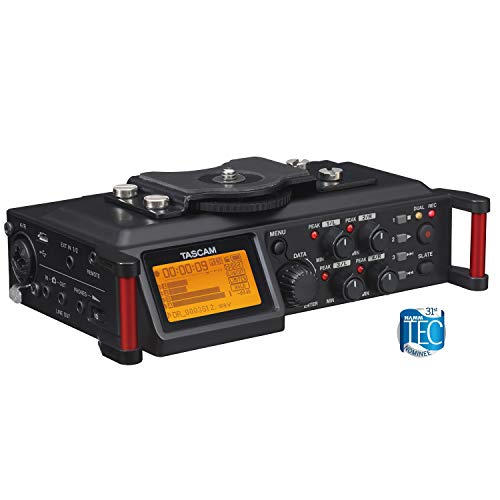
- Four XLR inputs with phantom power
- Built-in microphones for quick capture
- Dual Recording mode adds a safety copy
Best For: DSLR videographers and compact documentary camera rigs
Flexible Handheld Choice

- 32-bit float recording across six tracks
- Four XLR/TRS inputs plus X/Y microphones
- Interchangeable capsules support varied setups
Best For: Mobile filmmakers and solo documentary interview crews
Compact Sync Specialist

- 32-bit float recording with dual ADCs
- Built-in timecode generation and I/O
- Lightweight body with two combo inputs
Best For: Videographers needing compact, synchronized two-input recording
Flagship Field Sound

- Large 19.4mm X/Y stereo microphones
- 32-bit float and up to four-track recording
- Two XLR/TRS inputs with dedicated gain knobs
Best For: Documentary crews capturing detailed stereo sound and multiple sources
Flexible Stereo Capture

- Adjustable AB/XY stereo microphones
- 32-bit float recording and USB-C interface
- Up to 17.5 hours on two AA batteries
Best For: Solo documentary interviews, ambience, and audio-for-video
Wearable Interview Audio

- Included lavalier microphone with secure screw-lock connector
- 32-bit float body-pack recording
- Up to 15 hours on two AAA batteries
Best For: Discreet, hands-free documentary interviews
Best Compact Pick

- 32-bit float stereo recording
- Built-in mics support up to 125dB SPL
- USB-C interface and up to 17.5-hour battery life
Best For: Solo documentarians and lightweight interview kits
Best Heavy-Duty Pick
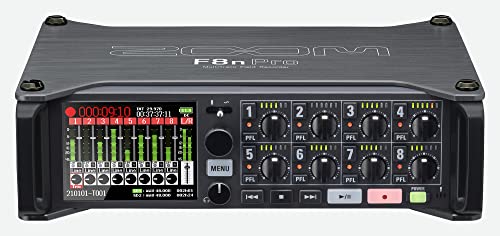
- Eight inputs and 10-track 32-bit float recording
- 0.2ppm timecode accuracy
- Dual SD slots for redundant recording
Best For: Film crews and complex multichannel location sound
Best Simple Pick

- Four-track 32-bit float recording
- Built-in mics plus two XLR/TRS inputs
- USB-C device recording and SD-card backup
Best For: Creators needing handheld portability and external mic flexibility
Professional Production Pick – Zoom F6
The Zoom F6 is a strong choice for a field recorder for documentary work when you need multiple microphones, wide dynamic range, and dependable sync with video. Its 32-bit float recording and timecode I/O suit demanding location workflows.
Best For: Documentary crews recording several microphones and syncing audio to video in professional production environments.
Pros:
- 32-bit float recording with dual A/D converters helps capture quiet dialogue and loud sounds without clipping.
- Six XLR inputs and support for up to 14 tracks provide substantial multitrack flexibility.
- Timecode I/O enables frame-accurate synchronization with video equipment.
- Rugged, portable construction, multiple power options, and USB interface functionality support location work.
Cons:
- Its 2.4-pound weight is greater than that of more compact handheld recorders.
- Six XLR inputs may be more capability than a solo interviewer needs.
Choose the F6 when production flexibility and synchronization matter more than the smallest possible setup. It is especially well suited to crews capturing several sources in unpredictable acoustic conditions.
Camera-Mount Value – TASCAM DR-70D
The TASCAM DR-70D is a practical field recorder for documentary shooters using DSLR or camera-based setups. It combines four XLR inputs, built-in microphones, level controls, and safety recording in a compact body that can mount above or below a camera.
Best For: Videographers and documentarians who need several balanced inputs and a camera-friendly recorder at the same time.
Pros:
- Four balanced XLR inputs with phantom power support production microphones.
- Built-in microphones provide a quick option for capturing on-set sound.
- Dual Recording mode creates a lower-level safety copy to help protect against distorted takes.
- Individual gain controls, limiter, and high-pass filtering support fast level management.
Cons:
- It does not list 32-bit float recording, so level-setting remains important.
- The recorder is limited to four channels compared with higher-input production models.
- Its 1.5-inch screen is relatively small for detailed monitoring.
The DR-70D makes sense for camera operators who want straightforward multitrack recording without moving to a larger production recorder. Its safety track is particularly useful when documentary levels can change quickly.
Flexible Handheld Choice – Zoom H6 Essential
The Zoom H6 Essential is a versatile field recorder for documentary interviews, events, and small crews. Its 32-bit float recording, four XLR/TRS inputs, built-in X/Y microphones, and interchangeable capsule system let you adapt the recorder to different sources.
Best For: Solo filmmakers, interviewers, and mobile crews that want handheld convenience with room for multiple external microphones.
Pros:
- 32-bit float recording across six tracks helps reduce the risk of distorted takes.
- Four XLR/TRS combo inputs accommodate microphones and other line-level sources.
- Built-in X/Y microphones capture up to 135 dB SPL for quick stereo recording.
- Interchangeable capsules and USB interface operation expand its recording options.
Cons:
- It uses four AAA batteries rather than the F6’s four AA battery setup.
- Timecode functionality is not listed, so video synchronization may require another workflow.
- Optional capsules are needed to expand beyond the included stereo microphone configuration.
The H6 Essential is a balanced option when portability and flexibility are priorities. It works well for documentary makers who alternate between interviews, ambient sound, and multichannel recording.
Compact Sync Specialist – TASCAM FR-AV2
The TASCAM FR-AV2 is a compact field recorder for documentary videographers who want no-clip capture and integrated timecode in a small package. It provides two XLR/TRS inputs, a 3.5 mm input, and high-resolution recording up to 192 kHz.
Best For: Video crews needing a lightweight two-input recorder with built-in timecode generation and synchronization.
Pros:
- 32-bit float recording with dual ADCs supports fast setup and helps avoid clipping.
- Built-in timecode generation plus timecode in/out supports synchronized video workflows.
- Dual XLR/TRS inputs use Ultra HDDA preamps, with an additional 3.5 mm input.
- Small 3.9-by-3.15-by-1.57-inch design weighs only 9.5 ounces.
Cons:
- Two XLR/TRS inputs provide less multitrack capacity than four- or six-input recorders.
- Wireless monitoring requires the optional AK-BT2 adapter.
- Its three-AA battery requirement may require carrying spares for extended shoots.
The FR-AV2 is compelling when synchronized audio and minimal bulk are central to the kit. It is less suited to large microphone arrays, but its compact design and timecode tools fit streamlined documentary video rigs.
Flagship Field Sound – Zoom H5 Studio
For filmmakers seeking a versatile field recorder for documentary work, the Zoom H5 Studio combines large 19.4mm X/Y microphones, 32-bit float recording, and dedicated gain controls. Its battery-powered design and multi-track capability suit demanding location sessions.
Best For: Documentary crews needing detailed stereo sound and flexible multi-track recording.
Pros:
- Large stereo microphones capture rich, detailed audio with wide dynamic range.
- 32-bit float recording helps produce clip-free takes.
- Records up to four tracks simultaneously at up to 192kHz in WAV format.
- Dedicated gain knobs and two XLR/TRS inputs support hands-on control.
Cons:
- Requires four AA batteries, more than the other recorders here.
- Its broader feature set may be more than needed for simple voice capture.
The H5 Studio is the strongest all-around choice when documentary production calls for high-resolution stereo ambience, external inputs, and substantial recording flexibility in a portable unit.
Flexible Stereo Capture – TASCAM DR-07XP
The TASCAM DR-07XP is a practical field recorder for documentary interviews, location audio, and general production. Its adjustable stereo microphones, 32-bit float modes, USB-C interface, and lightweight 4.8-ounce body make it easy to carry and adapt to different recording setups.
Best For: Solo documentarians who want adjustable stereo recording and direct USB-C computer connectivity.
Pros:
- Adjustable AB/XY condenser microphones handle sources up to 125dB SPL.
- Supports 32-bit float, 24-bit, 16-bit, high-resolution WAV, and MP3 recording.
- Works as a 2-in/2-out USB-C audio interface.
- Offers up to 17.5 hours of operation with two AA alkaline batteries.
Cons:
- Memory card is not included.
- Built-in recording is stereo rather than multi-track.
Choose the DR-07XP when portability and microphone positioning matter more than multiple isolated tracks. It is a well-rounded option for interviews, ambient sound, and audio-for-video work.
Wearable Interview Audio – Zoom F2 Lavalier Recorder
The Zoom F2 takes a different approach to a field recorder for documentary work: it is a compact body-pack recorder designed to stay with the speaker. Its included lavalier microphone, 32-bit float capture, and REC Hold switch make it especially useful for interviews and on-camera contributors.
Best For: Documentary interviews requiring discreet, wearable lavalier recording.
Pros:
- Included omnidirectional lavalier microphone is ready for discreet placement.
- 32-bit float recording captures clip-free audio without manual gain adjustment.
- Runs for up to 15 hours on two AAA batteries.
- Supports microSD cards up to 512GB and includes a REC Hold switch.
Cons:
- Its mono lavalier-focused design is less suited to stereo ambience.
- Recording is limited to 44.1kHz or 48kHz.
The F2 is the most focused option here. It is not a general-purpose stereo recorder, but its wearable format and included lav make it a strong fit for hands-free interview capture and contributor audio.
Best Compact Pick – TASCAM DR-05XP
For a field recorder for documentary work that prioritizes portability and simple stereo capture, the TASCAM DR-05XP is a practical choice. Its built-in omnidirectional condenser microphones support sources up to 125dB SPL, while 32-bit float recording provides useful flexibility for unpredictable interviews, ambience, and audio-for-video work.
Best For: Solo documentarians, interviews, meetings, ambient sound, and lightweight production kits.
Pros:
- 32-bit float, 24-bit, 16-bit, and MP3 recording options.
- Built-in stereo microphones handle sources up to 125dB SPL.
- USB-C 2-in/2-out audio interface for direct computer recording.
- Up to 17.5 hours of operation with two AA alkaline batteries.
Cons:
- Uses built-in microphones rather than listed XLR inputs for external microphones.
- SD card and batteries are not included.
The DR-05XP is a strong everyday option when you need a small recorder for documentary interviews and location sound without a more complex multichannel setup.
Best Heavy-Duty Pick – Zoom F8n Pro
For demanding documentary shoots, the Zoom F8n Pro offers the inputs, track count, and synchronization tools expected in a professional field recorder for documentary production. Its eight inputs, 10-track recording, 32-bit float capture, and accurate timecode are suited to multi-microphone work on location.
Best For: Film crews, multichannel dialogue recording, complex location setups, and productions requiring timecode.
Pros:
- Eight-channel, 10-track recording with 32-bit float and dual AD converters.
- 75dB of gain and -127dBu EIN preamps for quiet dialogue and dynamic scenes.
- Timecode accuracy down to 0.2ppm for alignment with picture.
- Dual SD slots support redundant recording, with up to 1TB per slot.
Cons:
- At 1.8kg, it is considerably less portable than handheld recorders.
- Listed battery life is approximately 8.5 hours.
- Its larger feature set may be more than needed for simple stereo interviews.
The F8n Pro is the most capable option here for documentary crews that need multiple inputs, backup recording, and dependable synchronization rather than a minimalist handheld recorder.
Best Simple Pick – Zoom H4 Essential
The Zoom H4 Essential balances handheld convenience with connectivity, making it a versatile field recorder for documentary interviews, video audio, and small productions. Its built-in stereo microphones can be paired with two XLR/TRS inputs, while 32-bit float recording helps reduce concern about distorted takes.
Best For: Documentary creators who need built-in microphones plus external mic, instrument, mixer, or soundboard connections.
Pros:
- 32-bit float recording with four-track capability.
- Built-in stereo microphones and two XLR/TRS inputs.
- USB-C connectivity supports recording or streaming with phones, tablets, and computers.
- Can save to an SD card while recording to a connected device.
Cons:
- Two XLR/TRS inputs provide less expansion than the F8n Pro’s eight inputs.
- Listed digital recording time is approximately 10 hours.
- Requires two AA batteries.
The H4 Essential is a useful middle ground: more adaptable than a basic stereo recorder, but easier to carry and operate than a full professional multichannel unit.
How We Picked the Best Field Recorder for Documentary
We focused on features that matter during real documentary shoots: input flexibility, preamp and limiter performance, recording reliability, portability, battery practicality, monitoring, and compatibility with common microphones. We also considered whether each recorder suits solo operators, small crews, or productions that need multiple isolated tracks.
Bit-depth and sample-rate specifications matter, but they are not the only criteria. A recorder that is easy to operate quickly and safely can be more valuable than a technically advanced model that slows down a fast-moving shoot.
Quick Comparison
| Recorder type | Best suited to | Strength to prioritize |
|---|---|---|
| Compact handheld | Run-and-gun interviews and ambient audio | Portability and simple operation |
| Camera-mounted recorder | Single-camera documentary rigs | Multiple XLR/TRS inputs |
| Lavalier recorder | Discreet subject microphones | Small size and independent recording |
| Professional multitrack recorder | Small crews and complex setups | Input count, timecode, and track control |
Key Buying Factors for a Field Recorder for Documentary
Inputs and Microphone Compatibility
Count how many microphones you need to record at once, then leave room for expansion. XLR inputs support professional microphones, while combo XLR/TRS connections can also accept line-level sources. Built-in microphones are useful for quick stereo ambience, but they do not replace dedicated inputs for interviews.
32-Bit Float Recording and Level Protection
32-bit float recording can provide extra flexibility when input levels change unexpectedly, especially for solo operators who cannot monitor meters continuously. It does not fix clipping caused elsewhere in the signal chain, so microphone placement, gain structure, and monitoring still matter.
Timecode and Synchronization
If audio will be recorded separately from one or more cameras, timecode can reduce syncing work in post-production. For simpler shoots, a camera-mounted recorder or a handheld unit with a clear reference track may be sufficient.
Portability, Power, and Controls
Documentary work often involves long walks, crowded locations, and limited opportunities to change batteries or cards. Look for a recorder that fits your rig, offers accessible controls, supports dependable media, and provides a headphone output you can use comfortably for extended monitoring.
Who Should Buy Which Field Recorder for Documentary?
Choose a compact handheld model if you need fast setup, interviews, room tone, or location ambience with minimal gear. A camera-mounted multichannel recorder is a better fit when you want several wired microphones close to the camera. Choose a lavalier recorder for discreet subject capture or situations where a cable running to a larger recorder is impractical.
Small documentary crews should consider a multitrack recorder when they regularly use a boom, multiple lavaliers, and other sources at the same time. If your production depends on synchronized audio across several cameras, prioritize timecode support. For occasional shoots and straightforward interviews, a simpler recorder may deliver the best balance of cost, speed, and reliability.