
Finding reliable lighting control on a limited budget does not have to mean settling for a confusing setup. These DMX controllers under $100 cover practical options for DJs, home users, small stages, parties, and compact venue installations.
Our selection includes traditional 192-channel consoles, compact mini controllers, wireless DMX systems, and simple dimming boards. Compare channel capacity, connectivity, programming controls, and portability to find the best match for your lights.
Best 10 Dmx Controllers Under 100 Picks for 2026
Versatile Scene Control

- 192 channels for up to 12 intelligent lights
- Stores up to 240 scenes
- Voice control and three-pin compatibility
Best For: DJs and small event lighting setups
Fast Wireless Setup

- Includes one transmitter and two receivers
- Up to 1,000-foot stated range
- Seven group IDs and frequency hopping
Best For: Mobile events needing cable-free DMX links
Programmable Show Builder

- Controls 12 fixtures across 192 channels
- Stores 240 scenes and six chase sets
- Programs up to 40 steps per scene
Best For: Users building timed, repeatable light shows
Sound-Activated Value

- 192 channels for up to 12 smart lights
- 240 scenarios and six chase sets
- Sound, MIDI, tap, and automatic modes
Best For: Music-driven DJ and party lighting
Best for Beginners
Portable 14-Channel DMX512 Console
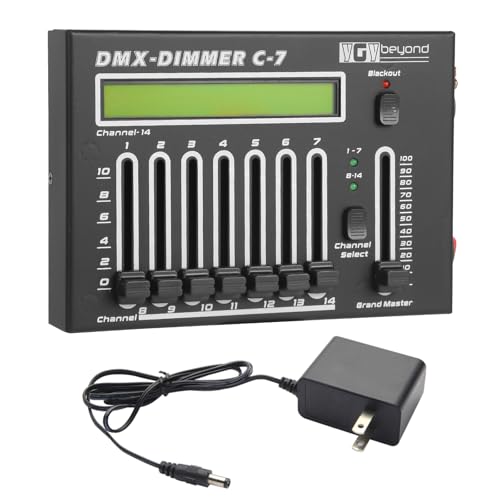
- Simple manual channel control
- Includes Grand Master and Blackout controls
- Compact 1.83-pound design
Best For: Small venues and first-time DMX users
Best for Scene Programming
192-Channel Stage Light Controller

- Stores up to 240 programmable scenes
- Controls 12 devices and 192 channels
- Includes 3-pin cable and eight sliders
Best For: Small events using repeatable lighting scenes
Compact 12-Channel Dimmer

- Controls up to 12 DMX512 channels
- Portable aluminum design with physical faders
- Includes standard 3-pin XLR DMX output
Best For: Small stages and portable DMX setups
Programmable 192-Channel Console
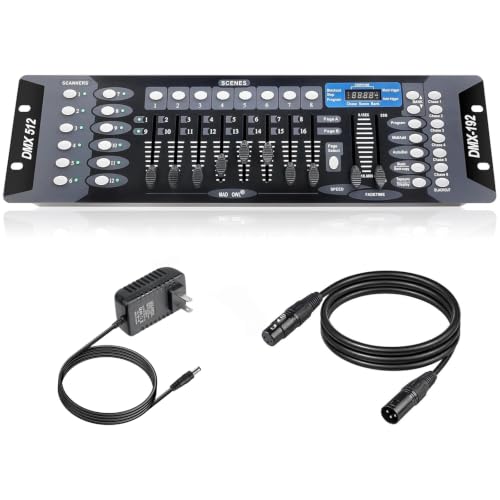
- Controls up to 192 DMX channels
- Supports scenes, banks, and programmable chases
- Includes a 6.6-foot DMX cable
Best For: DJs and small venues running programmed light shows
Wireless 512-Channel Control

- Supports 2.4G wireless and standard DMX512
- Provides manual dimming and auto scene playback
- Includes six banks of eight programmable scenes
Best For: Portable party, wedding, club, and bar lighting
Versatile Scene Control – CO-Z 192 DMX Controller
For shoppers comparing DMX controllers under 100, the CO-Z 192 DMX console offers a practical way to manage multiple fixtures and programmed scenes from one board. Its 192 channels support up to 12 intelligent lights with as many as 16 channels each, while the organized control layout is approachable for beginners.
Best For: DJs, small venues, parties, weddings, and users who want scene programming with voice control.
Pros:
- Controls up to 12 fixtures and up to 240 scenes.
- Works with three-pin equipment including fog machines, PAR lights, strobes, and beam lights.
- Seven-section layout separates fixture, scene, channel, speed, and function controls.
- Voice control enables hands-free scene switching.
Cons:
- Its corded design requires access to power during use.
- The controller is made primarily from plastic.
The CO-Z is a capable entry-level console for lighting setups that need more structure than a simple sound-activated controller. Its scene capacity and broad three-pin compatibility make it especially useful for repeatable event shows.
Fast Wireless Setup – JERRAY 2.4G DMX Wireless Set
If you are comparing DMX controllers under 100 and want to avoid long XLR cable runs, the JERRAY wireless set provides one transmitter and two receivers for DMX512 lighting systems. Its 2.4G connection supports automatic frequency hopping and a stated range of up to 1,000 feet.
Best For: Mobile DJs, weddings, and stage events where quick wireless setup and separate lighting groups matter.
Pros:
- Wireless design can reduce cable clutter and setup time.
- 126-channel frequency hopping is designed to resist interference.
- Seven group IDs allow separate lighting rigs to be controlled independently.
- Includes one transmitter, two receivers, and three power adapters.
Cons:
- Each unit requires a power adapter; there is no built-in battery.
- This is a wireless transmitter-and-receiver set rather than a channel programming console.
The JERRAY is best viewed as a wireless DMX bridge for simplifying connections, not as a standalone lighting board. It is a strong fit when reliable signal distribution and faster venue setup are higher priorities than onboard scene programming.
Programmable Show Builder – 192-Channel DMX Console
Among DMX controllers under 100, this 192-channel console stands out for combining fixture control with detailed scene timing. It can manage up to 12 lights, store up to 240 scenes, and program up to 40 steps per scene through a clearly divided control surface.
Best For: DJs, clubs, churches, weddings, and users creating repeatable lighting sequences with adjustable transitions.
Pros:
- Controls up to 12 fixtures with up to 16 channels each.
- Supports up to 240 scenes and six sets of chases.
- Allows 40 steps per scene with adjustable pause and fade speeds.
- Includes voice control and a three-pin DMX512 output.
Cons:
- It is a corded console rather than a wireless controller.
- The feature set may require a learning period for first-time users.
This model is a good choice when scene sequencing is central to your setup. Its timing controls provide more programming flexibility than a basic manual controller, while the 192-channel format remains suitable for smaller lighting rigs.
Sound-Activated Value – MINI 192A DMX Controller
For buyers seeking DMX controllers under 100 with automatic performance features, the MINI 192A combines 192-channel control with sound activation, MIDI beat activation, tap synchronization, and automatic operation. It also offers 240 scenarios and six sets of chases for compact lighting systems.
Best For: DJs, bands, bars, clubs, house parties, and users who want beat-responsive lighting without relying entirely on manual operation.
Pros:
- Controls up to 12 smart lights with up to 16 channels each.
- Provides 240 scenarios and six sets of chases.
- Built-in microphone supports sound activation.
- Includes MIDI beat activation, tap synchronization, and automatic operation.
Cons:
- It is a corded controller.
- The supplied notes do not specify voice control or wireless operation.
The MINI 192A is suited to compact entertainment setups where music-reactive effects are useful. Its sound and beat activation options can reduce hands-on control during performances while retaining traditional DMX scene and chase functions.
Best Overall Control – Compact 192-Channel DMX Console
For shoppers comparing DMX controllers under 100, this compact 192-channel console offers substantial programming capacity in a portable format. It controls up to 12 fixtures with up to 16 channels each and includes programmable scenes, chases, and real-time sliders.
Best For: Small stage productions and users who need extensive scene and chase programming.
Pros:
- Controls up to 192 individual lighting channels.
- Provides 23 banks of programmable scenes and six programmable chases.
- Backlit LCD, numeric keypad, and eight real-time sliders support hands-on programming.
- Compact aluminum design weighs 2.29 pounds for easier transport.
Cons:
- Its larger feature set may take more time for beginners to learn.
- Designed for corded electric operation rather than battery-powered use.
This is a strong choice when programming flexibility matters more than having the simplest possible interface. Its 192-channel layout and chase capacity make it suitable for more elaborate lighting setups while remaining easy to carry.
Best for Beginners – Portable 14-Channel DMX512 Console
Among DMX controllers under 100, this 14-channel mini console is aimed at straightforward operation for parties, bars, KTV venues, weddings, and small performances. Its channel faders, LCD display, Grand Master control, and one-touch Blackout button keep essential lighting adjustments accessible.
Best For: Beginners and small venues that want simple manual control without complicated programming.
Pros:
- Supports standard DMX512 and works with many stage, DJ, PAR, moving head, and strobe lights.
- Seven faders per page provide access to channels 1–7 and 8–14.
- Grand Master fader adjusts overall brightness from 0 to 100%.
- Blackout button quickly cuts all light output during transitions or emergencies.
Cons:
- Its 14-channel capacity is more limited than 192-channel consoles.
- Requires the included type of 9V–12V DC power adapter for operation.
This controller prioritizes speed and ease of use over advanced scene programming. It is a practical entry-level option when you need basic channel control and quick blackout functionality for smaller events.
Best for Scene Programming – 192-Channel Stage Light Controller
This 192-channel console is worth considering among DMX controllers under 100 when you want programmable scenes and chases for parties, concerts, festivals, or seasonal shows. It supports up to 12 devices with 16 channels each, includes eight manual sliders, and comes with a 3-pin cable for compatible stage equipment.
Best For: Beginners and small-event users building repeatable lighting scenes with compatible 3-pin equipment.
Pros:
- Controls up to 192 channels across 12 scanners.
- Offers 23 banks of eight programmable scenes and six chases with up to 240 scenes.
- Eight sliders allow manual channel adjustments and automatic speed or fade control.
- Includes a 3-pin cable and supports a wide range of compatible stage lighting devices.
Cons:
- The controller’s extensive scene options may require practice for new users.
- Its listed dimensions and rack-mount design may be less convenient for casual tabletop use.
- The supplied warranty information is inconsistent, listing both 360-day repair service and a 90-day manufacturer warranty.
With substantial scene storage and a beginner-oriented control layout, this model balances programming capability with approachable operation. It is a sensible fit for users who want repeatable lighting sequences without moving to a more complex console.
Compact 12-Channel Dimmer – MAD OWL Mini DMX Controller
If you need one of the simplest DMX controllers under 100 for a small lighting setup, the MAD OWL 12-channel controller is a practical option. Its six sub-control faders and main control fader provide direct control of up to 12 DMX512 channels, while the compact aluminum housing is easy to transport.
Best For: Small stages, portable setups, and DMX512 fixtures using 12 channels or fewer.
Pros:
- Direct fader control for up to 12 DMX512 channels
- Compact, lightweight design suited to travel
- Standard 3-pin XLR DMX output
- One-key blackout function for quick control
Cons:
- Not suitable for fixtures requiring more than 12 channels
- More limited than larger programmable consoles
This controller keeps operation straightforward and installation quick. It is best chosen when your fixtures have modest channel requirements and you prefer physical faders over complex programming features.
Programmable 192-Channel Console – Basic DMX512 Lighting Board
For users comparing DMX controllers under 100 with more programming capacity, this 192-channel board offers a broader control layout than a basic dimmer. It can manage up to 12 fixtures with 16 channels or fewer and includes banks, programmable scenes, chases, and a 6.6-foot DMX cable.
Best For: DJs, small stages, clubs, and performance spaces needing programmable scenes and chase effects.
Pros:
- 192 channels for flexible fixture control
- Supports up to 12 fixtures with 16 channels or fewer
- Stores 23 banks of eight programmable scenes
- Includes six programmable chases with 240-step scenes
Cons:
- Limited to fixtures using 16 channels or fewer
- Larger and heavier than compact mini controllers
- Programming may take more setup than direct fader control
The WK-192 is a stronger fit for repeatable lighting shows than for occasional manual adjustments. Its programmable banks and chases add useful flexibility, but the larger rack-style form factor may be less convenient for highly mobile users.
Wireless 512-Channel Control – Mini 2.4G DMX Console
This mini wireless console stands out among DMX controllers under 100 by combining 2.4G wireless transmission with standard DMX512 control. It supports up to 512 channels, offers manual and automatic modes, and provides programmable scenes in a compact format for mobile events.
Best For: Parties, weddings, clubs, bars, and small lighting projects where portable wireless control is useful.
Pros:
- Supports up to 512 channels through wireless or DMX512 control
- Offers manual dimming and automatic scene playback
- Six banks with eight programmable scenes
- Compact design with one-key record and blackout functions
Cons:
- Requires an external 9V–12V DC adapter
- Does not include a built-in battery
- Wireless compatibility depends on the connected lighting equipment
The controller is a versatile choice when portability and wireless operation matter. Its scene memory and smooth 0–100% master dimming also make it practical for users who want both hands-on adjustments and automatic playback.
How We Picked the Best Dmx Controllers Under 100
We focused on controllers that offer useful DMX functionality at an accessible price, while considering the needs of beginners and experienced lighting operators alike. The lineup includes wired and wireless models, full-size and mini consoles, and options ranging from basic dimming to programmable scene control.
We compared channel counts, control layout, operating modes, portability, wireless capability, included accessories, and suitability for common fixtures such as LED PAR cans, moving heads, and DJ effects. Because product specifications can vary by seller and configuration, verify the listing details before purchase.
Quick Comparison
| Controller type | Best suited to | Main advantage |
|---|---|---|
| 192-channel console | DJs and small stages | More programming flexibility |
| Mini 12- or 14-channel console | Beginners and compact setups | Simple, portable operation |
| Wireless DMX controller | Clean installations and mobile rigs | Less cable clutter |
| Dimming controller | Basic small-stage lighting | Straightforward intensity control |
Key Buying Factors for Dmx Controllers Under 100
Channel Capacity
Channel count determines how many DMX parameters you can control. A 192-channel board is a common budget choice for multiple fixtures, while a 12- or 14-channel controller may be enough for a small party rig or a few simple lights.
Fixture Compatibility
Check that the controller supports the DMX512 protocol and that its channel layout can address your fixtures. Moving heads, PAR lights, dimmers, and effects may require different numbers of channels and careful fixture addressing.
Programming and Operation
Look for scene, chase, bank, speed, fade, sound-activation, blackout, and grand-master controls if you want more than manual adjustment. Beginners may prefer clearly labeled faders and dedicated buttons over dense menus.
Wired Versus Wireless Control
Wired DMX is generally familiar and dependable when you can run cables neatly. Wireless systems can simplify mobile setups, but confirm transmitter and receiver compatibility, range, power requirements, and whether enough receivers are included.
Portability and Setup
Consider the controller’s footprint, power supply, cable requirements, and protection during transport. A compact mini console is convenient for occasional use, while a larger board may be easier to operate during longer events.
Who Should Buy Which Dmx Controllers Under 100?
- Choose a 192-channel console if you run several fixtures and want room for programmed scenes or chases.
- Choose a mini 12- or 14-channel controller if you need basic, portable control for a small lighting setup.
- Choose a wireless model if minimizing signal cables is a priority for parties, mobile DJ work, or temporary installations.
- Choose a dimming controller if your main goal is simple intensity control rather than complex fixture programming.
Before ordering, count your fixtures, map their DMX channel requirements, and confirm the controller has the outputs and controls your setup needs. The best budget controller is the one that leaves enough operating headroom without adding unnecessary complexity.