
The right lighting controller can make a mobile DJ setup faster to program, easier to transport, and more consistent from one event to the next. The best options balance fixture capacity with practical controls, wireless flexibility, and a manageable learning curve.
This roundup compares 10 DMX controllers for mobile DJs, including standalone consoles, wireless and wired models, MIDI-capable controllers, dimmer packs, and app-based systems. Use the guide below to narrow your choice by show size, workflow, and budget.
Best 10 Dmx Controllers for Mobile Djs Picks for 2026
Best Standalone Pick

- Standalone touchscreen and button control
- Four DMX universes with extensive fixture support
- Includes protective Decksaver cover
Best For: Mobile DJs and event technicians wanting laptop-free control
Best Wireless Software Interface

- Dual-mode Wi-Fi for wireless programming
- Two DMX universes plus one Art-Net universe
- Supports desktop and mobile platforms
Best For: ShowXpress users needing portable wireless control
Best Budget Manual Console

- 384 DMX channels for hands-on control
- 30 banks with eight programmable scenes
- Compact console with gooseneck light
Best For: Bars, clubs, and live shows using manual scene programming
Best Dimmer/Relay Add-On

- Four-channel DMX-512 dimmer/relay pack
- Channels support dimmer or relay modes
- Adjustable addressing and 0–100% dimming
Best For: Adding dimmer or relay control to an existing DJ lighting rig
Best App-Based Pick

- 256-channel tablet-based DMX control
- 15,000+ fixture library
- 50 presets and 21 automatic effects
Best For: Mobile DJs who want quick, touch-screen lighting control
Best Traditional Controller

- Controls up to eight intelligent lights
- 96 DMX channels
- Six chases with up to 999 steps each
Best For: DJs who prefer dedicated hardware and programmed chase sequences
Best High-Capacity Wireless Option
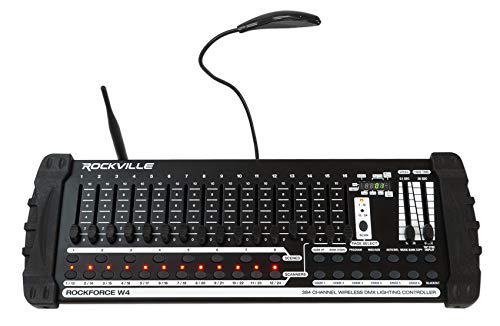
- 384-channel control for up to 24 lights
- Built-in 2.4GHz wireless transmitter
- MIDI, music sync, and 16 physical sliders
Best For: Mobile setups needing wireless control and extensive scene capacity
Compact Scene Builder
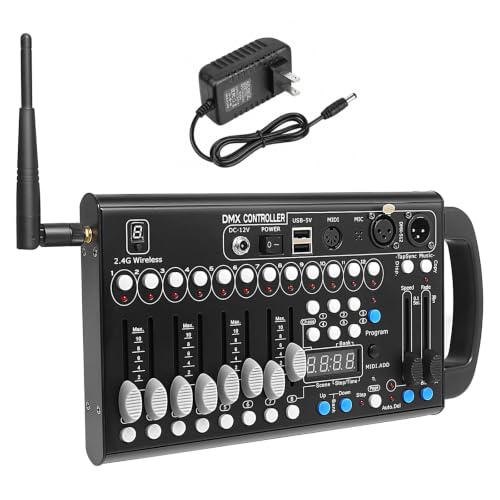
- 192 channels for up to 12 intelligent lights
- 240 scenarios and six programmable chases
- Mic, MIDI, tap-sync, and automatic modes
Best For: Smaller mobile DJ rigs, parties, weddings, and club setups
Full-Size Fixture Control
Rockville ROCKFORCE 384 DMX Controller

- 384 channels control up to 24 intelligent lights
- 30 scene banks and six programmable chases
- MIDI, music mode, manual override, and gooseneck lamp
Best For: Larger mobile DJ, club, and stage lighting systems
Wireless Event Flexibility
DMX512 384 Wireless/Wired Controller

- 384-channel DMX512 control for up to 12 lights
- 2.4G wireless and 3-pin wired operation
- Sound, MIDI, manual, and automatic modes
Best For: Weddings, bars, discos, and mobile events needing flexible connections
Best Standalone Pick – ADJ WMX1 MK2 WolfMix Bundle
For mobile DJs who want capable dmx controllers for mobile djs without carrying a laptop, the ADJ WMX1 MK2 bundle combines standalone control with a protective Decksaver cover. Its touchscreen, physical buttons, fixture library, and BPM-sync features are suited to fast event setups.
Best For: Mobile DJs, event technicians, houses of worship, and venues needing compact standalone lighting control.
Pros:
- Standalone operation with a 4.3-inch touchscreen and 37 backlit buttons
- Supports up to four DMX universes and 3,500+ built-in fixture profiles
- Includes a polycarbonate Decksaver cover for transport protection
- Offers BPM detection, MIDI, audio input, and four DMX outputs
Cons:
- Its advanced feature set may require more training than a basic controller
- Additional fixture profiles require the WTOOLS app
The WMX1 MK2 is a strong choice when quick, computer-free operation and rugged portability matter more than the simplest possible interface.
Best Wireless Software Interface – CHAUVET DJ Xpress 1024W
The CHAUVET DJ Xpress 1024W is a compact interface for mobile DJs who prefer software-based lighting control with wireless access. Its dual-mode Wi-Fi, ShowXpress compatibility, and mobile-app support allow scenes to be programmed or triggered from several platforms.
Best For: DJs, venues, and event productions already using ShowXpress software or mobile-device control.
Pros:
- Dual-mode Wi-Fi supports existing networks or its own access point
- Controls two DMX universes and unlocks an additional Art-Net universe
- Works with Windows, Mac, Linux, iOS, Android, and Raspberry Pi systems
- Provides isolated 3-pin XLR outputs with hot-swappable reconnection
Cons:
- Requires ShowXpress software for its primary operation
- It is an interface rather than a standalone console with built-in lighting controls
This is a flexible pick for software-oriented users who value wireless scene triggering and broad device compatibility over standalone operation.
Best Budget Manual Console – DMX512 384CH DJ Controller
This 384-channel DMX512 console offers a traditional approach for mobile DJs and small stage setups. With programmable banks, scenes, compact construction, and an LED gooseneck light, it provides hands-on control for programmed lighting looks.
Best For: Bar, club, and live-show operators who want a straightforward hardware console for scene programming.
Pros:
- Provides 384 DMX channels for detailed fixture control
- Offers 30 banks with eight programmable scenes each
- Compact design includes side handles and an LED gooseneck light
- Supports 110–240V AC power input according to the supplied specifications
Cons:
- Does not list wireless, touchscreen, or software-based control features
- The product notes do not specify fixture-profile support
For operators comfortable programming scenes manually, this console supplies substantial channel capacity in a compact format without adding computer-based complexity.
Best Dimmer/Relay Add-On – CHAUVET DJ DMX-4
The CHAUVET DJ DMX-4 is a four-channel dimmer/relay pack rather than a complete lighting console. For mobile DJs building a modular rig, it can add control for compatible lighting loads, with each channel configurable as either a dimmer or relay.
Best For: Mobile DJ rigs that need a compact four-channel DMX dimmer or relay module.
Pros:
- Four-channel DMX-512 dimmer/relay design
- Each channel can be assigned as a dimmer or relay
- Channels can be set to any DMX address
- Offers 0–100% variable dimming and adjustable speed control
Cons:
- It is an add-on pack, not a standalone DMX controller
- Its four-channel capacity is limited compared with full lighting consoles
The DMX-4 makes sense when you already have a primary controller and need dependable, configurable dimmer or relay functionality in a metal enclosure.
Best App-Based Pick – MyDMX Go
For mobile DJs who want a compact, tablet-driven setup, the ADJ MyDMX Go provides app-based wireless lighting control without requiring traditional programming. Its 256-channel interface supports iPad and Android tablets, Wi-Fi and USB connectivity, and a library of more than 15,000 fixtures.
Best For: Mobile DJs who prefer touch-screen control, quick effects, and lightweight event setups.
Pros:
- App-based control works with iPad and Android tablets.
- Supports up to 256 DMX channels and two lighting universes.
- Offers 50 user presets, 21 automatic effects, and no-programming operation.
- Includes an extensive fixture library and truss-mounting O-Clamp brackets.
Cons:
- Requires a compatible tablet for the app-based interface.
- Its compact interface is less suited to DJs who prefer physical sliders.
The MyDMX Go is a practical choice when portability and fast setup matter more than hands-on fader control. It is especially appealing for DJs who want to build lighting looks quickly from a tablet.
Best Traditional Controller – CHAUVET DJ Obey 10
The CHAUVET DJ Obey 10 is a conventional DMX controller for mobile DJs who want dedicated hardware rather than an app. It controls up to eight intelligent lights, with up to 12 channels per fixture and 96 DMX channels overall.
Best For: DJs who prefer physical DMX controls for programmed chases and straightforward fixture management.
Pros:
- Controls up to eight intelligent lights.
- Provides 96 DMX channels with up to 12 channels per light.
- Supports six chases with up to 999 steps each.
- Offers sequential linking of chases for structured shows.
Cons:
- Has less overall channel capacity than the other controllers in this roundup.
- Does not offer the supplied notes’ wireless, app, MIDI, or music-synchronization features.
The Obey 10 keeps lighting control focused and hardware-based. Its chase capacity makes it a sensible fit for mobile DJs who value repeatable sequences and do not need wireless or tablet operation.
Best High-Capacity Wireless Option – Rockforce W4
The Rockville ROCKFORCE W4 is a high-capacity choice among DMX controllers for mobile DJs, combining 384 channels with a built-in 2.4GHz wireless transmitter. It can control up to 24 intelligent lights, while MIDI, music sync, and manual override add flexibility during live events.
Best For: Mobile and professional setups needing wireless control, many programmable scenes, and physical sliders.
Pros:
- Controls up to 24 lights with 16 channels each and 384 channels total.
- Wireless transmitter supports up to seven light groups and 25 receivers.
- Includes 30 banks of eight scenes, six chases with 240 scenes, MIDI, and music sync.
- Provides 16 sliders, wired DMX in/out, and a rugged rack-mountable design.
Cons:
- At 6.2 pounds, it is less lightweight than simpler mobile controllers.
- Wireless compatibility is specified for Rockville, Chauvet, and American DJ lights.
- Its larger feature set may be more than needed for small lighting rigs.
With substantial channel capacity and both wireless and wired connections, the ROCKFORCE W4 is built for expandable event systems. Its sliders and manual override also suit DJs who want immediate physical control while running programmed scenes.
Compact Scene Builder – Wireless DMX Controller 192
For mobile DJs seeking practical dmx controllers for mobile djs, this 192-channel console offers a compact way to manage multiple stage lights, scenes, and chases. Its built-in microphone, MIDI beat activation, tap synchronization, and automatic operation support both hands-on and rhythm-driven lighting.
Best For: Mobile DJs, bands, weddings, bars, clubs, and house parties using up to 12 intelligent lights.
Pros:
- 192 channels can control up to 16 lights with 12 channels each.
- Provides 240 scenarios, six chases, and simultaneous chase operation.
- Includes built-in microphone, MIDI beat activation, tap sync, and automatic modes.
- Compact aluminum housing measures approximately 11.42 by 6.3 by 1.77 inches.
Cons:
- Its 192-channel capacity is lower than the 384-channel alternatives.
- The supplied information indicates wired 3-pin DMX connectivity rather than wireless transmission.
This is a sensible portable choice when you want scene and chase control without a larger console. It is especially suitable for smaller mobile setups that can work within its 192-channel and 12-light configuration.
Full-Size Fixture Control – Rockville ROCKFORCE 384 DMX Controller
The Rockville ROCKFORCE 384 is one of the more expansive dmx controllers for mobile djs, with enough capacity for up to 24 intelligent lights using 16 channels each. Its programmable banks, chases, MIDI control, and music mode make it suited to repeatable lighting shows and live operation.
Best For: Mobile DJs and performers managing larger club, stage, or event lighting systems.
Pros:
- 384 channels support up to 24 intelligent lights with 16 channels each.
- Stores 30 banks of eight scenes and six programmable chases, totaling 240 scenes.
- Offers MIDI control, a built-in microphone, adjustable fade times, and chase speeds.
- Metal housing, LED display, gooseneck lamp, manual override, and power-failure memory improve live usability.
Cons:
- At about 20.71 inches long and 5.3 pounds, it is less compact for highly portable setups.
- The supplied details describe 3-pin XLR DMX connections and do not list wireless DMX operation.
- Its larger feature set may be more than needed for small lighting rigs.
Choose this controller when fixture count and detailed programming matter more than minimizing case space. The metal construction and included LED gooseneck lamp are useful additions for darker performance environments.
Wireless Event Flexibility – DMX512 384 Wireless/Wired Controller
This DMX512 console stands out among dmx controllers for mobile djs by combining 2.4G wireless transmission with traditional 3-pin XLR wired operation. It also provides sound activation, MIDI, manual and automatic modes, plus programmable scenes for weddings, bars, discos, and indoor stages.
Best For: Mobile DJs and event operators who need flexible wired or wireless lighting layouts.
Pros:
- Supports 384-channel DMX512 control and up to 12 intelligent lights.
- Offers both 2.4G wireless and wired 3-pin XLR operation.
- Includes sound-activated, MIDI, automatic, and manual control modes.
- Stores 30 banks and 240 static scenes with scene copy, insert, and delete functions.
Cons:
- Its stated fixture capacity is up to 12 intelligent lights, fewer than some 384-channel controllers.
- The product requires a 9V battery according to the supplied details, which adds a maintenance consideration.
- The supplied information does not specify the wireless range or battery runtime.
For venues where cable runs can change from gig to gig, the dual-mode design offers useful setup flexibility. Its compact housing and scene-management features make it a practical fit for event-focused lighting control.
How We Picked the Best Dmx Controllers for Mobile Djs
We focused on features that matter when lighting gear travels between weddings, clubs, private events, churches, and small stages. Our comparisons consider channel and fixture capacity, number of DMX universes, wired versus wireless operation, programming controls, MIDI and software compatibility, portability, and the type of lighting workflow each controller supports.
We also separated simple controllers from more advanced systems. A compact console may be ideal for basic scenes and manual adjustments, while a standalone or software-based controller can better handle moving lights, LED fixtures, multiple universes, and repeatable show programming.
Quick Comparison
| Controller type | Best for | What to prioritize |
|---|---|---|
| Standalone console | Reliable gig-to-gig operation | Fixture capacity, playback controls, portability |
| Wireless DMX controller | Fast setups and reduced cabling | Range, interference handling, receiver compatibility |
| Software or app controller | Visual programming and flexible shows | Device support, wireless network stability, software features |
| Compact 192- or 384-channel console | Basic LED and effect-light control | Scene storage, sound activation, ease of use |
| Dimmer or relay pack | Simple fixture switching and dimming | Load compatibility, safety ratings, channel layout |
Key Buying Factors for Dmx Controllers for Mobile Djs
Channel and Universe Capacity
Count the DMX channels required by every fixture, not just the number of lights. Moving heads and advanced LED fixtures can use many channels each. Leave room for future additions, and consider a two-universe controller if your rig may outgrow a single output.
Programming and Playback
Look for scene, bank, chase, and blackout controls that match your performance style. Physical faders can be useful for quick manual changes, while app and computer systems may make complex programming easier. Sound activation is convenient for simple automatic shows but should not replace reliable manual control.
Wireless, Wired, and MIDI Options
Wireless DMX reduces cable runs, but it depends on compatible transmitters, receivers, range, and a clean radio environment. Wired DMX remains a dependable fallback. MIDI support is valuable if you want to trigger lighting from a DJ controller, keyboard, sequencer, or show-control system.
Portability and Reliability
Mobile entertainers should check dimensions, protective cases, power requirements, connector type, and setup time. A controller with extensive features is less useful if it is difficult to transport or operate under pressure. Save and test scenes before each event, and carry essential DMX and power backups.
Who Should Buy Which Dmx Controllers for Mobile Djs?
Choose a standalone console if you want lighting control without relying on a laptop or tablet. These are strong choices for repeatable event work and quick access to physical controls.
Choose a wireless or MIDI-equipped controller if you frequently change venue layouts, want fewer cables, or plan to trigger lighting alongside music. Verify that your fixtures support the required wireless system or DMX connection.
Choose an app or software-based system if you prefer visual programming, advanced fixture control, or multiple universes. It is best for users willing to manage software, device compatibility, and network setup.
Choose a compact entry-level controller for a small rig using conventional LED pars, simple effects, or a limited number of fixtures. For larger productions, prioritize expansion capacity and more sophisticated playback controls instead of buying only for the lowest price.