
Digitizing books, manuscripts, photographs, and other bound materials requires more than a high megapixel count. The right scanner must capture pages clearly while minimizing handling, distortion, and strain on fragile originals.
We selected 10 book scanners for archival projects across overhead, portable, flatbed, and large-format designs. Use the guide below to compare their strengths and choose a setup that fits your collection, workflow, and budget.
Best 10 Book Scanners for Archival Projects Picks for 2026
Professional A3 Detail
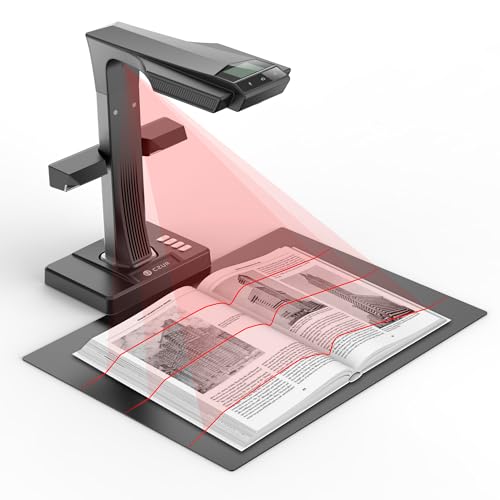
- 24MP camera with up to 5696 × 4272 resolution
- A3 capture with curved-page flattening
- OCR supports 180+ languages
Best For: Desktop archival projects needing detailed A3 scans and OCR
Fragile-Material Specialist
VIISAN S48 Duo Overhead Scanner
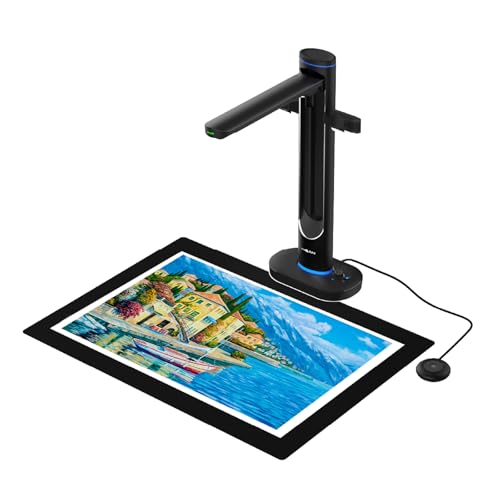
- Overhead capture supports materials up to A2
- Dual 48MP cameras with up to 600 DPI
- AI processing, OCR, and text-to-speech
Best For: Archives handling oversized or fragile bound materials
Portable Workflow Pick
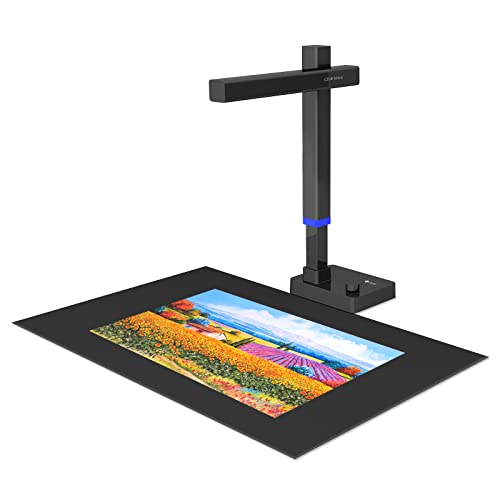
- Foldable, height-adjustable design weighs about 2 pounds
- 24MP imaging reaches 5696 × 4272 resolution
- Creates searchable PDFs and editable office files
Best For: Mobile archival scanning and compact research setups
High-Throughput Value

- Continuous shooting reaches up to 40 pages per minute
- Automatic flattening, finger removal, and smart paging
- Supports A3/A4 workflows and Windows multi-format export
Best For: Fast book digitization with automated page cleanup
High-Resolution Choice
CZUR ET MAX Professional Book Scanner

- 38MP capture with 410 DPI detail
- Flattens curved bound-book pages
- OCR supports 180+ languages
Best For: Detailed, searchable archival scans of bound books and A3 documents
Large-Format Flatbed
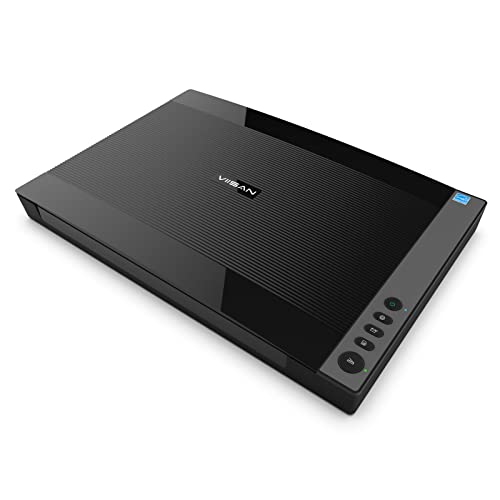
- A3 scanning area for oversized materials
- 1200 DPI optical resolution
- Eight-second A3 color scans at 200 DPI
Best For: Flat books, artwork, photos, and large archival documents
Portable Book Workflow

- Corrects curved pages with three laser lines
- Scans pages in about two seconds
- Auto-detects page turns and scans
Best For: Fast, hands-free digitization of bound books and A3-sized material
Best Large-Format Pick

- Captures pages and materials up to A2 size
- 26MP imaging with software-enhanced output up to 600 DPI
- Auto-flattening, OCR, page splitting, and finger removal
Best For: Oversized archival books, maps, newspapers, and manuscripts
Best Fast Workflow

- Scans a page in about two seconds
- Supports searchable PDF, Word, PDF, and JPG output
- Laser flattening and 180-plus-language OCR
Best For: Fast A3/A4 book digitization and searchable document creation
Best Simple Pick

- Up to 48MP capture with stated 600 DPI capability
- AI page flattening and automatic page splitting
- OCR, text-to-speech, and 4K document-camera modes
Best For: Detailed A3 archival scans plus teaching and document sharing
Professional A3 Detail – CZUR ET24 Pro
For archival teams seeking book scanners for archival projects, the CZUR ET24 Pro combines a 24MP camera, A3 capture area, page-flattening technology, and OCR in a desktop setup. Its HDMI connection and three-angle lighting add flexibility when digitizing books, documents, magazines, and other materials.
Best For: Desktop archival work requiring high-resolution A3 capture, OCR, and broad operating-system support.
Pros:
- 24MP camera captures up to 5696 × 4272 resolution at a stated 320 DPI.
- Page-flattening technology helps correct curved book pages after image processing.
- Supports A3-size materials and OCR in more than 180 languages.
- HDMI connectivity and side/head lighting provide useful workflow flexibility.
Cons:
- Very glossy papers are not recommended.
- Thai and Hebrew are not supported for OCR, and Arabic support varies by operating system.
- At 4.5 kg, it is less portable than compact document-camera designs.
The ET24 Pro is a strong fit when image detail, large-format capture, and OCR matter more than portability. Check the lighting and language limitations against your collection before buying.
Fragile-Material Specialist – VIISAN S48 Duo Overhead Scanner
The VIISAN S48 Duo is designed for book scanners for archival projects where oversized or fragile materials should be captured without pressing down on bindings. Its overhead, dual-camera design supports A2-size originals, while built-in processing assists with curved pages, distortion, and background cleanup.
Best For: Libraries, schools, and archives digitizing oversized books, maps, manuscripts, and bound materials with minimal handling.
Pros:
- Overhead design scans up to A2 size without flattening or damaging fragile pages.
- Dual 48MP cameras provide up to 600 DPI capture for text, lines, and color detail.
- AI processing helps flatten pages, remove finger marks, correct edge distortion, and clean backgrounds.
- OCR, text-to-speech, and UVC camera functionality support accessibility and live teaching.
Cons:
- The feature set may be more than needed for straightforward document scanning.
- Requires a USB 2.0 port, at least 4GB RAM, and recommended 20GB of hard-drive space.
- Its large-format overhead setup is less suited to highly portable workflows.
Choose the S48 Duo when protecting bindings and capturing large originals are central priorities. It also stands out for archival workflows that need searchable or audio-ready content.
Portable Workflow Pick – CZUR Shine Ultra Pro
For researchers who need book scanners for archival projects in more than one location, the CZUR Shine Ultra Pro offers a foldable USB document-camera design weighing about 2 pounds. It can flatten curved pages and export scans as JPG, PDF, searchable PDF, Word, or Excel files.
Best For: Mobile researchers and small archival workflows that value portability and flexible file conversion.
Pros:
- 90-degree foldable, height-adjustable design is convenient for transport and storage.
- 24MP imaging provides up to 5696 × 4272 resolution.
- Page-flattening technology assists with curved book surfaces.
- Exports to JPG, PDF, searchable PDF, Word, and Excel formats.
Cons:
- It is a USB-connected document scanner, so it requires a computer during use.
- The supplied notes do not specify an A3 capture size or a DPI figure.
- Compared with heavier desktop models, its lightweight design may be less suited to fixed high-volume stations.
The Shine Ultra Pro is appealing when equipment needs to move between reading rooms, offices, or field locations. Its format conversion and searchable-PDF support make it practical for organizing captured material.
High-Throughput Value – JOYUSING V320pro Book Scanner
The JOYUSING V320pro targets book scanners for archival projects that involve repeated page capture and mixed document sizes. Its software uses automatic continuous shooting, page flattening, finger removal, and smart paging, with a stated scanning speed of up to 40 pages per minute.
Best For: Windows users and mixed Windows/macOS workflows prioritizing fast capture, automatic cleanup, and A3/A4 flexibility.
Pros:
- Continuous shooting is rated at up to 40 pages per minute.
- Four laser lines support book-curve flattening, while software offers finger removal and smart paging.
- Switches between A3 and A4 workflows and supports PDF, image, video, and scanning modes.
- Converts to PDF, Word, and Excel on Windows, with PDF output on Mac.
Cons:
- The stated resolution is 260 DPI, lower than several higher-resolution models in this roundup.
- It is designed for books up to 3 cm thick.
- Full multi-format conversion is more limited on Mac than on Windows.
The V320pro makes the most sense for projects where speed and automated page handling outweigh maximum image resolution. Confirm your operating system and required output formats before committing to it.
High-Resolution Choice – CZUR ET MAX Professional Book Scanner
For book scanners for archival projects, the CZUR ET MAX is designed for detailed, efficient capture of bound books and large documents. Its 38MP CMOS sensor, page-flattening technology, and OCR make it suited to digitizing material without unbinding it.
Best For: Archives needing high-resolution scans, searchable files, and support for bound books up to A3 size.
Pros:
- 38MP sensor captures detailed 7168 × 5376 images at 410 DPI.
- Curve-flattening technology reduces distortion from bound pages.
- OCR supports more than 180 languages and exports searchable or editable files.
- Works with Windows, macOS, and Ubuntu 20.04–24.04 Linux systems.
Cons:
- Not recommended for glossy or highly reflective materials.
- Arabic OCR is limited by operating system, while Thai and Hebrew are unsupported.
The ET MAX is a strong archival option when image detail, OCR, and non-destructive book handling matter more than a traditional flatbed workflow. Its HDMI output is also useful for live demonstrations or projection.
Large-Format Flatbed – VIISAN VF3120 A3 Scanner
The VIISAN VF3120 is a practical choice among book scanners for archival projects when flat, oversized materials need consistent color capture. Its A3 bed, 1200 DPI optical resolution, and frameless design accommodate books, albums, artwork, and other large documents.
Best For: Libraries, schools, and home offices scanning flat books, albums, photos, artwork, and large paper documents.
Pros:
- Scans materials up to approximately 11.98 × 16.8 inches.
- Offers 1200 × 1200 DPI optical resolution and 48-bit color depth.
- Scans an A3 color page in about eight seconds at 200 DPI.
- Auto-Scan and frameless design support efficient scanning of thick items.
Cons:
- CIS technology is intended for flat paper images, not three-dimensional objects.
- Windows WIA scanning is limited to 600 DPI; 1200 DPI requires supplied software.
- The large scanner has a substantial footprint.
Choose the VF3120 when a conventional flatbed workflow and large scanning area are priorities. It is less suitable for strongly curved pages or objects that cannot rest flat on the glass.
Portable Book Workflow – CZUR Aura Pro A3 Scanner
The CZUR Aura Pro offers a flexible approach to book scanners for archival projects, combining curved-page correction with portable A3-size scanning. Its automatic page detection, optional foot pedal, and supplemental side lights are useful for repeated book digitization.
Best For: Users who want fast, hands-free scanning of books and documents smaller than A3 without removing pages from the binding.
Pros:
- Three laser lines help flatten and reproduce curved book pages.
- Scans single sheets and double-page books in about two seconds per page.
- Auto-detects page turns and can trigger scans automatically.
- Supplemental side lights help reduce reflections on glossy paper.
Cons:
- OCR excludes Thai, Hebrew, and Arabic according to the supplied notes.
- Sound-controlled lamp functionality can be affected by noise and distance.
- Its listed resolution is 1300, lower than the ET MAX’s 38MP specification.
The Aura Pro is appealing for operators who value speed and portability alongside book-page correction. Its automated workflow can reduce repetitive button presses during longer scanning sessions.
Best Large-Format Pick – VIISAN S21 A2 Book Scanner
For archival projects involving oversized books, newspapers, manuscripts, maps, or other large materials, the VIISAN S21 stands out among book scanners for archival projects because it captures up to A2-size pages. Its overhead design combines 26MP imaging with software-assisted page flattening, finger removal, page splitting, and OCR.
Best For: Large-format archival materials and users who need OCR plus flexible document-camera functions.
Pros:
- Captures materials up to A2 size, with adjustable A2/A3 scanner height.
- 26MP resolution and software-enhanced output up to 600 DPI support detailed captures.
- Software can flatten curved pages, remove fingers, repair damaged edges, split pages, and create editable or searchable files.
- Supports Windows and macOS, with a foldable hinge and built-in adjustable LED lighting.
Cons:
- Bundled OfficeCam software is not compatible with ARM-based devices such as the Surface Pro X.
- Glare-prone paper is not recommended, and the built-in LEDs are not intended for bright-light use.
- Its large-format overhead design may require more workspace than a compact scanner.
The S21 is a strong choice when page size and automated cleanup matter most. Confirm your computer uses a supported x64 or x86 Windows setup or compatible macOS device before buying.
Best Fast Workflow – CZUR Aura Pro A3 Book Scanner
The CZUR Aura Pro is a practical option for book scanners for archival projects when speed, compact operation, and searchable output are priorities. It scans a page in about two seconds, supports A3 and A4 materials, and uses laser-guided flattening technology to improve captures of curved book pages.
Best For: Rapid digitization of A3/A4 books and documents where searchable PDFs and broad OCR support are useful.
Pros:
- Scans at a stated speed of approximately two seconds per page.
- Outputs JPG, Word, PDF, and searchable PDF files.
- OCR supports more than 180 languages, though some languages are excluded.
- Three laser lines help flatten curved pages, while 32 LEDs and supplemental lights support even illumination.
Cons:
- Thai, Hebrew, and Arabic are not currently supported for OCR.
- Uses a USB connection and does not require or provide Wi-Fi or Bluetooth connectivity.
- Its A3 capture size is smaller than the A2 capacity offered by some large-format models.
With fast page handling and useful OCR formats, the Aura Pro suits organized scanning sessions involving standard-size bound materials. Check the supported operating-system and OCR-language requirements for your workflow.
Best Simple Pick – VIISAN K48 48MP Scanner
The VIISAN K48 is designed for book scanners for archival projects that require detailed captures and a streamlined workflow for bound materials. Its A3 overhead format combines up to 48MP image capture, stated 600 DPI capability, AI-assisted page flattening, automatic page splitting, and OCR for searchable or editable files.
Best For: Detailed A3 book and document scanning, especially when the same device may also be used for teaching or live document sharing.
Pros:
- Captures fine text, diagrams, and printed materials with up to 48MP clarity and stated 600 DPI capability.
- AI-assisted flattening and automatic page splitting can reduce manual cleanup.
- OCR creates searchable PDFs and editable documents, with text-to-speech for audio playback files.
- Functions as a 4K USB document camera at 30fps for teaching, presentations, and document sharing.
Cons:
- Its A3 capture format may not accommodate oversized A2 materials.
- USB connectivity requires a compatible Windows or Mac computer for operation.
- At 2.8 kg, it is less lightweight than some compact overhead scanners.
The K48 offers a capable mix of high-resolution capture, automated book processing, OCR, and camera functionality. It is particularly appealing for users who want one desktop device for archival digitization and live document presentation.
How We Picked the Best Book Scanners for Archival Projects
We compared these scanners by looking at image resolution, capture area, page-flattening technology, OCR support, file-format options, scanning speed, portability, and ease of use. We also considered whether each design is better suited to bound books, loose documents, photographs, oversized pages, or mixed archival collections.
Specifications such as megapixels and advertised DPI are useful starting points, but they do not tell the whole story. Lighting consistency, camera alignment, software quality, and the ability to correct curved pages can have a larger effect on usable results.
Quick Comparison
| Scanner type | Best for | Main advantage | Potential limitation |
|---|---|---|---|
| Overhead book scanner | Bound books and delicate originals | Fast, low-contact capture | Needs desk space and controlled lighting |
| Large-format overhead scanner | Maps, newspapers, and oversized books | Broad capture area | Usually larger and less portable |
| Portable document camera | Mobile or occasional scanning | Easy to store and transport | May require careful positioning |
| Flatbed scanner | Photos, loose pages, and detailed artwork | Consistent contact-based capture | Slower and less convenient for bound books |
Key Buying Factors for Book Scanners for Archival Projects
Resolution and Image Quality
Higher resolution can preserve small type, marginalia, illustrations, and fine photographic detail, but it also creates larger files. For text-heavy collections, a well-lit 16MP to 24MP camera may be sufficient; detailed photographs, maps, and oversized material can benefit from higher-resolution models or a true flatbed design.
Page Flattening and Book Protection
Automatic page flattening, curve correction, and finger-removal tools can make overhead scanners particularly useful for bound volumes. These features reduce editing time and help produce more readable pages without forcing a book completely flat. For rare or fragile materials, prioritize a low-contact workflow over maximum speed.
Capture Size and Workspace
Check the actual capture area rather than relying only on the product name. A3 scanners suit most books and documents, while A2-capable models are more appropriate for newspapers, maps, posters, and oversized volumes. Also measure the available desk space, including room for page turning and lighting.
OCR, Software, and Export Formats
OCR can turn image files into searchable or editable documents, but accuracy depends on typography, language, page condition, and image quality. Confirm that the software supports the languages and formats you need, such as searchable PDF, Word, TXT, or Excel. Keep high-quality image masters even if you create compressed access copies.
Connectivity and File Management
USB models are generally straightforward for computer-based workflows, but verify operating-system compatibility and software requirements. Archival projects also need a reliable naming system, backups, metadata, and storage planning because high-resolution scans can consume substantial capacity.
Who Should Buy Which Book Scanners for Archival Projects?
Choose an Overhead Scanner for Bound Collections
Overhead models are the most practical choice for books, journals, and manuscripts that should not be pressed flat. They offer quick page turning and useful correction features for routine digitization.
Choose a Large-Format Model for Oversized Material
If your collection includes maps, newspapers, architectural sheets, or large art books, select a scanner with an appropriately sized capture area. Avoid cropping oversized pages simply to fit a smaller platform.
Choose a Portable Scanner for Occasional or Mobile Work
Portable document cameras work well for researchers, teachers, small collections, and projects that move between locations. They are convenient, but consistent positioning and lighting become especially important.
Choose a Flatbed for Photos and Loose Originals
A flatbed scanner is often preferable for photographs, postcards, prints, and loose pages where even contact and predictable image quality matter more than rapid book handling.
For most home and small-institution collections, the best choice balances gentle handling, dependable software, and manageable file sizes rather than simply choosing the highest advertised resolution.