
The right MIDI interface can simplify a crowded hardware setup, improve timing, and make it easier to connect keyboards, drum machines, controllers, and software instruments. This roundup covers ten options under $1,000, from compact USB-to-MIDI cables to multi-port studio interfaces.
We focus on connection capacity, routing flexibility, compatibility, standalone operation, and overall usefulness for different recording and performance needs.
Best 10 Midi Interfaces Under 1000 Picks for 2026
Best Routing Value

- Standalone 3-in/3-out MIDI routing
- Broad OS compatibility
- Supports filtering, merging, and MPE
Best For: Complex keyboard and synth MIDI setups
Best for Recording
Focusrite Scarlett Solo 3rd Gen

- One mic preamp and one Hi-Z input
- 24-bit/192kHz recording
- Includes useful recording software
Best For: Solo recording, vocals, guitar, and podcasts
Best MIDI Merger

- Combines up to five MIDI inputs
- Two MIDI outputs with per-port filtering
- Standalone operation without a computer
Best For: Hardware setups with multiple MIDI controllers
Best for Large Setups
ESI M4U eX 8-Port MIDI Interface

- Eight adaptable MIDI ports
- Integrated three-port USB 3.0 hub
- Standalone routing and merging
Best For: Large studios with multiple MIDI and USB devices
Best MIDI Thru Box

- Routes one 5-pin MIDI input to five outputs
- Supports clock, SysEx, MPE, and other MIDI messages
- Compact USB-C-powered design for studio or stage
Best For: Expanding a traditional hardware MIDI rig
Best Recording Interface

- Combines USB audio recording with 5-pin MIDI I/O
- Includes two inputs, phantom power, balanced outputs, and headphones
- Comes with bundled software and a five-year warranty
Best For: Home studios recording instruments, vocals, and MIDI gear
Best USB MIDI Host

- Bridges USB MIDI devices and 5-pin DIN hardware
- Supports routing, filtering, mapping, and four presets
- Works standalone or with major desktop and mobile operating systems
Best For: Hybrid USB-and-DIN MIDI performance and production rigs
Best MIDI Splitter
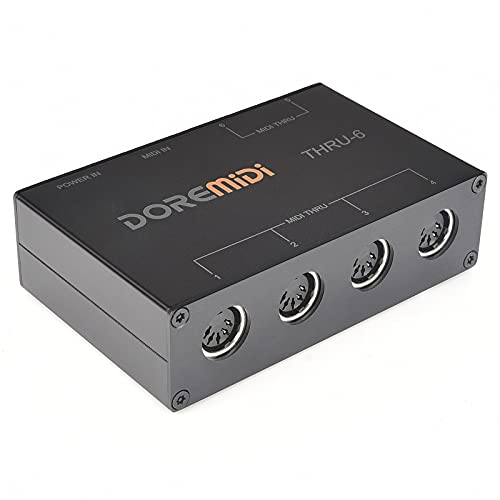
- 1-in/6-out MIDI routing
- Standard 16-channel support
- USB-powered, plug-and-play design
Best For: Distributing one MIDI source to up to six hardware devices
Best Heavy-Duty Pick
Behringer UMC1820 USB Audio/MIDI Interface

- 18x20 USB audio/MIDI connectivity
- Eight mic preamps with phantom power
- ADAT I/O for studio expansion
Best For: Multi-input recording studios needing MIDI and audio connectivity
Best USB MIDI Cable

- Plug-and-play USB-to-MIDI connection
- Filtering, mapping, and routing tools
- Compatible with major desktop and mobile OSes
Best For: Portable one-in/one-out MIDI connections with advanced control
Best Routing Value – CME U6MIDI Pro
For musicians comparing MIDI interfaces under 1000, the CME U6MIDI Pro is a compact choice when routing flexibility matters more than audio recording. Its standalone 3-in/3-out design supports MIDI merging, splitting, filtering, and mapping, while USB-C connectivity works with major desktop and mobile operating systems.
Best For: Keyboardists, electronic musicians, and home studios that need detailed MIDI routing without leaving a computer connected.
Pros:
- Standalone 3-in/3-out MIDI operation with router and filter functions.
- Supports MIDI notes, controllers, clock, SysEx, timecode, and MPE.
- Compatible with macOS, iOS, Windows, Android, Linux, and Chrome OS.
- Compact design with claimed low latency, no jitter, and error-free transmission.
Cons:
- Handles MIDI only, not microphone or instrument audio.
- Advanced configurations require the UxMIDI Tools software.
The U6MIDI Pro stands out for compact, computer-free MIDI control and broad device compatibility. It is a strong fit for complex keyboard or synth setups that need reliable routing in a small enclosure.
Best for Recording – Focusrite Scarlett Solo 3rd Gen
Among MIDI interfaces under 1000, the Scarlett Solo 3rd Gen is better suited to creators who also need to record vocals or instruments. It combines one XLR microphone preamp, one Hi-Z instrument input, headphone monitoring, and USB connectivity in a compact audio interface.
Best For: Solo musicians, podcasters, and home-recording beginners who need audio inputs alongside a computer-based music setup.
Pros:
- Records at up to 24-bit/192kHz with high-performance converters.
- Includes an XLR mic input and dedicated Hi-Z guitar or bass input.
- Air mode and Gain Halos support practical recording adjustments.
- Includes several software packages, including Ableton Live Lite and Pro Tools Intro+.
Cons:
- It is an audio interface rather than a dedicated multi-port MIDI interface.
- Only two input channels are provided.
- Listed operating-system support centers on Mac, Windows, and iPadOS.
The Scarlett Solo is the most versatile option here for recording real-world audio, but it should not be chosen as a substitute for a DIN-based MIDI router. Choose it when microphone and instrument recording are central to your workflow.
Best MIDI Merger – MERGE-5 Pro MIDI Merger
For shoppers seeking MIDI interfaces under 1000 that can combine several controllers, the MERGE-5 Pro focuses on signal merging. It can combine up to five MIDI inputs into one stream and send the result through two MIDI outputs, with filtering available for each port.
Best For: Hardware-based MIDI rigs that combine multiple keyboards, controllers, or other standard MIDI devices.
Pros:
- Merges up to five MIDI input signals into one data stream.
- Provides two MIDI outputs for flexible signal distribution.
- Supports filtering on each MIDI port.
- Works standalone and handles Note, CC, PC, Clock, Time Code, and SysEx messages.
Cons:
- Its primary focus is merging rather than broad multi-function MIDI routing.
- Supplied details list a 30-day warranty.
- Computer compatibility is listed for Linux, Windows, and macOS.
The MERGE-5 Pro is a focused solution for expanding a hardware MIDI system with several inputs. Its standalone operation is useful on stage or in a rack where a computer-based merger would be inconvenient.
Best for Large Setups – ESI M4U eX 8-Port MIDI Interface
For larger studios comparing MIDI interfaces under 1000, the ESI M4U eX offers eight adaptable MIDI ports plus a built-in USB 3.0 hub. Its class-compliant, plug-and-play design supports flexible input and output assignments, while standalone routing and merging help it serve computer-free setups too.
Best For: Professional or expanding studios that need many MIDI connections and additional USB ports in one central unit.
Pros:
- Provides eight adaptable MIDI ports that can function as inputs or outputs.
- Built-in USB 3.0 hub adds three connectors for other devices.
- Standalone operation supports MIDI routing and merging without a computer.
- Works with Windows and macOS and includes optional advanced Windows driver support.
Cons:
- Larger and heavier than compact MIDI interfaces, at about 454 g.
- Optional Windows driver installation may be needed for complex multi-client setups.
- Its extensive port count may be unnecessary for a small MIDI rig.
The M4U eX is the most expandable option in this group, especially for studios with several MIDI devices and USB peripherals. Its adaptable ports and standalone mode make it a practical central hub for a busy setup.
Best MIDI Thru Box – CME MIDI Thru5 WC
CME MIDI Thru5 WC 1-in-5-out MIDI Thru | 5-pin DIN, High-speed, Optional Bluetooth
Check Price On AmazonFor shoppers comparing midi interfaces under 1000, the CME MIDI Thru5 WC is a focused solution for distributing one standard 5-pin MIDI input to five outputs. It is designed for accurate, low-latency synchronization in studio, stage, and pedalboard setups.
Best For: Musicians who need to route one MIDI source to multiple traditional MIDI devices without a computer.
Pros:
- Provides one MIDI input and five MIDI outputs for expanding a hardware setup.
- Supports MIDI channels and messages including notes, controllers, clock, SysEx, timecode, and MPE.
- Compact, lightweight housing with USB-C 5V power and opto-couplers to help prevent ground loops.
Cons:
- The USB-C port is for power only, not USB MIDI connectivity.
- It is a MIDI Thru distributor rather than a full audio interface or configurable MIDI router.
The MIDI Thru5 WC makes sense when reliable one-to-many DIN MIDI distribution is the priority. Its simple standalone design keeps the setup compact, though users needing computer integration or advanced routing should consider a different interface.
Best Recording Interface – Arturia MiniFuse 2
Among midi interfaces under 1000, the Arturia MiniFuse 2 stands out for buyers who want MIDI connectivity alongside recording features. It combines 5-pin MIDI I/O with microphone, instrument, and line inputs in a compact USB interface.
Best For: Home producers, vocalists, guitarists, and content creators who need audio recording plus MIDI connections.
Pros:
- Includes 5-pin MIDI input and output for synths, controllers, and drum machines.
- Offers two combo mic/instrument/line inputs with 48V phantom power, two balanced outputs, and a headphone output.
- Supports up to 192 kHz and includes Loopback, a USB hub, bundled software, and a five-year warranty.
Cons:
- It is larger and more feature-focused than a dedicated MIDI-only interface.
- The supplied details identify USB connectivity for computer use but do not describe standalone operation.
The MiniFuse 2 is a versatile choice if your MIDI setup is part of a broader recording workflow. Its audio I/O and included software add value, while the 5-pin connections preserve compatibility with traditional MIDI hardware.
Best USB MIDI Host – CME H2MIDI Pro
For flexible midi interfaces under 1000, the CME H2MIDI Pro bridges modern USB MIDI equipment with traditional 5-pin DIN hardware. It can work standalone as a USB host or connect to a computer and mobile device for routing, filtering, mapping, and preset-based control.
Best For: Producers and performers combining USB controllers, synths, pedals, and legacy DIN MIDI equipment in hybrid rigs.
Pros:
- Connects class-compliant USB MIDI devices directly to 5-pin DIN hardware without a computer.
- Supports up to eight USB MIDI device ports through a standard hub and provides USB-C computer connectivity.
- Offers routing, filtering, mapping, splitting, four presets, broad operating-system compatibility, and lifetime software updates.
Cons:
- Its advanced configuration features may be more than needed for a simple MIDI connection.
- It provides MIDI connectivity rather than audio recording inputs and outputs.
- A USB hub may be required to connect multiple USB MIDI devices.
The H2MIDI Pro is the most adaptable option here for mixed USB and DIN setups. Its compact form and software-controlled routing suit complex performance systems, while standalone host functionality removes the need for a computer in many configurations.
Best MIDI Splitter – 6-Output MIDI Thru Box
If you need multiple hardware connections, this MIDI Thru-6 Box is a practical choice among MIDI interfaces under 1000. It sends incoming MIDI data to six outputs, making it useful for connecting several instruments or devices to one controller or synth.
Best For: Musicians who need a simple, plug-and-play 1-in/6-out MIDI distribution box.
Pros:
- Provides one MIDI input and six MIDI Thru outputs.
- Supports standard MIDI channels and commands.
- USB-powered by 5V DC and requires no batteries.
- Works with Windows, macOS, and Linux systems.
Cons:
- Designed for MIDI signal distribution rather than audio recording.
- Requires a separate 5V DC USB power source.
Choose this model when your setup is centered on routing one MIDI source to several hardware devices. Its focused 1-in/6-out design is less suitable if you need MIDI-to-computer recording or audio inputs.
Best Heavy-Duty Pick – Behringer UMC1820 USB Audio/MIDI Interface
The Behringer UMC1820 is a strong option among MIDI interfaces under 1000 when MIDI connectivity is needed alongside extensive audio recording. It combines USB audio/MIDI operation, eight MIDAS-designed mic preamps, ADAT I/O, and high-resolution recording support.
Best For: Home studios and recording setups that need multiple microphone or instrument inputs plus MIDI and expansion connectivity.
Pros:
- Offers an 18×20 USB audio/MIDI interface configuration.
- Includes eight mic preamps with +48V phantom power.
- Provides ADAT I/O for system expansion.
- Supports up to 24-bit/96 kHz audio and popular recording software.
Cons:
- Its extensive I/O may be more than a basic MIDI-only setup requires.
- The supplied details list Mac OS X and Windows compatibility but do not specify every current operating-system version.
The UMC1820 makes the most sense for producers who want a full recording hub rather than a standalone MIDI adapter. Its large input/output count and ADAT support can accommodate a more demanding studio workflow.
Best USB MIDI Cable – CME U2MIDI Pro
The CME U2MIDI Pro is a compact choice among MIDI interfaces under 1000 for connecting one MIDI instrument to a computer or mobile device. Its plug-and-play USB cable supports filtering, mapping, and routing through the included UxMIDI Tools software.
Best For: Keyboardists and producers who need a portable one-in/one-out USB-to-MIDI connection with advanced MIDI control.
Pros:
- Provides 5-pin DIN MIDI input and output through a USB connection.
- Works with macOS, iOS, Windows, Android, Linux, and ChromeOS without drivers.
- Supports MIDI filtering, mapping, routing, and all 16 channels.
- Uses a high-speed optocoupler and includes smart LED indicators.
Cons:
- Offers one MIDI input and one MIDI output, limiting multi-device setups.
- Uses a USB-A connection, so some newer devices may require an adapter.
This cable is well suited to straightforward computer-to-instrument connections while adding useful routing and filtering options. Consider a multi-port interface instead if you need several simultaneous hardware connections.
How We Picked the Best Midi Interfaces Under 1000
We compared these Midi Interfaces Under 1000 by looking at the number and type of inputs and outputs, USB connectivity, routing capabilities, class-compliant operation, and suitability for computer-based and hardware-focused setups. We also considered whether each model is designed primarily for MIDI, combines MIDI with audio recording, or offers standalone functionality without a computer.
Because musicians have different workflows, the list includes simple one-cable solutions, MIDI thru boxes, multi-port patch-bay-style interfaces, and full audio/MIDI interfaces. The best choice depends less on price alone than on how many devices you need to connect and how much routing control you require.
Quick Comparison
- For basic computer-to-keyboard connections: CME U2MIDI Pro is the simplest option.
- For compact MIDI routing: CME U6MIDI Pro and CME H2MIDI Pro offer more flexibility in small setups.
- For splitting one signal: CME MIDI Thru5 WC and the MIDI Thru 6 Box provide multiple hardware outputs.
- For combining several MIDI sources: MERGE-5 Pro is designed to merge multiple inputs into one stream.
- For larger MIDI systems: ESI M4U eX provides eight ports and standalone functionality.
- For recording audio and MIDI together: Arturia MiniFuse 2, Focusrite Scarlett Solo, and Behringer UMC1820 add audio-interface features.
Key Buying Factors for Midi Interfaces Under 1000
Port Count and Signal Direction
Count your MIDI inputs and outputs before buying. A one-in/one-out cable may be enough for a single keyboard, while a multi-port interface is better for several synthesizers, controllers, or drum machines. Also check whether the device merges inputs, duplicates one signal across multiple outputs, or supports independent routing.
USB and Computer Compatibility
Class-compliant, plug-and-play models are convenient for modern Mac and PC systems, but confirm the required USB connector and operating-system support. If you plan to use the interface away from a computer, prioritize a model with standalone operation or hardware-based routing.
MIDI Timing and Routing
Hardware setups benefit from reliable signal handling, filtering, and fast data transfer. Look for features such as MIDI mapping, filtering, optocoupled inputs, or configurable routing when you need tighter control over clock, notes, controllers, and synchronization.
Audio Features
If you also record microphones, instruments, or line-level sources, an audio/MIDI interface may offer better value than a dedicated MIDI box. However, dedicated MIDI hardware generally provides more ports and routing flexibility for synth-heavy systems.
Who Should Buy Which Midi Interfaces Under 1000?
Choose a compact USB-to-MIDI interface if you have one keyboard or hardware instrument. Pick a thru box when one controller or sequencer must feed several devices simultaneously. A merger is more suitable when multiple MIDI sources need to share one destination.
For expanding studios, an eight-port interface offers room to grow and can reduce cable swapping. Musicians who need microphones, instruments, and MIDI in one device should consider an audio interface with MIDI connections, with the Behringer UMC1820 standing out for larger recording setups. Smaller recording rigs may prefer the Focusrite Scarlett Solo or Arturia MiniFuse 2. Before ordering, map every current connection and leave at least one or two ports available for future gear.