
The best compact audio equalizers give you practical control over bass, mids, and treble without requiring a large studio rack or complicated signal chain. The right model can refine a car system, improve headphone listening, or add flexible tone shaping to a home stereo.
Our selection covers compact graphic and parametric equalizers for vehicles, desktop systems, headphones, recording, and DJ use. Compare connectivity, control range, installation requirements, and output options before choosing.
Best 10 Compact Audio Equalizers Picks for 2026
Best High-Output Car EQ
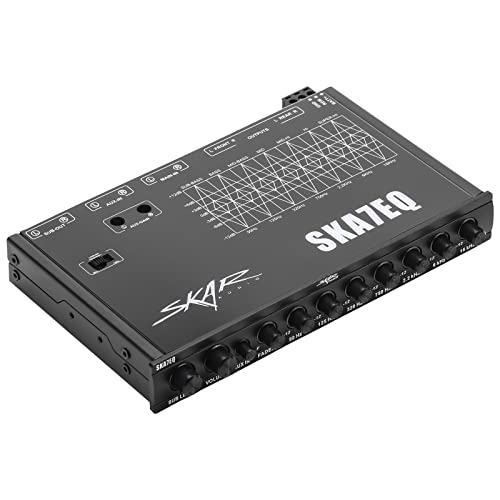
- Seven adjustable EQ bands
- 7V RCA outputs for front, rear, and subwoofer
- Main and auxiliary RCA inputs
Best For: Detailed car-audio system tuning
Best Portable Headphone EQ

- Bass, midrange, and treble controls
- 3.5mm and 6.35mm headphone jacks
- Up to 2400mW and six-hour battery life
Best For: Portable headphone and instrument setups
Best Parametric Car EQ
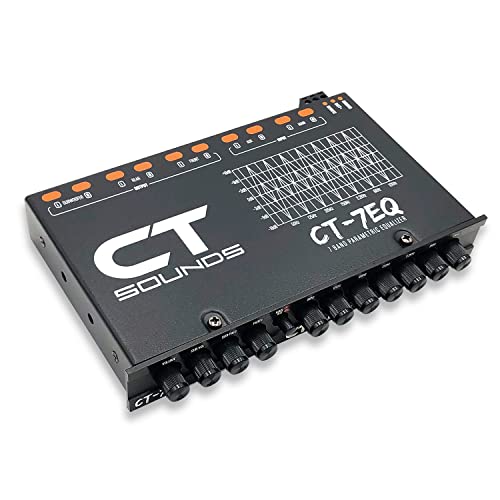
- Seven segments across 20 Hz–20 kHz
- Separate bass, mid, treble, and sub-bass controls
- Includes mounting brackets and hardware
Best For: Customizable 1/2 DIN car-audio installations
Best Flexible Desktop EQ

- Seven bands with ±12 dB adjustment
- Dual-channel preamp with stated 14 dB gain
- 3.5mm headset and microphone support
Best For: Streaming, podcasting, and headphone setups
Best Bluetooth Pick

- Five-band tone control with independent op-amp processing
- Bluetooth 5.0 wireless streaming
- Dual adjustable VU meters and compact metal case
Best For: Home listeners wanting wireless playback and visual level monitoring
Best Car Audio Routing

- Seven-band graphic equalization
- Four inputs and six outputs
- Dedicated subwoofer level and frequency controls
Best For: Multi-source car-audio systems with several amplifiers
Best Balanced Home Setup
Douk Audio T7 7-Band Equalizer

- Seven bands with ±6dB adjustment
- XLR and RCA inputs and outputs
- High SNR and low reported distortion
Best For: Home systems needing balanced or unbalanced connectivity
Rack-Mount Control

- Dual-channel 15-band control
- Low-cut and bypass switches
- XLR and 1/4-inch connectivity
Best For: Rack-based home audio, DJ, live, and studio setups
Car Audio Tuning

- Seven-band stereo adjustment
- Three RCA stereo outputs
- Compact 12V car-audio design
Best For: RCA-based vehicle audio systems
Detailed Frequency Shaping

- Dual-channel 31-band control
- Low-cut and bypass functions
- Four-segment LED monitoring
Best For: Detailed live, studio, and installation tuning
Best High-Output Car EQ – 7-Band Pre-Amp Equalizer
The SKA7EQ is a practical choice among compact audio equalizers for car systems that need flexible tone shaping and multiple RCA connections. Its seven adjustable bands, selectable inputs, and dedicated subwoofer controls give installers considerable control in a 1/2 DIN footprint.
Best For: Car-audio systems needing high-voltage RCA outputs, front/rear/subwoofer control, and an auxiliary input.
Pros:
- Seven bands provide ±12 dB adjustment from 50 Hz to 16 kHz.
- Offers main and auxiliary RCA inputs with variable auxiliary gain.
- Provides front, rear, and subwoofer RCA outputs, with variable subwoofer level control.
- Includes mounting brackets and hardware, plus a two-year limited warranty.
Cons:
- Its 1/2 DIN installation is primarily suited to vehicle audio setups.
- The 1.72-pound unit and included hardware may be more than needed for a simple system.
With 7V maximum RCA output, a 100 dB signal-to-noise ratio, and a selectable 60/120 Hz low-pass switch, this is a feature-rich compact EQ for more involved car installations.
Best Portable Headphone EQ – SK01 Headphone Amp Equalizer
The Fosi Audio SK01 stands out among compact audio equalizers for portable listening and instrument use. It combines three-band tone control with headphone amplification, gain selection, loudness compensation, and a rechargeable battery in a small aluminum enclosure.
Best For: Headphone listeners, electric-guitar users, and desktop setups wanting portable bass, midrange, and treble adjustment.
Pros:
- Tri-band bass, midrange, and treble controls include central tone-defeat detents.
- Supports 3.5mm and 6.35mm headphone connections for 32–300 ohm headphones.
- Provides up to 2400mW in high-impedance mode and includes a gain switch.
- Built-in 2500mAh battery offers up to six hours of use.
Cons:
- Only three tone bands are provided, rather than the seven bands found on some dedicated EQs.
- Battery runtime is specified at up to six hours, so extended portable use may require recharging.
A one-click tone-defeat button, loudness function, and dual headphone-jack sizes make the SK01 a versatile option when portability matters as much as tone control.
Best Parametric Car EQ – CT-7EQ 7-Band Equalizer
The CT-7EQ is a compact audio equalizer designed for car installations where seven frequency segments and dedicated tone controls are useful. Its 1/2 DIN format divides the 20 Hz–20 kHz range into adjustable sections and includes installation hardware.
Best For: Car-audio builders who want seven-band frequency shaping with separate bass, mid, treble, and sub-bass controls.
Pros:
- Seven bands cover frequencies from 20 Hz to 20 kHz.
- Includes bass, mid, and treble adjustment of ±10 dB.
- Provides selectable 43 Hz and 60 Hz sub-bass controls.
- Installation brackets and hardware are included.
Cons:
- The supplied specifications list a one-year manufacturer warranty.
- Its 1/2 DIN design is intended for compatible car-audio installations rather than general portable use.
With a stated 25 Hz–50 kHz frequency response, +16 dB output level, and greater-than-60 dB separation, the CT-7EQ offers targeted control for a vehicle system without requiring a full-size processor.
Best Flexible Desktop EQ – 7-Band Dual-Channel Equalizer
This seven-band unit is one of the more flexible compact audio equalizers for basic recording, streaming, podcasting, and headphone use. It combines dual-channel ±12 dB tone adjustment with a 3.5mm interface, microphone-compatible headset support, and a 5–12V DC power range.
Best For: Users who need an inexpensive freestanding EQ/preamp for streaming, podcasting, mobile calls, or headphone listening.
Pros:
- Seven bands range from 60 Hz to 15 kHz with ±12 dB control.
- Dual-channel design includes a preamp stage with stated 14 dB gain.
- 3.5mm input supports a four-pin plug and headset output with microphone.
- Aluminum-alloy construction and NE5532 headphone circuitry support varied headphone use.
Cons:
- Requires an external 5–12V DC power source.
- It is freestanding rather than a vehicle-specific or rack-mounted unit.
- The supplied notes do not specify a warranty.
Its broad voltage compatibility, dual-channel layout, and headset-oriented 3.5mm connections make it a practical small-form option for voice and listening applications where simple hands-on EQ is preferred.
Best Bluetooth Pick – Douk Audio EQ5 Tone Mini
The Douk Audio EQ5 Tone Mini is a practical choice among compact audio equalizers when you want hands-on tone shaping plus wireless playback. Its five frequency bands, bypass function, balance control, and adjustable VU meters suit home stereo and computer-speaker setups.
Best For: Home listeners who want Bluetooth streaming, visual level monitoring, and detailed five-band adjustment in a portable metal enclosure.
Pros:
- Five independently processed bands support precise sound tuning.
- Bluetooth 5.0 adds convenient wireless playback.
- Dual VU meters include adjustable speed, brightness, and gain.
- Compact aluminum design includes gold-plated input and output interfaces.
Cons:
- Its five-band layout offers fewer adjustment points than seven-band models.
- It requires a DC 5V power source.
The EQ5 Tone Mini stands out for combining visual appeal, Bluetooth convenience, and useful analog controls. Choose it when easy wireless listening and real-time monitoring matter more than extensive system routing.
Best Car Audio Routing – Stetsom EQX764
The Stetsom EQX764 is built for car-audio systems that need more than basic tone adjustment. Among compact audio equalizers, it combines seven-band control with four inputs, six outputs, dedicated subwoofer settings, and up to 10 VRMS of line-driver output.
Best For: Car-audio installations connecting multiple sources and amplifiers while requiring separate front, rear, and subwoofer control.
Pros:
- Seven adjustable bands cover 50Hz through 16KHz with a 12dB range.
- Four inputs and six outputs support complex system layouts.
- Dedicated subwoofer level and frequency controls simplify bass management.
- Outputs can reach up to 10 VRMS to provide additional amplifier signal voltage.
Cons:
- Its car-audio-focused connections and controls may be excessive for a simple home setup.
- The supplied notes do not mention Bluetooth or balanced XLR connectivity.
The EQX764 is the most system-oriented option here. Its broad input/output arrangement and dedicated sub controls make it a strong fit for expandable vehicle audio installations rather than casual two-channel listening.
Best Balanced Home Setup – Douk Audio T7 7-Band Equalizer
The Douk Audio T7 is a straightforward option for home stereo systems that use either RCA or XLR connections. This compact audio equalizer provides seven bands of adjustment, simultaneous balanced and unbalanced outputs, and a high signal-to-noise ratio for focused system tuning.
Best For: Home-audio users who need flexible XLR/RCA connectivity and precise seven-band adjustment without an added volume-control stage.
Pros:
- Seven bands offer -6dB to +6dB adjustment across low, mid, and high frequencies.
- XLR and RCA inputs and outputs support varied amplifier systems.
- Reported SNR exceeds 104dB with distortion as low as 0.003%.
- Shielded black aluminum housing is compact and durable.
Cons:
- It has no volume control knob and outputs at the rated level.
- It does not include the EQ5’s Bluetooth functionality or VU meters.
The T7 favors clean integration and simple operation over extra features. It is a sensible pick when your system benefits from balanced connectivity and seven-band correction, and volume is already handled elsewhere.
Rack-Mount Control – 15-Band Stereo EQ
For shoppers comparing compact audio equalizers for home audio, DJ, or studio setups, the EQ-215 offers dual-channel control in a standard 1U rack-mount format. Its 15 bands per channel provide detailed adjustment without the complexity of a larger 31-band unit.
Best For: Home audio systems, live applications, installations, and studios needing flexible rack-mounted EQ control.
Pros:
- 15 adjustable bands per channel with a ±12 dB range.
- Low-cut switch helps reduce wind noise, floor rumble, and electrical hum.
- Supports XLR balanced and 1/4-inch TRS unbalanced inputs and outputs.
- Bypass switch simplifies testing and machine debugging.
Cons:
- Its 18.9-inch width and 1U rack format may be more equipment than casual users need.
- At 4.64 pounds, it is less portable than smaller desktop-style equalizers.
The EQ-215 is a practical middle ground for users who want meaningful frequency shaping and noise reduction while keeping a conventional rack-based installation. Choose it when 15-band control is sufficient and balanced connectivity is important.
Car Audio Tuning – Taramps TEQ 7.4 7-Band EQ
Among compact audio equalizers, the Taramps TEQ 7.4 stands out for vehicle installations. This 12V stereo unit combines seven-band EQ adjustment with auxiliary gain, fader control, and separate front, rear, and subwoofer outputs.
Best For: Car audio systems requiring compact RCA-based tuning and multiple output channels.
Pros:
- Seven adjustable bands covering 50 Hz to 12 kHz.
- Two RCA stereo inputs and three RCA stereo outputs support flexible system integration.
- Offers ±12 dB gain adjustment, auxiliary gain, and fader control.
- Compact 4 x 3 x 1-inch design is intended for 12V systems.
Cons:
- Designed for 12V car audio rather than home or studio rack systems.
- Requires mounting in a ventilated, accessible location.
- RCA connectivity may not suit systems built around balanced inputs and outputs.
The TEQ 7.4 is a focused choice for car audio builders who want straightforward tone shaping and dedicated front, rear, and subwoofer routing in a small enclosure. Its blue lighting also adds a visual accent to the vehicle interior.
Detailed Frequency Shaping – 31-Band Stereo EQ
For buyers seeking compact audio equalizers with maximum hands-on control, the EQ-231 provides 31 bands per channel in a dual-channel stereo design. It is suited to rack-based audio environments where precise tuning and visual monitoring matter.
Best For: Live sound, studio, and installation applications that benefit from detailed frequency adjustments and level monitoring.
Pros:
- 31 bands per channel offer extensive tonal customization.
- Adjustable gain range of ±12 dB with selectable ±6 dB to ±12 dB operation.
- Low-cut and bypass switches support noise reduction and troubleshooting.
- Four-segment LED ladders provide gain-reduction and output-level feedback.
Cons:
- Its larger control set may be unnecessary for users who only need basic tone shaping.
- At 6.69 pounds, it is relatively heavy for a compact equalizer.
- The supplied dimensions indicate a rack-oriented unit rather than a pocket-sized device.
The EQ-231 is the strongest fit here for detailed, hands-on sound correction. Choose it over a simpler equalizer when precise band-by-band control and LED monitoring are worth the added size and weight.
How We Picked These Compact Audio Equalizers
We focused on models that offer useful tone-shaping controls in a relatively small footprint. The lineup includes car-audio preamps, headphone equalizers, desktop and home-stereo units, and rack-style graphic equalizers. We considered band count, input and output connections, gain structure, installation needs, portability, and the type of system each unit is designed to serve.
Because these products are not interchangeable, we prioritized clear use cases over a single overall ranking. A seven-band car equalizer may be a better fit for a vehicle than a 31-band rack unit, while a balanced home-audio model may be preferable for equipment using XLR connections.
Quick Comparison
| Best For | Look For | Typical Format |
|---|---|---|
| Car audio | RCA or high-level inputs, multiple outputs, line-driver gain | Half-DIN or compact chassis |
| Headphones and desktop audio | Headphone output, preamp function, bass/mid/treble controls | Portable or desktop |
| Home stereo | RCA or XLR connectivity, low noise, compatible voltage levels | Desktop component |
| DJ and recording | More frequency bands, dual-channel control, rack mounting | 1U rack format |
Key Buying Factors for Compact Audio Equalizers
Band Count and Control Type
More bands provide finer adjustment, but they also require more setup knowledge. Seven-band units are often easier for everyday system tuning, while 15- and 31-band models suit users who need detailed room, speaker, or performance control. Parametric designs can offer more targeted adjustment than fixed graphic sliders.
Inputs, Outputs, and Signal Compatibility
Check whether the equalizer uses RCA, 3.5mm, XLR, Bluetooth, or high-level inputs. Car installations may benefit from multiple outputs, fader controls, or a line driver. Home and professional systems should match balanced or unbalanced connections and appropriate signal levels to avoid noise or distortion.
Size, Installation, and Power
Measure the available space before buying. Half-DIN car units have different mounting requirements from desktop and 1U rack models. Also verify the required power supply: vehicle equalizers generally use automotive power, while home units typically use an external adapter or AC power.
Extra Controls and Features
VU meters, loudness compensation, auxiliary gain, Bluetooth, and headphone outputs can be useful, but they should not replace basic compatibility checks. Choose features that support your actual signal chain rather than paying for controls you will not use.
Who Should Buy Which Compact Audio Equalizers?
Choose a compact car-audio equalizer if you want to tune a vehicle system, add preamp control, or manage multiple RCA channels. A headphone or desktop equalizer is better for personal listening and small computer-based setups. Home-stereo buyers should prioritize clean RCA or balanced XLR connectivity and a suitable number of bands. For DJ booths, recording rigs, and larger sound systems, a dual-channel 15- or 31-band rack unit provides more precise control and easier integration into professional equipment.
Before ordering, confirm the equalizer’s power requirements, connector types, channel layout, mounting dimensions, and whether it sits before or after your amplifier in the signal chain. These checks help ensure the unit improves flexibility without introducing compatibility problems or unwanted noise.