
The best voice recorder for an interview should capture clear speech, run reliably throughout the conversation, and make files easy to review afterward. The right choice depends on whether you prioritize simple recording, long battery life, discreet size, or automatic transcription.
We compare 10 options ranging from affordable digital dictaphones to AI note-taking devices, so you can match recording features and workflow tools to the way you conduct interviews.
Best 10 Voice Recorders for Interviews Picks for 2026
Best Value
EVISTR L357 Digital Voice Recorder

- 1536kbps stereo recording with noise reduction
- 64GB storage and up to 32 hours of recording
- Voice activation, playback, and USB-C transfer
Best For: Traditional interview recording with simple controls
Best AI Workflow

- One-tap recording for interviews and calls
- Transcription, summaries, and action items
- Up to four days of battery with MagSafe support
Best For: AI-assisted interview notes and follow-up
Best High-Capacity Recorder

- 128GB storage for extensive recording archives
- 1536kbps PCM recording with noise cancellation
- Password protection and four-folder organization
Best For: High-volume local recording and organized file storage
Best Professional AI Recorder
Comulytic Note Pro AI Recorder

- AI transcription, summaries, and action items
- Triple-mic recording with 45-hour battery life
- 64GB storage, Wi-Fi sync, and encrypted files
Best For: Professional interviews requiring fast transcription and analysis
Long-Battery Interview Recorder
Tonfarb 136GB Digital Voice Recorder

- 1536 kbps PCM audio with noise reduction
- 136GB listed storage and up to 68 hours of recording
- One-click recording with USB-C file transfer
Best For: Frequent interviews, meetings, and lectures requiring extensive storage
AI Interview Note-Taker
Plaud Note Pro AI Voice Recorder
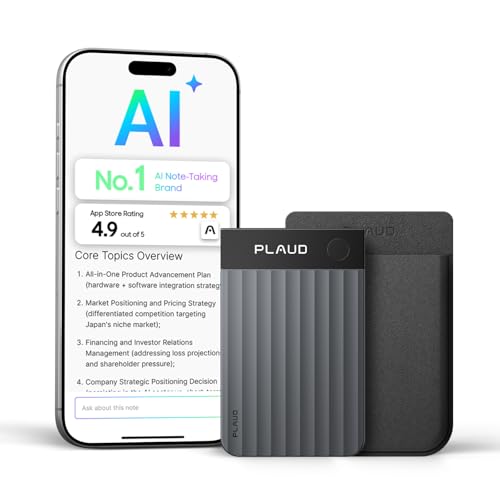
- Transcribes in 112 languages with speaker labels
- Creates summaries, action items, and follow-ups
- Records calls, online meetings, and in-person conversations
Best For: Professionals seeking automated interview transcription and structured notes
Simple Budget Interview Recorder

- Straightforward REC, STOP, and PLAY controls
- DSP noise reduction with 1536 kbps recording
- Up to 30 hours of recording and built-in playback
Best For: Students and occasional interviewers wanting simple local recording
Best AI Features
EVISTR L359 128GB AI Voice Recorder

- AI transcription in 113 languages with summaries and speaker identification
- 128GB storage and up to 33 hours of continuous recording
- One-touch controls, privacy lock, and wired OTG phone transfer
Best For: Interviewers who want automated transcription and organized notes
Best Portable Design
Vandlion V15 Mini Metal Voice Recorder

- Lightweight aluminum body weighs about 0.8 ounces
- 35–40 hours of recording with 32GB storage
- Simple slide control and optional voice activation
Best For: Mobile interviewers who value compact size and long battery life
Best Value Features
HoTiyan H-10001 16GB Voice Recorder

- Stereo recording with noise reduction and voice activation
- Up to 1,120 hours of listed storage capacity at 32kbps
- A-B repeat, variable playback speed, and password protection
Best For: Students and casual interviewers who want simple playback tools
Best Value – EVISTR L357 Digital Voice Recorder
For shoppers comparing voice recorders for interviews, the EVISTR L357 offers straightforward recording with adjustable gain, PCM noise reduction, playback controls, and a voice-activation mode. Its 64GB storage and Type-C transfer make it practical for frequent interviews, meetings, and lectures.
Best For: Interviewers who want a traditional, easy-to-operate recorder with substantial storage and long battery life.
Pros:
- 1536kbps stereo recording with dynamic and PCM noise reduction
- 64GB capacity, supporting up to 32 hours of continuous recording per charge
- Seven-level voice activation and recording-gain adjustment
- USB-C file transfers, WAV/MP3 support, and A-B repeat playback
Cons:
- It does not provide automatic transcription or AI summaries
- Voice activation may omit quiet pauses or softer speech depending on sensitivity settings
The L357 is a solid fit when dependable local recording matters more than connected productivity features. Its physical controls and playback tools are useful for reviewing interviews before transferring files to a computer.
Best AI Workflow – Pocket AI Voice Recorder
For voice recorders for interviews that can help with the work after recording, Pocket combines one-tap capture with automatic transcription, summaries, action items, and searchable questions about your recordings. MagSafe compatibility and a claimed four-day battery make it convenient for mobile use.
Best For: Interviewers who want recordings turned into organized notes and follow-up tasks through an AI-assisted workflow.
Pros:
- One-tap recording for in-person conversations, meetings, and calls
- Automatic transcription, summaries, action items, and conversation maps
- “Ask Pocket” can answer questions grounded in recorded conversations
- MagSafe compatibility and up to four days of battery life
Cons:
- Additional premium features require an optional subscription
- Its smartphone-focused design may be less suitable for users seeking a standalone USB recorder
Pocket is most compelling for buyers who value review speed over manual file handling. Before purchasing, check which AI functions are included in the core plan and which require the optional subscription.
Best High-Capacity Recorder – EVIDA Digital Voice Recorder
The EVIDA recorder is a practical option among voice recorders for interviews when storage and file organization are priorities. It combines 128GB capacity, adjustable voice activation, PCM recording, password protection, and multiple folders for managing long-term recordings.
Best For: Students, professionals, and interviewers who need extensive onboard storage and basic privacy and organization tools.
Pros:
- 128GB storage with support for WAV and MP3 recording settings
- 1536kbps PCM recording and noise-cancelling microphone
- Six-level voice activation, password protection, and four-folder organization
- Up to 54 hours of continuous recording and computer file transfer
Cons:
- The supplied details list no headphone jack
- It uses USB 2.0 rather than USB-C for computer transfers
- Voice activation can reduce blank sections but may require sensitivity adjustment
This model favors capacity and practical file management over modern AI features. It is a good choice for recording many interviews locally, especially if password protection and folder organization are useful to your workflow.
Best Professional AI Recorder – Comulytic Note Pro AI Recorder
Comulytic Note Pro is designed for buyers seeking voice recorders for interviews with built-in transcription and analysis tools. Its triple-mic array, adaptive recording, Wi-Fi syncing, local storage, and AI-generated summaries are aimed at turning interviews into usable notes quickly.
Best For: Professionals and journalists who want portable recording, transcription, summaries, and action-item extraction in one workflow.
Pros:
- Triple-mic array with AI noise reduction and adaptive recording modes
- AI transcription, summaries, action items, and support for 113 languages
- 64GB local storage, Wi-Fi syncing, and 45 hours of continuous recording
- AES encryption and CCPA-compliant privacy claims, plus magnetic accessories
Cons:
- Some advanced tools require the optional Premium Plan
- Cloud sync and storage depend on the Comulytic app and plan
- The feature-rich system may be more involved than a basic standalone recorder
Note Pro stands out for an end-to-end interview workflow rather than recording alone. Its free starter plan includes unlimited transcription and basic summaries according to the supplied notes, while deeper analysis and assistant features require an upgrade.
Long-Battery Interview Recorder – Tonfarb 136GB Digital Voice Recorder
For shoppers comparing voice recorders for interviews, the Tonfarb A20 emphasizes long recording time, simple controls, and clear audio capture. Its dual microphones, 1536 kbps PCM recording, automatic noise reduction, and one-click recording make it practical for interviews, meetings, and lectures.
Best For: Interviewers who want extensive storage, long battery life, and straightforward local recording.
Pros:
- Supports 1536 kbps PCM recording with dual noise-reduction microphones.
- Includes 8GB built-in storage and a complimentary 128GB TF card, for 136GB total listed storage.
- Provides up to 68 hours of continuous recording on one charge.
- One-click recording, voice activation, USB-C transfer, A-B repeat, and password protection add convenience.
Cons:
- The built-in microphone may be less flexible than an external microphone setup.
- The listed 68-hour figure is for continuous recording and may vary with usage.
The Tonfarb is a strong fit when recording endurance and capacity matter most. Its pocketable metal design and accessible controls make it a practical choice for frequent interview work.
AI Interview Note-Taker – Plaud Note Pro AI Voice Recorder
Among voice recorders for interviews, the Plaud Note Pro stands out for turning recordings into organized notes. Its four MEMS microphones and VPU support beamforming, while Plaud Intelligence can transcribe in 112 languages, identify speakers, and generate action items, decisions, and follow-ups.
Best For: Professionals who want interview recordings paired with automated transcription and summaries.
Pros:
- Captures in-person conversations, phone calls, and online meetings with dual-mode recording.
- Provides speaker labels, transcription in 112 languages, summaries, and customizable templates.
- Automatically transfers recordings to the Plaud app and connects across desktop, web, and mobile platforms.
- Credit-card-sized design weighs 1.06 ounces and includes a magnetic case and ring.
Cons:
- The free plan includes 300 minutes per month of AI transcription; higher usage requires an upgrade.
- AI features depend on the Plaud app and connected workspace rather than only on-device playback.
- It has no headphone jack and lists 30 hours of recording time.
The Plaud Note Pro is best when the goal is to reduce post-interview note-taking rather than simply store audio. Review the plan limits and privacy requirements before relying on its transcription workflow.
Simple Budget Interview Recorder – 16GB Digital Voice Recorder
If you want voice recorders for interviews with uncomplicated controls, this 16GB digital recorder keeps the workflow simple: press REC, STOP, and PLAY. Its sensitive microphone, DSP noise reduction, voice activation, and 1536 kbps recording support are suited to capturing speech in interviews, lectures, and meetings.
Best For: Students and occasional interviewers who prefer a compact recorder with physical controls and local playback.
Pros:
- Simple one-button recording and direct playback through the built-in speaker.
- DSP noise reduction and a sensitive microphone are designed to capture clearer speech.
- Voice activation can conserve recording time and power when no sound is detected.
- Offers up to 30 hours of continuous recording, a 3.5mm headphone jack, and USB file transfer.
Cons:
- Its 16GB capacity is substantially smaller than the storage offered by higher-capacity models.
- The listed battery life is up to 30 hours of recording and about 7 hours of playback.
- It provides mono recording rather than a stereo microphone mode.
This Sunlan recorder is a sensible low-complexity option for speech-focused recording. It lacks advanced transcription features, but its physical controls and direct playback suit basic interview workflows.
Best AI Features – EVISTR L359 128GB AI Voice Recorder
For shoppers comparing voice recorders for interviews, the EVISTR L359 stands out for its large storage, high-bitrate recording, and built-in AI workflow. It can record at up to 3072Kbps, reduce background noise, and connect to a phone through the included OTG cable for transcription and summaries.
Best For: Interviewers, students, and professionals who want recordings converted into searchable notes and summaries.
Pros:
- AI transcription supports 113 languages and can create summaries, mind maps, speaker identification, and Ask AI insights.
- 128GB storage provides substantial capacity, while the battery supports up to 33 hours of continuous recording.
- One-touch recording, voice activation, a HOLD switch, and password encryption simplify use and help protect files.
- Wired OTG transfer supports direct syncing with compatible phones without relying on Bluetooth.
Cons:
- AI processing requires the AI DVR Link app and a compatible phone connection.
- The built-in microphone is mono, according to the product details.
The L359 is a feature-rich choice when transcription and organization matter as much as recording. Its 65g design and privacy controls make it practical for field interviews, though buyers should confirm app compatibility before purchase.
Best Portable Design – Vandlion V15 Mini Metal Voice Recorder
If portability is a priority when choosing voice recorders for interviews, the Vandlion V15 is an especially compact option. Its aluminum-alloy body weighs about 0.8 ounces, while the upgraded recording chip, noise reduction, and 1536kbps output are designed to support clear speech capture.
Best For: Reporters, students, and mobile interviewers who need a discreet recorder with simple controls and long battery life.
Pros:
- Ultra-slim aluminum design measures about 1/4 inch thick and weighs approximately 21g.
- Offers up to 35–40 hours of continuous recording from a 1.5-hour Type-C charge.
- 32GB storage can hold up to 2,240 hours of audio files, depending on recording settings.
- Slide-to-record operation, automatic date-time file names, and optional voice activation keep operation straightforward.
Cons:
- Voice activation must be enabled manually and is off by default.
- File management requires connecting to a computer or compatible Android device by USB-C.
The V15 favors convenience over advanced extras. Its small metal build and extended battery make it easy to carry through a full day of interviews, while the straightforward switch helps you start recording quickly.
Best Value Features – HoTiyan H-10001 16GB Voice Recorder
The HoTiyan H-10001 is a practical pick among voice recorders for interviews when you want essential recording features without an app-based workflow. It supports stereo recording, noise reduction, voice activation, MP3/WAV files, and direct computer transfers through the supplied Micro USB cable.
Best For: Students, meeting participants, and casual interviewers who want simple recording, playback, and repeat-listening tools.
Pros:
- Enhanced microphone, noise reduction, and a recording chip support high-definition stereo recording.
- 16GB storage offers up to 1,120 hours at the listed 32kbps setting.
- Voice activation can reduce silent passages and conserve storage space.
- A-B repeat, variable playback speed, password protection, and timestamped file names add useful study and review functions.
Cons:
- Battery life is rated at up to 20 hours of continuous recording, shorter than the other listed options.
- File transfer uses Micro USB rather than USB-C.
- Storage is limited to 16GB and the product details specify a maximum of 199 recording files.
This recorder covers the core needs of interview recording and review at a straightforward feature level. Its A-B repeat and variable-speed playback are particularly useful when revisiting important answers or transcribing manually.
How We Picked the Best Voice Recorders for Interviews
We focused on practical features that matter during real interviews: recording clarity, microphone performance, storage capacity, battery convenience, playback controls, portability, and file transfer. We also separated traditional recorders from AI models that transcribe or summarize conversations, since those products have different costs, setup requirements, and privacy considerations.
Capacity claims can vary by recording quality and file format, so treat maximum recording hours as an estimate rather than a guarantee. For interviews, dependable operation and intelligible voices are usually more important than the highest headline storage number.
Quick Comparison
| Recorder Type | Best For | Key Advantage | Main Trade-Off |
|---|---|---|---|
| Basic digital recorder | Students and occasional interviewers | Simple operation and lower cost | Usually lacks transcription |
| High-capacity recorder | Frequent or long-form recording | Less frequent file management | More storage may not improve audio quality |
| AI voice recorder | Researchers and professionals | Transcription, summaries, and searchable notes | May require an app, account, or subscription |
| Mini recorder | Travel and discreet carry | Small, lightweight design | Controls and microphones may be limited |
Key Buying Factors for Voice Recorders for Interviews
Audio Quality and Microphone Pickup
Choose a recorder that captures speech clearly in the environments where you work. Built-in microphones are convenient, but placement still matters: keep the device unobstructed and reasonably close to the speakers. Noise reduction can help, but it cannot fully correct heavy background noise or poor positioning.
Battery Life, Storage, and File Transfer
Check expected battery life at your preferred recording quality, not only the maximum standby figure. Ample storage is useful for back-to-back sessions, while USB connectivity or straightforward app transfer makes archiving easier. A recorder with playback controls can also help you review key answers without another device.
Transcription, Summaries, and Privacy
AI models can save considerable time by converting speech into text and producing notes. Before buying, confirm supported languages, transcription limits, export formats, phone compatibility, and whether cloud processing is required. For sensitive interviews, review the provider’s data-handling policy before uploading recordings.
Size and Controls
A pocket-friendly design is easier to carry, but very small devices may have cramped buttons or shorter battery life. Physical record, pause, and stop controls are valuable when you need to begin recording quickly and confidently.
Who Should Buy Which Voice Recorders for Interviews?
Choose a basic 16GB or 32GB digital recorder if you want affordable, dependable recording for occasional interviews, lectures, or meetings. A higher-capacity model makes more sense for journalists, researchers, and students who record frequently and prefer not to transfer files after every session.
AI voice recorders are the better fit for professionals who spend substantial time transcribing interviews or turning conversations into summaries. They can streamline post-interview work, but verify subscription terms and privacy features first. If portability is your top priority, select a mini recorder with accessible controls and enough battery capacity for a complete session.