
The best voice recorders for musicians make it easy to capture lyrics, rehearsals, performances, interviews, and musical ideas before they disappear. The right model depends on whether you need simple dictation, high-quality stereo sound, or multitrack recording with external microphones.
This roundup compares compact Zoom recorders with feature-rich digital dictaphones, focusing on sound quality, portability, storage, controls, and workflow.
Best 10 Voice Recorders for Musicians Picks for 2026
Best Flexible Field Recorder

- Three mics with nine recording patterns
- 32-bit float/96kHz clip-free recording
- USB mic mode with SD backup recording
Best For: Musicians needing adaptable handheld recording for rehearsals, interviews, and soundscapes
Best Long-Life Pocket Recorder
EVISTR L357 64GB Voice Recorder

- 64GB storage for lengthy recordings
- Up to 32 hours of continuous recording
- WAV/MP3 support with voice activation
Best For: Musicians wanting a simple, portable recorder for ideas, lessons, and spoken notes
Best for Bands and Multitrack Sessions

- Six-track 32-bit float recording
- Four XLR/TRS inputs plus X/Y mics
- USB interface with simultaneous SD backup
Best For: Bands and ensembles recording several vocals, instruments, or live sources
Best High-Capacity Voice Recorder

- 128GB storage for up to 9,296 hours
- MP3 and 1536Kbps WAV recording
- Voice activation with organized folder storage
Best For: Users managing large collections of voice notes, lessons, interviews, and musical ideas
Professional Pick

- 32-bit float recording helps prevent clipped takes.
- Dual locking XLR/TRS inputs for secure connections.
- Low-noise preamps for demanding recording conditions.
Best For: Musicians and location recordists using external microphones
Smart Note-Taking Pick

- AI transcription and summaries through the companion app.
- 128GB storage with up to 33 hours of continuous recording.
- One-touch operation with noise reduction and voice activation.
Best For: Portable recording and organizing spoken notes
Versatile Music Pick

- Built-in stereo microphones for quick recording.
- Two XLR/TRS inputs plus four-track recording.
- 32-bit float and USB-C recording or streaming support.
Best For: Musicians recording performances, instruments, and creative projects
Best Bundle
Zoom H1essential Recorder Bundle
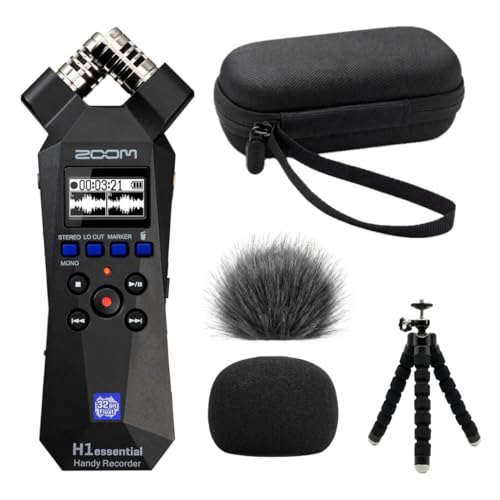
- 32-bit float recording
- 96 kHz stereo recording
- Case, windscreens, and tripod included
Best For: Musicians who want a complete mobile recording kit
Best for Multitrack Inputs

- Four-track simultaneous recording
- Two XLR/TRS inputs
- Interchangeable microphone capsules
Best For: Musicians recording multiple sources or using external microphones
Best Simple Recorder
Zoom H1essential for Musicians

- 32-bit float stereo recording
- USB-C microphone mode
- Up to 10 hours of battery life
Best For: Songwriters and performers capturing ideas, rehearsals, and performances
Best Flexible Field Recorder – Zoom H2 Essential
The Zoom H2 Essential is a versatile choice among voice recorders for musicians who need flexible microphone coverage without manually adjusting gain. Its three built-in microphones, nine recording patterns, and 32-bit float/96kHz capability suit rehearsals, songwriting sessions, interviews, and wide stereo recordings.
Best For: Musicians who want adaptable mono, stereo, or surround recording in a compact handheld unit.
Pros:
- Three built-in microphones provide nine selectable recording patterns.
- 32-bit float recording is designed to capture clip-free audio without gain adjustments.
- Can function as a USB microphone while recording simultaneously to an SD card.
- Offers audible menu navigation in seven languages.
Cons:
- Uses two AA batteries rather than a built-in rechargeable battery.
- Its 1.3-inch screen may feel small for users who prefer large controls.
- Advanced pattern options may be more than casual voice recording requires.
For musicians moving between solo ideas, interviews, and larger soundscapes, the H2 Essential offers unusually broad recording coverage. Bluetooth timecode support also makes it useful when syncing multiple compatible units.
Best Long-Life Pocket Recorder – EVISTR L357 64GB Voice Recorder
The EVISTR L357 is a practical option for musicians who want a small, straightforward recorder with substantial storage and long battery life. It supports WAV and MP3 recording, adjustable gain, voice activation, and playback controls for capturing lessons, rehearsals, meetings, or musical ideas.
Best For: Musicians and students who prioritize simple controls, extended recording time, and portable storage.
Pros:
- 64GB storage can hold up to 4,660 hours at the stated 32Kbps recording rate.
- Offers up to 32 hours of continuous recording and 35 hours of playback.
- Adjustable seven-level gain and voice-activation sensitivity provide recording flexibility.
- Supports WAV and MP3, with A-B repeat, variable-speed playback, and Type-C file transfer.
Cons:
- Its voice-activation design is oriented toward spoken audio and may not suit continuous music recording.
- The supplied notes do not indicate multitrack or instrument-input capabilities.
- High-capacity storage figures depend on lower-bitrate recording settings.
The L357 emphasizes convenience over studio-style connectivity. Its metal construction, simple two-button start-and-save operation, and long runtime make it a useful everyday recorder for quick musical notes and spoken instruction.
Best for Bands and Multitrack Sessions – Zoom H6 Essential
The Zoom H6 Essential is a strong fit for musicians recording multiple performers or instruments at once. It combines six-track 32-bit float recording, built-in X/Y microphones, four XLR/TRS combo inputs, and interchangeable capsule support for more adaptable session setups.
Best For: Bands, ensembles, and creators who need multiple inputs for vocals, instruments, and live sources.
Pros:
- Records up to six tracks with 32-bit float capture for distortion-free results across multiple sources.
- Includes four XLR/TRS combo inputs and built-in X/Y microphones rated up to 135 dB SPL.
- Interchangeable capsule system supports different stereo and mid-side recording scenarios.
- Works as a USB audio interface while recording to an SD card for backup.
Cons:
- Requires four AAA batteries and has a stated average battery life of 18 hours.
- Its broader input and capsule system may be excessive for solo voice memos.
- Optional capsules are needed to expand beyond the included microphone setup.
For musicians who need more than a basic stereo recorder, the H6 Essential provides the input count and track capacity for ensemble work. Its USB interface mode also lets it serve as part of a computer, iOS, or Android recording workflow.
Best High-Capacity Voice Recorder – EVIDA 128GB Digital Recorder
The EVIDA 128GB recorder is aimed at musicians and creators who want extensive onboard storage for ideas, lessons, interviews, and spoken notes. It records in MP3 or WAV, includes voice activation and noise cancellation, and adds password protection, folders, and playback features for easier file management.
Best For: Users who need high-capacity storage and organized playback for voice-focused recordings.
Pros:
- 128GB capacity is listed as supporting up to 9,296 hours of recording.
- Supports MP3 recording at multiple bitrates and WAV recording at 1536Kbps.
- Voice activation offers six sensitivity levels to reduce silent sections.
- Includes password protection, four-folder organization, bookmarks, and USB file transfer.
Cons:
- The built-in microphone operates in mono with noise cancellation rather than offering instrument inputs.
- The listed battery life is up to 54 hours, but continuous runtime depends on settings and use.
- The device has no headphone jack according to the supplied specifications.
The EVIDA is best viewed as a storage-rich voice recorder rather than a dedicated music-production device. Its organization tools and high capacity are useful when recording many lessons, rehearsals, conversations, or songwriting reminders.
Professional Pick – Zoom F3 Field Recorder
For musicians who need dependable voice recorders for musicians, the Zoom F3 prioritizes clean, clip-resistant capture in demanding recording environments. Its 32-bit float recording, dual locking inputs, and low-noise preamps make it especially suitable for external microphones and complex setups.
Best For: Musicians, location recordists, and filmmakers using professional microphones in unpredictable environments.
Pros:
- 32-bit float recording helps capture quiet sounds and sudden peaks without constant level adjustments.
- Dual locking XLR/TRS inputs help keep connected microphones and instruments secure.
- Ultra-low-noise preamps support clean recordings.
- Flexible battery-powered and USB workflows suit long recording sessions.
Cons:
- Built around external microphones rather than a simple all-in-one handheld setup.
- Records in WAV format, which may require more storage and file management than compressed audio.
The F3 is a focused choice for serious recording rigs where reliable input connections and protection against clipping matter more than built-in convenience features.
Smart Note-Taking Pick – EVISTR L359 AI Recorder
The EVISTR L359 takes a different approach to voice recorders for musicians by combining portable recording with transcription and summarization tools. It offers built-in microphones, one-touch recording, noise reduction, and app-based processing for turning spoken material into organized notes.
Best For: Musicians, students, and professionals who want to record rehearsals, ideas, interviews, or discussions and process them into searchable information.
Pros:
- AI tools support transcription in 113 languages, summaries, mind maps, and speaker identification through the companion app.
- 128GB of storage provides substantial capacity for recordings.
- One-touch recording, voice activation, and a HOLD switch simplify everyday use.
- Wired OTG connectivity supports direct transfer to a phone.
Cons:
- Its AI transcription and summary features depend on the AI DVR Link app workflow.
- Built-in microphone operation is oriented toward voice and general note taking rather than professional XLR microphone setups.
- Continuous recording is listed at up to 33 hours per charge.
Choose the L359 if organizing spoken material is as important as capturing it. It is more of a compact note-taking system than a traditional musician-focused field recorder.
Versatile Music Pick – Zoom H4 Essential Recorder
The Zoom H4 Essential is a flexible option for musicians comparing voice recorders for musicians that can also handle instruments, interviews, podcasts, and live performances. Built-in stereo microphones, two XLR/TRS inputs, 32-bit float recording, and four-track capability give it room to grow from quick ideas to more involved projects.
Best For: Musicians and creators who want built-in microphones plus connections for external microphones, instruments, mixers, or soundboards.
Pros:
- 32-bit float recording helps reduce concern about distorted takes across changing volume levels.
- Built-in stereo microphones support immediate recording without extra gear.
- Two XLR/TRS inputs accommodate external microphones, instruments, mixers, or soundboards.
- USB-C supports recording or streaming to compatible devices while also saving to an SD card.
Cons:
- Its listed continuous recording time is up to 10 hours.
- At 243 g, it is less lightweight than a compact voice-only recorder.
- The broader four-track feature set may be more than needed for simple voice notes.
The H4 Essential is the strongest all-around choice here for musicians who want a handheld recorder that can move between spontaneous ideas, live performances, and connected recording setups.
Best Bundle – Zoom H1essential Recorder Bundle
If you want voice recorders for musicians with useful accessories included, this Zoom H1essential bundle is a practical option. It combines 32-bit float recording with X/Y stereo microphones, plus a protective case, two windscreens, and a flexible tripod for mobile recording.
Best For: Musicians who need a ready-to-use recorder for rehearsals, vocals, instruments, field recording, or outdoor sessions.
Pros:
- 32-bit float recording helps capture takes without clipping or distortion.
- X/Y microphones support stereo recording up to 120 dB SPL and recording up to 96 kHz.
- Includes a hard-shell case, furry and foam windscreens, and an octopus tripod.
- Can function as a USB microphone with PCs, Macs, iOS devices, or Android devices.
Cons:
- Requires two AAA batteries.
- The included accessories add value but also make the bundle less compact than the recorder alone.
- Its 3.5 mm headphone connection may require an adapter for some newer devices.
This is a strong pick when accessory coverage matters as much as recording performance. The case, windscreens, and tripod make it especially convenient for musicians moving between indoor rehearsals and outdoor locations.
Best for Multitrack Inputs – Zoom H5 4-Track Recorder
For musicians comparing voice recorders for musicians with expansion potential, the Zoom H5 offers a more hands-on setup. Its interchangeable capsule system, detachable X/Y microphone, and two XLR/TRS combo inputs support stereo or multitrack recording for instruments, vocals, and audio-for-video work.
Best For: Musicians and filmmakers who need external microphones, phantom power, or up to four-track simultaneous recording.
Pros:
- Records up to four tracks simultaneously.
- Two XLR/TRS combo inputs include selectable phantom power and -20 dB pads.
- Interchangeable input capsules provide room to expand the recording setup.
- Works as a multichannel or stereo USB audio interface for PC, Mac, or iPad.
Cons:
- Records to SD or SDHC cards up to 32 GB.
- Its larger feature set may be more than needed for quick voice memos or simple rehearsals.
- Requires two batteries for portable operation.
The H5 is the most flexible choice here for musicians who plan to connect dedicated microphones or record several sources at once. Choose it over a simpler stereo recorder when input control and expandability are priorities.
Best Simple Recorder – Zoom H1essential for Musicians
The Zoom H1essential is a straightforward choice among voice recorders for musicians who want to capture ideas quickly. Its X/Y stereo microphones and 32-bit float recording are suited to songwriting sessions, rehearsals, acoustic performances, lessons, and live music, while USB-C microphone mode adds flexibility for calls and streaming.
Best For: Songwriters, performers, podcasters, and content creators who need a compact recorder for stereo sessions and everyday audio capture.
Pros:
- 32-bit float recording provides clip-free audio capture.
- X/Y stereo microphones record rehearsals, performances, voices, ambience, and room tone.
- USB-C microphone mode supports livestreams, remote meetings, calls, and voiceovers.
- Offers up to 10 hours of battery life and accessibility features.
Cons:
- It provides stereo recording rather than the H5’s multitrack input setup.
- Requires two AAA batteries.
- No accessory bundle is specified, so a case or wind protection may need to be purchased separately.
Choose the H1essential when portability and ease of use matter more than connecting multiple external microphones. It is well suited to capturing musical ideas immediately and doubling as a USB microphone when needed.
How We Picked the Best Voice Recorders for Musicians
We selected these models to cover the main recording needs musicians have in 2026, from quickly saving melodies and lyric ideas to recording rehearsals, live performances, and location audio. We considered microphone design, recording formats, input flexibility, storage, battery practicality, monitoring options, and how easily each device fits into a real creative workflow.
Dedicated field recorders generally receive more emphasis for music because they are designed around microphone performance, gain control, low-noise recording, and reliable monitoring. Digital voice recorders can still be useful for spoken notes, songwriting ideas, lessons, and interviews, particularly when long battery life, large storage, transcription, or voice activation matters more than studio-quality sound.
Quick Comparison
| Best For | Look For | Most Suitable Type |
|---|---|---|
| Song ideas and practice notes | Small size, simple controls, built-in microphones | Compact handheld recorder |
| Rehearsals and stereo performances | Adjustable microphone placement and clean recording | Higher-quality stereo field recorder |
| Multiple microphones or instruments | Several inputs, overdubbing, multitrack support | Multitrack handheld recorder |
| Spoken notes and interviews | Voice activation, playback, ample storage | Digital voice recorder |
| Outdoor and location recording | Low-noise preamps, rugged handling, wind protection | Professional field recorder |
Key Buying Factors for Voice Recorders for Musicians
Microphones and Recording Quality
Built-in stereo microphones are convenient for rehearsals, room ambience, acoustic instruments, and quick demos. Check microphone orientation and pickup pattern if you plan to record from different positions. For polished results, prioritize a recorder with clean preamps, suitable WAV recording, and enough headroom for loud sources.
Inputs, Tracks, and Expandability
Basic models work well for solo ideas, while musicians recording a band or several sources should consider combo inputs, phantom power, overdubbing, or multitrack capabilities. XLR or combo inputs are especially useful when you already own microphones or want to connect a mixer.
Storage, Power, and Monitoring
Look for removable or generous internal storage, straightforward file transfer, and a battery setup that suits your sessions. A headphone output, level meters, and adjustable monitoring help prevent clipping and make it easier to judge takes while recording. Windscreens and a case are valuable for outdoor use and transport.
Voice Features and Usability
Voice activation, password protection, playback controls, and transcription tools can be helpful for lessons, interviews, and spoken songwriting notes. They should not be treated as substitutes for musical recording features, particularly if you need accurate dynamics or detailed stereo imaging.
Who Should Buy Which Voice Recorders for Musicians?
Choose a compact handheld recorder if you want the fastest way to capture songwriting ideas, lessons, practice sessions, or acoustic performances. These models offer the best balance of portability and musical usefulness.
Choose a multitrack recorder if you record several instruments, connect external microphones, or want more control during rehearsal and production. Extra inputs and track flexibility justify the larger size for serious projects.
Choose a professional field recorder for demanding location work, film audio, live ambience, or musicians who need dependable gain control and clean recordings in varied environments.
Choose a digital voice recorder when spoken notes, interviews, lectures, transcription, long recording times, and simple playback are your priorities. It is the practical option for ideas and documentation, but dedicated music recorders are usually the better choice for detailed musical performances.