
Choosing DMX controllers for church halls means balancing capable lighting control with approachable operation. The right console should handle worship services, presentations, concerts, and community events without creating unnecessary setup complexity.
This roundup compares 10 options across channel capacity, programming workflow, wireless connectivity, MIDI support, and portability, helping you match your hall’s lighting system and volunteer skill level.
Best 10 Dmx Controllers for Church Halls Picks for 2026
Best Overall

- Four-universe standalone control
- Touchscreen and 37 backlit buttons
- Decksaver cover included
Best For: Church halls needing scalable, computer-free lighting control
Best for Programmed Scenes

- 192-channel DMX control
- 240 stored scenes
- Fog, strobe, and MIDI support
Best For: Halls running repeatable scenes with up to 12 fixtures
Best Compact Controller

- Up to four DMX universes
- 37 backlit silicone buttons
- Compact 2.36-pound design
Best For: Portable church-hall setups needing standalone multi-universe control
Best for Software-Based Lighting

- Two DMX universes for larger installations
- Tactile controls and RGB performance pads
- Works with Engine DJ and supported software
Best For: Church halls using DJ software or live audio lighting workflows
Best Budget Scene Controller

- 384 channels for multiple fixtures
- 30 banks with eight scenes each
- Compact console with gooseneck light
Best For: Manual scene programming for services and stage events
Best Wireless Control Option
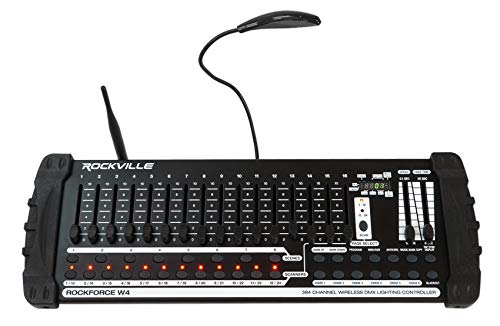
- Built-in 2.4GHz wireless DMX
- 384 channels with banks and chases
- Wired DMX, MIDI, and music-sync control
Best For: Multi-zone halls wanting wireless and wired flexibility
Best Budget Manual Console
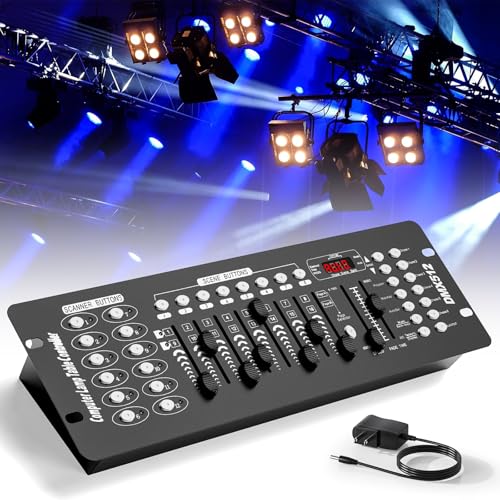
- Controls up to 12 devices and 192 channels
- Stores 240 scenes with six programmable chases
- Beginner-friendly layout with eight sliders
Best For: Small church halls using conventional 3-pin DMX lighting
Best App-Based Option
ADJ MyDMX Go Wireless Controller

- Controls 256 channels from an iPad or Android tablet
- Supports Wi-Fi, USB, and two lighting universes
- Includes 15,000-plus fixtures and preset effects
Best For: Church halls wanting tablet-based, low-programming control
Best Wireless Flexibility

- Offers 384 channels for up to 12 intelligent lights
- Combines 2.4G wireless with 3-pin wired control
- Stores 240 scenes across 30 banks
Best For: Church halls needing wireless layout flexibility and expanded control
Best Overall – ADJ Wolfmix WMX1 MK2 Bundle
For church halls needing flexible dmx controllers for church halls, the ADJ WMX1 MK2 bundle offers standalone operation, touchscreen control, and substantial fixture support without requiring a laptop. Its included Decksaver cover is also useful for storage and transport.
Best For: Churches and venues that want advanced, computer-free lighting control with protective storage included.
Pros:
- Controls up to 680 fixtures across four DMX universes, with 1,024 channels listed in the specifications.
- Includes a 4.3-inch touchscreen, 37 backlit buttons, and 3,500-plus built-in fixture profiles.
- Supports manual or BPM-synced shows, MIDI, audio input, and multiple DMX fixture types.
- Decksaver cover helps protect the compact steel controller from dust, spills, and transport damage.
Cons:
- Its advanced feature set may be more than a small church hall needs.
- Additional fixture profiles beyond the built-in library require the WTOOLS app.
The WMX1 MK2 is the strongest choice here for a church hall expecting varied fixtures, recurring events, or growth. The bundle adds practical protection, while the standalone design keeps setup simpler than a laptop-based system.
Best for Programmed Scenes – Chauvet DJ Obey 40
The Chauvet DJ Obey 40 is a practical option among dmx controllers for church halls when the priority is storing repeatable lighting looks. It controls up to 12 fixtures and provides dedicated scene, chase, fog, and strobe functions.
Best For: Church halls that use a defined collection of fixtures and want organized scene and chase playback.
Pros:
- Provides 192 DMX channels for managing up to 12 fixtures with up to 16 channels each.
- Stores up to 240 scenes across 30 banks, supporting repeatable service and event setups.
- Six chases can contain up to 240 scenes for sequenced lighting playback.
- Includes fog and strobe controls, MIDI compatibility, and reversible sliders.
Cons:
- It has less stated capacity than the ADJ Wolfmix controller.
- The button-and-slider interface may require more programming time than a touchscreen system.
For a hall with consistent lighting routines, the Obey 40 provides useful scene organization without unnecessary complexity. Its 12-fixture limit should be checked against the planned installation before buying.
Best Budget Pick – MINGJIE 192-Channel DMX Console
The MINGJIE DMX512 console is a straightforward choice for buyers comparing dmx controllers for church halls on a tighter budget. It combines 192-channel control with scene storage, sound activation, and an included 3-pin DMX cable.
Best For: Smaller church halls, volunteer operators, and mobile setups needing basic programmed or sound-activated lighting.
Pros:
- Controls up to 12 intelligent fixtures across 192 DMX channels.
- Stores 240 scenes in 30 banks and provides six programmable chases.
- Offers sound-activated operation alongside manual programming.
- Includes a 4-foot 3-pin DMX cable and supports 100–240V input.
Cons:
- Its 192-channel capacity is less suited to large or expanding installations.
- The supplied notes do not indicate touchscreen control or multi-universe operation.
- Programming may still require orientation for volunteer operators.
The MINGJIE makes sense when a church hall needs familiar faders, stored looks, and a ready-to-use cable at a modest scale. Confirm that its 12-fixture and 192-channel limits match the lighting plan.
Best Compact Controller – ADJ WMX1 MK2
The ADJ WMX1 MK2 is a compact standalone option for dmx controllers for church halls where portability and direct operation matter. It provides 37 backlit silicone buttons, four rotary encoders, and up to four DMX universes from a small controller.
Best For: Church halls that need a portable standalone controller with multi-universe capability.
Pros:
- Supports up to four DMX universes and has four output sockets.
- 37 backlit silicone buttons provide direct control in dim operating areas.
- At 2.36 pounds, it is relatively easy to move between rooms or events.
- Standalone operation avoids dependence on a laptop during use.
Cons:
- This listing does not include the Decksaver cover supplied with the bundle version.
- The supplied notes provide fewer feature details than the bundled listing.
- Its compact control surface may take practice for operators managing complex setups.
The WMX1 MK2 is a good fit when a church wants the core controller without the bundle’s protective cover. Its four-universe design offers room to grow, while the compact format suits shared or traveling equipment.
Best for Software-Based Lighting – SoundSwitch Control One
For church halls that use DJ software, live audio, or Engine DJ hardware, the SoundSwitch Control One offers tactile control over programmed lighting and effects. It supports two DMX universes, music synchronization, and hands-on adjustments for colors, brightness, strobes, moving heads, and gobos.
Best For: Church halls needing software-integrated DMX control for worship events, concerts, and DJ-led programs.
Pros:
- Two DMX universe inputs and outputs with a thru option for installations.
- Works directly with compatible Denon DJ and Numark Engine DJ devices.
- Provides tactile controls, RGB performance pads, and live audio BPM detection.
- Supports lighting adjustments including color, brightness, strobe, moving heads, and gobos.
Cons:
- Full software-based functionality may require a computer, depending on the setup.
- Its feature set may be more advanced than needed for simple static lighting.
This is a strong choice when the hall’s lighting workflow already centers on SoundSwitch or compatible DJ equipment. Its control layout is better suited to operators who want to edit and trigger dynamic shows rather than make only occasional fixture changes.
Best Budget Scene Controller – 384CH DMX512 Stage Console
This 384-channel DMX512 console gives church halls a straightforward way to program scenes for stage and event lighting. Its 30 banks, eight programmable scenes per bank, and support for 24 fixtures make it suitable for repeatable lighting setups without relying on computer software.
Best For: Church halls that need conventional hands-on scene programming for services, performances, and community events.
Pros:
- Offers 384 DMX channels for control of multiple lighting fixtures.
- Provides 30 banks with eight programmable scenes each.
- Compact, lightweight design includes side handles and an LED gooseneck light.
- Uses standard DMX512 control and supports 110–240V AC power.
Cons:
- The supplied notes do not indicate wireless DMX capability.
- Its scene-based interface may be less convenient for computer-integrated or automated shows.
For halls seeking a dedicated console for programmed scenes, this model offers substantial channel capacity in a compact format. It is most practical when an operator will manually recall prepared looks during events.
Best Wireless Control Option – Rockville ROCKFORCE W4
The Rockville ROCKFORCE W4 is a flexible option for church halls that want both wired and wireless DMX control. Its built-in 2.4GHz transmitter can control up to seven light groups and 25 receivers, while 384 channels, MIDI, music sync, and manual override support more involved event setups.
Best For: Church halls needing wireless fixture control, multiple lighting groups, and a rack-mountable console for recurring events.
Pros:
- Built-in 2.4GHz wireless DMX supports up to seven groups and 25 receivers.
- Controls up to 24 intelligent lights with 384 channels.
- Includes 30 banks, six chases, MIDI control, music sync, and manual override.
- Offers wired DMX in/out, a rugged 4U rack-mountable design, and wide-voltage power.
Cons:
- Wireless operation requires compatible receivers or fixtures.
- The larger professional feature set may be unnecessary for a small, simple lighting rig.
Choose this controller when reducing DMX cable runs is a priority or when the hall uses several lighting zones. Its combination of wireless transmission, wired connections, and manual controls gives operators flexibility across fixed installations and mobile events.
Best Budget Manual Console – 192-Channel DMX Controller
For church halls seeking straightforward dmx controllers for church halls, this compact console offers manual fader control, programmable scenes, and support for up to 12 fixtures. Its conventional layout may suit volunteer operators who prefer physical controls over app-based operation.
Best For: Small church services, gatherings, and simple stage-lighting setups with 3-pin DMX equipment.
Pros:
- Controls up to 192 channels across 12 devices.
- Provides 240 scenes, 23 programmable scenario sets, and six chases.
- Includes eight sliders and a beginner-oriented control layout.
Cons:
- Limited to 12 devices and 16 channels per device.
- Uses 3-pin connections, so compatibility should be checked with existing equipment.
- Its manual-console workflow may require more hands-on operation than an app-based controller.
This is a practical entry-level option when a church hall needs dependable scene recall and physical controls without a more advanced programming system. Confirm fixture compatibility and power requirements before purchase.
Best App-Based Option – ADJ MyDMX Go Wireless Controller
The ADJ MyDMX Go is a flexible choice for church halls that want tablet-based control. This 256-channel system connects through Wi-Fi or USB, avoids traditional programming, and supports a broad range of fixtures through its extensive fixture library.
Best For: Church lighting teams that prefer quick setup, tablet operation, and wireless control for varied fixture brands.
Pros:
- Offers 256-channel DMX control from an iPad or Android tablet.
- Includes a library of more than 15,000 fixtures.
- Provides 50 user presets, 21 automatic effects, and manual display creation.
- Supports two lighting universes and includes O-Clamp mounting brackets.
Cons:
- Requires a compatible iPad or Android tablet for app operation.
- Its wireless and USB workflow may be less familiar than a dedicated hardware console.
- Additional upgrades are available separately.
For churches that regularly change lighting scenes or use fixtures from multiple brands, the large fixture library and preset-based controls can reduce setup time. It is especially appealing where tablet access and Wi-Fi integration fit the existing workflow.
Best Wireless Flexibility – 384-Channel DMX512 Controller
For larger or more flexible church-hall lighting layouts, this controller combines 384-channel DMX512 operation with wired and 2.4G wireless modes. It also adds sound activation, MIDI support, and extensive scene storage for services, events, and live performances.
Best For: Church halls, banquet spaces, and indoor stages using up to 12 intelligent lights with wired or wireless placement needs.
Pros:
- Provides 384 channels and supports up to 12 intelligent lights.
- Offers both 2.4G wireless and traditional 3-pin XLR wired operation.
- Stores 30 banks and 240 programmable static scenes.
- Includes sound-activated, automatic, manual, MIDI, and one-key blackout functions.
Cons:
- Wireless operation may require compatible wireless fixtures or components.
- Its broader feature set may take more time to learn than a basic console.
- The product notes list a required 9V battery, which adds a maintenance consideration.
This is the strongest fit when a church hall needs room-layout flexibility and more channel capacity than a basic 192-channel console. Its mix of wireless control, scene recall, and sound activation can support both planned services and lively events.
How We Picked These Dmx Controllers for Church Halls
We focused on controllers that can manage common LED fixtures, moving lights, fog machines, and stage effects used in multipurpose church spaces. The selection includes compact consoles, wireless and wired systems, app-based control, and models with MIDI or computer integration.
We also considered channel count, scene and bank storage, programming access, portability, and the learning curve. A high channel count is useful only when the interface remains manageable for the people operating it.
Quick Comparison
| Controller type | Best suited to | Main advantage |
|---|---|---|
| Compact standalone console | Small to midsize halls | Dedicated controls and reliable offline operation |
| Higher-channel console | Large rigs or multiple fixture groups | More programming capacity |
| Wireless DMX controller | Temporary or difficult-to-cable setups | Faster installation and fewer signal cables |
| App or computer-based system | Operators comfortable with software | Flexible editing and show management |
| MIDI-compatible controller | Music-led services and performances | Integration with keyboards, software, or playback systems |
Key Buying Factors for Dmx Controllers for Church Halls
Channel Capacity and Fixture Growth
Count the DMX channels required by every fixture, then leave room for expansion. A 192-channel controller may suit a simple wash-light setup, while 384 or 512 channels provide more flexibility for moving heads, pixel fixtures, and additional zones.
Ease of Programming
Look for clear controls, accessible scene storage, and an operating workflow volunteers can learn quickly. Preset scenes and hands-on faders are valuable when lighting must change rapidly during a service.
Wired Versus Wireless Control
Wired DMX is often the safest default for permanent installations because it is predictable and easy to troubleshoot. Wireless models can simplify temporary layouts, but verify range, interference handling, and compatibility with your fixtures.
Connectivity and Automation
MIDI, USB, app, sound-activated, and computer-control features can be useful for rehearsed shows or music-synchronized lighting. Confirm that the controller works with your current software and that essential functions remain available if a device or network connection fails.
Portability and Installation
Choose a compact unit for shared spaces or mobile events, and consider protective covers, mounting, cable management, and storage. A controller that can be packed away securely is less likely to be damaged between services.
Who Should Buy Which Dmx Controllers for Church Halls?
Choose a compact standalone controller if your hall has a modest fixture count and needs straightforward manual operation. These systems are generally easier for rotating volunteers to learn.
Choose a higher-channel console if you already use several fixture types or expect the lighting rig to grow. Extra capacity can prevent an expensive controller upgrade later.
Choose wireless DMX when running signal cable is difficult, temporary, or visually disruptive. Keep a wired fallback for critical events where reliability matters most.
Choose an app- or computer-based controller if one trained operator will program detailed scenes and manage repeatable show cues. For music-driven services, MIDI support can make transitions more consistent.
Before buying, confirm fixture compatibility, required cables or wireless receivers, power needs, operator training, and return support. The best controller is the one your team can program confidently and operate reliably every week.