Choosing a DMX controller can feel complicated when channel counts, fixture banks, scenes, MIDI, and wireless features all appear in the specifications. The best option for a beginner is usually the one that matches your lights and makes programming easy—not necessarily the most advanced board.
We’ve gathered 10 DMX controllers suited to different starter setups, from compact mini consoles for simple parties to 192- and 384-channel boards for DJs, small stages, clubs, and mobile entertainers.
Best 10 Dmx Controllers for Beginners Picks for 2026
Easy-Start Pick

- Controls 12 fixtures with 192 channels
- Stores up to 240 scenes
- Beginner-oriented layout with voice control
Best For: Small DJ, event, church, and home lighting setups
Proven Programming Choice

- Controls 12 fixtures across 192 channels
- Stores 240 scenes and supports six chases
- Adds fog, strobe, MIDI, and reversible-slider controls
Best For: Scene-based shows needing organized programming
High-Capacity Starter

- Provides 384 DMX channels
- Supports 30 banks of eight scenes
- Includes handles and an LED gooseneck light
Best For: Beginners building larger bar, club, or stage rigs
Feature-Rich 384-Channel Pick

- Controls up to 24 fixtures
- Includes MIDI, music mode, and built-in microphone
- Metal housing with display and gooseneck lamp
Best For: DJs and live operators wanting automated effects
Best Beginner-Friendly Console
192-Channel Stage Lighting Controller

- Controls up to 12 intelligent lights
- Supports up to 240 programmable scenes
- Includes voice control and 3-pin DMX output
Best For: Beginners building flexible DJ, event, or small-stage lighting setups
Best for Expanding Setups
Rockville ROCKFORCE W4 DMX Controller
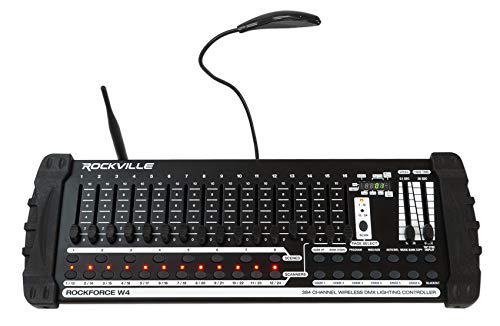
- Controls up to 24 intelligent lights
- Built-in 2.4GHz wireless DMX transmission
- Adds MIDI, music sync, and manual override
Best For: Mobile DJs and larger multi-fixture lighting systems
Best Compact Pick
14-Channel Mini DMX Controller
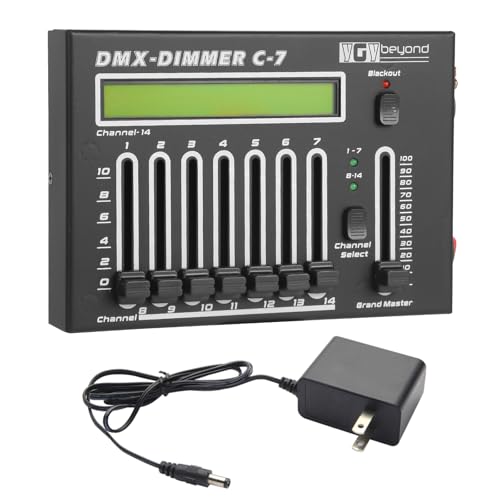
- Simple controls for first-time users
- 14 channels with seven faders per page
- Includes Grand Master and Blackout controls
Best For: Small parties, bars, KTV venues, and beginner DJ setups
Compact Starter Pick

- Six sub-control faders plus a main control fader
- One-key blackout and standard 3-pin DMX output
- Suitable for fixtures with 12 channels or fewer
Best For: Small stages and straightforward dimming control
Feature-Rich Beginner Console
TCFUNDY 192-Channel DMX Controller

- Controls up to 12 fixtures with 16 channels each
- Stores programmable scenes and six lighting chases
- Eight sliders support real-time manual adjustments
Best For: DJs and small shows needing programmable effects
Value Programming Board
WK-192 192-Channel DMX Controller
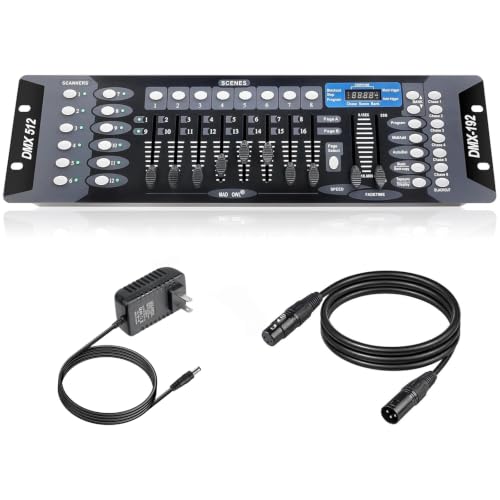
- 192-channel control for up to 12 compatible fixtures
- 23 scene banks and six programmable chases
- Includes a 6.6-foot DMX cable
Best For: Beginners programming DJ and stage lighting sequences
Easy-Start Pick – CO-Z 192 DMX Controller
For shoppers comparing dmx controllers for beginners, the CO-Z 192 DMX controller offers a clearly divided layout with fixture selection, scene switching, channel controls, display, and speed/time controls. It supports up to 12 fixtures with up to 16 channels each, making it a practical entry point for small DJ, event, church, or home setups.
Best For: Beginners who want straightforward control for small-to-medium lighting setups and programmed scenes.
Pros:
- Controls up to 12 fixtures and 192 DMX channels.
- Stores up to 240 scenes for more involved shows.
- Includes three-pin connectivity and voice control for convenient operation.
- Upgraded buttons and control sticks are designed for smooth, durable use.
Cons:
- Its 192-channel capacity is lower than the 384-channel alternatives in this roundup.
- The plastic construction may appeal less to users seeking an all-metal console.
The CO-Z balances useful programming capacity with a beginner-friendly control layout. Choose it when ease of use and compact event lighting matter more than maximum channel expansion.
Proven Programming Choice – CHAUVET DJ OBEY40
The CHAUVET DJ OBEY40 is a strong option for beginners who want room to grow. This DMX controller manages up to 12 fixtures with 16 channels each, while its banks, scenes, and chase functions provide a structured way to build and recall lighting looks.
Best For: New operators who want organized scene programming, chase playback, and fog or strobe control.
Pros:
- Provides 192 DMX channels for up to 12 fixtures.
- Stores 30 banks with eight scenes each, totaling up to 240 scenes.
- Offers six chase sets and fog and strobe controls.
- Includes MIDI compatibility and reversible sliders.
Cons:
- It controls fewer fixtures than the 384-channel models listed here.
- At 6.7 pounds, it is the heaviest product in this comparison.
With its dedicated programming and playback features, the OBEY40 suits users who want a more structured workflow than a basic controller provides. Its MIDI compatibility also leaves room for external integration.
High-Capacity Starter – DMX512 384CH Stage Console
For beginners who expect their lighting rig to expand, this DMX512 console provides 384 channels and programming for up to 24 fixtures. Its 30 banks of eight scenes give you substantial room to build repeatable looks for bar, club, live, and stage shows.
Best For: New users who need high channel capacity and extensive scene storage for larger lighting systems.
Pros:
- Offers 384 DMX channels for detailed fixture control.
- Supports 30 programmable banks with eight scenes each.
- Compact, lightweight design includes side handles and an LED gooseneck light.
- Works with 110–240V AC power according to the supplied specifications.
Cons:
- The higher channel count may be more capability than a very small beginner setup requires.
- The supplied notes do not specify features such as MIDI or built-in music triggering.
This console is worth considering when buying for future growth rather than the smallest possible setup. Its 384-channel architecture and scene capacity give beginners considerable programming headroom.
Feature-Rich 384-Channel Pick – Rockville ROCKFORCE 384 DMX
The Rockville ROCKFORCE combines 384-channel control with features that can make live operation easier for beginners, including a built-in microphone for music-triggered lighting and MIDI control. It can operate up to 24 intelligent lights and stores scenes in banks and programmable chases.
Best For: DJs and performers who want high fixture capacity plus music mode, MIDI, and manual override options.
Pros:
- Controls up to 24 intelligent lights with 16 channels each.
- Stores 30 banks of eight scenes and six programmable chases.
- Includes a built-in microphone, MIDI control, and music mode.
- Metal housing, LED display, gooseneck lamp, and power-failure memory support live use.
Cons:
- Its broader feature set may take longer to learn than a simpler controller.
- The larger 384-channel layout may be excessive for a small two- or three-fixture setup.
The ROCKFORCE is a versatile choice among dmx controllers for beginners who want automation and expansion potential. It is particularly appealing for DJs and live operators who value music-triggered effects alongside programmed control.
Best Beginner-Friendly Console – 192-Channel Stage Lighting Controller
For beginners seeking DMX controllers for beginners, this 192-channel console offers a clearly organized layout while leaving room to build more complex shows. It controls up to 12 intelligent lights with up to 16 channels each and supports up to 240 scenes.
Best For: DJs, small event operators, churches, weddings, and hobbyists who want scene programming, voice control, and broad fixture compatibility.
Pros:
- Controls up to 12 fixtures and supports up to 240 scenes.
- Organized controls and voice operation can make setup approachable for amateur users.
- Supports 3-pin DMX equipment, including fog machines, PAR lights, strobes, and moving-beam fixtures.
- Allows up to 40 steps per scene with adjustable pause and fade speeds.
Cons:
- The larger feature set may take time for a first-time user to learn.
- Its corded design is less convenient than a compact portable controller.
This is a versatile entry point for users who expect their lighting setup to grow. Its scene capacity and 192 channels provide useful headroom beyond basic manual control.
Best for Expanding Setups – Rockville ROCKFORCE W4 DMX Controller
Among DMX controllers for beginners, the Rockville ROCKFORCE W4 is aimed at users who want substantial capacity and wireless control from the start. It handles up to 24 intelligent lights and combines wired DMX, wireless transmission, MIDI, music sync, and manual override.
Best For: Mobile DJs, event production, and users managing multiple compatible fixtures across larger or more demanding setups.
Pros:
- Offers 384 channels for controlling up to 24 lights with 16 channels each.
- Built-in 2.4GHz wireless DMX supports up to 7 groups and 25 receivers.
- Includes 30 banks, 6 chases, and up to 240 scenes for programmed shows.
- Provides MIDI, music-triggered effects, manual override, and wired DMX in/out.
Cons:
- Its professional feature set may feel more complex than necessary for a very small setup.
- The 20.7-inch rack-mountable design is less portable than a mini console.
This controller makes the most sense when wireless reach and expansion matter more than minimal controls. Beginners can grow into its features, while experienced users benefit from the extra channels and control methods.
Best Compact Pick – 14-Channel Mini DMX Controller
For shoppers comparing DMX controllers for beginners, this compact 14-channel console keeps the controls straightforward. Seven faders per page, a clear LCD, a Grand Master fader, and a dedicated Blackout button provide direct control without complicated programming.
Best For: Beginners running a small number of DJ lights, PAR lights, moving heads, or strobes at parties, bars, KTV venues, weddings, and small performances.
Pros:
- Simple layout is designed for beginners and requires no complicated programming.
- Offers independent control across 14 DMX channels with quick 1–7 and 8–14 selection.
- Grand Master fader adjusts overall brightness from 0 to 100%.
- Dedicated Blackout button enables fast output shutoff during transitions or emergencies.
Cons:
- Its 14-channel capacity is more limited than larger consoles.
- It lacks the wireless, MIDI, and extensive scene features found on higher-capacity models.
This is the most approachable option for a small lighting rig and quick manual adjustments. Its compact size and low 0.7W power consumption also suit portable, everyday use.
Compact Starter Pick – MAD OWL 12-Channel DMX Dimmer
For beginners seeking DMX controllers for beginners setups, the MAD OWL 12-channel dimmer keeps operation simple with a main fader, six sub-control faders, and a one-key blackout function. Its compact aluminum design and standard 3-pin DMX output suit small lighting rigs.
Best For: Small stages and beginners controlling DMX512 fixtures with 12 channels or fewer.
Pros:
- Simple fader-based operation with one-key blackout.
- Portable, lightweight design for travel and quick installation.
- Smooth controls and standard 3-pin DMX output.
Cons:
- Cannot control lighting equipment requiring more than 12 channels.
- Designed primarily as a dimming controller, with fewer programming features than larger consoles.
This is the most approachable option for basic dimming control, provided your fixtures stay within its 12-channel limit and work with DMX512.
Feature-Rich Beginner Console – TCFUNDY 192-Channel DMX Controller
The TCFUNDY 192-channel console is a practical choice for beginners who want room to grow with DMX controllers for beginners. It can address up to 12 intelligent lights with up to 16 channels each, while programmable scenes and chases support more involved shows.
Best For: DJs, parties, churches, and small performances needing programmable scenes and multiple fixture control.
Pros:
- Controls up to 192 channels across as many as 12 fixtures.
- Offers 30 banks of scenes and six programmable chases with up to 240 scenes.
- Includes eight sliders for manual control plus speed and fade-time controls.
- Supports common 3-pin DMX-connected fixtures such as par lights and strobes.
Cons:
- More programming controls may take longer to learn than a basic dimmer.
- Requires a 9–12V DC, 300mA minimum power input.
Choose this model when scene storage and chase programming matter more than the simplest possible interface. Its 192-channel layout gives beginners useful expansion room.
Value Programming Board – WK-192 192-Channel DMX Controller
For users comparing DMX controllers for beginners, the WK-192 combines a conventional fader-and-button layout with programmable scene and chase functions. It controls up to 12 fixtures with 16 channels or fewer and includes a 6.6-foot DMX cable.
Best For: Beginners building programmable stage, club, or DJ lighting setups with multiple fixtures.
Pros:
- Provides 192 channels for controlling multiple compatible fixtures.
- Offers 23 banks of eight programmable scenes.
- Supports six programmable chases with up to 240 steps.
- Includes a 6.6-foot DMX cable.
Cons:
- Its larger 22.44-inch-wide body is less portable than a mini controller.
- Limited to 12 fixtures with 16 channels or fewer.
The WK-192 is a solid middle ground for learning programmed lighting sequences without moving to a more specialized system. Confirm your fixtures match its channel and DMX requirements before buying.
How We Picked the Best Dmx Controllers for Beginners
We focused on controllers that provide a practical entry point into DMX lighting rather than boards designed only for professional theater production. Our comparison considered channel capacity, fixture and scene organization, onboard controls, portability, connection options, and the type of setup each controller is likely to suit.
We also looked for useful beginner features such as blackout and grand master controls, dedicated fixture buttons, programmable scenes, banks, fog-machine support, MIDI compatibility, and wireless operation. Because DMX equipment is highly dependent on compatibility, buyers should still verify connector type, channel requirements, and fixture support before ordering.
Quick Comparison
| Controller type | Best suited for | What to look for |
|---|---|---|
| 14-channel mini console | Small parties and simple light kits | Portable layout and basic master controls |
| 12-channel dimmer controller | Small stages and straightforward dimming | Simple operation and fixture compatibility |
| 192-channel console | Entry-level DJ and stage setups | Scene storage, fixture buttons, and manageable programming |
| 384-channel console | Multiple fixtures or growing rigs | More banks, MIDI, and expanded control capacity |
| Wireless DMX controller | Mobile setups with fewer cables | Wireless compatibility and reliable signal range |
Key Buying Factors for Dmx Controllers for Beginners
Match the Channel Count to Your Fixtures
DMX channels describe how many control channels the board can address, not simply how many lights it can operate. A fixture using 10 DMX channels consumes more capacity than a basic dimmer. Add the channel requirements of every fixture and leave room for future expansion.
Check How Scenes and Banks Are Organized
Scenes let you save lighting looks, while banks group scenes for quick access. Beginners generally benefit from clearly labeled fixture buttons and a layout that makes programming, playback, and blackout control easy to understand.
Consider Portability and Connections
A compact controller is convenient for DJs and mobile entertainers, while a larger board may be easier to operate during a stage show. Confirm whether the unit uses 3-pin or 5-pin DMX connections, whether cables are included, and whether adapters are required.
Decide Whether You Need MIDI, Fog, or Wireless Control
MIDI can help integrate lighting with music equipment, and dedicated fog controls are useful for compatible effects machines. Wireless DMX can reduce setup time, but it adds another compatibility requirement and should not be assumed to work with every wireless fixture.
Who Should Buy Which Dmx Controllers for Beginners?
Choose a 12- or 14-channel mini controller if you only need basic control for a small number of lights and value low cost and portability. A 192-channel board is a sensible starting point for most DJs, party hosts, and small-stage users who want programmable scenes without an oversized console.
Move to a 384-channel model if you operate several fixtures, expect your rig to grow, or want MIDI and more programming headroom. A wireless model makes the most sense for mobile installations where reducing signal cables matters. For any first purchase, prioritize fixture compatibility and a clear control layout over a high channel number alone.