
Choosing among today’s 4K computer monitors is easier when you know what matters most: panel quality, refresh rate, connectivity, and screen size.
This roundup highlights ten strong options for creators, office users, gamers, and anyone who wants sharper detail and more usable screen space.
Best 10 4K Computer Monitors Picks for 2026
Office-First 4K Performer

- 32-inch 4K VA panel with 99% sRGB and 95% DCI-P3
- 120Hz refresh rate with FreeSync Premium support
- ComfortView Plus cuts harmful blue light by up to 35%
Best For: Large-screen business, editing, and casual gaming
Creator-Friendly 4K IPS Pick

- 32-inch IPS 4K display with HDR10
- More than 1 billion accurate colors
- Eye Saver Mode helps reduce strain
Best For: Design, editing, and productivity work
Ultrawide Value Curve
ZZA 34" Curved Ultrawide Monitor

- 34-inch curved ultrawide with 3440 x 1440 resolution
- 100Hz refresh rate with FreeSync support
- 100% sRGB and built-in speakers
Best For: Multitasking, gaming, and immersive ultrawide use
Compact USB-C 4K All-Rounder

- 27-inch 4K IPS monitor with 99% sRGB
- 120Hz refresh rate and FreeSync Premium
- USB-C connection delivers up to 65W power
Best For: Compact desks, business use, and editing
Value 4K Office Pick

- 4K UHD on a 27-inch matte display
- 2x HDMI 2.0 and 2x DP 1.2 ports
- 75Hz with FreeSync and VESA mount support
Best For: Budget office users, CAD work, and casual entertainment
Premium Smoothness Pick

- 4K IPS panel with 99% sRGB color
- 120Hz refresh rate with FreeSync Premium
- Ultra-low 0.03ms response time
Best For: Mixed-use buyers who want smooth motion and vivid color
Productivity 4K Workhorse

- 4K UHD with high pixel density
- Eye Saver Mode and flicker reduction
- Display Manager adds split-screen and KVM tools
Best For: Office multitaskers and long-session desktop users
Color-Accurate 4K Pick
LG 27US500-W Ultrafine Monitor 27-Inch 4K UHD
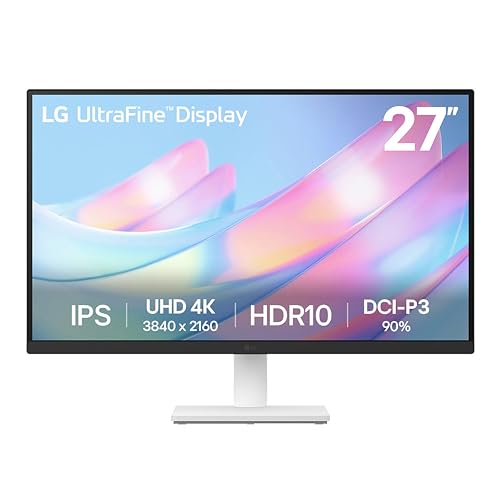
- 4K UHD IPS display with wide viewing angles
- HDR10 and up to 90% DCI-P3 color support
- Onscreen Control and ergonomic tilt stand
Best For: Creatives and everyday users who want a crisp 27-inch 4K display
Budget FHD Work Monitor
Samsung 32" Flat Computer Monitor

- 32-inch Full HD 1080p display
- 75Hz refresh with AMD FreeSync
- Eye Saver Mode and Flicker Free comfort features
Best For: A large budget monitor for general use, not 4K buyers
Office-First 4K Performer – Dell 32 Monitor S3225QS
If you want a 4k computer monitor that balances everyday productivity with a smoother feel for light gaming and media, the Dell S3225QS is a strong all-around pick. Its 32-inch VA panel brings 4K detail, 99% sRGB and 95% DCI-P3 coverage, and HDR readiness, while the 120Hz refresh rate and FreeSync Premium help motion stay clean.
Best For: Users who want a large 32-inch 4K display for business, photo/video editing, and casual gaming.
Pros:
- 120Hz refresh rate with FreeSync Premium for smoother motion
- 4K VA panel with 99% sRGB and 95% DCI-P3 color coverage
- Improved ComfortView Plus reduces harmful blue light by up to 35%
- Built-in speakers and height/tilt adjustment add desktop convenience
Cons:
- VA panel contrast is strong, but it is not an IPS panel
- Response time and gaming features are geared more toward mixed use than pure esports
- Uses a standard monitor design rather than an ultrawide format
This model stands out if you want a roomy 32-inch screen with better-than-basic speed and color for work or entertainment. It looks especially practical for users who value comfort, clean motion, and a simple HDMI/DisplayPort setup.
Creator-Friendly 4K IPS Pick – Samsung ViewFinity S7 32"
The Samsung 32″ ViewFinity S7 is a practical choice in 4k computer monitors if you want sharp detail and dependable color for professional work. Its 32-inch IPS panel, HDR10 support, and 4K resolution give you lots of screen space for complex diagrams, design work, and video content, while the matte finish helps keep reflections in check.
Best For: Professionals and creators who want a spacious 4K IPS monitor for work-focused tasks.
Pros:
- 32-inch 4K UHD panel with IPS viewing angles
- HDR10 support with more than 1 billion accurate colors
- Eye Saver Mode and flicker reduction for more comfortable viewing
- HDMI and DisplayPort connectivity keep setup simple
Cons:
- 60Hz refresh rate is more basic than faster 4K alternatives
- 5ms response time is fine for work, but not tuned for fast gaming
- No USB-C connectivity listed in the supplied details
If your priority is clear text, lots of workspace, and color-reliable output rather than high refresh performance, this Samsung fits well. It is a straightforward 4K monitor for office work, creative tasks, and everyday productivity.
Ultrawide Value Curve – ZZA 34" Curved Ultrawide Monitor
Although it is labeled as a 4k computer monitor, this ZZA model is really a 34-inch ultrawide built for extra workspace and immersive viewing. The 3440 x 1440 curved panel, 100Hz refresh rate, and 100% sRGB coverage make it a practical option for gaming, general productivity, and color-aware everyday use.
Best For: Buyers who want an ultrawide curved monitor for multitasking and immersive use.
Pros:
- 34-inch ultrawide curved screen with 3440 x 1440 resolution
- 100Hz refresh rate for smoother motion
- 100% sRGB color gamut for richer, more accurate color
- Built-in speakers and VESA mount compatibility add convenience
Cons:
- Not a true 3840 x 2160 4K panel despite the product title
- 250 brightness is modest compared with brighter monitors
- Only one HDMI port is listed in the supplied details
This is best viewed as an ultrawide productivity-and-entertainment display rather than a classic 4K monitor. If you want more horizontal room and a curved format, it offers a lot of screen for the money.
Compact USB-C 4K All-Rounder – Dell 27 Monitor S2725QC
The Dell S2725QC is a smart fit if you want a sharper, desk-friendly 4k computer monitor with modern connectivity. Its 27-inch IPS panel delivers 4K resolution, 99% sRGB color, and HDR readiness, while the 120Hz refresh rate and FreeSync Premium support make scrolling and motion feel noticeably smoother.
Best For: Users who want a compact 4K monitor for business, editing, and a cleaner USB-C setup.
Pros:
- 27-inch 4K IPS panel with 99% sRGB color coverage
- 120Hz refresh rate with FreeSync Premium for smoother motion
- Single USB-C cable support with up to 65W power delivery
- Built-in speakers and adjustable stand improve day-to-day use
Cons:
- Smaller 27-inch size offers less screen space than 32-inch models
- 4ms response time is solid, but not aimed at competitive gaming
- Uses a flat 16:9 layout instead of an ultrawide format
For users who want a cleaner desk and a compact 4K display, this Dell is one of the most practical options here. It blends productivity-friendly color with a faster refresh rate and useful USB-C connectivity.
Value 4K Office Pick – ZZA 27 inch 4K UHD Monitor
If you want one of the more affordable 4k computer monitors for everyday work, the ZZA 27-inch model makes a strong case with sharp 3840 x 2160 detail, a matte IPS-style panel, and practical connectivity. It is built for office use, light creative work, and casual entertainment rather than premium gaming, but the 75Hz refresh rate and HDR10 support give it a bit more flexibility than a basic 60Hz display.
Best For: Budget-conscious buyers who want a sharp 27-inch 4K monitor for office work, CAD, photo editing, and casual media.
Pros:
- 4K UHD resolution on a 27-inch screen for crisp text and detailed visuals
- 2x HDMI 2.0 and 2x DP 1.2 ports for flexible desktop and laptop hookups
- 75Hz refresh rate with AMD FreeSync support for smoother scrolling and playback
- VESA mount support and tilt adjustment for a cleaner, more comfortable setup
Cons:
- 60Hz-class use cases may not need the added refresh rate
- Color/performance claims are more general than a high-end creator monitor
Overall, this ZZA display focuses on practical value: sharp 4K resolution, straightforward connectivity, and a few comfort features that help it fit into a work-focused desk setup. It is a sensible choice if you want solid fundamentals without paying for premium extras.
Premium Smoothness Pick – Dell 27 Monitor S2725QS
The Dell S2725QS stands out among 4k computer monitors if you want a sharper work-and-play screen with noticeably smoother motion. Its 4K IPS panel, 120Hz refresh rate, AMD FreeSync Premium, and very low response time make it a versatile option for everyday productivity, content viewing, and lighter gaming, while the thin-bezel design keeps the desk look clean.
Best For: Buyers who want a polished 27-inch 4K monitor with high refresh rate smoothness and strong color accuracy for mixed use.
Pros:
- 4K IPS panel with 99% sRGB for vivid, accurate-looking color
- 120Hz refresh rate and AMD FreeSync Premium for smoother motion
- Ultra-low 0.03ms response time for a more responsive feel
- ComfortView Plus reduces blue light emissions while preserving color
Cons:
- Higher-end feature set may be more than basic office users need
- Audio improvements are mentioned, but sound is not the main reason to buy it
In practice, this Dell is a strong all-rounder for people who want 4K clarity without giving up fast refresh behavior. If you care about smooth scrolling, clean visuals, and a more premium feel, it is an easy model to shortlist.
Productivity 4K Workhorse – Samsung ViewFinity S7 27-inch
The Samsung ViewFinity S7 is aimed at productivity-first shoppers looking at 4k computer monitors for office work, multitasking, and detailed screen space. Its 27-inch 4K UHD resolution, HDR10 support, wide 178-degree viewing angle, and eye-comfort features make it a practical desktop display for long work sessions, while the built-in display manager tools add convenience for split-screen setups and calibration.
Best For: Office users and multitaskers who want a clean 27-inch 4K monitor with eye comfort features and productivity tools.
Pros:
- 4K UHD resolution with high pixel density for crisp productivity work
- HDR10 and wide viewing angles for clear, consistent visuals
- Eye Saver Mode and flicker reduction for better comfort during long sessions
- Display Manager tools support split screen, KVM, PIP/PBP, and calibration
Cons:
- Connectivity is limited to HDMI and DP rather than a wider port mix
- Feature set is centered on productivity, not gaming-specific performance
This Samsung is best viewed as a streamlined work monitor with thoughtful software and comfort features. If your priority is a dependable 4K desktop display for multitasking and extended office use, it fits that brief well.
Smart 4K Hub Monitor – Samsung 43” M7 (M70F) Series 4K UHD Smart Monitor
If you want a large-screen option in the world of 4k computer monitors, this Samsung 43-inch Smart Monitor leans hard into convenience. It combines 4K UHD clarity with built-in streaming access, AI picture tuning, and USB-C, HDMI, and USB-A connectivity for an all-in-one desk or entertainment setup.
Best For: Users who want a big 4K display that doubles as a streaming and smart-home hub.
Pros:
- 43-inch 4K UHD panel delivers detailed images and video.
- Built-in streaming access and Samsung TV Plus support add entertainment value.
- USB-C, HDMI, and USB-A ports simplify multi-device connections.
- AI features include picture optimization, Active Voice Amplifier, and Click to Search.
Cons:
- The smart features add complexity if you only need a basic monitor.
- Its large size may be too much for smaller desks.
This model stands out if you want more than a standard monitor and prefer one screen that can handle work, streaming, and connected-home tasks. It is best approached as a versatile hub first and a pure productivity display second.
Color-Accurate 4K Pick – LG 27US500-W Ultrafine Monitor 27-Inch 4K UHD
For shoppers comparing 4k computer monitors for creative work or everyday sharpness, the LG 27US500-W focuses on image quality and workspace flexibility. It offers 4K UHD resolution, HDR10 support, up to 90% DCI-P3 color gamut expression, and an IPS panel with wide viewing angles.
Best For: Creators and general users who want a crisp 27-inch 4K screen with strong color support.
Pros:
- 4K UHD resolution with a 1000:1 contrast ratio.
- HDR10 and up to 90% DCI-P3 support for vivid color.
- IPS panel with wide viewing angles for flexible viewing.
- Onscreen Control and an ergonomic stand make setup easier.
Cons:
- It is aimed at standard productivity and imaging rather than gaming features.
- The stand only lists tilt adjustment, not broader ergonomics.
This LG model is a practical pick if you care most about sharp text, detailed imagery, and dependable color in a straightforward package. It keeps the focus on display quality and easy workspace adjustments rather than extra bells and whistles.
Budget FHD Work Monitor – Samsung 32" Flat Computer Monitor
This Samsung 32-inch flat monitor is included as a lower-cost comparison point among 4k computer monitors, but it is actually a 1080p display rather than a 4K model. It still offers a large screen, 75Hz refresh rate, FreeSync, and eye comfort features for everyday work, media, and light gaming.
Best For: Buyers who want a large, affordable 32-inch monitor for general use and do not need 4K resolution.
Pros:
- 32-inch size with a three-sided borderless design.
- 75Hz refresh rate and AMD FreeSync help keep motion smooth.
- Eye Saver Mode and Flicker Free features support more comfortable long sessions.
- HDMI and DisplayPort connectivity cover common setups.
Cons:
- It is Full HD 1080p, not 4K.
- Brightness and 8ms response time are modest compared with higher-end monitors.
If you are mainly shopping by screen size and comfort features, this Samsung makes sense as a simple everyday monitor. Just note that it does not deliver the 4K detail suggested by the roundup keyword, so it fits best as a budget alternative.
How We Picked These 4K Computer Monitors
We focused on the features buyers actually feel day to day: image sharpness, panel type, refresh rate, ergonomic flexibility, and port selection. We also favored models that fit clear use cases, from budget-friendly office displays to smoother 120Hz options and larger screens for multitasking.
Quick Comparison: Which 4K Computer Monitors Fit Which Needs?
If you want the best all-around setup for mixed work and light gaming, a 27-inch or 32-inch 4K display with 120Hz is a strong target. For office work and text-heavy tasks, IPS panels usually offer the most consistent viewing angles and color stability. If your priority is pure workspace, larger 32-inch or 43-inch models can make multitasking feel easier without immediate scaling compromises.
Key Buying Factors for 4K Computer Monitors
Screen Size and Desk Distance
27-inch monitors are a popular sweet spot for sharp 4K detail, while 32-inch models feel more spacious and reduce the need for scaling in some workflows. Bigger screens are useful if you sit farther back or want to keep multiple windows visible.
Panel Type and Image Quality
IPS panels are usually preferred for color consistency and wider viewing angles, especially for productivity and creative work. VA panels can offer stronger contrast, which may appeal to users who watch a lot of video or prefer deeper blacks.
Refresh Rate and Motion Smoothness
A 60Hz display is still fine for office use, but 120Hz can make scrolling, cursor movement, and casual gaming feel noticeably smoother. For buyers considering 4K Computer Monitors for both work and play, refresh rate is one of the most important upgrades to watch for.
Ports, Compatibility, and Mounting
Check for HDMI, DisplayPort, and USB-C if you want easier laptop connectivity. Wall-mount support and VESA compatibility also matter if you plan to save desk space or build a multi-monitor setup.
Who Should Buy Which 4K Computer Monitors?
Choose a 27-inch 4K IPS monitor if you want a balanced everyday display for office tasks, streaming, and light creative work. Go with a 32-inch model if you want more screen real estate and a more relaxed viewing experience. Pick a higher-refresh monitor if smoother motion and occasional gaming matter, and consider a smart or ultrawide model if you want built-in convenience or broader multitasking space.
In short, the best 4K Computer Monitors depend on whether you value sharpness, speed, size, or flexibility most. Matching the panel and features to your workload will lead to a better purchase than chasing specs alone.