
If you need more NVMe storage than your motherboard can natively support, an M.2 to PCIe expansion card is one of the simplest upgrades. It lets you add one or more M.2 drives through an open PCIe slot.
The right choice depends on lane support, bifurcation, drive type, and how much cooling your SSDs need. This guide helps you match the card to your build before you buy.
Best 10 M.2 to PCIe Expansion Card Picks for 2026
Best cooled x4 adapter
M.2 NVMe to PCIe 3.0/4.0 x4 Adapter

- Supports 2230/2242/2260/2280 NVMe and AHCI SSDs
- Fits PCIe x4/x8/x16 slots with PCIe 4.0 support
- Includes aluminum heatsink, pads, and brackets
Best For: desktop NVMe installs with included cooling
Best dual-drive option
Dual M.2 NVMe/NGFF PCIe x4 Adapter

- Supports NVMe and SATA M.2 SSDs in two slots
- Fits 2230 through 22110 M.2 form factors
- Works in PCIe x4/x8/x16 slots with cooling features
Best For: dual-drive storage expansion and broad compatibility
Best premium Gen5 pick
M.2 NVMe SSD to PCIe x16 Adapter

- Tool-free design with built-in aluminum heatsink
- Supports NVMe M-key drives in 2230/2242/2260/2280 sizes
- Gen5-capable and backward compatible with older PCIe speeds
Best For: modern Gen5 NVMe builds that value easy installation
Best for spare x1 slots
M.2 NVMe to PCIe X1 Expansion Card

- Fits a spare PCIe x1 slot to add NVMe storage
- Supports 2230/2242/2260/2280 M.2 NVMe drives
- Works on Windows, Linux, and Mac OS
Best For: adding NVMe storage when only a PCIe x1 slot is free
Single-drive simplicity
Single M.2 NVMe/AHCI x4 Adapter

- Supports one M.2 NVMe or AHCI SSD
- Works in PCIe 3.0, 2.0, and 1.0 slots
- Includes full-height and low-profile brackets
Best For: Users who want a simple, driver-free single-SSD PCIe adapter
Dual-drive bifurcation pick
Dual M.2 NVMe PCIe x8 Bifurcation Card

- Runs two NVMe SSDs with bifurcation support
- Uses a PCIe 3.0 x8 slot
- Includes both full-height and low-profile brackets
Best For: Systems with bifurcation support that need dual-NVMe expansion
High-capacity expansion
4-Slot PCIe 4.0 NVMe Expansion Card
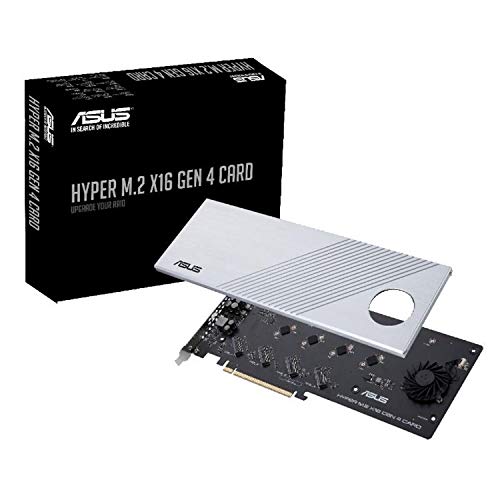
- Supports up to four NVMe M.2 SSDs
- Uses PCIe 4.0 bandwidth with x8/x16 compatibility
- Includes heatsink and blower fan cooling
Best For: Users with compatible platforms who need four NVMe drives on one card
Quad-Drive PCIe Bifurcation Card
RIITOP 4-Port PCIe x16 Adapter

- Adds up to 4 NVMe SSDs in one x16 slot
- Built-in heatsink and LED status lights
- Requires PCIe x16 bifurcation support
Best For: Compatible server and enthusiast boards needing four-drive NVMe expansion
Single-Drive NVMe Adapter
Sabrent M.2 NVMe to PCIe Adapter

- Fits PCIe x16, x8, or x4 slots
- Includes aluminum heatsink and thermal pad
- Supports 2230 through 2280 NVMe SSDs
Best For: Easy single-NVMe desktop upgrades with basic cooling
Dual-Protocol M.2 Adapter

- Runs one NVMe and one SATA M.2 SSD
- Includes heatsinks and low-profile bracket
- No driver installation required
Best For: Mixed M.2 storage builds needing both NVMe and SATA support
Best cooled x4 adapter – M.2 NVMe to PCIe 3.0/4.0 x4 Adapter
If you need a straightforward M.2 to PCIe expansion card for an NVMe or AHCI drive, this Bejavr adapter is built around broad slot compatibility and cooling. It supports 2230/2242/2260/2280 M.2 SSDs, fits PCIe x4/x8/x16 slots, and includes an aluminum heatsink plus thermal pads to help manage drive temperatures.
Best For: Users who want a simple, cooled adapter for installing an M.2 NVMe SSD into a desktop PCIe slot.
Pros:
- Supports M.2 NVMe and AHCI SSDs in 2230/2242/2260/2280 sizes
- Works in PCIe x4, x8, and x16 slots with PCIe 4.0 backward compatibility
- Includes aluminum heatsink, thermal pads, brackets, and screws
- Plug-and-play support is listed for Windows 11/10/8 and several Linux distributions
Cons:
- Win7 and Windows Server 2008 R2 need an additional NVMe driver
- Only one M.2 slot is provided
- Speed depends on the host slot and SSD generation
This is a practical pick if you want wide compatibility and included cooling without extra parts. It is especially appealing for common desktop installs where a stable x4 adapter is enough.
Best dual-drive option – Dual M.2 NVMe/NGFF PCIe x4 Adapter
The ELUTENG M.2 to PCIe expansion card is aimed at buyers who want support for both NVMe and SATA-style M.2 drives in one board. It accepts 2230 through 22110 form factors, works in PCIe x4/x8/x16 slots, and uses a dual-slot layout with heat-dissipation features to help keep SSD temperatures under control.
Best For: Anyone looking to connect two M.2 SSDs or need broad M.2 compatibility in a PCIe adapter.
Pros:
- Supports both NVMe and SATA M.2 SSDs, including B-Key, M-Key, and B&M key
- Dual M.2 slot design accepts 2230/2242/2260/2280/22110 drives
- Compatible with PCIe x4/x8/x16 slots
- Includes voltage regulation and heat-dissipation features for stability
Cons:
- PCIe x1 and PCI slots are not supported
- Booting as a system disk requires motherboard BIOS support for PCI-e boot
- Windows 7 and lower may require SSD drivers
If you need flexibility more than raw simplicity, this card stands out for its dual-slot design and broad drive support. It is a strong fit for storage expansion builds where compatibility across M.2 types matters.
Best premium Gen5 pick – M.2 NVMe SSD to PCIe x16 Adapter
This SABRENT M.2 to PCIe expansion card is built for newer NVMe SSDs and emphasizes easy installation. It supports M.2 M-key drives in 2230/2242/2260/2280 sizes, includes a built-in aluminum heatsink with thermal padding, and uses a x16 connector for physical stability while operating at up to PCIe 5.0 x4 speeds.
Best For: PC builders who want a tool-free, cooler-running adapter for modern Gen5 NVMe drives.
Pros:
- Tool-free design makes drive installation simpler
- Supports NVMe M-key SSDs across 2230/2242/2260/2280 form factors
- Backwards compatible with older PCIe link speeds
- Built-in aluminum heatsink and thermal padding help reduce throttling
Cons:
- Requires an NVMe-capable host system
- Rated speed depends on the PCIe slot and system support
- Although it may fit some x4/x8 slots, it uses an x16 connector physically
For a premium desktop upgrade, this card is attractive because it combines Gen5 readiness with cooling and a no-fuss install. It is best suited to users who want a modern adapter and already know their platform supports NVMe properly.
Best for spare x1 slots – M.2 NVMe to PCIe X1 Expansion Card
The SK1 M.2 to PCIe expansion card is a practical way to use a spare PCIe x1 slot for an NVMe SSD. It supports 2230/2242/2260/2280 M.2 NVMe drives, works with PCIe 4.0/3.0/2.0/1.0 protocols, and is designed for users who want storage expansion without consuming a larger x4 or x16 slot.
Best For: Builds where only a PCIe x1 slot is available and full x4 bandwidth is not required.
Pros:
- Uses an available PCIe x1 slot instead of taking up x16 space
- Supports M.2 NVMe drives in 2230/2242/2260/2280 sizes
- Compatible with Windows 11/10/8, Linux, and Mac OS
- Can be used for OS booting on systems that support PCIe boot
Cons:
- Maximum bandwidth is limited to PCIe x1 speeds
- Does not support M.2 SATA SSDs
- Some older motherboards may not support booting from the drive
This card makes sense when slot availability matters more than peak transfer rates. It is a sensible expansion choice for secondary storage, especially if your motherboard only has an open x1 lane.
Single-drive simplicity – Single M.2 NVMe/AHCI x4 Adapter
If you need a straightforward M.2 to PCIe expansion card for adding a single SSD, this StarTech adapter is built for broad compatibility and simple installation. It supports M-Key PCIe M.2 drives in NVMe or AHCI mode, works with PCIe 3.0 and falls back to PCIe 2.0/1.0, and fits x8 or x16 slots.
Best For: Desktop users who want an easy, driver-free way to add one M.2 NVMe or AHCI SSD through PCIe.
Pros:
- Supports M.2 2242, 2260, 2280, and 22110 drives
- Compatible with PCIe 3.0, 2.0, and 1.0 motherboards
- Includes full-profile and low-profile brackets
- No software or drivers required
Cons:
- Only supports a single M.2 SSD
- Does not add RAID or multi-drive capability
This is a practical choice if you want a reliable single-drive adapter with flexible slot and bracket support. It keeps setup simple while covering the common M.2 sizes most builders use.
Dual-drive bifurcation pick – Dual M.2 NVMe PCIe x8 Bifurcation Card
This M.2 to PCIe expansion card is aimed at builders who want to mount two NVMe SSDs on one adapter and have motherboard bifurcation support. The card uses a PCIe 3.0 x8 slot, supports M.2 NVMe drives in several lengths, and includes both full-height and low-profile brackets.
Best For: Desktop systems with BIOS bifurcation support that need dual-NVMe expansion on a single PCIe card.
Pros:
- Supports two NVMe drives through bifurcation
- Fits PCIe 3.0 x8 slots and is backward compatible
- Includes full-height and low-profile brackets
- Supports common M.2 sizes: 2230, 2242, 2260, and 2280
Cons:
- Motherboard and BIOS must support bifurcation
- Without bifurcation, only the first drive is recognized
- Hot swapping is not supported
Choose this card if you already know your platform supports lane splitting and you want to maximize storage density. It is less universal than a single-drive adapter, but it can be a strong fit for dual-SSD builds.
High-capacity expansion – 4-Slot PCIe 4.0 NVMe Expansion Card
For high-capacity storage builds, this M.2 to PCIe expansion card stands out by supporting up to four NVMe M.2 SSDs on one board. It uses PCIe 4.0 x16 bandwidth, is also compatible with x8 and x16 slots, and includes a heatsink plus integrated blower fan to help prevent throttling.
Best For: Power users and storage-heavy builds that need four NVMe drives on a single high-bandwidth expansion card.
Pros:
- Supports up to four NVMe M.2 drives
- Uses PCIe 4.0 bandwidth for high-speed expansion
- Compatible with PCIe x8 and x16 slots
- Includes heatsink and blower fan for cooling
Cons:
- Requires compatible AMD TRX40/X570 or Intel VROC support
- Designed specifically for PCIe 4.0 systems
- Heavier, more specialized card than basic adapters
This is the most expansion-focused option in the group, especially if you need multiple NVMe drives and have a compatible platform. Its cooling hardware and higher bandwidth make it a better fit for serious storage expansion than a basic single-drive adapter.
Quad-Drive PCIe Bifurcation Card – RIITOP 4-Port PCIe x16 Adapter
If you need a true M.2 to PCIe expansion card for building a high-capacity NVMe array, this RIITOP model is made for systems with PCIe x16 bifurcation support. It lets you mount up to four M.2 NVMe SSDs in one x16 slot, with a heatsink and LED indicators to help manage performance and status.
Best For: Users with compatible server or enthusiast boards who want to add four NVMe drives through a single PCIe x16 slot.
Pros:
- Supports up to 4 NVMe SSDs at once through a PCIe 4.0/3.0 x16 slot
- Built-in heatsink helps reduce temperature-related slowdowns
- LED indicators show each SSD’s working status
- Works with common M.2 NVMe sizes including 2280, 2260, 2242, and 2230
Cons:
- Requires motherboard PCIe x16 bifurcation support in BIOS
- Does not support SATA-based M.2 drives
- Not a fit if your board cannot set x4x4x4x4 mode
This is a strong pick for multi-drive NVMe expansion, but only if your motherboard and CPU platform can support the bifurcation setup it requires. If not, you may only see one drive recognized.
Single-Drive NVMe Adapter – Sabrent M.2 NVMe to PCIe Adapter
This M.2 to PCIe expansion card is a straightforward way to add a single NVMe SSD to a desktop with an available PCIe x16, x8, or x4 slot. The Sabrent adapter keeps the install simple and includes an aluminum heatsink and thermal pad for better cooling during sustained use.
Best For: Desktop users who want an easy single-NVMe upgrade in a standard PCIe slot.
Pros:
- Supports 2230, 2242, 2260, and 2280 NVMe SSD sizes
- Includes aluminum heatsink and thermal pad
- Tool-free setup with screws and screwdriver included
- Works with PCIe x16, x8, or x4 physical slots
Cons:
- Not compatible with SATA drives
- Does not work in PCIe x1 slots
- Needs a modern BIOS/system with NVMe support
For a simple storage expansion, this Sabrent card focuses on broad compatibility and easy installation rather than multi-drive features. It’s a practical choice when you just need one fast NVMe drive in a spare PCIe slot.
Dual-Protocol M.2 Adapter – MHQJRH Dual M.2 PCIe Adapter
This M.2 to PCIe expansion card is a flexible option if you want to connect both an NVMe SSD and a SATA M.2 SSD from the same adapter. It converts the NVMe slot to PCIe 3.0 x4 and the SATA slot to SATA 6Gbps, making it useful for mixed-drive builds.
Best For: Builders who need one adapter for both an M.2 NVMe drive and an M.2 SATA drive.
Pros:
- Supports two M.2 SSDs simultaneously: one NVMe and one SATA
- Includes heat sink solution plus 2 heat sinks for added cooling
- Comes with regular and low-profile brackets for flexible installation
- No driver installation required
Cons:
- NVMe side is limited to PCIe 3.0 x4
- SATA drive requires a separate SATA cable connection
- Not a multi-NVMe expansion card
This adapter stands out for mixed compatibility rather than raw expansion capacity. If your goal is to use one NVMe and one SATA M.2 SSD in a compact setup, it offers a practical and easy-to-install solution.
How We Picked the Best M.2 to PCIe Expansion Cards
We focused on cards that make practical sense for real PC builds: stable PCIe connectivity, broad M.2 size support, thermal management, and clear compatibility requirements. We also weighed whether a card is designed for a single drive, dual-drive setups, or multi-drive expansion so you can choose based on your actual motherboard slot availability and storage goals.
Quick Comparison
Single-drive cards are the easiest to install and usually work in more systems. Dual- and quad-drive cards offer much higher capacity, but they often depend on PCIe bifurcation support in BIOS. If you want maximum simplicity, look for a straightforward M.2 to PCIe Expansion Card with a heatsink and support for your target M.2 lengths. If you want higher drive density, make sure your motherboard and CPU can split lanes correctly.
Key Buying Factors for an M.2 to PCIe Expansion Card
PCIe Generation and Lane Width
Match the card to the slot you plan to use. A PCIe 4.0-capable card can still work in older slots, but actual speed will be limited by the host slot. Also check whether the card needs x4, x8, or x16 physical space to function as intended.
Drive Type and Keying
Most modern options are for NVMe M-Key drives, while some support SATA-based M.2 SSDs or B-key/B&M-key modules. This matters because a card that supports only NVMe will not run a SATA M.2 drive, even if the connector looks similar.
Bifurcation and BIOS Support
Multi-drive cards often require lane splitting from the motherboard BIOS, especially for dual and quad adapters. If your board does not support bifurcation, choose a single-drive adapter or a model designed to work around that limitation.
Cooling and Form Factor
High-speed NVMe drives can throttle under load, so heatsinks and airflow matter. Make sure the card supports your SSD lengths, such as 2230 through 22110, and leave room for neighboring components and GPU clearance.
Who Should Buy Which M.2 to PCIe Expansion Card?
If you only need one extra SSD, a basic single-slot M.2 to PCIe Expansion Card is the safest and most compatible option. If you are building a fast workstation, content library, or game storage array, a dual or quad card makes more sense—provided your motherboard supports bifurcation. For users focused on simplicity and reliability, pick a card with a built-in heatsink and clear NVMe support. For maximum capacity in a single expansion slot, choose a multi-drive solution only if your platform is confirmed compatible.