
The best wireless trackballs make precise cursor control easier without requiring constant wrist movement. They can be especially useful for desk work, creative tasks, and anyone managing limited workspace.
We compared 10 wireless models across comfort, connectivity, ball design, customization, charging, and overall value to help you choose the right fit.
Best 10 Wireless Trackballs Picks for 2026
Premium Ergonomic Pick

- 20-degree tilt with sculpted ergonomic grip
- Bluetooth and Logi Bolt connectivity
- USB-C charging with up to 120 days of use
Best For: Medium- to large-handed users wanting premium comfort and productivity controls
Ambidextrous Control Pick

- Ambidextrous design for either hand
- Dedicated scroll ring for documents and webpages
- Four selectable DPI settings
Best For: Shared workstations and users who want scroll-ring navigation
Everyday Comfort Pick

- Compact thumb-control design saves desk space
- Bluetooth and Logi Bolt connectivity
- Up to 18 months from one AA battery
Best For: Everyday office work and small, space-saving setups
Versatile Budget Pick

- Connects with up to three devices
- Rechargeable built-in battery
- Six fixed buttons and adjustable DPI
Best For: Right-handed users wanting multi-device flexibility and rechargeable power
Best Overall Wireless Trackball

- Bluetooth, 2.4GHz, and wired connectivity
- Rechargeable battery lasts up to four months
- Ambidextrous design with a 55mm tracking ball
Best For: Flexible, long-term desktop use
Best Quiet Wireless Trackball
Nulea M511 Ergonomic Trackball
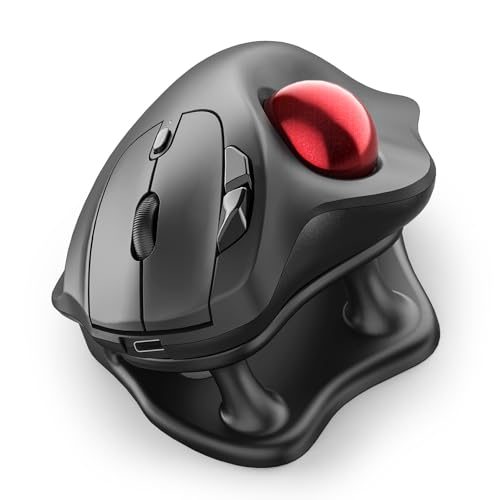
- Silent operation for shared or quiet spaces
- Pairs with up to three devices
- 21.7-degree tilt and four DPI levels
Best For: Right-handed, multi-device office setups
Best Ergonomic Wireless Trackball

- Large 55mm ball with Diamond Eye tracking
- Detachable wrist rest and ambidextrous layout
- Bluetooth LE or 2.4GHz wireless operation
Best For: Comfort-focused desk setups with ample space
Best Premium Pick
ELECOM Huge Plus Wireless Trackball

- Large 52mm ball for precise control
- Three connection modes and 10 programmable buttons
- Rechargeable battery lasts up to five months
Best For: Power users building a highly customizable desktop setup
Best Adjustable Ergonomics
SABLUTE Adjustable Wireless Trackball

- Choose between 0° and 18° tilt angles
- Three-device Bluetooth and 2.4GHz connectivity
- Five DPI levels, quiet clicks, and rechargeable power
Best For: Students and office users who want customizable wrist positioning
Best Value for Larger Hands
TECKNET Wireless Trackball Mouse

- 16° angled design for a natural hand position
- Three-device Bluetooth and 2.4GHz connection
- Quick-charge 500mAh battery and quiet clicks
Best For: Medium- to large-handed users needing an everyday office trackball
Premium Ergonomic Pick – Logitech MX Ergo S
The Logitech MX Ergo S is a strong choice among wireless trackballs for users who want a rechargeable, ergonomic design with extensive customization. Its 20-degree tilt, thumb-controlled ball, quiet clicks, and dual wireless connectivity are suited to long work sessions.
Best For: Medium- to large-handed users seeking premium comfort, rechargeable power, and advanced productivity controls.
Pros:
- 20-degree tilt and sculpted grip support a more comfortable forearm posture.
- Bluetooth and included Logi Bolt receiver provide flexible connectivity.
- USB-C charging offers up to 120 days of use, with a quick-charge option.
- Six customizable buttons and Smart Actions add workflow flexibility.
Cons:
- The ergonomic shape is designed for right-handed use.
- Charging cable is not included.
- Its feature-rich design may be more than casual users need.
The MX Ergo S stands out when comfort, battery convenience, and customization matter more than a basic control setup. It is especially compelling for a dedicated office or productivity workspace.
Ambidextrous Control Pick – Kensington Orbit Wireless
The Kensington Orbit Wireless is a practical option among wireless trackballs for users who want ambidextrous handling and a dedicated scroll ring. Its 40mm ball, adjustable DPI settings, and dual wireless modes make it adaptable for browsing, documents, and precision work.
Best For: Right- or left-handed users who prioritize a scroll ring and adjustable cursor speed.
Pros:
- Ambidextrous design works for both right- and left-handed users.
- Dedicated scroll ring makes moving through documents and webpages easy.
- Four DPI settings range from 400 to 1,600 for different tasks.
- Supports both 2.4 GHz and Bluetooth LE wireless connections.
Cons:
- Uses two AA batteries rather than a rechargeable battery.
- Only two buttons are listed in the supplied specifications.
- KensingtonKonnect does not currently support Windows ARM-based computers.
With its symmetrical shape and scroll ring, the Orbit Wireless is a sensible fit for shared workstations or households with different users. Its lower button count favors straightforward navigation over extensive onboard controls.
Everyday Comfort Pick – Logitech ERGO M575S
The Logitech ERGO M575S is one of the more approachable wireless trackballs for everyday office use. Its sculpted thumb control keeps the hand mostly stationary, while Bluetooth, Logi Bolt connectivity, quiet clicks, and long AA battery life support convenient daily use.
Best For: Office users with limited desk space who want an ergonomic, low-maintenance trackball.
Pros:
- Thumb control moves the cursor without requiring the whole hand to move.
- Ergonomic shape supports a relaxed hand and improved forearm posture.
- Bluetooth and included Logi Bolt receiver offer two connection options.
- Included AA battery can last up to 18 months.
Cons:
- The right-handed design is not suitable for left-handed users.
- It uses a replaceable AA battery rather than rechargeable power.
- Only two buttons are listed in the supplied specifications.
The ERGO M575S balances comfort and simplicity well. It is a particularly practical choice for compact desks, since thumb control works without needing much surface area.
Versatile Budget Pick – Nulea M501 Wireless Trackball
The Nulea M501 offers useful flexibility for shoppers comparing wireless trackballs, including three-device connectivity, a rechargeable battery, adjustable DPI, and six physical buttons. Its thumb-controlled design can work well on cramped desks or other surfaces where moving a conventional mouse is inconvenient.
Best For: Right-handed users seeking rechargeable power and multi-device switching at a practical feature level.
Pros:
- Connects with up to three devices through Bluetooth or its USB dongle.
- Built-in rechargeable battery eliminates disposable cells.
- Adjustable DPI supports different cursor-speed preferences.
- Six buttons include convenient forward and back controls.
Cons:
- Buttons are not programmable.
- Charging should use the included cable and a computer USB port or 5V charger, not a fast charger.
- The design is intended for right-handed use.
The M501 is a flexible choice when multi-device support and rechargeable operation are priorities. Its main limitation is the lack of button programming, so it is better suited to users who are satisfied with its fixed controls.
Best Overall Wireless Trackball – Kensington SlimBlade Pro
The Kensington SlimBlade Pro is a flexible choice among wireless trackballs, offering Bluetooth, 2.4GHz wireless, and wired USB-C connectivity. Its ambidextrous low-profile design, large 55mm ball, and rechargeable battery make it well suited to extended desktop use.
Best For: Users who want versatile connectivity, a rechargeable battery, and an ambidextrous design.
Pros:
- Supports Bluetooth, 2.4GHz wireless, and wired connections.
- Rechargeable battery provides up to four months of use per charge.
- Large 55mm ball and dual sensors support accurate cursor control.
- Eight sets of programmable buttons can be configured with KensingtonWorks and KensingtonKonnect.
Cons:
- Its advanced button customization requires downloadable software.
- The included wireless dongle is USB-A, though a USB-C adapter is supplied.
With broad compatibility across Windows, macOS, and Linux plus three connection modes, the SlimBlade Pro is a strong all-around option for a multi-device or changing workspace.
Best Quiet Wireless Trackball – Nulea M511 Ergonomic Trackball
The Nulea M511 brings a quiet, thumb-controlled design to the wireless trackball category. Its 21.7-degree tilt stand, multi-device pairing, and adjustable DPI settings make it practical for shared workspaces and everyday multitasking.
Best For: Right-handed users who prioritize silent operation and quick switching between devices.
Pros:
- Silent trackball, buttons, and scroll wheel suit shared spaces and late-night work.
- Connects through Bluetooth or the included USB receiver and supports up to three devices.
- Four DPI settings from 400 to 1600 provide control over cursor speed.
- Ergonomic 21.7-degree tilt stand helps promote a more natural wrist position.
Cons:
- Designed for right-handed use only.
- Buttons are not programmable.
- Compatibility notes list Windows 11 and macOS 14 Sonoma as the minimum operating system versions.
The M511 is a focused ergonomic option rather than a highly customizable one. Its strongest advantages are quiet performance, device switching, and a comfortable tilted shape.
Best Ergonomic Wireless Trackball – Kensington Expert Mouse
The Kensington Expert Mouse is a substantial wireless trackball built around a large 55mm ball, a patented scroll ring, and a detachable wrist rest. Its ambidextrous layout and Bluetooth or 2.4GHz connectivity make it a practical choice for users who want supported hand positioning and precise navigation.
Best For: Users who want a large, ambidextrous trackball with wrist support and a dedicated scroll ring.
Pros:
- Large 55mm ball and Diamond Eye optical tracking support precise cursor movement.
- Patented scroll ring makes vertical page navigation straightforward.
- Detachable wrist rest adds support during extended use.
- Bluetooth LE and 2.4GHz wireless dongle connectivity provide setup flexibility.
Cons:
- Uses two AA batteries rather than a rechargeable battery.
- Its larger 8-by-6.1-inch footprint requires more desk space.
- Linux is not supported according to the supplied compatibility details.
The Expert Mouse favors a roomy, traditional design over portability. It is a good fit when wrist support, a scroll ring, and ambidextrous operation matter more than a compact footprint.
Best Premium Pick – ELECOM Huge Plus Wireless Trackball
The ELECOM Huge Plus is a feature-rich choice among wireless trackballs, combining a large 52mm ball with three connection modes and extensive customization. Its rechargeable battery, silent clicks, and broad device compatibility make it well suited to demanding desk setups.
Best For: Productivity users who want a large, highly customizable trackball for long work sessions.
Pros:
- Large 52mm ball is designed for precise, fluid control.
- Supports Bluetooth, 2.4GHz wireless, and wired USB-C connections for up to three devices.
- Offers 10 programmable buttons, swappable steel bearings, and up to five months of battery life.
- Quiet clicks and compatibility with Windows, macOS, iPadOS, Android, and ChromeOS add flexibility.
Cons:
- Right-hand design may not suit left-handed users.
- Its larger size and 291 g weight may be less portable than smaller trackballs.
The Huge Plus stands out for its oversized ball, extensive button customization, and connection flexibility. Choose it if maximum control and long battery life matter more than a compact footprint.
Best Adjustable Ergonomics – SABLUTE Adjustable Wireless Trackball
The SABLUTE MAM1 Pro is one of the more adaptable wireless trackballs for users who want to change their hand position. Its selectable 0° or 18° angle, three-device connectivity, adjustable DPI, and rechargeable design support varied workspaces and routines.
Best For: Students and office users seeking adjustable wrist positioning and quiet, flexible control.
Pros:
- Switchable 0° and 18° angles let users choose a preferred hand position.
- Thumb-operated trackball helps reduce arm movement in confined workspaces.
- Connects with up to three devices through Bluetooth and 2.4GHz wireless.
- Includes five DPI settings from 800 to 4800, quiet buttons, USB-C charging, and optional backlighting.
Cons:
- The included customization driver is not compatible with Mac OS.
- New trackball users may need one to two weeks to adapt.
With its adjustable tilt and broad wireless compatibility, the MAM1 Pro offers a practical way to experiment with ergonomic positioning. It is especially appealing if quiet operation and multiple DPI options are priorities.
Best Value for Larger Hands – TECKNET Wireless Trackball Mouse
The TECKNET wireless trackball focuses on comfortable thumb control and straightforward multi-device connectivity. Its 16° vertical angle, quiet operation, rechargeable battery, and larger body make it a practical option for office users with medium to large hands.
Best For: Medium- to large-handed users who want an ergonomic wireless trackball for everyday office work.
Pros:
- 16° vertical angle is designed to encourage a more natural forearm posture.
- Pairs with up to three devices through two Bluetooth connections and 2.4GHz wireless.
- A 500mAh rechargeable battery can provide a full day of use after 15 minutes of charging.
- Quiet operation and five DPI settings support focused work and cursor adjustment.
Cons:
- Its 1200 DPI maximum is lower than some competing wireless trackballs.
- The larger body may be less comfortable for users with small hands.
- It has six buttons, offering less customization than models with more programmable controls.
The TECKNET is a focused, practical pick rather than an especially customizable one. Its angled design, quick charging, and three-device support make it a sensible everyday choice for larger hands.
How We Picked the Best Wireless Trackballs
We evaluated these Wireless Trackballs against the features that matter most in everyday use: ergonomic design, cursor precision, connection reliability, battery or charging convenience, button layout, scroll control, and compatibility with common computers. We also considered whether each model suits a particular hand size, grip preference, workspace, or workflow.
Because trackball designs vary substantially, the best option is not always the one with the most features. Thumb-controlled models tend to feel familiar to users transitioning from a conventional mouse, while finger- or palm-controlled designs can offer more precise movement and reduce repetitive thumb use.
Quick Comparison
| Best For | Look For |
|---|---|
| Everyday office work | Comfortable shaping, dependable wireless connection, and easy scrolling |
| Small desks and travel | Compact body, Bluetooth support, and low maintenance |
| Precision work | Large, smooth ball and adjustable sensitivity |
| Long work sessions | Palm support, an ergonomic angle, and accessible buttons |
| Advanced customization | Programmable buttons and software support |
Key Buying Factors for Wireless Trackballs
Trackball Position and Control
Thumb-controlled trackballs are compact and familiar, but they may place more work on the thumb. Central or finger-controlled designs let you move the pointer with several fingers or the palm and can be preferable for detailed work. A larger ball generally provides smoother, more controlled movement, though it also increases the mouse’s footprint.
Ergonomics and Fit
Look for a shape that supports the palm without forcing the wrist into an awkward angle. Tilt stands and adjustable angles can improve comfort, but they are most useful when the dimensions match your hand. Check the product size and button placement before buying, particularly if you have small hands or prefer fingertip control.
Connectivity and Power
Bluetooth is convenient for laptops and reduces the need for a receiver, while 2.4GHz wireless connections often offer straightforward plug-and-play setup. Multi-connection models are useful if you switch between computers. Rechargeable batteries reduce disposable waste, whereas replaceable batteries can provide longer use between changes and an easy backup option.
Buttons, Scrolling, and Sensitivity
A scroll ring can be comfortable for vertical navigation, while a conventional wheel may feel more familiar. Extra programmable buttons benefit editing, productivity, and gaming workflows, but only if the software supports your operating system. Adjustable DPI or pointer speed helps tailor control for large displays, detailed tasks, and general browsing.
Who Should Buy Which Wireless Trackballs?
Choose a thumb-controlled ergonomic model if you want the easiest transition from a traditional mouse and prioritize everyday comfort. Choose a central-ball design if precision, palm control, or reduced thumb movement matters most. A compact Bluetooth model is best for laptop users and smaller workspaces, while a rechargeable multi-connection trackball suits people who move between devices.
For demanding productivity or creative work, prioritize a large ball, smooth bearings, customizable buttons, and adjustable sensitivity. If you are uncertain, focus first on the control style and hand fit; wireless range and extra features matter less if the trackball feels uncomfortable after extended use.