
The best voice recorders make it easier to capture lectures, meetings, interviews, music rehearsals, and quick personal notes without relying on a phone. The right model depends on recording quality, storage, battery life, portability, and whether you need features such as voice activation or AI transcription.
We’ve compared 10 popular options across basic dictation, high-capacity recording, noise reduction, and professional handheld audio to help you choose a recorder that fits your workflow and budget.
Best 10 Voice Recorders Picks for 2026
Best for Everyday Note-Taking

- 64GB storage with up to 4,660 hours at 32Kbps
- Noise reduction and seven-level recording gain
- Voice activation, playback tools, and Type-C transfer
Best For: Students, teachers, writers, and professionals
Best for Music and Video Production

- 32-bit float audio with four-track recording
- Stereo microphones and two XLR/TRS inputs
- USB-C recording or streaming with SD backup
Best For: Musicians, podcasters, filmmakers, and live-performance recording
Best AI-Enabled Option

- Transcription in 113 languages with smart summaries
- 128GB storage and up to 33 hours of recording
- Password lock, voice activation, and wired OTG transfers
Best For: Students and professionals organizing lectures or meetings
Best for Maximum Storage

- Up to 9,800 hours of storage at 32Kbps
- Triple noise reduction and voice activation
- Up to 100 hours of recording with useful accessories
Best For: Long meetings, lectures, interviews, and audio archiving
Best High-Capacity Pick
Tonfarb 136GB Digital Voice Recorder

- 136GB total storage with included TF card
- Up to 68 hours of continuous recording
- PCM audio, noise reduction, and one-click recording
Best For: Extended lectures, meetings, interviews, and large recording libraries
Best Simple Budget Option

- Simple three-button recording and playback
- Stereo recording with noise reduction
- Voice activation and A-B repeat controls
Best For: Students and occasional lecture or meeting recording
Best Lightweight Design
Sunlan 16GB Digital Voice Recorder

- Lightweight 35-gram portable design
- 1536 kbps recording with DSP noise reduction
- Voice activation and simple one-button operation
Best For: Portable lecture, interview, and meeting recording
Best with Extra Features
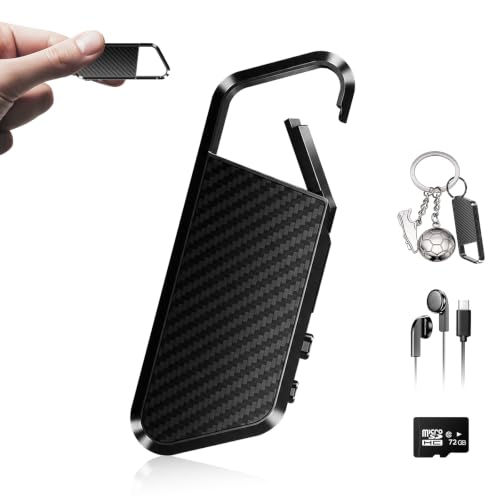
- DSP 6.0 noise reduction for clearer WAV recordings
- 72GB storage with up to 10,860 hours stated capacity
- OTG file transfer to compatible smartphones and tablets
Best For: Long-term lecture, meeting, and interview recording
Best Feature-Rich Choice

- MP3 and 1536kbps WAV recording options
- Six voice-activation sensitivity levels
- Password protection, bookmarks, and four-folder organization
Best For: Organized lecture, meeting, and interview recordings
Best Easy-Operation Pick
128GB Voice Recorder with Playback

- 1536kbps PCM recording with stereo microphone
- One-button recording and smart voice activation
- Time-stamped files, playback controls, and Type-C transfer
Best For: Simple stereo recording for lectures, meetings, and dictation
Best for Everyday Note-Taking – EVISTR 64GB Voice Recorder
For shoppers comparing voice recorders for lectures, meetings, interviews, and everyday notes, the EVISTR L357 focuses on straightforward operation and generous storage. Its adjustable recording gain, voice activation, playback controls, and Type-C file transfer make it a practical all-purpose option.
Best For: Students, teachers, writers, and professionals who want an easy-to-use recorder with substantial storage.
Pros:
- 64GB capacity can store up to 4,660 hours at 32Kbps.
- PCM noise reduction, adjustable seven-level gain, and up to 1536Kbps stereo recording.
- Voice activation, A-B repeat, variable-speed playback, and scheduled recording.
- Up to 32 hours of continuous recording and convenient Type-C transfers.
Cons:
- The extensive menu and recording settings may take some setup time.
- Voice activation can omit quiet sections by design.
This is a well-rounded choice when simple controls, long recording sessions, and file organization matter more than advanced multitrack production features.
Best for Music and Video Production – Zoom H4 Essential Recorder
Among voice recorders, the Zoom H4 Essential is aimed at creators who need more than basic spoken-word capture. It combines built-in stereo microphones with two XLR/TRS inputs, four-track recording, 32-bit float audio, and USB-C connectivity for recording or streaming.
Best For: Musicians, podcasters, filmmakers, and users recording live performances or external microphones.
Pros:
- 32-bit float recording helps provide clip-free audio for varied sound levels.
- Built-in stereo microphones support portable field recording.
- Two XLR/TRS inputs accommodate external microphones, instruments, mixers, or soundboards.
- Can record or stream through USB-C while saving a backup to an SD card.
Cons:
- Its creative-production features may be more than needed for simple lectures or reminders.
- It uses two AA batteries rather than a built-in rechargeable battery.
The H4 Essential is the strongest fit here for hands-on audio production, especially when input flexibility and protection against distorted takes are priorities.
Best AI-Enabled Option – EVISTR L359 AI Voice Recorder
If you want voice recorders that can help turn audio into usable notes, the EVISTR L359 adds app-based AI tools to standard recording. Through the AI DVR Link app, it supports transcription in 113 languages, summaries, mind maps, speaker identification, and Ask AI insights.
Best For: Students and professionals who want recording, transcription, and organized meeting or lecture notes in one workflow.
Pros:
- AI tools support transcription in 113 languages, summaries, mind maps, and speaker identification.
- 128GB storage can hold up to 9,216 hours at 32Kbps.
- One-button recording, voice activation, password encryption, and a HOLD switch.
- Wired OTG connection supports direct phone transfers without Bluetooth.
Cons:
- AI processing depends on the AI DVR Link app and a compatible phone connection.
- The built-in battery is rated for up to 33 hours of continuous recording.
This model stands out for buyers who want to move from raw recordings to searchable, summarized information, provided they are comfortable using the companion app.
Best for Maximum Storage – Elasound 132GB Voice Recorder
For shoppers who prioritize capacity and long unattended sessions, this Elasound is one of the more storage-focused voice recorders in the group. It combines a 128GB TF card, voice activation, triple noise reduction, one-touch recording, and a battery rated for up to 100 hours of continuous recording.
Best For: Professionals, journalists, and students who regularly archive long meetings, lectures, and interviews.
Pros:
- Up to 9,800 hours of storage at 32Kbps with the included 128GB TF card.
- AI intelligent triple noise cancellation is designed to clarify vocals.
- One-touch recording and voice activation simplify everyday use.
- Includes a clip-on microphone, headphones, OTG adapters, and USB-C cable.
Cons:
- The advertised maximum storage and recording time apply to lower-bitrate recording conditions.
- Its listed format is MP3, offering less format flexibility than models supporting WAV.
The Elasound is a practical pick when recording endurance and archive space are more important than advanced editing or studio-oriented connections.
Best High-Capacity Pick – Tonfarb 136GB Digital Voice Recorder
For shoppers comparing voice recorders, the Tonfarb stands out for its unusually large storage capacity, long battery life, and quick one-click recording. Its dual microphones, PCM recording, and automatic noise reduction make it a practical option for lectures, meetings, interviews, and extended recording sessions.
Best For: Students, journalists, and professionals who need substantial storage and long recording sessions.
Pros:
- 136GB total storage with the included 128GB TF card and 8GB built-in memory.
- Up to 68 hours of continuous recording from the 1100mAh rechargeable battery.
- 1536 kbps PCM recording, dual microphones, automatic noise reduction, and voice activation.
- One-click recording, USB-C file transfer, A-B repeat, and password protection.
Cons:
- Its many features may be more than casual users need.
- The supplied specifications list USB 2.0 hardware despite the USB-C connection description.
The Tonfarb is the strongest choice here for buyers who prioritize recording endurance and storage capacity. Its compact metal body and simple controls add everyday portability, while the playback and security features make managing recordings easier.
Best Simple Budget Option – HoTiyan 8GB Voice Recorder
If you want voice recorders with straightforward controls and useful playback tools, this HoTiyan model offers a compact setup for lectures, meetings, and interviews. It combines stereo recording, voice activation, A-B repeat, and multiple recording-quality modes in an easy-to-operate design.
Best For: Students and occasional users who want a simple recorder with flexible file and playback options.
Pros:
- High-sensitivity microphone, noise reduction, and a professional recording chip support HD stereo recording.
- Voice activation can reduce silent sections and help conserve storage space.
- 8GB storage supports up to 128 hours at 192 kbps, with lower-quality modes offering longer capacity.
- A-B repeat, variable playback speed, timestamps, password protection, and MP3 playback add versatility.
Cons:
- Its 20-hour continuous recording battery life is shorter than the larger Tonfarb model.
- Storage is limited to 8GB and the recorder supports up to 199 files.
- File transfer uses the supplied Micro USB cable rather than USB-C.
This HoTiyan recorder is a sensible everyday pick when ease of use matters more than maximum capacity. Its voice-activated mode and playback controls are especially useful for reviewing class notes or meeting highlights.
Best Lightweight Design – Sunlan 16GB Digital Voice Recorder
Among compact voice recorders, the Sunlan model keeps operation uncomplicated: press REC to start, STOP to finish, and PLAY to review. It adds noise reduction, voice activation, and a built-in speaker, making it useful for capturing lectures, interviews, and meetings without a steep learning curve.
Best For: Buyers seeking a lightweight, no-frills recorder with clear audio and basic playback features.
Pros:
- Lightweight 35-gram design with 16GB of built-in storage.
- 1536 kbps recording and DSP noise reduction help capture clearer voice audio.
- Voice-activated recording can reduce idle recording time and power use.
- Built-in speaker, A-B repeat, MP3-player functionality, and USB file storage.
Cons:
- Continuous recording is rated at more than 30 hours, below the Tonfarb’s 68-hour claim.
- The listed format is WAV, which may require more storage than compressed MP3 recording.
- The supplied specifications identify the microphone mode as mono.
The Sunlan is a good fit for users who value portability and uncomplicated controls. It offers useful recording assistance and playback features in a notably light body, though buyers needing stereo recording or very long battery life may prefer another option.
Best with Extra Features – 72GB Voice Activated Recorder
If you need voice recorders for lectures, interviews, meetings, or personal notes, this NekSide model emphasizes long-term storage and easy portability. Its DSP 6.0 noise reduction is designed to help produce clearer recordings in busy environments, while OTG support enables direct file transfers to compatible smartphones or tablets.
Best For: Users who want extensive built-in storage, playback, and mobile-friendly file transfer.
Pros:
- DSP 6.0 noise reduction and high-definition WAV recording.
- 72GB storage with up to 10,860 hours of stated recording capacity.
- OTG support for transferring files directly to compatible phones or tablets.
- Portable design and a two-year manufacturer warranty.
Cons:
- WAV is the default format; MP3 requires conversion through a computer.
- Built-in mono microphone may be less suitable for stereo recording needs.
This is a practical choice when storage capacity and portability matter most. Buyers who prefer ready-to-use MP3 files may need to account for the extra conversion step.
Best Feature-Rich Choice – EVIDA 128GB Voice Recorder
Among voice recorders for lectures, meetings, and interviews, the EVIDA VR01 stands out for its flexible recording settings and organization tools. It supports MP3 or WAV recording, offers adjustable voice activation, and includes password protection, bookmarks, and four-folder file management.
Best For: Students, professionals, and writers who want adjustable recording quality and organized file storage.
Pros:
- Records in MP3 at 128 or 192kbps, or WAV at 1536kbps.
- 128GB storage with stated capacity for up to 9,296 hours of recordings.
- Six voice-activation sensitivity levels help limit silent sections.
- Includes playback, password protection, A-B repeat, bookmarks, and MP3-player functionality.
Cons:
- Its stated continuous battery life is up to 54 hours, so extended sessions still require charging.
- No headphone jack is listed in the supplied specifications.
- File transfers are designed for computers through USB 2.0.
The VR01 offers a broad feature set for users who want more control than a basic recorder provides. Its password protection and folder system are especially useful for managing numerous recordings.
Best Easy-Operation Pick – 128GB Voice Recorder with Playback
For shoppers comparing voice recorders with simple controls and modern connectivity, the arungo ZD70 combines one-button recording with voice activation and playback features. Its stereo microphone, PCM noise cancellation, time-stamped files, and included 128GB TF card make it suited to everyday lectures, meetings, interviews, and dictation.
Best For: Users who want straightforward operation, stereo capture, and convenient playback controls.
Pros:
- 1536kbps PCM recording with an omnidirectional stereo microphone.
- Includes a 128GB TF card and supports up to 50 hours of continuous recording.
- One-button recording, voice activation, and automatic time-and-date file naming.
- Offers A-B repeat, speed control, MP3 playback, password lock, and Type-C transfer.
Cons:
- Listed battery life is up to 50 hours, below some longer-runtime options.
- The one-year warranty is shorter than the two-year coverage listed for some competing models.
- Its 1.44-inch screen is relatively compact for navigating files.
This model is a strong fit for buyers who prioritize ease of use and stereo recording. Time-stamped files and playback controls make reviewing recordings more convenient, while the included accessories reduce setup effort.
How We Picked These Voice Recorders
We focused on the features that matter most in everyday recording: microphone performance, storage capacity, battery endurance, playback controls, file transfer, portability, and ease of use. The selection includes compact dictation devices for lectures and meetings, high-capacity models for extended recording, and a more advanced handheld recorder for music, podcasts, and filmmaking.
Because advertised recording hours vary by audio quality and settings, treat maximum capacity claims as estimates rather than guaranteed real-world results. For important interviews or events, test the recorder beforehand and keep a backup when possible.
Quick Comparison
| Best For | Features to Prioritize | Recommended Type |
|---|---|---|
| Lectures and classes | Voice activation, clear playback, long battery life | Compact digital recorder |
| Meetings and interviews | Noise reduction, reliable storage, easy file transfer | Midrange recorder with playback |
| Long-term recording | High storage capacity and battery endurance | High-capacity voice-activated model |
| Music and film audio | Quality microphones, manual controls, versatile inputs | Handheld audio recorder |
Key Buying Factors for Voice Recorders
Recording Quality and Noise Control
For speech, prioritize intelligibility over headline storage numbers. Noise reduction can help in busy rooms, but microphone placement remains critical. If you record music or ambient sound, look for better microphones, adjustable levels, and support for higher-quality formats.
Storage and File Management
More storage is useful for long sessions, but it does not automatically improve audio quality. Check whether the device supports expandable storage, how files are organized, and whether recordings transfer through USB as standard audio files.
Battery Life and Charging
Choose a recorder that can last through your longest expected session with reserve power. USB charging is convenient, while a battery indicator and automatic recording safeguards can reduce the risk of missed audio.
Voice Activation, Playback, and Privacy
Voice activation can conserve storage and simplify lecture or meeting recordings, though it may miss very quiet speech. Built-in playback is useful for checking files immediately. Password protection may also matter when recordings contain private conversations or sensitive work information.
Who Should Buy Which Voice Recorders?
Students and casual note-takers: Choose a small, straightforward model with voice activation, playback, and dependable battery life.
Interviewers and professionals: Look for clear microphones, noise reduction, generous storage, simple file transfer, and optional transcription features.
Users who record frequently: A high-capacity recorder can reduce file-management interruptions, especially for recurring meetings, lectures, or field notes.
Musicians, podcasters, and filmmakers: Choose the most capable handheld audio recorder in the roundup, with better microphone options and manual control rather than focusing only on storage.