
Choosing among the best video transmitters for multi-camera setups means balancing range, latency, resolution, receiver capacity, and the connections your cameras and displays actually use. A system that works well for a home studio may not suit a live event, classroom, or production set.
This roundup covers wireless HDMI and HDMI/SDI options with different strengths, from multi-receiver distribution to low-latency monitoring and longer-range links. Use the guide below to narrow the choices by workflow rather than headline specifications alone.
Best 10 Video Transmitters for Multi Camera Setups Picks for 2026
Best All-in-One Monitor Hub
7-Inch Wireless HDMI Multi-Viewer
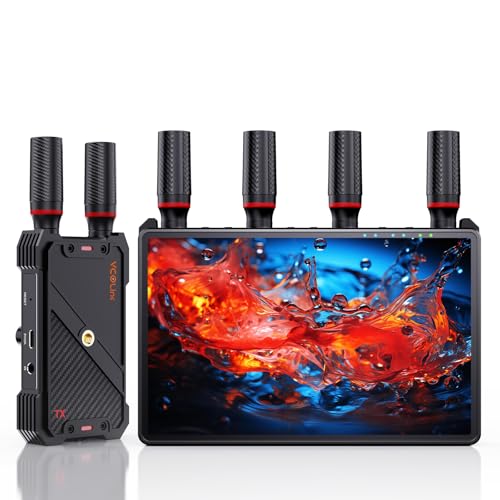
- One transmitter supports up to five receivers
- Built-in 7-inch screen plus HDMI output
- 1312-foot line-of-sight range and under 0.05-second latency
Best For: Film crews and live productions needing flexible multi-viewer monitoring
Best Expandable HDMI Splitter
Wireless HDMI Six-Screen System

- Expands from two included receivers to six screens
- Includes three useful HDMI adapter types
- Dual-band transmission reaches up to 165 feet in open areas
Best For: Multi-display presentations, venues, classrooms, and home theaters
Best Pro Camera Link
Accsoon CineView SE Transmitter

- Supports HDMI and SDI at 1080p/60fps
- Dual-band transmission combines 2.4GHz and 5GHz
- Up to 1200 feet of range and 0.05-second latency
Best For: Camera crews needing compact HDMI/SDI wireless monitoring
Best Plug-and-Play Multi-TV Kit

- Includes one transmitter and two pre-paired receivers
- Supports up to six screens with extra receivers
- 1080p/60Hz output with dual-band wireless transmission
Best For: Simple presentations and multi-screen viewing from HDMI sources
Flexible Multi-Screen Pick
Lemorele Wireless HDMI TX + 3 RX

- 1-to-4 wireless display sharing
- 1080p/60Hz transmission up to 656 feet line of sight
- TuTuPlay mobile monitoring
Best For: Multi-display camera monitoring and presentations
Portable Camera Monitoring Pick
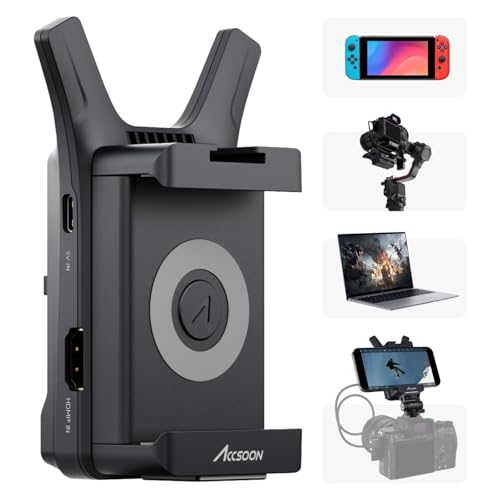
- 72.3-gram compact aluminum transmitter
- 1080p/60Hz with under 60ms latency
- Monitor on up to four mobile devices
Best For: Gimbals, solo shooters, and app-based monitoring
Long-Range Venue Pick
WELUSOPU Wireless HDMI TX + 2 RX
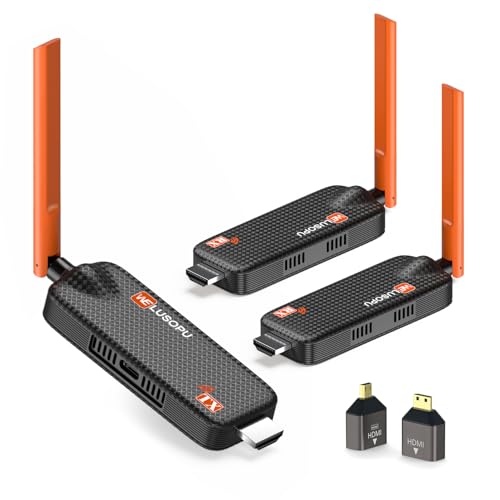
- 4K input with 1080p/60Hz output
- 656-foot stated range and about 0.1-second latency
- Two receivers included with multi-display expansion
Best For: Large venues, synchronized screens, and surveillance monitoring
Long-Range Pick
Vrriis 1080p Wireless HDMI System

- Up to 1,300-ft open-field range
- 1080p/60Hz with claimed 0.05-second delay
- Loop-out, dual HDMI output, and NP-F power support
Best For: Long-distance 1080p camera monitoring
Multi-Display Choice
WELUSOPU 5.8G HDMI Transmitter

- Mirrors one source to up to 6 receivers
- 4K input with 1080p output
- 2.4G/5.8G dual-band wireless operation
Best For: Multi-screen presentations and venue monitoring
Most Receivers

- Supports up to 8 receivers or mobile devices
- 4K decoding with 1080p/60Hz viewing
- Up to 656-ft open-environment transmission
Best For: Large multi-screen and mobile monitoring systems
Best All-in-One Monitor Hub – 7-Inch Wireless HDMI Multi-Viewer
For video transmitters for multi camera setups, this kit stands out when several crew members need to monitor the same feed. One transmitter can send 1080p/60Hz video to up to five receivers, while each receiver adds a built-in 7-inch monitor and HDMI output.
Best For: Film crews, studios, and live events needing multiple private and shared viewing points.
Pros:
- Supports one-to-five receiver distribution for collaborative monitoring.
- Built-in 7-inch receiver display, HDMI output, headphone jack, and sleep mode.
- Offers 1312-foot line-of-sight range, under 0.05-second latency, and HDMI loop out.
- Supports NP-F batteries, power banks, or USB-C power, with 1/4-inch mounting.
Cons:
- The listed range requires line-of-sight conditions.
- An HDMI cable is not included for connecting the receiver to an external monitor.
- Smartphone and tablet use requires a Type-C-to-HDMI cable.
This is the most production-oriented option here for teams that want both built-in monitoring and expandable HDMI distribution. Its longer stated range and flexible power options also suit mobile sets.
Best Expandable HDMI Splitter – Wireless HDMI Six-Screen System
If your video transmitters for multi camera setups need to feed several displays across a room, this plug-and-play system offers a practical approach. The included transmitter and two receivers can expand to as many as six screens with additional receivers.
Best For: Conference rooms, classrooms, churches, bars, restaurants, and home theaters distributing one source to multiple displays.
Pros:
- Supports up to six large screens or TVs with additional receivers.
- Includes USB-C-to-HDMI, Micro HDMI, and Mini HDMI adapters.
- Uses 2.4GHz/5.8GHz dual-band transmission with up to 165 feet of open-area range.
- Plug-and-play design works with cameras, laptops, consoles, projectors, and other HDMI sources.
Cons:
- Transmission distance may drop to about 50 feet through walls.
- It cannot transmit from one TV to another TV.
- The phone app does not control laptops connected as the transmitter.
This model is a strong choice when display quantity matters more than production-specific features. The included adapters broaden source compatibility, while the expandable receiver design supports larger presentation or venue installations.
Best Pro Camera Link – Accsoon CineView SE Transmitter
Among video transmitters for multi camera setups, the CineView SE is aimed at crews that need professional camera connectivity and app-based monitoring. Its dual-band design combines 2.4GHz and 5GHz streams, while HDMI and SDI support helps it fit into varied production workflows.
Best For: Camera operators and production crews using HDMI or SDI sources with smartphone-based preview monitoring.
Pros:
- Supports 1080p video at up to 60fps with stated 0.05-second latency.
- Provides up to 1200 feet of transmission range under suitable conditions.
- Uses simultaneous 2.4GHz and 5GHz transmission to improve wireless stability.
- Compact aluminum body includes a 1.3-inch OLED display and silent cooling.
Cons:
- This listing is for the transmitter only, so a compatible receiver is needed.
- It is limited to one HDMI port, alongside its SDI connection.
- The product details identify H.264 video encoding.
The CineView SE is the most camera-focused pick in this group, especially for setups that rely on SDI as well as HDMI. Its compact construction, dual-band transmission, and Accsoon GO preview support make it well suited to professional monitoring workflows.
Best Plug-and-Play Multi-TV Kit – G9R Pro Wireless HDMI
For straightforward video transmitters for multi camera setups, the G9R Pro provides one transmitter and two pre-paired receivers for simultaneous display expansion. It sends 1080p/60Hz video to two screens and can support up to six with additional receivers.
Best For: Presentations, church services, sports viewing, meetings, and streaming from a laptop or HDMI source to multiple screens.
Pros:
- Includes one transmitter and two receivers for two-screen output.
- Pre-paired, plug-and-play operation requires no app, Wi-Fi, Bluetooth, or drivers.
- Supports 1080p/60Hz output with 2.4GHz/5.8GHz dual-band transmission.
- Includes a USB-C-to-HDMI adapter for compatible newer laptops.
Cons:
- The transmitter must connect to an HDMI output device, not directly to a TV.
- Open-area range is 165 feet, while transmission through walls is about 50 feet.
- The transmitter supports 1080p output only, despite receiver 4K decoding support.
This kit prioritizes simple installation and dependable multi-screen expansion. It is a good fit when you want to connect a laptop, TV box, or other HDMI source to multiple displays without configuring a network or installing software.
Flexible Multi-Screen Pick – Lemorele Wireless HDMI TX + 3 RX
For video transmitters for multi camera setups, the Lemorele is a practical choice when you need to distribute one HDMI source to several screens. It supports 1080p at 60Hz, uses 5GHz wireless transmission, and can send the same feed to up to four receivers.
Best For: Filmmakers, presenters, classrooms, and monitoring setups that need one HDMI source viewed on multiple displays or mobile devices.
Pros:
- One transmitter can stream to up to four receivers simultaneously.
- Offers 1080p/60Hz transmission with a stated line-of-sight range of up to 656 feet.
- TuTuPlay app supports real-time preview on compatible iOS and Android phones or tablets.
- Aluminum construction supports heat dissipation and durability.
Cons:
- Designed for Full HD output rather than 4K output.
- Phone and tablet monitoring uses the app; mobile devices cannot serve as the HDMI source.
- Line-of-sight conditions affect the stated transmission range.
The Lemorele stands out for multi-display distribution and simple setup. It is especially useful when a camera feed needs to reach several monitors, though users seeking 4K output or a dedicated camera-to-receiver workflow may prefer a more specialized system.
Portable Camera Monitoring Pick – Accsoon CineView Nano
Among video transmitters for multi camera setups, the Accsoon CineView Nano is aimed at compact camera rigs and gimbals. It sends a 1080p/60Hz feed to up to four iOS or Android devices through the Accsoon SEE app, with latency below 60 milliseconds and a stated range of 500 feet.
Best For: Solo shooters, gimbal operators, and small production crews that want lightweight app-based monitoring or mobile live streaming.
Pros:
- Very compact 72.3-gram design with an aluminum housing.
- Supports up to four mobile monitoring devices through the Accsoon SEE app.
- Provides 1080p/60Hz transmission with less than 0.06-second latency.
- Can run from compatible NP-F batteries or 5V USB power.
Cons:
- HDMI cables, NP-F batteries, and charging cables are sold separately.
- Mobile live streaming requires a 5G network because the video feed occupies the phone’s Wi-Fi connection.
- It is a transmitter-focused system and does not include a dedicated HDMI receiver.
The CineView Nano is a strong fit for camera teams prioritizing portability and phone-based monitoring. Its app workflow is convenient for lightweight productions, but crews requiring physical receiver outputs should consider a transmitter-and-receiver kit instead.
Long-Range Venue Pick – WELUSOPU Wireless HDMI TX + 2 RX
For video transmitters for multi camera setups in larger spaces, the WELUSOPU system emphasizes long-range distribution and synchronized displays. It includes one transmitter and two receivers, supports expansion to multiple displays, accepts 4K input, and delivers 1080p/60Hz output.
Best For: Churches, conference rooms, classrooms, sports bars, security monitoring, and other installations that need a synchronized feed across several rooms or screens.
Pros:
- Supports 4K source input while delivering 1080p/60Hz output.
- Includes two receivers and can expand to as many as six displays according to the supplied notes.
- Offers a stated 656-foot range and approximately 0.1-second latency.
- Plug-and-play operation requires no app, Bluetooth pairing, or Wi-Fi password.
Cons:
- Output resolution is limited to 1080p/60Hz even with a 4K source.
- The supplied details do not fully specify the included expansion accessories or final receiver count.
- Large-venue range claims depend on placement, interference, and line-of-sight conditions.
The WELUSOPU is the most venue-oriented option in this group, combining multiple receivers with long-range wireless distribution. It makes sense for synchronized displays and monitoring, but users needing true 4K output should look for a system that explicitly supports 4K transmission to the receivers.
Long-Range Pick – Vrriis 1080p Wireless HDMI System
For video transmitters for multi camera setups, the Vrriis system is a practical option when you need a long point-to-point wireless HDMI link plus local monitoring. It supports 1080p at 60Hz, includes a transmitter loop-out, and can send to multiple receivers, though walls and other obstacles can reduce its advertised range.
Best For: Long-distance 1080p camera feeds, event monitoring, and setups that need a local monitor alongside a remote display.
Pros:
- Advertised transmission distance reaches up to 1,300 feet in an open field.
- Supports 1080p at 60Hz with a claimed 0.05-second delay.
- Transmitter loop-out and receiver dual HDMI outputs support convenient monitoring.
- Accepts several power options, including USB-C, adapters, and NP-F batteries.
Cons:
- Walls, metal, brick, and glass may substantially reduce signal coverage.
- Batteries are not included.
- Transmission distance decreases as additional receivers are added.
The Vrriis stands out for range and flexible power, making it suitable for larger open spaces. Its 1080p limit and sensitivity to obstructions are important considerations for complex indoor multi-camera installations.
Multi-Display Choice – WELUSOPU 5.8G HDMI Transmitter
If your video transmitters for multi camera setups need to feed several screens, the WELUSOPU system supports up to six receivers simultaneously. It combines 4K input with 1080p output and dual-band wireless operation, while its 165-foot open-space range is better suited to rooms and moderate-size venues than very long outdoor runs.
Best For: Conference rooms, classrooms, venues, and other installations that mirror one HDMI source across multiple displays.
Pros:
- Supports simultaneous mirroring to up to six receivers.
- Accepts 4K input and provides 1080p output.
- Uses 2.4G/5.8G dual-band transmission with auto frequency hopping.
- Can mirror to supported iOS and Android phones or tablets through an app.
Cons:
- Advertised range is up to 165 feet in open spaces, shorter than some alternatives.
- Mobile-device support is for mirroring only, without reverse operation.
- Multiple receivers are best suited to one-source, multi-display distribution rather than independent camera feeds.
WELUSOPU is a strong fit when synchronized viewing on several screens matters more than maximum range. It is especially convenient for presentation and monitoring environments that can use a plug-and-play HDMI workflow.
Most Receivers – AIMIBO 5.8G Wireless HDMI Kit
The AIMIBO kit is worth considering for video transmitters for multi camera setups that require broad audience viewing across displays and mobile devices. One transmitter can support up to eight receivers or eight phones and tablets, with a claimed 656-foot open-environment range, while indoor walls can reduce that distance substantially.
Best For: Classrooms, churches, conference rooms, bars, and other spaces needing one HDMI feed on many screens or mobile monitors.
Pros:
- Supports up to eight receivers or eight phones and tablets, with mixed use allowed.
- Offers 4K decoding and 1080p viewing at 60Hz.
- Advertises up to 656 feet of range in an open environment.
- Factory-paired plug-and-play design requires no Bluetooth or Wi-Fi setup.
Cons:
- Through-wall range may drop to approximately 32 feet.
- Claimed delay is 0.1 seconds, which may matter for highly timing-sensitive monitoring.
- Phones and tablets function as viewing monitors; operating the source from them is not supported.
AIMIBO offers the most receiver capacity of these three options and adds useful mobile viewing. Its strong open-space range is appealing, but the sharp reduction through walls should be factored into indoor camera layouts.
How We Picked the Best Video Transmitters for Multi Camera Setups
We compared these systems by the factors that matter most when several cameras, monitors, or displays must share video reliably. Priority went to transmission stability, usable range, latency, supported resolutions and refresh rates, input and output types, receiver expansion, and setup simplicity.
We also considered practical features such as HDMI loop-out, IR control, dual-band operation, included monitors, power requirements, and whether a product is better suited to consumer AV distribution or camera production. Advertised range is measured in ideal conditions, so walls, interference, antenna placement, and line of sight can significantly affect results.
Quick Comparison
| Feature | Why It Matters |
|---|---|
| Transmission range | Determines how far cameras can be positioned from the receiving station or displays. |
| Latency | Lower delay is important for live direction, camera operation, and real-time performance. |
| Receiver capacity | Multi-receiver systems can feed several screens without adding a transmitter for each display. |
| Video format | Check resolution, frame rate, HDR support, and whether the system downscales 4K sources. |
| Connections | HDMI-only units differ from models that add SDI, loop-out, or other production-friendly ports. |
Key Buying Factors for Video Transmitters for Multi-Camera Setups
Range and Wireless Environment
Choose more range than your measured distance requires. Wireless congestion from Wi-Fi networks and other equipment can reduce reliability, especially in venues with many users. For critical shoots, prioritize stable performance and clear line of sight over the longest advertised figure.
Latency and Synchronization
Low latency matters when operators need to frame subjects, follow action, or communicate with talent. If feeds must be switched or viewed side by side, also check whether the cameras and displays can maintain consistent timing; wireless transmitters do not automatically synchronize multiple cameras.
Resolution, Inputs, and Outputs
Confirm that each camera’s HDMI or SDI output matches the transmitter. Some products advertise 4K decoding while transmitting 1080p, and many cameras use micro or mini HDMI. An HDMI loop-out is useful when the local camera feed must also reach a monitor or recorder.
Power and Installation
Battery-powered camera transmitters are convenient for mobile production, while continuously powered units suit fixed displays. Check battery runtime, charging options, mounting hardware, antenna placement, and whether every receiver requires its own power source.
Who Should Buy Which Video Transmitters for Multi Camera Setups?
- For multi-screen distribution: Choose a transmitter that supports several receivers, especially for presentations, classrooms, demonstrations, and venue displays.
- For camera operators and live production: Favor low-latency models with dependable range, loop-out, and a mounting design that works on a camera rig.
- For professional HDMI and SDI workflows: Select a dual-interface system such as an Accsoon CineView model when camera and monitoring equipment require more flexible connectivity.
- For straightforward home or office use: A plug-and-play HDMI kit can be the better value if you need to send one source to multiple televisions and do not require advanced production features.
- For long-distance installations: Compare real-world obstruction limits, not just headline range, and consider wired backup options when uninterrupted video is essential.