
The best subwoofers for small rooms add convincing low-end impact without overwhelming the space. Compact powered models can make music, movies, and games sound fuller while fitting beside a TV stand, desk, or bookshelf system.
These 10 picks cover compact 6.5-inch and 8-inch designs, larger 10-inch options, desktop-friendly models, and easy-to-connect home theater subwoofers. Use the guide below to match output, connectivity, and placement flexibility to your room.
Best 10 Subwoofers for Small Rooms Picks for 2026
Best Compact Pick

- Compact 6-inch design
- 210W maximum output
- RCA and 3.5mm connectivity
Best For: Small rooms, desktop audio, and compact home theaters
Best Immersive Bass
Klipsch Reference R-8SW Subwoofer

- 8-inch spun-copper woofer
- Down-firing driver
- RCA and LFE inputs
Best For: Compact home theater systems with space for an 8-inch model
Best Connectivity Value
BESTISAN SW65D Powered Subwoofer
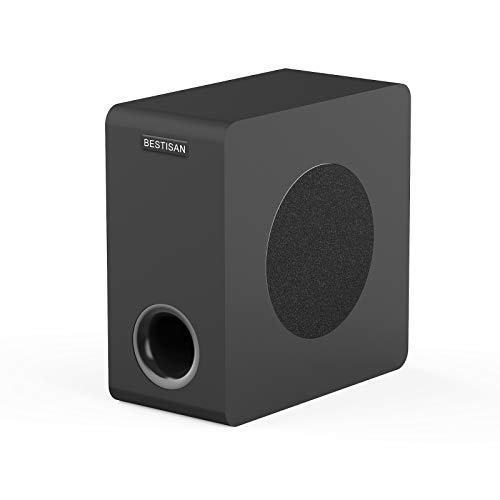
- 6.5-inch side-firing woofer
- RCA, AUX, LFE, and high-level connections
- Narrow 6.3-inch width
Best For: Flexible TV, soundbar, and home theater installations
Best Traditional 8-Inch Option
Yamaha NS-SW050BL Powered Subwoofer

- 8-inch cone woofer
- 100W dynamic power
- 28 Hz stated frequency response
Best For: Small home theaters with room for a conventional 8-inch cabinet
Deep-Bass Home Theater Pick

- 10-inch front-firing woofer
- 150W continuous, 300W peak amplifier
- LFE/RCA inputs with phase control
Best For: Small-room home theater and music systems
Compact Studio-Control Pick

- 8-inch driver reaches 30Hz
- Bluetooth 5.0 plus TRS and RCA inputs
- Adjustable crossover and room-tuning controls
Best For: Desktop studios and compact monitor systems
Value Home Theater Pick
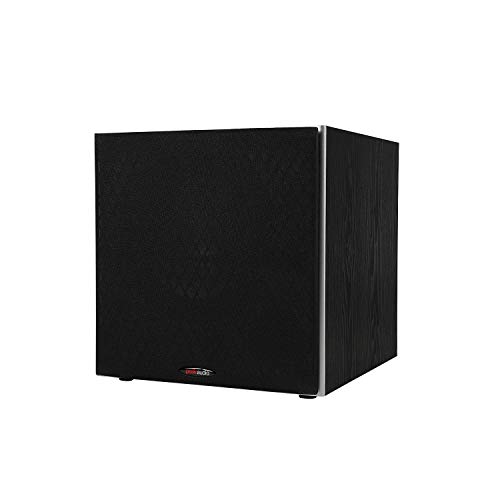
- 10-inch Dynamic Balance woofer
- 50W RMS amplifier with 100W listed power
- 80–160Hz variable crossover
Best For: Budget-friendly small-to-medium home theater systems
Balanced Bass Pick

- 8-inch driver with 70W output
- Low-pass filter reaches 38Hz
- MDF cabinet and automatic standby
Best For: Small-room stereo systems using RCA connections
Compact Down-Firing Option

- 8-inch down-firing woofer
- RCA, AUX, LFE, and speaker inputs
- Compact 9.3-inch square footprint
Best For: Small home theater systems with varied wired sources
Most Adjustable Compact Design

- 6.5-inch driver with DSP and Class-D amp
- 40–250Hz low-pass dial and phase switch
- Compact MDF-style wood cabinet
Best For: Small wired systems needing flexible bass tuning
Best Compact Pick – Audioengine S6 Mini Subwoofer
For shoppers seeking subwoofers for small rooms, the Audioengine S6 offers a particularly space-conscious design while still providing a stated 210 watts of maximum output. Its 6-inch, front-firing driver and 33 Hz frequency response suit music, movies, gaming, and desktop audio without requiring a large enclosure.
Best For: Small living areas, desktop setups, and listeners who want a compact wired subwoofer with flexible RCA and 3.5mm connectivity.
Pros:
- Compact 9.92-by-8.74-by-9.96-inch footprint
- 6-inch front-firing driver with 33 Hz frequency response
- RCA and 3.5mm inputs, plus compatibility with the Audioengine W3 wireless adapter
- Includes a three-year warranty
Cons:
- Wired connectivity is standard; wireless communication is not built in
- Its 6-inch driver may provide less output than larger subwoofers
The S6 is a strong fit when floor space matters most. It combines a small enclosure, useful analog inputs, and a high stated power rating, making it an easy choice for compact home theater or near-field listening.
Best Immersive Bass – Klipsch Reference R-8SW Subwoofer
Klipsch Reference R-8SW Surround Subwoofer, 150 Watts Peak Power (Brushed Black Vinyl, 8-Inch)
Check Price On AmazonThe Klipsch Reference R-8SW is a practical option among subwoofers for small rooms when you want an 8-inch driver without moving to a particularly heavy unit. Its down-firing design, compact enclosure, and all-digital amplifier are aimed at adding rich bass to home theater, TV, and music systems.
Best For: Small-to-medium home theater setups that have room for an 8-inch, floor-standing subwoofer.
Pros:
- 8-inch spun-copper woofer
- Down-firing driver and compact design
- RCA and LFE connectivity
- Remote control included as a control method
Cons:
- Its 15.75-by-11.75-by-13.25-inch dimensions require more floor space than mini models
- Maximum output is listed at 150 watts
- Limited warranty is listed as one year
The R-8SW makes sense for buyers who prefer the fuller potential of an 8-inch woofer but still need a relatively compact cabinet. Check the available floor space and confirm that your receiver provides a compatible RCA or LFE connection.
Best Connectivity Value – BESTISAN SW65D Powered Subwoofer
The BESTISAN SW65D is designed for buyers who need subwoofers for small rooms with broad connection flexibility. Its 6.5-inch side-firing woofer, bass-reflex cabinet, and 12.5-by-6.3-by-12.6-inch dimensions make it a space-conscious choice, while RCA, AUX, LFE, and high-level speaker connections simplify integration with different systems.
Best For: TV, soundbar, bookshelf-speaker, and home theater setups that need multiple input options in a narrow cabinet.
Pros:
- Space-saving 6.5-inch side-firing design
- RCA, 3.5mm AUX, LFE, and high-level speaker inputs and outputs
- Bass-reflex cabinet with bottom port and internal bracing
- Lightweight 9.2-pound enclosure
Cons:
- Maximum output is listed at 100 watts
- Best results are specified for devices outputting 850 mV or less
- Its frequency-response figures vary between the supplied bullet and detail information
The SW65D stands out when installation flexibility is more important than maximum power. Its narrow profile and extensive connection panel make it adaptable, though buyers should verify signal compatibility with their source equipment before purchasing.
Best Traditional 8-Inch Option – Yamaha NS-SW050BL Powered Subwoofer
The Yamaha NS-SW050BL offers an 8-inch cone woofer and 100 watts of dynamic power in a straightforward powered-subwoofer design. For subwoofers for small rooms, its 12-by-14-by-12-inch cabinet can work well when you want stronger low-end potential than a mini model while keeping the setup relatively simple.
Best For: Home theater listeners who want an 8-inch Yamaha subwoofer with a focused bass design and a stated 28 Hz frequency response.
Pros:
- 8-inch cone woofer with Advanced YST II technology
- Twisted flare port is designed to contribute to clear, tight bass
- Stated 100 watts of dynamic power
- Two-year manufacturer warranty
Cons:
- Its 14-inch width may be less suitable for very tight spaces
- Connectivity details in the supplied specifications are limited and should be checked for your system
- It weighs 18.7 pounds, more than some compact alternatives
The NS-SW050BL is a sensible middle ground for rooms that can accommodate a conventional 8-inch cabinet. Its port and Yamaha bass technology emphasize controlled low-end performance, while the moderate power rating keeps expectations realistic.
Deep-Bass Home Theater Pick – Klipsch R-100SW 10-inch
The Klipsch R-100SW is a strong option for shoppers comparing subwoofers for small rooms who want impactful movie and music bass without stepping up to a larger cabinet. Its front-firing 10-inch woofer, 150-watt continuous amplifier, and LFE/RCA inputs make it easy to add to a wired home audio system.
Best For: Small-room home theater and music setups that need deep, room-filling bass.
Pros:
- 10-inch spun-copper IMG woofer delivers bass down to a listed 32Hz.
- 300 watts peak power provides substantial headroom.
- Includes low-pass crossover, phase control, and auto power-on.
- LFE and line-level RCA inputs support broad receiver compatibility.
Cons:
- Its 16.4-inch height and 26-pound weight may require careful placement in a compact room.
- Connectivity is wired rather than wireless.
With adjustable crossover and phase controls, the R-100SW offers useful setup flexibility for smaller spaces. It is a sensible choice when strong low-end impact matters more than having the smallest possible enclosure.
Compact Studio-Control Pick – PreSonus Eris Sub 8BT
The PreSonus Eris Sub 8BT is designed for listeners and creators who need subwoofers for small rooms, desktops, or compact monitoring setups. Its front-firing 8-inch driver, Bluetooth 5.0, adjustable filters, and tuning controls make it especially adaptable when space and precise integration are priorities.
Best For: Desktop music production, compact studio monitors, and flexible music listening.
Pros:
- Compact 8-inch woofer reaches down to a listed 30Hz.
- Bluetooth 5.0 supports convenient wireless playback.
- Balanced TRS, RCA, and front-panel aux connections accommodate varied sources.
- High-pass, low-pass, and frequency tuning controls help match the room and main speakers.
Cons:
- Its studio-focused feature set may be more than needed for a basic TV setup.
- Wireless connectivity is listed for Bluetooth audio, while wired monitoring connections are still required for some systems.
The Eris Sub 8BT stands out for precise adjustment rather than sheer output. Its crossover controls and compact format make it one of the more practical choices for a small listening or production space.
Value Home Theater Pick – Polk Audio PSW10
The Polk Audio PSW10 is a straightforward choice for shoppers seeking subwoofers for small rooms at a modest system size. Its 10-inch driver, 50-watt RMS amplifier, and compact-design positioning are suited to adding extra bass to music and movie systems without complicated setup.
Best For: Small-to-medium home theater systems and budget-conscious listeners wanting more bass.
Pros:
- 10-inch Dynamic Balance woofer adds bass depth and punch.
- Continuously variable 80–160Hz crossover helps blend with existing speakers.
- Offers both speaker-level outputs and line-level inputs.
- Phase toggle supports setups using multiple subwoofers.
Cons:
- Its 50-watt RMS amplifier is less powerful than the Klipsch option in this roundup.
- The 17-inch depth may be challenging in especially tight spaces.
- Connectivity is wired and it has no listed wireless feature.
The PSW10 focuses on useful integration features and approachable performance rather than maximum output. Its crossover range and dual connection options make it an easy upgrade for an existing wired home audio system.
Balanced Bass Pick – Edifier T5
Edifier T5 Powered Subwoofer - 70w RMS Active Woofer with 8 inch Driver and Low Pass Filter
Check Price On AmazonFor shoppers comparing subwoofers for small rooms, the Edifier T5 offers a straightforward powered design with an 8-inch driver, 70 watts of output, and a cabinet built to help reduce resonance. Its low-pass filter reaches down to 38Hz, making it a practical match for bookshelf speakers and other compact indoor audio setups.
Best For: Small-room stereo systems that need fuller bass and simple wired RCA connectivity.
Pros:
- 8-inch driver with 70 watts of maximum output power.
- Low-pass filter with frequency response down to 38Hz.
- Thick MDF enclosure helps reduce acoustic resonance.
- Automatic standby helps avoid unnecessary power use.
Cons:
- Uses wired RCA connectivity rather than a wireless subwoofer connection.
- Its 16.5-inch depth may require careful placement in a compact room.
- It is designed to supplement speakers, not replace a complete audio system.
The T5 is a sensible choice when you want adjustable low-frequency support without a complicated feature set. Check its dimensions and your system’s RCA output before buying.
Compact Down-Firing Option – BESTISAN SW65C
The BESTISAN SW65C is a compact powered subwoofer for small rooms, using a down-firing 8-inch woofer to distribute bass across the floor. Multiple wired inputs—including RCA, AUX, LFE, and high-level speaker connections—make it flexible for home theater, TV audio, music, and gaming setups.
Best For: Compact home theater systems and mixed setups that need broad wired-input compatibility.
Pros:
- Down-firing 8-inch woofer delivers room-filling low frequencies.
- Supports RCA, AUX, LFE, and high-level speaker connections.
- Compact 9.3-by-9.3-inch footprint is easy to place.
- Includes a coaxial cable for quick setup.
Cons:
- Its 60-watt maximum output is lower than some larger powered subwoofers.
- Requires main speakers or a soundbar for full-range audio.
- The manufacturer recommends avoiding direct pairing with high-power amplifiers.
Choose the SW65C when connection flexibility matters as much as bass output. Its compact footprint and down-firing design suit smaller spaces, while the included cable simplifies installation.
Most Adjustable Compact Design – LITTOAK BS02
The LITTOAK BS02 is designed for listeners who want flexible control from one of the more compact subwoofers for small rooms. Its 6.5-inch down-firing driver, DSP, Class-D amplification, adjustable 40–250Hz low-pass range, and phase switch provide useful tools for matching bass to a desktop, TV, or compact home theater system.
Best For: Small-room listeners who want tuning controls and a compact subwoofer for wired audio equipment.
Pros:
- DSP and Class-D amplifier provide 60 watts RMS and 100 watts peak power.
- Adjustable low-pass dial covers 40Hz to 250Hz.
- Phase switch supports 0–180-degree adjustment.
- Compact 9.96-by-9.96-inch footprint fits under TVs or in entertainment centers.
Cons:
- Only supports wired outputs; Bluetooth, USB, and optical connections are not compatible.
- The 6.5-inch driver may provide less low-frequency scale than an 8-inch model.
- Its brown cabinet may not suit every décor.
The BS02 stands out for its tuning flexibility and small footprint. It is a strong fit for desktop or TV systems with an LFE or line output, provided wireless and optical connectivity are not requirements.
How We Picked the Best Subwoofers for Small Rooms
We focused on powered subwoofers with compact or manageable cabinets, practical amplifier power, and features suited to apartments, bedrooms, offices, and smaller living rooms. The selection includes models with 6.5-inch, 8-inch, and 10-inch drivers so you can balance deep bass against available space and neighbors’ tolerance.
We also considered setup convenience, including low-pass controls, automatic standby, common line-level connections, Bluetooth availability on applicable models, and compatibility with home theater, stereo, TV, and desktop audio systems. Published power ratings are useful for comparison, but cabinet design, driver size, placement, and room acoustics also affect real-world bass.
Quick Comparison
| Best For | Recommended Size | What to Prioritize |
|---|---|---|
| Desktop or nearfield listening | 6.5–8 inches | Compact enclosure, adjustable crossover, low noise |
| Small bedrooms and apartments | 6.5–8 inches | Moderate output, auto-on, flexible placement |
| Small living rooms | 8–10 inches | Deeper extension, phase and volume controls |
| Movies and action games | 8–10 inches | Higher headroom, down- or front-firing driver |
Key Buying Factors for Subwoofers for Small Rooms
Driver Size and Output
A 6.5-inch subwoofer is usually easier to place and can be a good match for a desk or compact stereo. An 8-inch model offers a useful middle ground, while a 10-inch subwoofer can deliver more authority for movie effects and larger small-room spaces. More output is not automatically better: excessive bass can create boominess and disturb adjacent rooms.
Connections and System Compatibility
Check whether your receiver, soundbar, powered speakers, or desktop setup provides a subwoofer output or compatible line-level connection. A model with adjustable crossover is easier to blend with main speakers. If your source lacks a dedicated subwoofer output, verify the subwoofer’s available inputs before buying.
Placement and Controls
Placement strongly affects bass. Start near the front wall, then move the subwoofer a small distance at a time to reduce peaks and nulls. Front-firing and down-firing designs can both work well, but leave adequate clearance around ports and controls. Volume, crossover, and phase controls help integrate the subwoofer instead of making it sound detached.
Power, Auto-On, and Room Acoustics
Look for enough power to reach your preferred listening level without audible strain. Auto-on/standby is convenient for everyday use, while DSP can help manage response in some designs. Rugs, curtains, furniture, and room dimensions can change bass substantially, so allow time for adjustment before judging performance.
Who Should Buy Which Subwoofers for Small Rooms?
Choose a 6.5-inch model if space is extremely limited or you mainly want fuller desktop and nearfield sound. An 8-inch subwoofer is the safest all-around choice for most small rooms, offering stronger low-end impact without requiring a large footprint. Select a 10-inch model if movies, games, and electronic music are priorities and you have room to position it properly.
For a desktop or studio setup, prioritize compact dimensions, clean integration, and convenient controls. For a TV or home theater, prioritize compatible inputs, sufficient headroom, and adjustable crossover. Apartment dwellers should favor controlled output and careful placement over maximum loudness. Whichever model you choose, begin with conservative volume and crossover settings, then increase gradually until the bass sounds integrated rather than dominant.