
Powered KVM switches make it easier to run one workstation across multiple computers, monitors, and USB peripherals without constantly swapping cables. For creators, IT pros, and home-office users, the right switch can save time and reduce desk clutter.
In this roundup, we focus on practical options for different setups, from simple single-monitor sharing to more advanced multi-display configurations with modern resolution support and USB expansion.
Best 10 Powered Kvm Switches Picks for 2026
Dual-Monitor DP/HDMI Pick

- DP + HDMI dual-monitor sharing for 2 PCs
- 4 USB-A ports with 5Gbps USB 3.0
- Includes 5V/2A power adapter and wired controller
Best For: Desktop-only users who need powered dual-monitor switching
High-Resolution Powered Choice

- 8K@60Hz and 4K@120Hz support
- 4 USB 3.0 ports with 5Gbps transfer
- Powered with 5V/2A adapter and metal housing
Best For: High-resolution dual-monitor setups that need powered USB sharing
USB Sharing Station

- Shares 7 USB devices between 2 computers
- 4 USB-A plus 3 USB-C ports with 5Gbps data transfer
- Includes power adapter for stable peripheral use
Best For: Shared USB-peripheral setups that do not need video switching
Extended-Display Workhorse

- Copy and extend modes for dual displays
- 8K@60Hz / 4K@120Hz support with 4 USB 3.0 ports
- 12V power adapter for stable high-power use
Best For: Dual-HDMI desktop setups that need extended display support
Single-monitor DisplayPort pick
UGREEN 8K DisplayPort KVM for 2 PCs

- One-monitor DisplayPort KVM for 2 computers
- 4 USB 3.0 ports share common peripherals
- 8K@60Hz support with button/controller switching
Best For: Users needing a simple DP KVM for one monitor and USB sharing
Triple-monitor desktop switcher
8K Triple-Monitor KVM for 2 PCs

- 2 PCs share 3 monitors with HDMI and DP inputs
- 4 USB 3.0 ports plus wired remote and power adapter
- Up to 8K@60Hz / 4K@144Hz with proper cables
Best For: 2-PC workstations needing three displays and USB 3.0 sharing
Quad-monitor workstation hub
Quad-Monitor 8K KVM for 2 Desktop PCs

- 2 PCs share 4 monitors with 2 DP + 2 HDMI each
- 4-port USB 3.0 hub handles common peripherals
- Stability-focused design with 8K/4K support
Best For: Users building a desktop-only four-monitor workstation
Triple-Display Workhorse
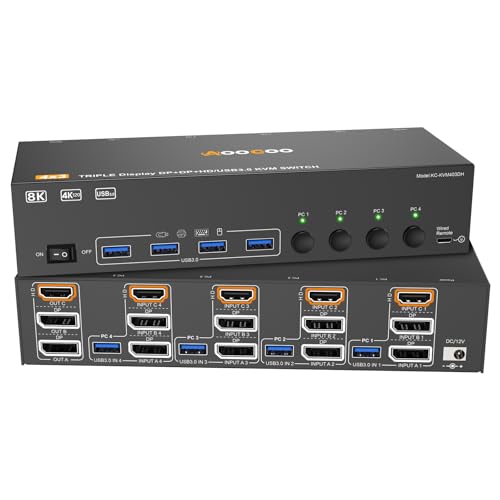
- Shares 3 monitors across 4 computers
- Up to 8K@60Hz / 4K@144Hz support
- Includes power adapter, remote, and USB 3.0 cables
Best For: Multi-PC users who need a high-end triple-monitor switching setup.
Premium Dual-System Hub

- Two computers share 3 monitors and 4 USB 3.0 ports
- Up to 8K@60Hz / 4K@240Hz with HDR and VRR support
- Includes controller, cables, and power adapter
Best For: Users building a high-resolution dual-PC triple-monitor workstation.
Simple Single-Monitor Switcher

- Two computers share one monitor and 4 USB 3.0 devices
- Supports up to 4K@60Hz over HDMI
- Includes power adapter and desktop controller
Best For: HDMI-based users who want a simple 2-PC single-monitor switch.
Dual-Monitor DP/HDMI Pick – Unitek 2PC Dual Monitor KVM
If you need a powered KVM switch for a dual-monitor desktop setup, this Unitek model is built around sharing two computers across two displays and multiple USB devices. It supports 4K@60Hz output, includes a 5V/2A power adapter for stability, and uses a push-button or wired desktop controller for simple switching.
Best For: Desktop users who want dual-monitor sharing, USB 3.0 expansion, and a powered setup with both DP and HDMI support.
Pros:
- Supports two computers and dual monitors with DP + HDMI input/output.
- Includes 4 USB-A ports with USB 3.0 speeds up to 5Gbps.
- Comes with a 5V/2A power adapter for steadier multi-device use.
- Offers push-button switching plus a wired desktop controller.
Cons:
- Not compatible with laptops, according to the notes.
- Requires the included USB A-to-B cable and full cabling for dual video use.
This is a practical option if your setup is a desktop-only workstation and you want a powered KVM switch that handles both display sharing and USB peripherals without extra software.
High-Resolution Powered Choice – 8K Dual Monitor HDMI KVM
This powered KVM switch is aimed at users who want a dual-monitor HDMI setup with strong display performance and fast USB sharing. It supports up to 8K@60Hz or 4K@120Hz, includes four USB 3.0 ports, and uses a 5V/2A adapter plus a metal housing for stable operation.
Best For: Windows, Mac, and Linux users who want a high-resolution dual-monitor KVM with powered USB sharing.
Pros:
- Supports 8K@60Hz and 4K@120Hz for sharp, high-refresh visuals.
- Includes 4 USB 3.0 ports at up to 5Gbps.
- Powered design with 5V/2A adapter for steadier performance.
- Supports mirror and extend mode with front-button or wired remote switching.
Cons:
- Requires a dual-monitor-capable computer setup.
- Depends on the included power adapter for stable high-load use.
If display quality is a top priority, this model stands out among powered KVM switches thanks to its 8K support, smart charging compatibility, and stable hardware-focused design.
USB Sharing Station – UGREEN 2-in 7-Out USB Switch
This is not a video KVM, but it still fits the needs of buyers searching for powered KVM switches when the goal is simply sharing USB peripherals between two computers. UGREEN’s USB switch lets you connect up to seven devices, supports 5Gbps transfers, and includes a power adapter for more stable operation with higher-demand peripherals.
Best For: Users who only need shared USB peripherals between two computers and want a powered switch with both USB-A and USB-C support.
Pros:
- Shares up to 7 USB devices across 2 computers.
- Includes 4 USB-A and 3 USB-C ports for flexible device matching.
- Supports 5Gbps data transfer and plug-and-play setup.
- Comes with a power adapter for steadier performance with demanding devices.
Cons:
- No video output support, so it is not a true KVM switch.
- USB ports are not recommended for charging devices.
For a clutter-free desk where you only need to share keyboards, mice, printers, or drives, this powered switch is a straightforward and practical alternative to a full KVM.
Extended-Display Workhorse – 8K Dual Monitor 2-Port KVM
This powered KVM switch is built for dual-monitor desktop users who need both copy and extended display modes across two computers. It supports up to 8K@60Hz and 4K@120Hz, includes a 12V power supply for stable operation, and adds a 4-port USB 3.0 hub for shared peripherals.
Best For: PC users with dual HDMI outputs who want a powered dual-monitor KVM with extended display support.
Pros:
- Supports copy mode and extension mode for dual-monitor workflows.
- Offers 8K@60Hz and 4K@120Hz display support.
- Includes four USB 3.0 ports at 5Gbps for shared devices.
- Comes with a 12V power adapter for stable high-power use.
Cons:
- Requires a computer with two HDMI output ports for dual-monitor use.
- Keyboard shortcut switching is not supported.
If your desktop can output to two monitors, this powered KVM is a capable all-in-one switch for high-resolution display sharing and USB device management.
Single-monitor DisplayPort pick – UGREEN 8K DisplayPort KVM for 2 PCs
If you need powered kvm switches for a clean one-monitor setup, this UGREEN DisplayPort model is built for two computers sharing one display and four USB peripherals. It focuses on high-resolution DP workflows, with fast USB 3.0 sharing and simple button-based switching for a tidy desk.
Best For: Desktop users who want a single-monitor DisplayPort KVM with USB 3.0 device sharing.
Pros:
- Supports one monitor for 2 computers with DisplayPort input/output.
- Handles up to 8K@60Hz, with backward support for lower resolutions.
- Includes 4 USB 3.0 ports for keyboard, mouse, drives, printer, and webcam sharing.
- Offers one-button switching and a desktop controller for flexible placement.
Cons:
- Does not support HDMI and is limited to one monitor.
- DP cables, USB-C power cable, and power adapter are not included.
- No hotkey toggles and no EDID emulation.
For a straightforward DisplayPort-focused KVM, this model is practical if your setup matches its one-monitor design and you are comfortable supplying the required cables and power. It is best chosen for simple productivity switching rather than feature-heavy multitasking.
Triple-monitor desktop switcher – 8K Triple-Monitor KVM for 2 PCs
Among powered kvm switches, this triple-monitor model is aimed at users who need two computers to drive three displays with high-resolution support. It combines HDMI and DisplayPort connections, USB 3.0 peripheral sharing, and a wired remote for convenient switching in a multi-screen workspace.
Best For: Multi-monitor desktop users who want 3-display switching with USB 3.0 sharing.
Pros:
- Supports 2 computers sharing 3 monitors in one KVM.
- Up to 8K@60Hz and 4K@144Hz support with HDMI 2.1 and DP 1.4 cabling.
- Includes 4 USB 3.0 ports for high-speed peripheral sharing.
- Comes with a wired remote controller, USB 3.0 cables, and a 12V power adapter.
Cons:
- USB input must be connected to the computer or keyboard and mouse will not be recognized.
- Performance depends on using the correct HDMI 2.1 and DP 1.4 cables.
- Best suited to a 2-PC, 3-monitor setup rather than simpler single-display systems.
This is a strong pick if your workspace is built around multiple displays and you want one switch for both video and USB peripherals. The included power adapter and remote make it more complete out of the box than many bare-bones KVMs.
Quad-monitor workstation hub – Quad-Monitor 8K KVM for 2 Desktop PCs
If your priority is a larger multi-display desk, this powered kvm switch is built for two desktop PCs sharing four monitors with a mixed HDMI and DisplayPort layout. It also adds a 4-port USB 3.0 hub, making it a practical central switch for peripherals in demanding workstation setups.
Best For: Desktop workstation users who need 4-monitor switching and USB device sharing.
Pros:
- Supports 2 PCs across 4 monitors with 2 DP + 2 HDMI per computer.
- Built-in 4-port USB 3.0 hub for keyboard, mouse, printer, and webcam sharing.
- Claims 8K/4K support with HDMI 2.1 and DP 1.4 cabling.
- Designed with 4 independent circuit boards for more stable operation.
Cons:
- Not compatible with laptops; intended for desktop computers with dedicated graphics cards.
- Windows desktop systems are specifically noted, with Android-based system support also mentioned.
- Requires the right high-spec cables for best results.
This model makes sense when you need a serious four-screen switching hub rather than a basic office KVM. Its stability-focused design and included USB hub should appeal to users who keep a lot of peripherals connected all day.
Triple-Display Workhorse – 4 PC 3 Monitor 8K KVM Switch
If you need powered kvm switches for a serious multi-display desk, this model is built for sharing 3 monitors across 4 computers. It supports a triple-monitor setup with 2 DisplayPort 1.4 connections plus 1 HDMI 2.1 connection per PC, and it includes a power adapter, 4 USB 3.0 cables, and a wired remote for switching.
Best For: Users who want to connect 4 computers to 3 monitors with high-resolution support and included accessories.
Pros:
- Shares 3 monitors and 4 USB 3.0 devices across 4 computers
- Supports up to 8K@60Hz and 4K@144Hz, with HDMI 2.1 and DP 1.4 support
- Includes a power adapter, wired remote, and 4 USB 3.0 cables
- Panel button and wired remote switching are both supported
Cons:
- Requires each computer to support 3-display output for full use
- Triple-monitor mode needs 2 DP + 1 HDMI connections per computer
- Performance depends on using the right HDMI 2.1 and DP 1.4 cables
This is a strong fit for people who need a high-end, shared workstation and are ready to wire it correctly. The main upside is the combination of 4-PC support, triple-monitor output, and included accessories.
Premium Dual-System Hub – 2 PC 3 Monitor 8K KVM
For a clean desk and fast switching, this powered kvm switch lets two computers share 3 monitors and 4 USB 3.0 peripherals. It uses 2 DisplayPort 1.4 ports and 1 HDMI 2.1 port, supports both button and desktop controller switching, and includes the power adapter plus cables in the box.
Best For: People who want a two-computer, three-monitor setup with strong resolution support and easy switching.
Pros:
- Shares 3 monitors and 4 USB 3.0 ports between 2 computers
- Supports up to 8K@60Hz and 4K@240Hz with HDR10+, HDCP, VRR, FreeSync, and G-Sync
- Includes button switching and a desktop controller
- Comes with DP cables, HDMI cables, USB A cables, and a power adapter
Cons:
- Both computers must support triple-monitor output to use all 3 displays
- Does not support hotkey switching
- Noted as not supporting EDID emulation
This is the most feature-rich option in the group for users who prioritize video quality and smooth high-refresh operation. Just make sure both PCs and monitors match the triple-display requirements before buying.
Simple Single-Monitor Switcher – 2 PC 1 Monitor 4K HDMI KVM
If you only need to switch one display and a few peripherals, this powered kvm switch keeps things straightforward. It lets 2 computers share 1 monitor and 4 USB 3.0 devices, supports up to 4K@60Hz, and comes with a power adapter and desktop controller for practical daily use.
Best For: Buyers who want an easy 2-computer, 1-monitor HDMI KVM for a tidy desk.
Pros:
- Shares 1 monitor and 4 USB 3.0 devices between 2 computers
- Supports up to 4K@60Hz with HDMI 2.0, HDCP, HDR, and 3D support
- Includes a power adapter and wired desktop controller
- Driver-free and compatible with Windows, Mac OS, and Linux
Cons:
- Not a DP KVM switch or USB-C KVM switch
- Not supported for use with a docking station
- Does not support hotkey switching or EDID emulation
This is the most straightforward choice if your setup is HDMI-based and you want reliable peripheral sharing without extra complexity. It is best matched to single-monitor desks rather than advanced multi-display workstations.
How We Picked the Best Powered Kvm Switches
We prioritized Powered Kvm Switches that offer stable switching, external power for better device support, and a sensible mix of video outputs, USB ports, and compatibility. We also looked for models that fit real-world use cases: dual-monitor productivity, high-refresh gaming, and multi-computer workstations.
Quick Comparison
If you mainly need basic keyboard, mouse, and one display sharing, a compact 1-monitor switch is usually the simplest choice. If you work across two or more systems with extended desktops, look for dual- or triple-monitor support plus enough USB ports for your accessories. Users with specialized setups should pay close attention to port type, resolution limits, and whether the switch supports matching display standards across all connected machines.
Key Buying Factors for Powered Kvm Switches
Display Count and Layout
Start by matching the switch to your monitor setup. A 2-monitor KVM is ideal for most productivity desks, while 3- and 4-monitor units are better for trading, editing, and complex developer workflows. Confirm whether the switch supports mirrored or extended displays, since that affects how each computer can use the screens.
Resolution, Refresh Rate, and Port Type
Make sure the unit supports the resolution and refresh rate you actually need, such as 4K at 60Hz, 4K at 120Hz, or 8K at 60Hz. HDMI and DisplayPort models are not interchangeable in practice, so the best choice depends on your monitors and graphics outputs.
USB Sharing and Peripheral Needs
Good Powered Kvm Switches should handle more than just a keyboard and mouse. Look for USB 3.0 ports if you plan to share webcams, storage drives, audio gear, or touch peripherals. If you use both USB-A and USB-C devices, a broader USB layout can reduce the need for extra hubs.
Power, Switching Method, and Compatibility
External power can improve stability, especially with multiple monitors and bus-powered accessories. A wired remote is often more reliable than front-panel-only control, and plug-and-play support is useful if you move between Windows, macOS, and Linux systems.
Who Should Buy Which Powered Kvm Switches?
Choose a simpler 1-monitor model if you want a clean home-office setup with basic sharing. Pick a dual-monitor powered KVM if you work between two PCs and want extended desktop support. Go for triple- or quad-monitor options if your workflow depends on wide screen real estate and frequent switching between systems. If your main goal is only USB device sharing, a USB switch may be the better fit than a full video KVM.