
The best network cable testers under $100 can quickly reveal open wires, shorts, crossed pairs, and incorrect pinouts before they become time-consuming networking problems. Some models also add cable tracing, length measurement, PoE detection, or support for telephone and coaxial wiring.
This roundup compares 10 budget-friendly testers for home users, IT technicians, installers, and small offices. Use the guide below to match the right features, connectors, and testing depth to your network work.
Best 10 Network Cable Testers Under 100 Picks for 2026
Best Overall

- Backlit LCD wiremap display
- Detects multiple RJ45 cable faults
- Includes remote and batteries
Best For: Routine CAT5e, CAT6, and CAT6A RJ45 testing
Best Multi-Connector Pick
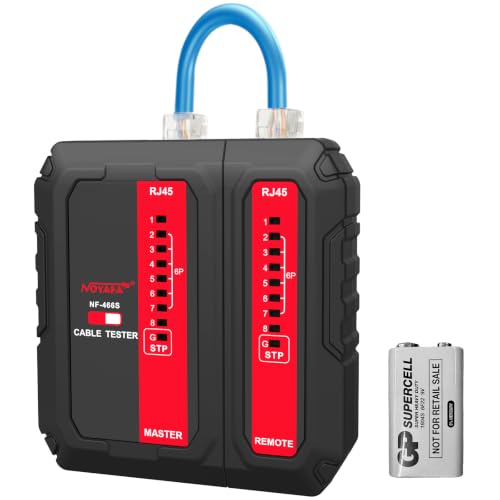
- Tests RJ45, RJ11, and RJ12
- Supports CAT5 through CAT7 UTP
- Automatic checks with indicator lights
Best For: Mixed network and telephone cable maintenance
Best for Cable Length
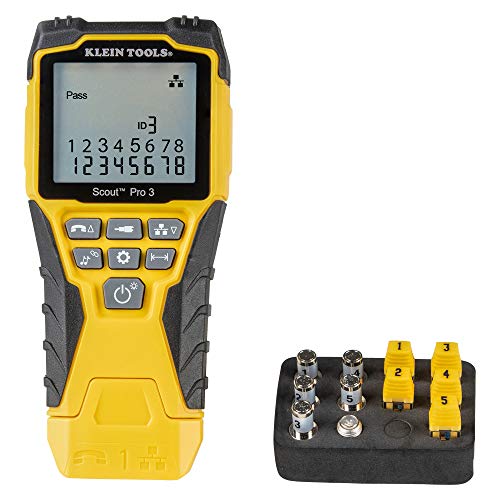
- Measures runs up to 2,000 feet
- Tests voice, data, and coax
- Includes LANMap and CoaxMap remotes
Best For: Installation work requiring length and cable identification
Best Simple Pocket Tester

- One-button RJ11/RJ12/RJ45 testing
- Fast LED fault indications
- Compact body with stored remote
Best For: Quick everyday voice and data cable checks
Best Analog Tracing Kit

- Traces open-ended low-voltage wires
- Includes clips and RJ45 test cable
- Work light, volume control, and wire mapping
Best For: Basic Ethernet, telephone, speaker, and data-wire tracing
Best Feature-Rich Network Tester

- Tests continuity, length, speed, and PoE
- Finds cables and identifies active ports
- Rechargeable, with NCV detection and flashlight
Best For: Network installation and active Ethernet troubleshooting
Best Long-Run Cable Tester

- Measures runs from 2.5 to 200 meters
- Supports PoE, NCV, link, and port-flash tests
- Traces live cables up to 600 meters
Best For: Long Ethernet runs, PoE checks, and network installation
Best Budget All-Rounder
Compact RJ45/RJ11 Cable Tester
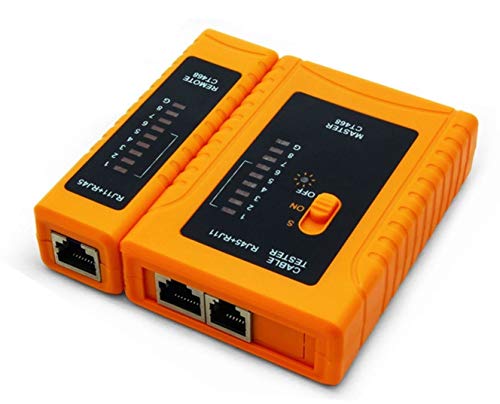
- Tests continuity, opens, shorts, and crossed pairs
- Supports RJ45, RJ11, and CAT5–CAT7 cables
- LED display provides quick visual results
Best For: Basic Ethernet and telephone cable testing on a budget
Best for Flexible Testing

- Tests RJ45 Ethernet and RJ11 telephone cables
- Separates for convenient long-run testing
- Offers fast and slow detection modes
Best For: Installers and DIY users testing cable runs and patch cables
Best for Shielded Cable Checks

- Checks wiring faults and shielding status
- Supports RJ45 CAT5–CAT7 and RJ11 cables
- Split design helps test long or wall-mounted runs
Best For: UTP/STP verification and structured-cabling maintenance
Best Overall – Klein Tools LAN Scout Jr
For shoppers comparing network cable testers under 100, the Klein Tools LAN Scout Jr is a compact option for checking RJ45-terminated data cables and patch cords. Its backlit display and clear fault readouts make basic troubleshooting practical in dim work areas.
Best For: Home users and technicians testing CAT5e, CAT6, and CAT6A cables with RJ45 connectors.
Pros:
- Detects opens, shorts, miswires, split pairs, crossover, and shield issues.
- Backlit LCD shows pin-to-pin wiremap results clearly.
- Includes a remote and two batteries in a compact 4.32-ounce design.
- Offers solid and warble tone modes for tracing when paired with the optional probe.
Cons:
- Designed for RJ45 data cables rather than RJ11 or coax connections.
- The tone-tracing probe is sold separately.
This is a well-rounded pick when you want readable diagnostics, broad RJ45 fault detection, and a portable tester for everyday network-cable checks.
Best Multi-Connector Pick – NOYAFA NF466 Cable Tester
Among network cable testers under 100, the NOYAFA NF466 stands out for supporting RJ45, RJ11, and RJ12 connections. Automatic testing and indicator lights simplify continuity and wiring checks for home-office maintenance.
Best For: DIY users and home-office setups that work with both network and telephone cables.
Pros:
- Supports RJ45, RJ11, and RJ12 interfaces.
- Works with CAT5, CAT6, CAT7 UTP, and telephone cables.
- Automatically checks continuity, opens, shorts, and miswiring.
- Compact handheld design runs on a standard 9V battery.
Cons:
- The supplied components list includes the tester and manual, but does not specify a remote.
- Results are presented through indicator lights rather than a detailed LCD.
Choose this model if connector flexibility and simple automatic operation matter more than advanced on-screen measurements.
Best for Cable Length – Klein Tools Scout Pro 3
For buyers seeking network cable testers under 100 with broader installation functions, the Klein Tools Scout Pro 3 adds cable-length measurement to fault testing. It handles voice, data, and coax connections and displays length, wiremap, cable ID, and test results.
Best For: Installers and maintenance users who need to test RJ11/12, RJ45, and coax cables and measure runs up to 2,000 feet.
Pros:
- Measures cable length up to 2,000 feet or 610 meters.
- Tests voice, data, and coax F-connector cables.
- Detects opens, shorts, miswires, and split pairs.
- Includes LANMap and CoaxMap locator remotes, a coax adapter, and battery.
Cons:
- It is not designed to test PoE.
- Tracing with the tone generator requires the optional analog probe.
- Its larger 6.9-by-3.2-by-1.5-inch body is less pocket-friendly than simpler testers.
This is the strongest choice here for multi-cable installations where length information and locator remotes are more useful than a minimal pocket tester.
Best Simple Pocket Tester – LAN Explorer Cable Tester
If you want a straightforward option among network cable testers under 100, the LAN Explorer uses single-button testing for RJ11, RJ12, and RJ45 cables. Fast LED responses identify common cable conditions, while the compact body fits easily in a pocket.
Best For: Quick checks of CAT3, CAT5e, CAT6, and CAT6A voice or data cables at home or on-site.
Pros:
- Tests RJ11, RJ12, and RJ45 terminated cables.
- Identifies pass, miswire, open, short, and shield conditions.
- Includes a securely stored remote and 9V battery.
- Offers auto power-off and a low-battery indicator.
Cons:
- LED responses provide less display detail than an LCD tester.
- The supplied notes do not indicate cable-length measurement.
This model makes sense for users who prioritize fast, uncomplicated continuity and wiring checks over advanced measurements or multi-format cable support.
Best Analog Tracing Kit – Klein Tools VDV500-705
If you need network cable testers under 100 for straightforward wire tracing, the Klein Tools VDV500-705 is a practical analog tone-and-probe kit. It is designed for open-ended, non-active low-voltage wires up to 60V and supports Ethernet, telephone, speaker, coax, video, and data cables.
Best For: Home repair, basic Ethernet and telephone wire tracing, and technicians who need to identify unterminated low-voltage cables.
Pros:
- Traces multiple low-voltage cable types with an adjustable tone volume.
- Includes alligator clips and an RJ45-to-RJ45 test cable.
- Performs pin-to-pin wire mapping and includes a probe work light.
- Headphone jack can help with tracing in noisy environments.
Cons:
- Designed for open-ended, non-active wires rather than live network testing.
- Analog tracing may require separating wires and using proper grounding for best results.
This is a focused, affordable option when your main task is locating and mapping low-voltage wiring. It is less suitable if you need cable length, PoE, link-speed, or non-contact voltage measurements.
Best Feature-Rich Network Tester – FNIRSI LPM-10A
Among network cable testers under 100, the FNIRSI LPM-10A stands out for combining tracing with continuity, length, speed, PoE, port-flash, and safety checks. Its rechargeable transmitter and receiver are suited to network installation and repair work involving CAT5, CAT5e, CAT6, RJ11, and RJ45 cables.
Best For: Network technicians testing Ethernet runs, identifying active ports, checking PoE equipment, and locating cables in bundled or noisy environments.
Pros:
- Tests RJ45 continuity, crimp quality, couplers, patch cords, opens, shorts, and miswires.
- Measures cable length, verifies 10/100/1000Mbps speed, and detects standard or non-standard PoE.
- Adjustable tracing sensitivity helps with bundled or electrically noisy cables.
- Includes NCV detection, rechargeable batteries, a flashlight, and a low-battery alert.
Cons:
- Its broader feature set may be more than needed for simple continuity checks.
- The supplied notes do not specify a measurement range for cable-length testing.
The LPM-10A is the most versatile choice of these three for active network troubleshooting. Choose it when port identification, PoE checks, link speed, and rechargeable jobsite convenience matter alongside basic wire mapping.
Best Long-Run Cable Tester – NOYAFA NF-8209
The NOYAFA NF-8209 is a strong option among network cable testers under 100 when cable length and PoE diagnostics are priorities. It supports CAT5/CAT6 tracing, RJ45 continuity and fault testing, cable-length measurements from 2.5 to 200 meters, and live tracing up to 600 meters.
Best For: Home repair and network installation tasks involving longer cable runs, PoE devices, port identification, and shielded or unshielded RJ45 cables.
Pros:
- Measures twisted-pair cable length from 2.5 to 200 meters.
- Supports normal, anti-interference, and PoE tracing modes, plus NCV detection.
- Checks opens, shorts, miswiring, and continuity on 8-pin and 9-pin shielded cables.
- Tests 5–60V standard and non-standard PoE and supports 10/100/1000M port flashing.
Cons:
- The receiver uses a separate 9V battery while the transmitter is rechargeable.
- Its feature set may be unnecessary for users who only need basic cable continuity testing.
With dedicated length, PoE, link, and anti-interference modes, the NF-8209 is well suited to diagnosing installed cable runs rather than just checking patch cables. Its included remote adapter, cable set, bag, and LED light add practical jobsite value.
Best Budget All-Rounder – Compact RJ45/RJ11 Cable Tester
iMBAPrice - RJ45 Network Cable Tester for Lan Phone RJ45/RJ11/RJ12/CAT5/CAT6/CAT7 UTP Wire Test Tool
Check Price On AmazonIf you need one of the network cable testers under 100 for basic home, office, or repair work, this compact iMBAPrice tester covers common RJ45 and RJ11 cable checks. It automatically tests continuity, open, shorted, and crossed wire pairs with a visible LED display.
Best For: Budget-conscious users testing Ethernet and telephone cables.
Pros:
- Supports RJ45 LAN and RJ11 telephone cables.
- Checks continuity, open, short, and crossed pairs automatically.
- Works with CAT5 through CAT7 Ethernet cables.
- Compact design with clear LED status indicators.
Cons:
- Requires a 9V battery, which is not included.
- Supplied notes describe basic cable testing rather than advanced diagnostics.
This is a straightforward pick when you want broad connector compatibility and simple visual results without paying for more elaborate testing features.
Best for Flexible Testing – HABOTEST HT812A Cable Tester
Among network cable testers under 100, the HABOTEST HT812A stands out for its separated master-and-remote design and adjustable test speed. It checks RJ45 Ethernet and RJ11 telephone cables while identifying shorts, opens, and cross-pairs through LED indicators.
Best For: Users testing longer cable runs or wanting fast and slow scan modes.
Pros:
- Tests CAT5, CAT5e, CAT6, CAT6A, and RJ11 cables.
- Detachable structure helps with testing installed cable runs.
- Fast and slow detection modes add testing flexibility.
- Includes batteries and a user manual.
Cons:
- Its listed minimum operating voltage is 60 volts.
- LED indicators provide basic results rather than detailed measurements.
The HT812A is a practical choice for patch-cable makers, installers, and DIY users who value portability and the ability to separate the tester units during testing.
Best for Shielded Cable Checks – HT812A Ethernet Cable Tester
This HT812A variant is one of the more versatile network cable testers under 100 for users who need Ethernet, telephone, and shielding checks. It supports RJ45 and RJ11 cables, uses fast or slow scanning, and includes a remote unit for testing long or wall-mounted runs.
Best For: Home, office, and IT users checking cable wiring and UTP/STP status.
Pros:
- Supports RJ45 CAT5 through CAT7 and RJ11 telephone lines.
- Detects continuity, shorts, opens, miswiring, and shielding status.
- Remote unit supports testing long-distance and structured-cabling runs.
- Includes two AAA batteries and a user manual.
Cons:
- Designed for cable verification rather than advanced network performance testing.
- Its supported telephone-line range is described as typical 48–72V lines.
Choose this model if identifying shielded versus unshielded cable matters alongside ordinary wiring checks. Its compact split design also makes it useful for maintenance work where both cable ends are separated.
How We Picked the Best Network Cable Testers Under 100
We focused on testers priced below $100 that support common Ethernet connections, especially RJ45 and CAT5 through CAT7 cabling. We also considered RJ11/RJ12 compatibility, continuity and wire-map testing, remote units, cable tracing, PoE detection, length testing, display clarity, portability, and overall usefulness for home and small-business troubleshooting.
Because feature sets vary widely at this price, the best choice depends on whether you need simple pass/fail checks or more advanced diagnostic functions. A basic tester may be ideal for patch cables, while an installer may benefit from tone generation, remote identification, and length measurements.
Quick Comparison
| Best For | Features to Prioritize |
|---|---|
| Basic home troubleshooting | RJ45 continuity, wire mapping, clear indicators, compact design |
| Small-office support | Remote testing, multiple cable standards, durable construction |
| PoE environments | PoE detection, pin identification, voltage awareness |
| Structured-cabling work | Tone generator, probe, length testing, fault location |
| Mixed telephone and Ethernet jobs | RJ11/RJ12 support and selectable connector testing |
Key Buying Factors for Network Cable Testers Under 100
Supported Connectors and Cable Types
Confirm that the tester accepts the connectors you actually use. RJ45 is essential for Ethernet, while RJ11 and RJ12 support matters for telephone wiring. If you work with older installations or specialty media, look for models that support coax, speaker, or other cable types.
Testing Functions
Continuity and wire-map testing should be the baseline. More advanced testers may identify reversed, crossed, or shorted conductors, measure approximate cable length, detect PoE, or help locate a cable with a tone and probe. These additions can save time, but they are not necessary for occasional patch-cable checks.
Remote Units and Usability
A detachable remote makes it easier to test cables installed through walls, ceilings, or floors. Look for numbered remotes, readable displays or LEDs, intuitive controls, and a design that can be operated while holding a cable bundle. Battery type and automatic shutoff also affect day-to-day convenience.
Safety and Network Conditions
Do not assume every cable tester is designed for live network or telephone circuits. Follow the manufacturer’s instructions, especially when testing PoE wiring. A tester that identifies PoE or includes protection for higher-voltage conditions can be a better fit for active office networks, but it should not replace proper electrical safety practices.
Who Should Buy Which Network Cable Testers Under 100?
Choose a simple RJ45 tester if you mainly build or repair home Ethernet cables and need quick continuity checks. Pick a model with RJ11/RJ12 support if your work includes telephone lines. For small-business administrators, a remote unit and dependable wire mapping provide a useful balance of speed and value.
Installers and field technicians should consider a tester with tone tracing, cable-length measurement, PoE awareness, and broader cable support. These features justify choosing a more capable model even when basic testers cost less. For occasional use, prioritize clarity, portability, and low operating complexity over advanced functions you may rarely use.