
Building or maintaining a home lab often means troubleshooting cables before investigating switches, patch panels, or configuration. The right tester can quickly reveal miswires, opens, shorts, split pairs, and other physical-layer problems.
This roundup compares 10 network cable testers for home labs, including compact continuity testers, professional copper verifiers, cable tracers, and advanced tools with PoE, IP scanning, or optical testing capabilities.
Best 10 Network Cable Testers for Home Labs Picks for 2026
Best Compact RJ45 Tester

- Backlit LCD wiremap display
- Detects common Ethernet wiring faults
- Tests CAT5e, CAT6, and CAT6A RJ45 cables
Best For: Straightforward Ethernet cable testing in compact home labs
Best Diagnostic Detail

- Reports length, wiremap, ID, and fault distance
- Tests RJ11, RJ45, and coax
- Includes IntelliTone toning and carrying case
Best For: Detailed troubleshooting across varied home lab cabling
Best Cable Mapping Kit

- Tests RJ11/12, RJ45, and coax
- Includes 36 locator remotes
- Adds PoE testing and 2,000-foot length measurement
Best For: Mapping and troubleshooting multiple home lab cable runs
Best Budget-Style LED Tester
TESMEN TLP-123A Network Cable Tester

- Supports RJ11 and RJ45 cables through CAT7
- LEDs identify common wiring faults
- Detachable remote suits long cable runs
Best For: Simple Ethernet and telephone cable checks for DIY home labs
Versatile Starter Kit
Klein Scout Pro 3 Cable Tester
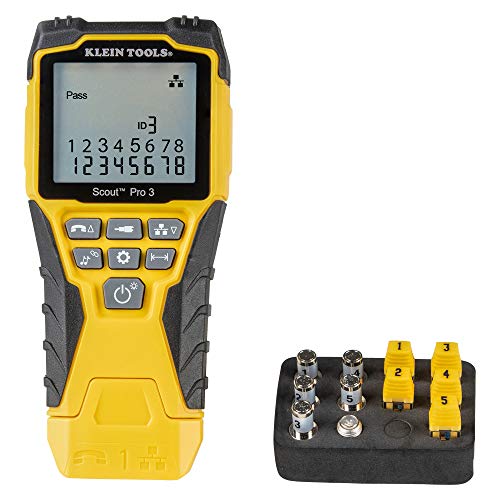
- Tests RJ11/12, RJ45, and coaxial cables
- Measures cable lengths up to 2,000 feet
- Detects open, short, miswire, and split-pair faults
Best For: Home labs testing Ethernet, telephone, and coaxial runs
Pocket-Friendly Essential

- Tests RJ11, RJ12, RJ45, and CAT3–CAT6/6A cables
- Uses one-button operation and fast LED responses
- Compact design includes a secure remote and auto-off
Best For: Quick checks of common voice and Ethernet cables
Advanced PoE Diagnostic Kit

- Tests PoE, link status, continuity, and wire faults
- Measures cable length from 2.5–200 meters
- Adds anti-interference tracing and NCV detection
Best For: Troubleshooting Ethernet runs and PoE equipment
Most Complete Kit

- Tests RJ45, RJ11/RJ12, and coax cables
- Measures cable length up to 2,000 feet
- Includes 20 LanMap and 20 CoaxMap remotes
Best For: Broad home-lab cable testing across data, voice, and coax
Best for Network Diagnostics

- Includes IP scan, ping, and network-rate testing
- Tests PoE and measures cables up to 200 meters
- Flashes ports for faster cable identification
Best For: Active Ethernet troubleshooting in home labs
Best for Fiber and Copper

- Adds optical power measurement across seven wavelengths
- Includes a 650 nm visual fault locator
- Tests copper cables, PoE, and lengths up to 200 meters
Best For: Mixed fiber-and-Ethernet home labs
Best Compact RJ45 Tester – Klein Tools LAN Scout Jr
For home labs focused on Ethernet patch cords and data cabling, the Klein Tools LAN Scout Jr is a compact network cable tester for home labs with a backlit display and straightforward controls. It tests CAT5e, CAT6, and CAT6A cables with RJ45 connectors while checking several common wiring faults.
Best For: Home lab users who want an easy-to-read RJ45 tester for routine Ethernet cable checks.
Pros:
- Tests for opens, shorts, miswires, split pairs, crossover, and shield conditions.
- Backlit LCD shows pin-to-pin wiremap results in low-light areas.
- Compact design includes a remote and batteries.
Cons:
- Designed for RJ45 data cables rather than the broader connector coverage of some testers.
- Tone tracing requires the separately sold VDV500-123 probe.
The LAN Scout Jr keeps basic Ethernet verification simple and portable. Its automatic power-off feature also helps conserve battery life during home lab work.
Best Diagnostic Detail – Fluke Networks MicroScanner2
The Fluke Networks MicroScanner2 is a strong choice for network cable testers for home labs when you need more than a basic pass-or-fail result. Its display reports cable length, wiremap, cable ID, and distance to a fault, while the verifier supports RJ11, RJ45, and coax connections.
Best For: Home lab builders who want detailed cable diagnostics and support for multiple cable types.
Pros:
- Shows cable length, wiremap, cable ID, and distance to fault on one screen.
- Supports RJ11, RJ45, and coax testing.
- Includes IntelliTone toning, a wiremap adapter, batteries, and carrying case.
Cons:
- Its broader diagnostic feature set may be more than needed for simple continuity checks.
- The supplied notes do not specify a dedicated PoE test function.
With its fault-location information and multi-connector support, the MicroScanner2 is suited to troubleshooting structured cabling where identifying the location of a problem matters.
Best Cable Mapping Kit – Klein Tools Scout Pro 3
The Klein Tools Scout Pro 3 stands out among network cable testers for home labs that include multiple rooms, wall ports, or PoE devices. It tests RJ11/12, RJ45, and F-connector coax, maps cable runs, measures lengths up to 2,000 feet, and provides PoE wire and voltage information.
Best For: Larger home labs that need cable identification, run mapping, and basic PoE troubleshooting.
Pros:
- Tests voice, data, and video cable connections.
- Includes 18 RJ45 and 18 coax locator remotes for identifying multiple runs.
- Measures cable length up to 2,000 feet and displays PoE wire and voltage information.
Cons:
- The extensive remote kit is more equipment than a small single-cable setup requires.
- Tone tracing requires the separately sold VDV500-123 analog probe.
This is the most comprehensive mapping-oriented option in the group. Its included remotes and broad connector support can simplify cable organization in a growing home lab.
Best Budget-Style LED Tester – TESMEN TLP-123A Network Cable Tester
The TESMEN TLP-123A offers a simple approach to network cable testers for home labs, supporting RJ45 and RJ11 cables from CAT5 through CAT7. One-button operation, adjustable test speed, and LED indicators help identify continuity, shorts, opens, miswiring, and shielding status.
Best For: Home users and DIY builders who want a lightweight tester for Ethernet and telephone cable maintenance.
Pros:
- Supports RJ45 and RJ11 cables, including CAT5, CAT5e, CAT6, CAT6A, and CAT7.
- Checks connectivity, shorts, opens, miswiring, and shielding status.
- Detachable main and remote units can test both ends of long or wall-mounted cables.
Cons:
- Uses LED indicators rather than the backlit LCD or detailed fault display found on some alternatives.
- The supplied kit includes only the tester, manual, and two AAA batteries.
For basic cable maintenance, the TLP-123A emphasizes portability and uncomplicated operation. Its separated remote is useful when testing installed runs or ports that are not close together.
Versatile Starter Kit – Klein Scout Pro 3 Cable Tester
For home labs that include more than Ethernet, the Klein Tools Scout Pro 3 is a versatile choice among network cable testers for home labs. It checks RJ11/12, RJ45, and coaxial F-connector cables, while its backlit display reports wiremap, cable length, cable ID, and detected faults.
Best For: Home lab users testing Ethernet, telephone, and coaxial cable runs.
Pros:
- Supports RJ11/12, RJ45, and coaxial cables.
- Measures cable lengths up to 2,000 feet.
- Detects open, short, miswire, and split-pair faults.
- Includes self-storing remotes, locator remotes, adapter, and battery.
Cons:
- Not designed to test PoE.
- Cable tracing requires the separately sold VDV500-123 analog probe.
The Scout Pro 3 is a strong all-around starter set when your home lab spans several cable types. Its long measurement range and readable display add practical value for installation and troubleshooting work.
Pocket-Friendly Essential – LAN Explorer Cable Tester
The LAN Explorer is a compact option for network cable testers for home labs when straightforward RJ-series checks are the priority. One-button testing covers RJ11, RJ12, and RJ45 cables, with LEDs indicating pass, miswire, open-fault, short-fault, or shield status.
Best For: Home lab users who want a simple tester for common voice and Ethernet cables.
Pros:
- Tests RJ11, RJ12, RJ45, and CAT3 through CAT6/6A cables.
- Single-button operation is quick to use.
- Compact, pocket-sized design weighs 4 ounces.
- Includes a remote, low-battery indicator, and automatic power-off.
Cons:
- Provides LED status indications rather than a backlit LCD readout.
- Does not list cable-length measurement or PoE testing.
This tester focuses on essential continuity and wiring checks without adding features that may be unnecessary for basic home lab work. It is a practical pick for quick patch-cable and installed-run verification.
Advanced PoE Diagnostic Kit – NOYAFA NF-8209 Tester
The NOYAFA NF-8209 adds PoE and tracing capabilities that can be valuable in network cable testers for home labs. It combines continuity and fault testing with length measurement, anti-interference tracing, non-contact voltage detection, port flashing, and PoE voltage and polarity checks.
Best For: Home lab builders troubleshooting Ethernet runs, PoE equipment, and cable paths.
Pros:
- Tests standard and non-standard PoE from 5–60V and identifies supported IEEE 802.3af/at details.
- Measures twisted-pair cable length from 2.5–200 meters.
- Supports anti-interference tracing, live tracing up to 600 meters, and NCV detection.
- Includes a rechargeable transmitter, receiver, remote adapter, cable set, tool bag, and Type-C cable.
Cons:
- The listed operating temperature range is 32–122°F.
- The receiver uses a 9V battery while the transmitter is rechargeable.
- Its broader feature set may be more than needed for basic continuity checks.
With PoE, link, length, and tracing functions in one kit, the NF-8209 is suited to more involved home lab troubleshooting. Choose it when identifying powered network faults matters as much as checking wire order.
Most Complete Kit – Klein Tools Scout Pro Max
For home labs that span Ethernet, phone, and coax connections, the Klein Tools Scout Pro Max is a versatile choice among network cable testers for home labs. It combines wiremap testing, PoE testing, network detection, tone generation, and cable-length measurement in one kit, with a full-color backlit display for easier reading.
Best For: Home-lab users who need broad RJ45, RJ11/RJ12, and coax testing with multiple remote identifiers.
Pros:
- Tests data, voice, and coax cables.
- Measures cable length and fault distance up to 2,000 feet.
- Includes 20 LanMap and 20 CoaxMap remotes, patch cables, batteries, and a carrying case.
- Offers PoE testing, wiremapping, network detection, hub blink, and report generation.
Cons:
- The digital probe for digital toning is sold separately.
- At 3.7 pounds, it is less compact than a basic cable tester.
This is the strongest all-around option when a home lab includes several cable types and you want a ready-to-use remote set. Its extensive capabilities may be more than necessary for simple continuity checks.
Best for Network Diagnostics – NOYAFA NF-8506
The NOYAFA NF-8506 adds network-oriented diagnostics to the basic testing functions expected from network cable testers for home labs. Along with continuity and fault-distance testing, it provides IP scanning, ping testing, network-rate checks, PoE detection, port flashing, and cable tracing for RJ11 and RJ45 installations.
Best For: Home-lab builders troubleshooting active Ethernet networks, locating ports, and checking PoE or TCP/IP connectivity.
Pros:
- Supports IP scanning and ping tests for TCP/IP network diagnosis.
- Measures cable length and fault distance across cables up to 200 meters.
- Detects multiple PoE standards and power-supply methods.
- Port flashing helps identify connected network ports and displays speed and duplex information.
Cons:
- Its listed cable-length range starts at 2.5 meters.
- The supplied notes do not specify included remote units or a carrying case.
This model is a practical fit when your home-lab work involves switches, routers, and active network links rather than cable verification alone. Choose it for diagnostic features, especially ping, port identification, and PoE checks.
Best for Fiber and Copper – NOYAFA NF-8508
The NOYAFA NF-8508 stands out among network cable testers for home labs by combining copper-cable diagnostics with fiber tools. It includes continuity, cable scanning, port flashing, length measurement, and PoE testing, while its optical power meter and visual fault locator support fiber-link checks and fault finding.
Best For: Home labs that work with both copper Ethernet cabling and fiber connections.
Pros:
- Measures optical power across seven wavelengths from 850 to 1650 nm.
- Includes a 650 nm visual fault locator for locating fiber breaks and poor connections.
- Tests PoE, cable length up to 200 meters, shorts, interruptions, and cable mapping.
- Provides up to 10 hours of battery life with Type-C charging.
Cons:
- Its fiber-focused features may be unnecessary for copper-only home labs.
- The supplied notes do not specify the complete included accessory set.
This is the most specialized choice of the three, particularly for users building or maintaining fiber links alongside standard Ethernet. Its optical measurement and fault-location tools give it broader coverage than a conventional RJ45 tester.
How We Picked the Best Network Cable Testers for Home Labs
We focused on testers that support common home-lab cabling, especially RJ45 Ethernet connections and, where applicable, RJ11 telephone or coaxial connections. We also considered the type of diagnosis each tool provides, including wire-map testing, continuity checks, cable-length measurement, remote identification, tone generation, PoE detection, and network discovery.
Ease of use and practical versatility matter in a home lab. A basic tester may be ideal for checking patch cables, while a more capable verifier can help locate faults in installed runs. Product descriptions and feature sets were compared to distinguish starter tools from equipment suited to larger or more complex networks.
Quick Comparison
- Basic continuity testing: Choose a compact LAN tester when you mainly need to verify patch cables and identify common wiring faults.
- Installed-cable troubleshooting: Look for a remote set, tone generator, or cable-length function to trace and diagnose runs between rooms or rack locations.
- Professional copper verification: A tool such as the Fluke Networks MicroScanner2 is better suited to users who need broader media support and more detailed fault finding.
- PoE and network checks: Advanced NOYAFA models add features such as PoE detection, non-contact voltage detection, IP scanning, or other network-oriented diagnostics.
- Fiber work: An optical power meter is useful only if your home lab includes fiber links; it adds capability but may be unnecessary for copper-only networks.
Key Buying Factors for Network Cable Testers for Home Labs
Test Types and Supported Cable
Confirm that the tester supports the connectors and cable categories you use. RJ45 support covers most Ethernet work, while RJ11 and coax support can be useful in mixed wiring environments. For modern home labs, CAT5e, CAT6, and CAT6A compatibility is generally more relevant than support for older cable types.
Fault Detail and Measurement Range
A continuity light can confirm that a cable is connected, but a wire map, split-pair detection, length measurement, or distance-to-fault function provides much more useful information. These features can reduce guesswork when cables are inside walls or terminated at patch panels.
Remote, Tone, and Locator Features
Remote units help identify cables and test runs where both ends are separated. Tone generation and locator support are especially valuable when several similar cables terminate in the same cabinet. Check how many remotes are included and whether additional identifiers are available.
PoE, IP, and Specialty Features
PoE detection can help when testing powered Ethernet connections, but it should not be confused with full switch certification. IP scanning and optical power measurement are specialist features: worthwhile for advanced labs, but unnecessary if your setup is limited to ordinary copper patch cables.
Who Should Buy Which Network Cable Testers for Home Labs?
Occasional DIY users should choose a simple, affordable tester for continuity and wire-map checks. Home-lab builders with structured cabling will benefit from a remote set, tone function, and length measurement. Network professionals and serious enthusiasts should consider a higher-end verifier with broader media support and clearer fault diagnostics. Advanced labs using PoE or fiber should select a model with those specific functions rather than paying for features they will never use.