
Reliable cabling is essential to data-center uptime, but diagnosing a failed link can be difficult without the right tester. The best network cable testers for data centers help technicians identify wiring faults, verify PoE, trace cables, and measure run length before small problems become costly outages.
This roundup compares 10 practical options, from compact Ethernet testers to multifunction tools with optical power meters, visual fault locators, remote units, and tone probes. Use the guide below to match features with your rack, installation, and maintenance requirements.
Best 10 Network Cable Testers for Data Centers Picks for 2026
Best All-Rounder
Klein Scout Pro 3 Cable Tester
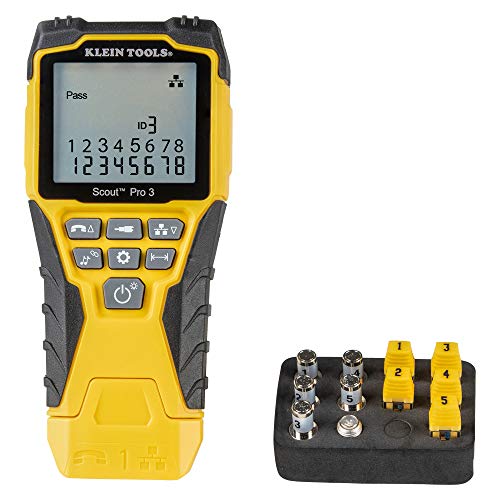
- Tests RJ11/12, RJ45, and coax cables
- Measures runs up to 2,000 feet
- Detects open, short, miswire, and split-pair faults
Best For: Mixed voice, Ethernet, and coaxial cable testing
Best for PoE Diagnostics
NOYAFA NF-8209 Network Cable Tester

- Tests 5–60V standard and non-standard PoE
- Measures CAT5/CAT6 runs up to 200m
- Includes anti-interference tracing and NCV detection
Best For: PoE, link, and active Ethernet troubleshooting
Best Compact Tester

- Tests RJ11, RJ12, RJ45, and CAT3–CAT6/6A
- LEDs show pass and wiring faults
- Pocket-sized design with built-in remote
Best For: Fast, routine cable verification in the field
Best for Wire Tracing

- Traces low-voltage Ethernet, phone, coax, and data wires
- Includes alligator clips and RJ45 test cable
- Features work light, volume control, and headphone jack
Best For: Locating and identifying unterminated low-voltage cables
Best Multifunctional Fiber-Ready Tester

- Combines copper, PoE, and fiber diagnostics
- Measures optical power across six wavelengths
- Tests cable lengths up to 200 meters
Best For: Mixed copper-and-fiber network maintenance
Best Simple RJ45 Diagnostic Tester

- Detects major RJ45 wiring faults
- Uses a readable backlit LCD
- Includes tester, remote, and batteries
Best For: Portable CAT 5e through CAT 6A checks
Best Long-Running All-in-One Tester

- Supports seven optical wavelengths
- Runs for up to 10 hours per charge
- Adds PoE, VFL, NVC, and cable tracing
Best For: Extended mixed-network troubleshooting
Multi-Cable Diagnostic Pick

- Tests up to eight cables simultaneously
- Measures length and locates cable faults
- Supports Ethernet, coaxial, and telephone lines
Best For: Data-center and contractor teams handling multiple cable runs
PoE Safety Pick

- Identifies PoE type, status, and polarity
- Tests cable continuity, mapping, and length
- Rechargeable with Type-C charging and 60V protection
Best For: Installers troubleshooting active PoE network connections
Simple Long-Run Pick
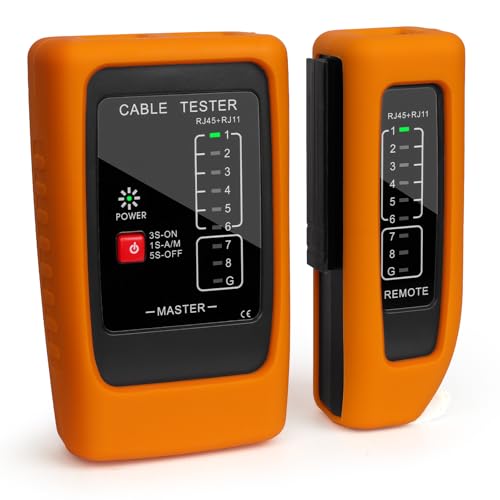
- Checks common RJ11, RJ12, and RJ45 faults automatically
- Supports PoE detection and 300-meter remote testing
- Offers fast and slow LED test modes
Best For: Routine Ethernet testing across offices and larger installations
Best All-Rounder – Klein Scout Pro 3 Cable Tester
For teams comparing network cable testers for data centers, the Klein Tools Scout Pro 3 is a versatile choice for checking unenergized RJ11/12, RJ45, and coaxial cables. It combines wire mapping, fault detection, cable identification, and length measurement in one tester.
Best For: Technicians who need one tester for voice, Ethernet, and coaxial cable installations.
Pros:
- Tests RJ11/12, RJ45, and coax F-connector cables.
- Measures cable lengths up to 2,000 feet.
- Detects open, short, miswire, and split-pair faults.
- Backlit display shows length, wiremap, cable ID, and results.
Cons:
- Not designed to test PoE.
- Analog probe for tracing is sold separately.
The long measurement range and broad connector support make this a practical general-purpose option, especially when coax and telephone cabling are part of the workload.
Best for PoE Diagnostics – NOYAFA NF-8209 Network Cable Tester
The NOYAFA NF-8209 stands out among network cable testers for data centers when PoE checks, cable tracing, and link testing are priorities. It supports shielded and unshielded RJ45 cables, length measurement, port flashing, and non-contact voltage detection.
Best For: Network technicians troubleshooting Ethernet runs with PoE, link, and tracing requirements.
Pros:
- Tests standard and non-standard PoE from 5–60V and identifies IEEE 802.3af/at.
- Measures CAT5/CAT6 twisted-pair lengths from 2.5–200m.
- Offers normal, anti-interference, and PoE tracing modes.
- Includes port flash/link testing for 10M, 100M, and 1000M connections.
Cons:
- Its stated length range is shorter than some long-run testers.
- The receiver uses a separate 9V battery while the transmitter is rechargeable.
With dedicated PoE and NCV functions plus a rechargeable transmitter, the NF-8209 is well suited to active network troubleshooting rather than basic continuity checks alone.
Best Compact Tester – LAN Explorer Cable Tester
For straightforward verification of common network runs, this LAN Explorer is a compact option among network cable testers for data centers. Its single-button operation checks RJ11, RJ12, and RJ45 cables, while LED indicators quickly identify common wiring conditions.
Best For: Field technicians who want a pocket-sized tester for routine voice and Ethernet cable checks.
Pros:
- Tests RJ11, RJ12, RJ45, and CAT3 through CAT6/6A cables.
- LEDs indicate pass, miswire, open, short, and shield status.
- Remote stores securely inside the tester body.
- Includes auto power-off, low-battery indication, and a 9V battery.
Cons:
- Does not list cable-length measurement or PoE testing.
- Provides LED status responses rather than a display with detailed measurements.
This is a sensible pick for quick pass/fail and wiring checks where portability and simple operation matter more than advanced diagnostics.
Best for Wire Tracing – Klein Tone and Probe Kit
The Klein Tools VDV500-705 takes a different approach to network cable testers for data centers by focusing on locating and identifying low-voltage wires. Its analog tone generator and probe work with Ethernet, telephone, speaker, coax, video, and other non-active wires below 60V.
Best For: Technicians tracing unknown or unterminated low-voltage cables through racks, walls, and equipment spaces.
Pros:
- Works with Ethernet, telephone, speaker, coax, video, and data cabling.
- Includes alligator clips for unterminated wires.
- Adjustable volume, headphone jack, and probe work light improve usability.
- Performs pin-to-pin wire mapping with the included RJ45 test cable.
Cons:
- Designed for open-ended, non-active wires below 60V.
- It is a tone-and-probe tracing kit rather than a full cable-length or PoE tester.
Choose this kit when cable identification and tracing are the main challenges. Proper grounding and separating wires can help improve tone detection accuracy.
Best Multifunctional Fiber-Ready Tester – NOYAFA NF-8518
For data centers that need more than basic wire mapping, the NOYAFA NF-8518 combines copper cable diagnostics with optical testing, PoE checks, and fiber fault location. It is a strong option among network cable testers for data centers where technicians may troubleshoot both Ethernet and fiber links.
Best For: Network engineers and maintenance teams handling mixed copper-and-fiber troubleshooting, PoE verification, and cable-length testing.
Pros:
- Combines continuity, scanning, port flashing, length, PoE, optical power meter, and VFL functions.
- Measures optical power across six listed wavelengths from -70 dBm to +10 dBm.
- Tests PoE polarity, voltage, and status up to 60VDC while supporting 10M/100M/1000M modes.
- Measures network, telephone, and BNC cable lengths from 2.5 to 200 meters.
Cons:
- FC, SC, and ST connectors for optical testing require separate purchase.
- Its broad feature set may be more than needed for basic RJ45 continuity checks.
The NF-8518 is best suited to teams that value one field instrument for copper, PoE, and fiber diagnostics. Its combination of optical power measurement and visual fault location can reduce the need to carry separate testers.
Best Simple RJ45 Diagnostic Tester – Klein Tools VDV526-200
The Klein Tools VDV526-200 is a compact choice for teams focused on RJ45 data cabling. Its clear backlit display and straightforward controls make it practical for routine checks in data centers, especially when portability and quick fault identification matter more than advanced fiber features.
Best For: Technicians testing CAT 5e, CAT 6, and CAT 6A Ethernet cables and patch cords with RJ45 connectors.
Pros:
- Detects open, short, miswire, split-pair, crossover, and shield faults.
- Backlit LCD displays pin-to-pin wiremap results in low-light areas.
- Includes a tester, remote, and two batteries in a compact package.
- Offers solid or warble tone generation across a wire, pair, or all eight conductors.
Cons:
- The tone function requires the separately sold VDV500-123 probe.
- Designed for RJ45 data cables rather than optical or PoE measurements.
Choose the VDV526-200 when your workflow centers on dependable Ethernet wire mapping and fault detection. Its simple three-button interface and automatic power-off help keep routine testing efficient.
Best Long-Running All-in-One Tester – NOYAFA NF-8508
The NOYAFA NF-8508 is built for technicians who need extensive diagnostics in a rechargeable handheld unit. Along with copper testing, it adds optical power measurement, a visual fault locator, PoE testing, non-contact voltage detection, and up to 10 hours of stated battery life, making it a versatile contender among network cable testers for data centers.
Best For: Field and facilities technicians who need extended battery operation and combined Ethernet, fiber, PoE, and cable-tracing functions.
Pros:
- Provides continuity, scanning, port flash, length, PoE, optical power, VFL, QC, and NVC functions.
- Measures seven optical wavelengths from 850nm through 1650nm with a -70 to +10 dBm range.
- Offers cable-length testing up to 200 meters and supports network, phone, and BNC cables.
- Uses a 1500mAh rechargeable battery with stated battery life of up to 10 hours and Type-C charging.
Cons:
- FC, SC, and ST optical connectors are not included and require separate purchase.
- Its 0.59 kg listed weight may be less convenient than a basic compact tester.
The NF-8508 stands out when battery endurance and broad diagnostic coverage are priorities. It is a practical fit for technicians moving between racks, cable runs, and fiber-link troubleshooting tasks.
Multi-Cable Diagnostic Pick – 8-Remote Cable Tester
For data centers managing dense cabling, this tester stands out among network cable testers for data centers because it can test up to eight cables simultaneously. It measures cable length, identifies wiring faults, and supports several common cable types.
Best For: Data-center teams, contractors, and wiring-closet technicians troubleshooting multiple Ethernet runs.
Pros:
- Tests up to eight cables at once with included RJ45 remotes.
- Measures length up to 300 meters and locates breakpoints with claimed 97% accuracy.
- Detects opens, shorts, crossovers, reversals, and crosstalk while showing pair status on the LCD.
- Supports Cat5e, Cat6, coaxial, telephone, STP, and UTP lines.
Cons:
- Its multiple-remotes design may be more equipment than needed for occasional single-cable checks.
- Although it supports several cable types, the included remote units are RJ45.
Choose this model when parallel testing and detailed fault-location features matter more than keeping the kit minimal. Its battery operation, memory function, and 50-plus-hour standby claim also suit extended field work.
PoE Safety Pick – Rechargeable RJ45/RJ11 Tester
This NOYAFA model is one of the more versatile network cable testers for data centers, combining continuity and wire-mapping checks with PoE identification. Its rechargeable design and Type-C charging are practical for installers who regularly move between network closets and active switch ports.
Best For: Network installers and IT or telecom technicians who need PoE checks, cable locating, and broad RJ45/RJ11 compatibility.
Pros:
- Tests RJ45, RJ11, RJ12, Cat5 through Cat6A, and specified Cat3 cables.
- Identifies PoE types, polarity, power status, and crossover patterns, including IEEE 802.3af and 802.3at.
- Offers cable locating, continuity testing, wire mapping, and length testing up to 2,000 meters.
- Rechargeable 1,100 mAh battery provides up to 10 hours of runtime and includes 60V anti-burn protection.
Cons:
- Its stated battery runtime is shorter than the standby claim of some larger diagnostic kits.
- The extensive PoE and cable options may be unnecessary for simple continuity checks.
This is a strong fit when active-network troubleshooting is part of the job. The PoE identification and protection features add useful safeguards, while Type-C charging reduces dependence on disposable batteries.
Simple Long-Run Pick – Automatic PoE Ethernet Tester
For straightforward field diagnostics, this Brileine tester offers automatic checks for common RJ11, RJ12, and RJ45 faults. Among network cable testers for data centers, its remote unit and 300-meter testing range make it useful for longer runs, while dual test speeds provide flexible visual feedback.
Best For: Technicians testing Cat5, Cat5e, or Cat6 runs across offices, security systems, and network installations.
Pros:
- Automatically checks continuity, open, short, and crossover faults.
- Supports live PoE detection and remote testing over distances up to 300 meters.
- Fast and slow test modes provide sequenced LED feedback for visual diagnosis.
- Compact kit includes main and remote units, with a protective, high-visibility silicone sleeve.
Cons:
- Requires a 9V DC battery, which is not included.
- Its supplied compatibility is centered on RJ11, RJ12, and RJ45 cables rather than coaxial or telephone-line varieties beyond those connectors.
- The notes do not specify cable-length measurement or detailed LCD diagnostics.
This model keeps the workflow simple for routine cable verification and long-run testing. It is a sensible choice if automatic fault checks and PoE detection are more important than advanced length or breakpoint measurements.
How We Picked the Best Network Cable Testers for Data Centers
We focused on the diagnostic tasks technicians perform most often: continuity and wire-map testing, open and short detection, cable-length measurement, PoE identification, remote-end testing, cable tracing, and fiber checks. We also considered whether each tool supports common copper cabling such as Cat5e and Cat6, as well as RJ45 and, where specified, RJ11 or coax connections.
For data-center work, practical usability matters as much as the feature list. Clear displays, rechargeable batteries, multiple remotes, durable construction, and straightforward operation can reduce troubleshooting time during installations and service calls. Specialized tools with optical power meters or visual fault locators are particularly useful when copper and fiber infrastructure are maintained by the same team.
Quick Comparison
- Basic copper verification: Choose a continuity and wire-map tester for routine patch-cord and permanent-link checks.
- PoE troubleshooting: Select a model that detects PoE presence and identifies relevant power information without connecting sensitive equipment unnecessarily.
- Cable tracing: A tone generator and probe kit is useful for locating unlabeled Ethernet, telephone, speaker, coax, or data cables.
- Length and fault location: Look for distance-to-fault or cable-length measurement when finding breaks inside pathways or behind racks.
- Fiber support: An optical power meter and visual fault locator can complement copper testing in mixed network environments.
- Large installations: Multiple remote units save time when testing many patch-panel ports or cables across separate rooms.
Key Buying Factors for Network Cable Testers for Data Centers
Test Coverage and Accuracy
Confirm that the tester supports the cable types and fault conditions you need to diagnose. Wire mapping is essential for crossed, reversed, split, open, or shorted pairs, while length testing is valuable for locating breaks and verifying installed runs. If certification-grade results are required, check whether the tool is a verifier or a true cable certifier; these are not interchangeable.
PoE and Active-Network Safety
For live network environments, PoE detection can help identify powered ports and avoid incorrect assumptions during service. Review the supported PoE standards and test method, especially if your facility uses newer high-power equipment. Follow the manufacturer’s safety guidance before testing connected or energized cabling.
Workflow, Remotes, and Durability
Consider how many technicians will use the tool and how far they must travel between endpoints. A remote set can accelerate multi-cable testing, while a tone probe is better for tracing unlabeled lines. Backlit displays, rechargeable power, protective cases, and rugged housings are worthwhile for frequent rack-side use.
Fiber and Specialty Functions
If your site includes fiber links, an optical power meter or visual fault locator may reduce the need to carry separate instruments. These features are helpful for troubleshooting, but they do not replace dedicated fiber certification equipment when loss, reflectance, or standards compliance must be documented.
Who Should Buy Which Network Cable Testers for Data Centers?
Choose a compact LAN tester for patch-panel checks, routine installs, and quick continuity verification. Choose a PoE-capable multifunction tester for technicians who troubleshoot active switches and powered endpoints. Choose a tone-and-probe kit when cable identification is the main challenge. Choose a length-testing model with remotes for larger facilities and repeated endpoint checks. Choose a tester with optical power and VFL functions when the same team maintains both copper and fiber infrastructure.
Before buying, match the tester’s connector support, measurement features, power source, and included accessories to your maintenance procedures. The right tool should shorten fault isolation without adding unnecessary complexity to everyday data-center work.