
Choosing the right motherboard for music production can make a real difference in stability, expandability, and future upgrades. The best boards balance solid power delivery, enough USB connectivity for audio gear, and reliable networking for modern studio workflows.
Whether you’re building a budget DAW or a high-end production workstation, this roundup focuses on feature sets that matter most for recording, mixing, sample libraries, and plugin-heavy sessions.
Best 10 Motherboard for Music Production Picks for 2026
Budget AM4 Pick

- Ryzen 5000/3000 support
- DDR4 up to 128 GB
- Wi‑Fi and Bluetooth included
Best For: Affordable AMD studio builds with wireless support
High-End AM5 Creator Board
GIGABYTE X870 AORUS Elite WIFI7

- AM5 with DDR5 and EXPO
- 4x M.2 plus PCIe 5.0
- USB4 and WiFi 7 support
Best For: Premium creator PCs needing speed and modern I/O
Feature-Rich AM4 Board
ASUS ROG Strix B550-F Gaming WiFi II

- WiFi 6E plus 2.5Gb LAN
- Dual M.2 and PCIe 4.0
- Ryzen 3000/5000 support
Best For: AM4 users wanting premium networking and expansion
Value AM5 Storage Pick

- Ryzen 7000/8000/9000 support
- Triple M.2 with PCIe 5.0
- Wi‑Fi 6E and GbE LAN
Best For: Midrange AM5 music PCs with multiple NVMe drives
LiveMix Creator Pick
ASRock B850 LiveMixer WiFi 7 AM5 ATX

- 14+2+1 phase power design with 80A Dr.MOS
- DDR5 up to 8000+ (OC) with four DIMM slots
- Realtek ALC1220 audio plus WiFi 7 and 2.5G LAN
Best For: AMD studio builds needing fast memory support and strong connectivity
Tomahawk Creator Choice
MSI MAG B850 Tomahawk MAX WiFi

- 14 Duet Rail Power System with 80A SPS VRM
- DDR5 Memory Boost up to 8400+ MT/s
- Wi-Fi 7, 5Gbps LAN, and dual Gen5 M.2 slots
Best For: High-performance AMD music production builds with heavy storage needs
Quiet Studio-Ready ATX Pick
GIGABYTE B550 AORUS Elite AX V2
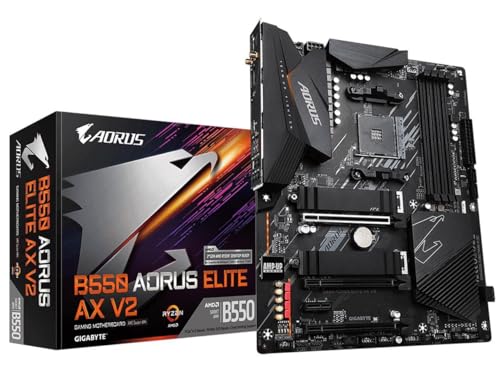
- 12+2 power phase design
- WiFi 6 and 2.5 GbE LAN
- 2x M.2 and front USB-C
Best For: Producers wanting a full-size AM4 board with strong connectivity
Budget Micro-ATX Essential

- Compact micro-ATX layout
- Dual M.2 with PCIe 4.0
- DDR4 support with 4 DIMMs
Best For: Budget builders who want a compact AM4 studio board
Wireless Feature-Rich B550

- WiFi 6 plus 1GbE LAN
- 10+3 phase VRM with heatsinks
- 2x M.2 and USB-C support
Best For: Producers wanting wireless connectivity and balanced B550 features
Budget AM4 Pick – MSI B550M PRO-VDH WiFi
If you want a motherboard for music production on the AM4 platform without overspending, the MSI B550M PRO-VDH WiFi is a practical Micro-ATX option. It supports Ryzen 5000 and 3000 series CPUs, offers DDR4 up to 128 GB, and includes Wi‑Fi, Bluetooth, and multiple display outputs for a compact studio PC.
Best For: Affordable Ryzen-based music production builds that still need wireless connectivity and solid upgrade room.
Pros:
- Supports AMD Ryzen 5000 and 3000 series processors with BIOS update support for future Ryzen CPUs.
- DDR4 memory support up to 128 GB, which is plenty for large sample libraries and DAWs.
- Includes Wi‑Fi, Bluetooth, and rear audio codec support with Realtek ALC892/ALC897.
- Flash BIOS Button adds convenience when updating the board.
Cons:
- Micro-ATX layout gives you fewer expansion options than a full ATX board.
- Rear audio uses a mainstream codec rather than a premium dedicated audio solution.
- Only 4 SATA ports are listed, which may feel limited for heavy storage setups.
This is a sensible value choice for builders who care more about stability, memory capacity, and wireless convenience than premium extras. For a music production workstation, it covers the essentials well while keeping the platform cost under control.
High-End AM5 Creator Board – GIGABYTE X870 AORUS Elite WIFI7
For a premium motherboard for music production on AMD’s newer platform, the GIGABYTE X870 AORUS Elite WIFI7 brings a strong feature set. It supports Ryzen 7000, 8000, and 9000 series processors, uses DDR5 memory, and adds USB4, WiFi 7, and four M.2 slots for fast, streamlined workstation storage.
Best For: High-end creators who want an AM5 board with modern connectivity and room to expand.
Pros:
- AM5 support for Ryzen 7000/8000/9000 series processors with DDR5 and AMD EXPO support.
- Four M.2 slots and PCIe 5.0 connectivity suit fast project drives and future upgrades.
- Includes dual USB4, front and rear USB-C, and WiFi 7 for modern peripheral support.
- 5-year manufacturer warranty adds long-term peace of mind.
Cons:
- Premium platform cost may be more than many home studio builds need.
- ATX size requires a case with enough space and airflow.
- Best paired with newer AM5 processors and DDR5, so it is not a budget refresh board.
This board is aimed at serious builds where storage speed, connectivity, and forward-looking compatibility matter. If your studio workflow benefits from multiple NVMe drives and next-gen USB, it is a very strong foundation.
Feature-Rich AM4 Board – ASUS ROG Strix B550-F Gaming WiFi II
The ASUS ROG Strix B550-F Gaming WiFi II is a strong motherboard for music production if you want a refined AM4 build with broad connectivity. It supports Ryzen 3000 and 5000 series CPUs, DDR4 memory up to 128 GB, and adds WiFi 6E, Bluetooth 5.2, and Intel 2.5 Gb Ethernet.
Best For: AM4 studio builds that need dependable networking, flexible outputs, and a well-rounded feature set.
Pros:
- Supports Ryzen 3000/5000 and 4000 G-series desktop processors on the AM4 socket.
- WiFi 6E, Bluetooth 5.2, and 2.5 Gb Ethernet provide flexible network options.
- Dual M.2 slots, PCIe 4.0 readiness, and USB 3.2 Gen 2 Type-C help with fast peripherals and storage.
- 12+2 teamed power stages and quality components add confidence for sustained use.
Cons:
- It is still a DDR4/AM4 platform, so it lacks the newer AM5 upgrade path.
- Listed memory clock speed is modest in the supplied details.
- Not the smallest or cheapest option if you only need a basic studio board.
For music creators who want a polished AM4 motherboard with strong networking and useful expansion, this board is easy to recommend. It balances reliable core hardware with extras that matter in a connected production setup.
Value AM5 Storage Pick – GIGABYTE B650 Eagle AX
The GIGABYTE B650 Eagle AX is a practical motherboard for music production if you want to move onto AM5 without jumping straight to a flagship board. It supports Ryzen 7000, 8000, and 9000 series processors, uses DDR5, and includes triple M.2 slots with one PCIe 5.0 lane for fast storage.
Best For: Midrange AM5 builds that prioritize SSD expansion, wireless connectivity, and stable performance.
Pros:
- AM5 support for Ryzen 7000/8000/9000 series processors with DDR5 memory support.
- Triple M.2 layout, including one PCIe 5.0 slot, is useful for project, sample, and scratch drives.
- Wi‑Fi 6E and GbE LAN provide solid networking options for studio use.
- 12+2+2 phase digital VRM and M.2 thermal guard support stable operation.
Cons:
- GbE LAN is not as fast as 2.5GbE or higher options.
- It has fewer premium extras than higher-end X870-class boards.
- Only 4 SATA ports are listed, which may be limiting for many drive builds.
This board hits a useful middle ground for creators who want modern AM5 features without chasing the most expensive chipset. It is especially appealing if your workflow benefits from multiple NVMe drives and a clean, stable foundation.
LiveMix Creator Pick – ASRock B850 LiveMixer WiFi 7 AM5 ATX
If you need a motherboard for music production on AMD AM5, the ASRock B850 LiveMixer WiFi 7 focuses on stability, fast storage, and strong connectivity. Its 14+2+1 phase power design, DDR5 support up to 8000+ (OC), and premium audio codec make it a capable foundation for a modern studio PC.
Best For: AMD-based music producers who want a feature-rich ATX board with WiFi 7, fast storage, and solid onboard audio.
Pros:
- 14+2+1 phase power design with 80A Dr.MOS for stable CPU delivery
- DDR5 support up to 8000+ (OC) with four DIMM slots
- Blazing M.2 Gen5x4 slot plus two Hyper M.2 Gen4x4 slots
- Realtek ALC1220 7.1 CH HD Audio with Nahimic enhancement
Cons:
- ATX size may not fit every pre-built or compact case
- Only two SATA3 ports are listed
This board is a strong fit if you want a flexible AMD music production motherboard with modern wireless networking, plenty of M.2 expansion, and a premium onboard audio solution.
Intel Studio Workhorse – GIGABYTE Z790 AORUS Elite AX DDR5
The GIGABYTE Z790 AORUS Elite AX is a practical motherboard for music production if you’re building around Intel 12th, 13th, or 14th Gen CPUs. It combines a strong 16+1+2 phase power design, DDR5 support, four M.2 slots, and USB-C connectivity in a standard ATX layout.
Best For: Intel-based creators who want a dependable DDR5 board with multiple NVMe drives and modern I/O.
Pros:
- Supports Intel Core 12th/13th/14th Gen processors on LGA 1700
- 16+1+2 phase digital VRM with 70A power stages
- Four PCIe 4.0 x4 M.2 slots for fast storage expansion
- Includes USB 3.2 Gen 2×2 Type-C and WiFi 6E
Cons:
- Maximum memory support is listed at 128GB
- No dedicated premium audio codec is highlighted in the notes
For Intel users building a music workstation, this board offers a balanced mix of power delivery, storage options, and connectivity without overcomplicating the layout.
Tomahawk Creator Choice – MSI MAG B850 Tomahawk MAX WiFi
The MSI MAG B850 Tomahawk MAX WiFi is built as a high-end AMD AM5 motherboard for music production workflows that need speed, stability, and expansion. With a 14 Duet Rail Power System, DDR5 Memory Boost up to 8400+ MT/s, PCIe 5.0 x16, and dual Gen5 M.2 slots, it covers the main demands of a serious studio PC.
Best For: AMD producers who want a robust ATX board with top-tier VRM cooling and fast storage options.
Pros:
- 14 Duet Rail Power System with 80A SPS VRM for Ryzen 9000/8000/7000
- DDR5 Memory Boost up to 8400+ MT/s with four DIMM slots
- PCIe 5.0 x16 slot plus two M.2 Gen5 x4 slots
- Wi-Fi 7, Bluetooth 5.4, and 5Gbps LAN for modern connectivity
Cons:
- ATX form factor may be too large for smaller cases
- Feature set may be more than casual builds need
If your priority is a stable, expandable foundation for a music production PC, this Tomahawk board stands out with fast memory support, strong cooling, and next-gen networking.
Quiet Studio-Ready ATX Pick – GIGABYTE B550 AORUS Elite AX V2
If you want a motherboard for music production with strong expansion and steady power delivery, the GIGABYTE B550 AORUS Elite AX V2 is a practical ATX option. Its 12+2 phase design, VRM heatsinks, and M.2 thermal guard make it a solid fit for long sessions, while WiFi 6, 2.5 GbE LAN, and front USB-C help keep a studio build convenient.
Best For: Music producers who want a full-size AM4 board with strong cooling, wireless networking, and plenty of I/O.
Pros:
- Digital twin 12+2 power phase design supports steadier power delivery.
- Advanced thermal armor and M.2 Thermal Guard help with heat management.
- WiFi 6, 2.5 GbE LAN, and front USB-C improve studio connectivity.
- 4 DDR4 DIMM slots and 2x M.2 slots give you useful upgrade room.
Cons:
- ATX size takes more case space than a micro-ATX board.
- Requires AM4 Ryzen 3000/4000/5000 compatibility.
For a music production PC that may run multiple drives, audio devices, and a fast network connection, this board offers a balanced set of features without pushing into workstation pricing. It is especially appealing if you want a roomy ATX layout and integrated wireless support.
Budget Micro-ATX Essential – GIGABYTE B550M K
The GIGABYTE B550M K is a straightforward motherboard for music production if you want the core B550 features in a smaller micro-ATX footprint. It supports Ryzen 3000/4000/5000 CPUs, DDR4 memory, PCIe 4.0, and dual M.2 slots, which makes it a sensible base for a compact audio PC.
Best For: Budget-conscious builders who want a compact AM4 board with the essentials for a studio PC.
Pros:
- Micro-ATX format fits smaller cases and simple studio rigs.
- Dual M.2 slots and PCIe 4.0 add useful storage and expansion options.
- DDR4 support with 4 DIMM slots leaves room for memory upgrades.
- Chipset heatsinks and 3+3 VRM design support basic thermal and power needs.
Cons:
- 3+3 power design is more modest than higher-end B550 boards.
- Connectivity is simpler, with no built-in WiFi noted.
- Fewer premium studio-focused extras than pricier options.
If your priority is a compact, practical build rather than a feature-packed board, this model covers the fundamentals well. It is a good match for a lean music production setup that still benefits from modern storage support.
Wireless Feature-Rich B550 – GIGABYTE B550 Eagle WIFI6
The GIGABYTE B550 Eagle WIFI6 is a strong motherboard for music production when you want wireless networking and modern connectivity on an AM4 platform. It combines a 10+3 power phase VRM, enlarged heatsinks, WiFi 6, USB-C, and two M.2 slots, making it a versatile choice for an audio workstation.
Best For: Producers who want WiFi 6, solid cooling, and a well-rounded ATX B550 board for a studio build.
Pros:
- 10+3 phase VRM design and enlarged heatsinks support steady operation.
- WiFi 6 and 1GbE LAN provide flexible network options.
- 2x M.2 slots and PCIe 4.0 suit fast storage and expansion.
- USB-C and multiple USB ports help connect audio gear and peripherals.
Cons:
- Only 1GbE LAN, so wired speed is lower than 2.5 GbE alternatives.
- Still limited to AM4 Ryzen 3000/4000/5000 CPUs.
For a music production PC, this board stands out by mixing solid power delivery with easy networking and plenty of practical ports. It is a particularly nice fit if you want wireless capability without giving up the storage and USB flexibility needed in a studio.
How We Picked the Best Motherboard for Music Production
For a Motherboard for Music Production, the priority is not flashy gaming branding, but dependable performance and sensible connectivity. We favored boards with strong VRMs, multiple M.2 slots for fast sample and project storage, USB options for audio interfaces and controllers, and onboard networking that suits streaming, collaboration, and cloud backups.
Quick Comparison
The list spans budget-friendly AM4 and modern AM5 choices, plus one Intel LGA 1700 option for users already committed to that platform. AM4 boards are the best value if you are pairing with Ryzen 3000/5000 CPUs, while AM5 and Intel DDR5 models are better for longer-term upgrade paths and newer I/O standards such as USB4, Wi-Fi 6E/7, and PCIe 5.0.
Key Buying Factors for a Motherboard for Music Production
USB and Audio Interface Support
Look for enough rear USB ports, preferably with a mix of USB-A and USB-C. A studio setup often includes an audio interface, MIDI controller, external storage, iLok or dongles, and sometimes a control surface, so port count matters more than raw benchmark numbers.
Expansion and Storage
Multiple M.2 slots are useful for separating operating system, project files, and sample libraries. That helps keep sessions responsive and makes future upgrades easier without relying too heavily on external drives.
Power Delivery and Stability
Music production often involves long sessions, high CPU loads, and many background tasks. A board with decent VRM quality and cooling is a smart choice, especially if you plan to run a higher-core processor for large projects and virtual instruments.
Connectivity and Workflow
Wi-Fi and 2.5GbE are both useful depending on your studio layout. Wired Ethernet is ideal for low-latency reliability, while strong wireless can help with flexible room placement and fast file transfers when needed.
Platform Longevity
If you want the most upgrade flexibility, AM5 and newer Intel platforms are attractive. If you want maximum value right now, AM4 still offers excellent performance for many DAW builds and leaves room for a quieter, more cost-effective system.
Who Should Buy Which Motherboard for Music Production?
Choose an AM4 board if you want a budget-conscious music workstation with proven compatibility and easy CPU pairing. Pick AM5 if you want newer features, DDR5 support, and a longer upgrade runway. Go Intel if you already use Core 12th, 13th, or 14th Gen parts and want a solid DDR5 workstation base. For most buyers, the best Motherboard for Music Production is the one that matches your CPU platform first, then gives you enough USB, storage, and networking for your studio workflow.