
Moist filament can cause stringing, weak layers, popping, and inconsistent extrusion, especially in busy home workshops where spools sit open between prints.
This roundup of the best filament dryers for home workshops in 2026 focuses on practical choices for drying speed, spool capacity, temperature control, and everyday reliability.
Best 10 Filament Dryers for Home Workshops Picks for 2026
Creality Quad-Chamber Workhorse
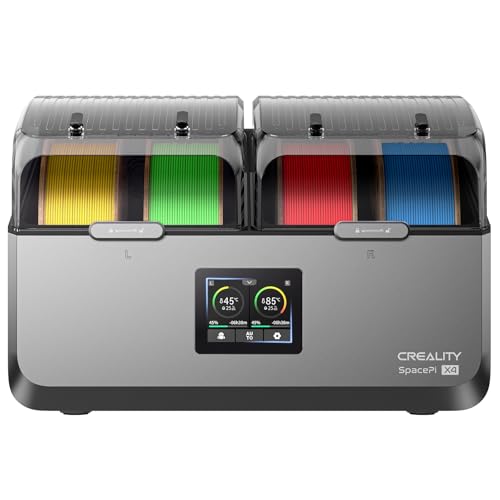
- Four-spool drying and printing support.
- Dual chambers with independent temperature control.
- Reaches up to 85°C with dual 200W PTC heaters.
Best For: Multi-printer workshops handling several filament types
SUNLU High-Capacity Dryer

- Dries up to four 1kg spools.
- Eight exit holes support multi-printer setups.
- 350W PTC heater with three circulation fans.
Best For: Busy makers who need high-capacity, multi-printer drying
Comgrow Compact Dry Box
Comgrow Filament Storage Dryer

- Stores two 1kg spools in a sealed dry box.
- 2-inch LCD shows temperature and humidity.
- Max temperature is 50°C for basic filament drying.
Best For: Small workshops needing simple, sealed filament storage
SUNLU 4-Spool Dryer

- Four-spool capacity for busy printing setups.
- Three fans provide more even chamber airflow.
- Adjustable 35-70°C temperature and 0-99 hour timer.
Best For: Users needing a roomy dryer with flexible controls
Compact Smart Dryer

- Fan-assisted drying for wetter filament
- LCD shows temp, time, and humidity
- 35°C-55°C adjustable range
Best For: Single-spool users who want simple, visible controls
Touchscreen All-Rounder
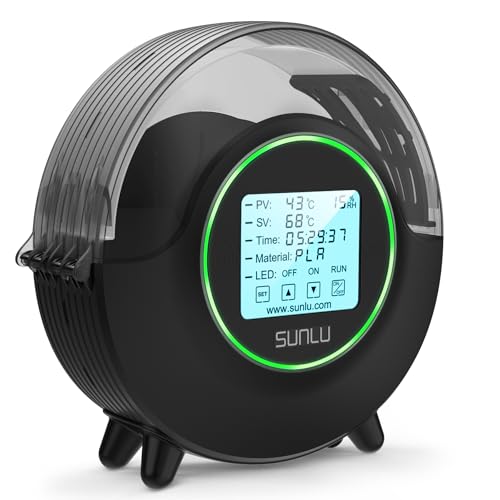
- 360° heating with fan support
- 4.6-inch touchscreen with humidity readout
- 70°C max temperature and broad compatibility
Best For: Users wanting a modern, flexible single-spool dryer
Fast single-spool drying

- 65°C in about 15 minutes
- 45°C-65°C with 0-24 hour timer
- Fits most 1kg, 1.75mm/2.85mm spools
Best For: Single-spool users who want quick, simple drying
Simple all-around dryer

- Dries filament during printing
- 35°C-70°C and 0-99 hour settings
- Large touch screen with translucent lid
Best For: Hobbyists who want an easy, reliable single-spool dryer
High-capacity multi-spool option

- Holds 4 x 1kg spools at once
- Up to 70°C with 3 circulation fans
- Triple-safe system with monitoring
Best For: Multi-printer workshops that need high drying capacity
Creality Quad-Chamber Workhorse – Official Creality Space Pi X4
If you’re comparing filament dryers for home workshops, the Creality Space Pi X4 is aimed at users who want to dry several spools at once without juggling multiple boxes. Its four-spool design, dual independent heating chambers, and support for dry-and-print setups make it a strong pick for busy multi-printer spaces.
Best For: Makers drying multiple filament types at once, especially in multi-printer home workshops.
Pros:
- Dries and prints from 4 spools at the same time.
- Dual chambers have independent temperature control for different filament types.
- Dual 200W PTC heaters can reach up to 85°C for engineering filaments.
- Single-chamber mode can save up to 40% energy.
Cons:
- Best results may depend on using heat-resistant plastic trays.
- The size and four-spool format may be more than a simple desktop setup needs.
Overall, the Space Pi X4 is built for high-throughput drying rather than minimal footprint convenience. If you regularly work with materials like PA, PAHT, PC, or flexible filaments, its dual-zone design gives it a clear practical edge.
SUNLU High-Capacity Dryer – SUNLU S4 4-Spool Black
For home workshops that need one dryer to handle a lot of filament, the SUNLU S4 stands out with 4-spool capacity, eight exit holes, and a 350W PTC heater. Among filament dryers for home workshops, it’s the kind of unit that makes sense when you want smoother multi-printer feeding and broad material compatibility.
Best For: Users who need a large-capacity dryer for frequent multi-material printing.
Pros:
- Holds and dries up to four 1kg spools.
- Eight filament exit holes help feed multiple printers.
- 350W PTC heater and three circulation fans support even heating.
- Works with PLA, PETG, ABS, TPU, PA, PC, and nylon in common diameters.
Cons:
- Large external dimensions take up substantial bench space.
- Its feature set may be more than needed for occasional single-spool drying.
The S4 is built for users who care more about throughput and flexibility than compactness. If your workflow involves multiple printers or many material changes, its size and airflow setup are real advantages.
Comgrow Compact Dry Box – Comgrow Filament Storage Dryer
If you want a simpler drying solution for a home workshop, the Comgrow filament dryer box focuses on sealed storage and basic moisture control rather than high-output capacity. It stores two rolls, includes real-time temperature and humidity monitoring, and is set up for PLA, ABS, and silk filament in standard 1.75mm or 2.85mm sizes.
Best For: Hobbyists who want a compact, sealed dry box for everyday filament protection.
Pros:
- Compact box holds two 1kg spools.
- Real-time temperature and humidity display on a 2-inch LCD.
- Sealed outlet design with silicone sheath, Teflon tube, and plug.
- Simple temperature and timer controls make setup straightforward.
Cons:
- Maximum temperature is only 50°C.
- Limited to 6 to 12 hours of drying time.
- Designed only for filament drying, not broader workshop use.
This is a practical option if you mainly need to keep filament dry and visible without moving to a larger multi-spool system. Its lower temperature ceiling makes it less suited to tougher engineering materials, but it fits everyday workshop storage well.
SUNLU 4-Spool Dryer – SUNLU S4 Black
The SUNLU S4 is a large-capacity choice for filament dryers for home workshops, especially if you want one unit to support several printers at once. With four-spool capacity, a 350W PTC heater, and three circulation fans, it’s built to keep drying more consistent across a wide chamber.
Best For: Users who want a roomy, multi-spool dryer with strong airflow and flexible settings.
Pros:
- Can dry up to four 1kg spools at once.
- Three circulation fans help maintain even temperatures.
- Eight filament exit holes support multiple printers and loading angles.
- Adjustable temperature and timer settings add flexibility.
Cons:
- Large footprint may be hard to fit on smaller benches.
- Its broad capabilities may be more than casual users need.
For heavier-duty desktop printing, the S4 offers a strong mix of capacity and airflow. It’s especially appealing if you print with a variety of materials and want one dryer to handle a busy workflow.
Compact Smart Dryer – SUNLU S1 Plus Black
For filament dryers for home workshops, the SUNLU S1 Plus focuses on straightforward drying and clear controls. Its upgraded fan helps move excess moisture out faster, while the LCD shows temperature, time, and humidity so you can keep track of the drying process without guessing.
Best For: Hobbyists who want a compact, easy-to-read dryer for common 1.75mm, 2.85mm, or 3.00mm filaments.
Pros:
- Fan-assisted drying helps reduce stringing, clogging, and poor adhesion caused by wet filament.
- 2-inch LCD displays temperature, time, and humidity for simple monitoring.
- Adjustable 35°C-55°C settings let you match different filament types and workshop conditions.
- Compatible with major brands and several common materials, including PLA, PETG, ABS, TPU, Nylon, and PA.
Cons:
- Designed for one spool at a time, so it is not suited to multi-spool workflows.
- Lower maximum temperature than some larger dryers, which may limit more demanding drying needs.
Overall, this is a practical pick if you want a simple dryer that covers the basics well and fits neatly into a home setup. The clear display and adjustable settings make it easy to use without adding much complexity.
Dual-Chamber Workhorse – Sovol SH03 4 Spools
Among filament dryers for home workshops, the Sovol SH03 stands out for capacity and flexibility. Its dual independent chambers let you dry two ways at once, and the sealed design means one chamber can keep dried filament stored without power while the other is actively drying.
Best For: Makers running multiple printers or multicolor jobs who need to dry and store several spools at once.
Pros:
- Dual independent heating chambers support different temperatures or different tasks at the same time.
- Large 4-spool capacity helps reduce bench clutter and supports multi-printer workflows.
- Dual 200W PTC heaters and built-in fan provide fast, 360° hot-air circulation.
- One-key presets cover 10 filament types, including PLA, TPU, PETG, ABS, ASA, PVA, PET, PC, PA, and PP.
Cons:
- Its size and multi-chamber design may be more than a casual single-printer setup needs.
- More features can mean more complexity than a basic plug-and-dry box.
If your workshop regularly juggles several spools, this model is built to keep pace. The mix of storage, drying, and preset controls makes it especially appealing when organization and throughput matter.
Touchscreen All-Rounder – SUNLU S2 360 Heating
For filament dryers for home workshops, the SUNLU S2 is a strong all-around option with a larger touchscreen and broad filament support. Its dual heating sheet and fan setup is designed for 360° heating, while the updated interface makes it easy to check temperature, humidity, countdown time, and filament type at a glance.
Best For: Users who want a simple, modern dryer with easy controls and support for many common filament materials.
Pros:
- 360° heating design aims for faster, more even drying.
- 4.6-inch LCD touch screen clearly shows temperature, time, humidity, filament type, and countdown.
- Maximum temperature can be set to 70°C for more flexible drying.
- Compatible with common filament sizes and materials, including PLA, PETG, ABS, TPU, Nylon, PA, and PC.
Cons:
- Single-spool capacity limits larger multi-material workflows.
- Not as specialized for multi-chamber storage as some higher-capacity options.
This is a solid pick if you want a balanced, easy-to-use dryer rather than a niche machine. The combination of touchscreen controls, higher max temperature, and broad compatibility makes it a sensible workshop upgrade.
Fast single-spool drying – Space Pi SE 1KG Dryer
If you want filament dryers for home workshops that heat fast and are simple to run, the Creality Space Pi SE is built around speed and straightforward control. It reaches 65°C in about 15 minutes, uses 360° hot-air circulation, and lets you set drying time and temperature based on the filament and your room conditions.
Best For: Makers who want a quick, easy-to-use dryer for standard 1kg spools and common desktop materials.
Pros:
- Heats to 65°C quickly with a built-in fan for 360° circulation.
- No assembly required; display screen and knob make setup simple.
- Adjustable 45°C-65°C temperature range and 0-24 hour timer.
- Works with many filament types, including PLA, PETG, TPU, ABS, ASA, and nylon.
Cons:
- Designed for 1kg spools, so it is not the best fit for larger-format drying needs.
- Requires attention to storage after drying if you want to keep filament dry.
This is a practical pick if you mainly need fast, flexible drying for a single spool at a time. Its combination of quick heat-up, real-time monitoring, and broad material support makes it well suited to regular workshop use.
Simple all-around dryer – SUNLU Filament Dryer S2 Black
For filament dryers for home workshops that do one job well, the SUNLU S2 is a straightforward choice. It is designed to remove moisture from damp filament, can dry while printing, and offers easy touch-screen control with customizable temperature and time settings.
Best For: Hobbyists who want a simple, effective dryer for restoring damp spools and keeping filament usable during prints.
Pros:
- Can dry filament during printing to help maintain print quality.
- Customizable drying time from 0-99 hours and temperature from 35°C-70°C.
- Built-in spindle helps filament spin continuously for even drying.
- Large touch screen and translucent lid make it easy to operate and check progress.
Cons:
- Single-spool design is less suited to multi-printer or high-volume workflows.
- Does not offer the larger capacity of newer multi-spool dryers.
The S2 is a sensible middle-ground option if you want a dryer that is easy to use and focused on practical results. Its ability to revive damp filament and keep it dry during a print makes it a dependable workshop accessory.
High-capacity multi-spool option – SUNLU S4 4-Spool Dryer
If your setup needs filament dryers for home workshops with more capacity, the SUNLU S4 is built for multi-spool drying and shared printer use. It holds four 1kg spools at once, heats up to 70°C, and uses three fans for 360° surround heating to help keep drying even across the chamber.
Best For: Small workshops or multi-printer setups that need to dry several spools at the same time.
Pros:
- Large 4-spool capacity supports simultaneous drying or feeding multiple printers.
- Heats up to 70°C for wide filament compatibility, including nylon, TPU, PLA, PETG, and ABS.
- Three circulation fans help provide even heating across the chamber.
- Triple-safe system adds a PTC heater, backup thermal switch, and software monitoring.
Cons:
- Much larger than single-spool dryers, so it needs more bench space.
- Better suited to users with multiple printers or frequent spool changes than casual one-off drying.
The S4 stands out when capacity matters more than compact size. For workshops that run multiple printers or multi-color jobs, its ability to dry four spools at once is the key advantage.
How We Picked the Best Filament Dryers for Home Workshops
We prioritized dryers that make sense for Filament Dryers for Home Workshops: enough capacity for real-world use, straightforward controls, reliable heat distribution, and formats that fit common desktop printing setups. We also looked for models that can handle multiple materials, not just basic PLA storage.
Quick Comparison
The main differences come down to how many spools you can dry at once, the highest safe temperature, whether the unit supports active printing while drying, and how much bench space it consumes. Single-spool units are simpler and usually cheaper; multi-spool boxes are better for users who rotate materials or print often.
Key Buying Factors for Filament Dryers for Home Workshops
Capacity and Spool Fit
If you only use one filament type at a time, a single-spool dryer may be enough. If you switch between PLA, PETG, TPU, ABS, or nylon, a larger box can save time and reduce clutter. Check support for 1.75 mm and 2.85 mm filament, plus spool diameter and width limits.
Temperature Range and Control
Different materials need different drying temperatures. A wider adjustable range is helpful for advanced users, but precision matters more than extreme heat. For most home workshops, stable, even drying is more valuable than the highest possible maximum temperature.
Printing While Drying
Some dryers are designed to feed filament directly to the printer. That matters if you want to keep hygroscopic materials dry during long jobs. Make sure the filament path is smooth and the box can sit close to your printer without awkward routing.
Efficiency, Noise, and Footprint
For shared desks or small studios, compact size and low noise can matter as much as drying power. Power-saving modes and insulated chambers are useful if you run the dryer often.
Who Should Buy Which Filament Dryers for Home Workshops?
Choose a compact single-spool unit if you print occasionally or mostly use PLA. Pick a higher-capacity multi-spool model if you run several materials, print often, or keep backup spools ready to go. If you work with nylon, TPU, or moisture-sensitive blends, prioritize stronger temperature control and the ability to dry and print at the same time. For most home makers, the best choice is the dryer that matches your spool turnover and material mix rather than the one with the highest spec sheet.