
Shopping for a 3D printer in 2026 is easier than ever, but the best choice still depends on what you want to make, how much setup you want, and how fast you need results.
This roundup focuses on standout 3D printers for beginners, hobbyists, and makers who want reliable performance, simple operation, or multicolor printing.
Best 10 3d Printers Picks for 2026
Fast Enclosed Multicolor Option

- Up to 500 mm/s printing speed
- Enclosed body with auto bed leveling
- Up to 16 colors with AMS
Best For: Fast, enclosed printing with multicolor expansion
Kid-Friendly Starter Mini

- Fully assembled and ready in about 8 minutes
- Auto leveling with power-loss recovery
- 3.9 x 3.9 x 3.9 inch print volume
Best For: Kids, beginners, and small STEM projects
High-Speed Multicolor Flagship

- Up to 600 mm/s printing speed
- Supports up to 16 colors with CFS
- AI camera with smart auto leveling
Best For: Fast multicolor printing with smart monitoring
Beginner-Friendly Speed Pick
Bambu Lab A1 3D Printer for Beginners

- Automatic calibration reduces setup work.
- Fast printing with 10,000 mm/s² acceleration.
- Optional multi-color printing with AMS lite.
Best For: Beginners and kids who want easy, quiet, high-speed printing.
Multi-Color Performance Pick
FLASHFORGE AD5X CoreXY High-Speed Printer

- Prints up to 4 colors simultaneously.
- CoreXY design reaches up to 600mm/s.
- Auto leveling and filament handling simplify use.
Best For: Makers who want speed, color, and flexible nozzle choices.
Compact Creative Starter
Bambu Lab A1 mini with LED Lamp Kit

- Compact, beginner-friendly design.
- Automatic calibration simplifies setup.
- LED Lamp Kit supports creative decor projects.
Best For: Beginners who want a small, quiet printer for creative projects.
Multi-Color Speed Pick
ELEGOO Centauri Carbon 2 Combo
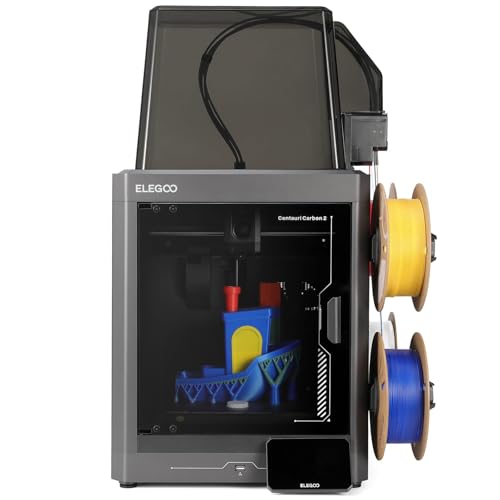
- 4-color printing with CANVAS
- Up to 500 mm/s speed
- Auto calibration and monitoring
Best For: Makers seeking fast multicolor printing with broad material support
Toolchanger Power Pick
Snapmaker U1 4-Toolhead 3D Printer

- 4-toolhead system with 5-second changes
- Up to 5X less waste
- Supports multi-material printing
Best For: Users who want fast, low-waste multicolor and multi-material prints
Enclosed Multicolor Value Pick
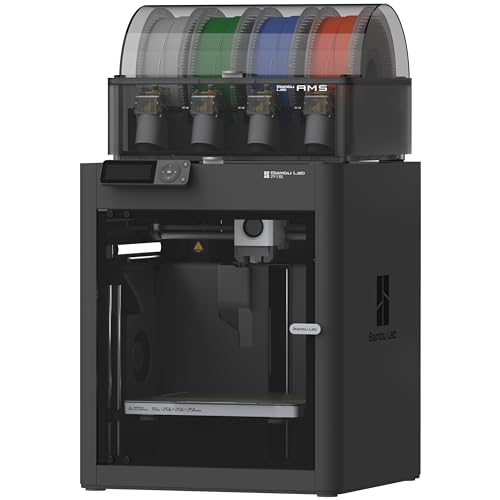
- Up to 16 colors with AMS
- 500 mm/s speed and 20,000 mm/s² acceleration
- Enclosed design with auto bed leveling
Best For: Buyers wanting a fast enclosed printer with multicolor support
Reliable Beginner FDM Pick – ELEGOO Neptune 3 Pro
If you want 3d printers that feel dependable from day one, the ELEGOO Neptune 3 Pro is a practical all-around option. Its 225 x 225 x 280 mm build volume fits everyday projects, while auto bed leveling, a direct drive extruder, and quiet stepper motors help simplify setup and keep prints consistent.
Best For: Makers who want a straightforward printer for PLA, TPU, PETG, and ABS with low-noise operation.
Pros:
- 36-point auto bed leveling helps improve first-layer success
- Dual-gear direct drive extruder supports flexible and common filaments
- Silent stepper motors can keep operation as low as 47 dB
- Dual Z-axis lead screws support stable vertical movement
Cons:
- Build size is standard rather than especially large
- Not aimed at advanced multicolor printing
Overall, the Neptune 3 Pro focuses on reliable printing rather than flashy extras. For buyers who value easier setup, good filament compatibility, and steady day-to-day performance, it is a solid entry in the 3d printers category.
Fast Enclosed Multicolor Option – Bambu Lab P1S
Among 3d printers aimed at speed and convenience, the Bambu Lab P1S stands out with a ready-to-use setup and an enclosed body. It reaches up to 500 mm/s printing speed, supports automatic bed leveling, and can handle multi-color or multi-material printing when paired with AMS.
Best For: Users who want fast printing, an enclosed design, and the option to expand into multicolor projects.
Pros:
- Up to 16-color printing is available with AMS
- Enclosed design supports advanced filament use
- Automatic bed leveling helps simplify setup
- Quick 15-minute setup makes it easy to get started
Cons:
- Multi-color printing requires the AMS add-on
- Some reinforced filaments are not recommended
If you want a machine that prioritizes speed and ease of use, the P1S is a strong fit. Its combination of enclosure, auto leveling, and fast printing makes it appealing for users who want efficient results without a long assembly process.
Kid-Friendly Starter Mini – Entina Tina2C
For families and first-time buyers comparing 3d printers, the Entina Tina2C is built to make the learning curve easier. It arrives fully assembled, can start printing in about 8 minutes, and adds app-based features, auto leveling, and flexible WiFi or offline printing for simple everyday use.
Best For: Kids, beginners, and STEM projects that need a small, quiet, easy-to-manage printer.
Pros:
- Fully assembled and beginner-friendly with 8-minute start time
- Auto leveling and power-loss recovery improve print success
- Poloprint Cloud app adds AI tools and 20+ creative modules
- Compact 3.9 x 3.9 x 3.9 inch build volume fits small spaces
Cons:
- Very small print volume limits project size
- Designed more for learning than high-capacity production
The Tina2C is best viewed as a compact learning printer rather than a full-size workshop machine. If your priority is a safe, approachable, and low-fuss option for home or classroom use, it delivers exactly that.
High-Speed Multicolor Flagship – Creality K2 Combo
If you are shopping 3d printers for speed and multicolor output, the Creality K2 Combo is built to cover both. It offers a 260 x 260 x 260 mm build volume, up to 600 mm/s printing speed, smart auto leveling, and AI camera monitoring, all in a mostly pre-assembled package.
Best For: Users who want fast, multicolor printing with smart monitoring and a plug-and-play setup.
Pros:
- Supports up to 16 colors with 4 x CFS units
- Up to 600 mm/s printing speed for rapid jobs
- Smart auto leveling targets only the needed bed area
- AI camera helps watch for spaghetti failure and idling
Cons:
- Full multicolor capability depends on CFS expansion
- Advanced features may be more than casual users need
The K2 Combo is aimed at buyers who want a faster, smarter printer with room to grow into multicolor work. For people focused on output speed, monitoring, and convenience, it offers a strong feature mix.
Beginner-Friendly Speed Pick – Bambu Lab A1 3D Printer for Beginners
If you want 3d printers that feel easy on day one but still print fast, the Bambu Lab A1 is a strong fit. It combines automatic calibration, active flow compensation, and a quick-swap nozzle setup to simplify setup and day-to-day use while still targeting high precision.
Best For: Beginners, kids, and home users who want a fast, low-hassle printer with optional multi-color capability.
Pros:
- Full-auto calibration handles Z-offset, bed leveling, and related setup automatically.
- High-speed printing with 10,000 mm/s² acceleration is designed for fast output without sacrificing detail.
- Active flow rate compensation helps keep prints smooth and consistent.
- Quiet operation and a simple touchscreen make it easier to live with in a home space.
Cons:
- Multi-color printing requires the AMS lite, which is sold separately or in the A1 Combo.
- Users who want the most compact footprint may prefer the smaller A1 mini instead.
Overall, the A1 stands out as a beginner-friendly option that focuses on convenience first, while still offering the speed and refinement many shoppers want in modern 3d printers.
Multi-Color Performance Pick – FLASHFORGE AD5X CoreXY High-Speed Printer
Among 3d printers aimed at speed and color, the FLASHFORGE AD5X is built for users who want a fast, capable machine with more advanced print controls. Its CoreXY design, 1-click auto leveling, and 300°C direct-drive extruder make it a practical choice for efficient everyday printing and more demanding projects.
Best For: Makers who want high-speed multi-color printing with flexible nozzle options and streamlined operation.
Pros:
- Supports up to 4 colors simultaneously for more vivid prints.
- CoreXY structure and up to 600mm/s speed are built for fast output.
- 1-click auto leveling and automatic filament handling simplify operation.
- Multiple nozzle sizes give you options for detail work or faster large-model printing.
Cons:
- Build volume is 220x220x220mm, which may feel limiting for larger projects.
- Its feature set is more advanced than a basic starter printer.
The AD5X is a strong pick if your buying priority is speed plus creative flexibility, especially when you want a printer that can handle both colorful prints and efficient batch work.
Compact Creative Starter – Bambu Lab A1 mini with LED Lamp Kit
If you’re comparing 3d printers for a smaller space or an easier first setup, the Bambu Lab A1 mini is built around simplicity and everyday creativity. This bundle adds an LED Lamp Kit, so you can print compatible lamp models and turn them into functional decor or personalized gifts.
Best For: Beginners and hobbyists who want a compact, quiet printer for creative home projects.
Pros:
- Automatic calibration and simple setup make it easy to start printing.
- Compact design suits home, studio, or workspace environments.
- Quiet, high-speed printing helps it fit into daily use.
- Included LED Lamp Kit adds a clear creative project angle.
Cons:
- The smaller size may not suit users who need a larger build area.
- Color and ecosystem features are less expanded than the larger A1 setup.
The A1 mini is a practical entry point if you want a smaller printer that keeps the learning curve low and the project ideas broad, especially for toys, decor, and gift-making.
Multi-Color Speed Pick – ELEGOO Centauri Carbon 2 Combo
If you’re comparing 3d printers for fast, multi-color output, the ELEGOO Centauri Carbon 2 Combo is built around speed, automation, and material flexibility. It combines 4-color printing with CANVAS, automated calibration, and a CoreXY frame that targets smooth, precise results without a lot of manual tuning.
Best For: Makers who want an automated, high-speed 3d printer for multicolor projects and a wide material range.
Pros:
- 4-color printing with CANVAS and smart filament detection
- Auto refill and tangle detection help keep prints running smoothly
- Up to 500 mm/s printing speed with 20,000 mm/s² acceleration
- Fully automated calibration and active vibration compensation
Cons:
- Multicolor printing depends on the CANVAS ecosystem workflow
- Best fit for users who want an advanced, feature-rich setup
Overall, this is a strong option if you want a 3d printer that prioritizes fast output, reduced hands-on upkeep, and more advanced material support. It leans toward convenience and performance rather than a basic entry-level experience.
Toolchanger Power Pick – Snapmaker U1 4-Toolhead 3D Printer
Among modern 3d printers, the Snapmaker U1 stands out for its 4-toolhead design and 5-second tool changer, which eliminates repeated filament swaps and purging. That makes it a practical choice for users who want multi-color and multi-material printing with less waste and a faster workflow.
Best For: Users who want a toolchanger-based 3d printer for fast multi-color, multi-material, and low-waste printing.
Pros:
- Four independent toolheads with a 5-second automatic tool change
- Up to 5X less waste and 5X faster multi-color printing versus traditional filament-changing systems
- Supports true multi-material builds, including rigid, flexible, and soluble support materials
- Auto calibration, vibration compensation, and AI print monitoring simplify setup and use
Cons:
- Designed for users who need more than a simple single-material machine
- Large feature set may be more than casual beginners need
The Snapmaker U1 is aimed at users who value productivity and material flexibility over a basic print-only workflow. Its toolchanger system is the key selling point, especially if you want multicolor prints without the waste and delays common to standard filament swapping.
Enclosed Multicolor Value Pick – Bambu Lab P1S Combo
If you’re shopping 3d printers for a balance of speed, multicolor output, and easier setup, the Bambu Lab P1S Combo is built to deliver a streamlined experience. It pairs the P1S printer with AMS support for up to 16 colors, while the enclosed design and automatic bed leveling help support reliable printing with compatible filaments.
Best For: Buyers who want a fast, enclosed 3d printer with multi-color capability and simple setup.
Pros:
- Up to 16-color printing with AMS support
- 500 mm/s speed and 20,000 mm/s² acceleration
- Fully enclosed body helps with advanced filament performance
- Automatic bed leveling and 15-minute setup reduce hassle
Cons:
- AMS is required for multi-color printing
- Carbon/glass fiber reinforced polymers are not recommended
This combo is a strong fit if you want a 3d printer that emphasizes quick setup and high-speed printing without giving up multicolor capability. It is especially appealing for users who want an enclosed machine for supported filaments and a more plug-and-play experience.
How We Picked These 3d Printers
We prioritized models that balance real-world ease of use with strong print quality, not just headline specs. The best picks combine reliable auto leveling, sensible build volumes, stable motion systems, and features that reduce failed prints. We also weighed assembly time, software ecosystem, and whether a printer is better suited to first-time users or experienced makers.
Quick Comparison
If you want the simplest setup, look at fully assembled or nearly ready-to-use models. If speed and throughput matter, prioritize CoreXY or similarly tuned high-speed machines. For multicolor work, choose printers with dedicated filament systems or tool-changing hardware. If you need a family-friendly option, a compact machine with guided setup and app control is usually the least intimidating.
Key Buying Factors for 3d Printers
Ease of Setup
Some 3d Printers arrive ready to print in minutes, while others need more assembly and calibration. Beginners usually benefit from auto leveling, clear onboard instructions, and app-based controls.
Build Volume
Smaller printers are great for desk space, kids, and tabletop models. Larger build volumes are better if you want helmets, functional parts, or fewer split-up prints.
Speed and Motion System
Fast printers can save time, but only if they maintain quality. Look for a stable frame, good extrusion control, and motion systems designed for high-speed printing rather than just high advertised numbers.
Materials and Extruder Temperature
PLA is easiest for most users, but many buyers also want support for PETG, TPU, or higher-temperature materials. A direct drive extruder and higher nozzle temperatures expand what you can print.
Multicolor and Automation
If color variety matters, check how the printer handles filament swapping, waste, and software workflows. Automation features like camera monitoring and error detection can also make printing more dependable.
Who Should Buy Which 3d Printers?
Beginners and families should focus on compact, fully assembled 3d Printers with auto leveling and simple apps. Makers who want stronger enclosures, faster output, or more advanced materials should lean toward performance-oriented models. If your goal is multicolor display pieces or prototyping, prioritize systems built around dedicated color management or tool changes. For the best overall experience, choose the printer that matches your space, skill level, and the kind of projects you’ll actually make most often.