
3D printing can release particles, odors, and volatile organic compounds, especially when working with resin, ABS, ASA, or other high-emission materials. A suitable air purifier can help reduce airborne contaminants and make your workspace more comfortable.
We selected 10 options for different printer types and budgets, from compact carbon-filter units for resin vats to HEPA-equipped systems designed for enclosed FDM printers.
Best 10 3d Printer Air Purifiers Picks for 2026
Best Compact Resin-Odor Pick
ELEGOO Mini Air Purifier 2-Pack

- Activated carbon targets resin odors
- Rechargeable battery lasts at least 24 hours
- Designed for LCD, DLP, and MSLA printers
Best For: Compact resin-printing setups
Best Bambu Lab Filtration System

- Triple-layer particle and VOC filtration
- Up to 60 m³/h airflow
- Quick-swap filters and broad adapter support
Best For: Enclosed Bambu Lab P1S or X1C printers
Best Large Resin-Printer Purifier
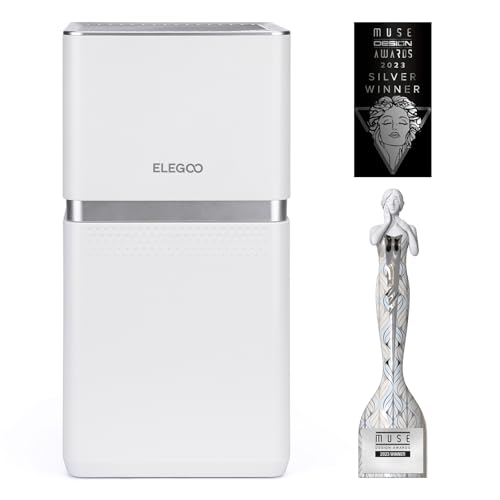
- Large design for photocuring printers
- Two fan speeds with automatic switching
- VOC and filter-life replacement reminders
Best For: Large ELEGOO Saturn and Mars printers
Best for Quiet, High-Capacity Resin Printing
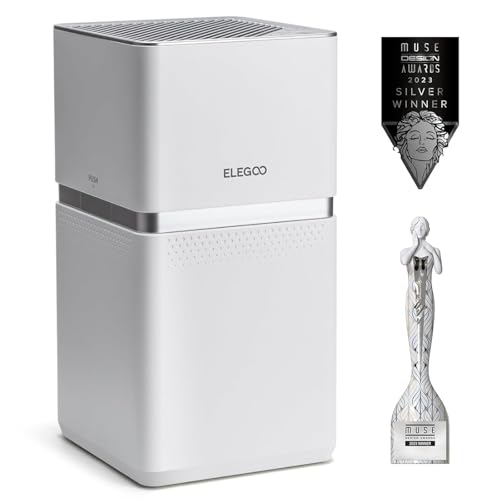
- Removes up to 95% TVOC
- Quiet 35 dB, 6W operation
- VOC sensor and replaceable carbon filter
Best For: Resin-printing workspaces needing quiet operation and VOC reminders
Best for Monitored Desktop Crafting
Resiners Purair Lite Air Purifier

- Real-time TVOC display with color indicators
- Auto mode and three fan speeds
- Compact design for resin and craft work
Best For: Small workspaces needing visible air-quality monitoring
Best Compact Two-Pack
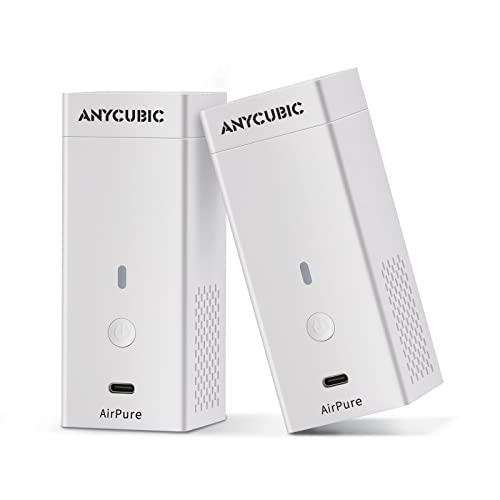
- Two compact activated-carbon purifiers
- 4.5-inch lightweight printer-friendly design
- Replaceable filters rated for 3–6 months
Best For: Compact LCD or DLP resin-printer setups focused on odor control
High-Capacity Choice

- 250 m³/h airflow and 1,700 Pa suction
- Five-stage filtration with PM2.5 display
- Filters rated up to 1,500 hours
Best For: High-volume FDM or resin printing
Compact Enclosure Pick

- HEPA H13 and activated carbon filtration
- Compatible with common enclosed printers
- Compact 60 m³/h design with included hardware
Best For: Enclosed printers in home or studio spaces
Smart Resin-Focused Pick

- H13 HEPA and dual activated-carbon filtration
- 250 m³/h airflow with PM2.5 monitoring
- Touch control and broad printer compatibility
Best For: Resin-printing spaces needing VOC and odor filtration
Best Compact Resin-Odor Pick – ELEGOO Mini Air Purifier 2-Pack
If you need a compact option among 3d printer air purifiers, the ELEGOO Mini Air Purifier 2-pack focuses on resin odor control for LCD, DLP, and MSLA printers. Its rechargeable battery and small footprint make it easy to place near individual printers.
Best For: Resin-printing setups that need a small, rechargeable odor-control solution.
Pros:
- Activated carbon filter targets irritant resin odors.
- Rechargeable 2,000mAh battery provides at least 24 hours of continuous operation per charge.
- Includes two units and works with LCD, DLP, and MSLA resin printers.
Cons:
- Uses activated carbon only, rather than a HEPA filtration system.
- Carbon filter replacement is required after roughly three to six months and must be purchased separately.
This is a straightforward choice for reducing resin smells close to the printer, especially when you want two small units rather than a larger enclosure filtration system. It is less suited to buyers specifically seeking documented ultrafine-particle filtration.
Best Bambu Lab Filtration System – HEPA H13 Carbon Filter System
This purpose-built option stands out among 3d printer air purifiers for enclosed Bambu Lab printers. It combines a pre-filter, HEPA H13 media, and activated carbon bed with a centrifugal fan designed to maintain steady airflow during printing.
Best For: Bambu Lab P1S and X1C owners printing in home offices, workshops, classrooms, or makerspaces.
Pros:
- Triple-layer filtration includes a pre-filter, HEPA H13 filter, and chemically activated carbon bed.
- HEPA H13 is specified to capture more than 99.97% of ultrafine particles down to 0.3 micrometers.
- Provides airflow up to 60 m³/h and supports tool-free, quick-swap filter changes.
- Adapter options broaden compatibility with several enclosed printer models.
Cons:
- The default connector is intended for Bambu Lab P1S and X1C; other printers may require adapters.
- Its 5.3-inch-square footprint and 3.54-pound weight may be substantial for very small workspaces.
With both particle and VOC-focused filtration, this is the more comprehensive pick for enclosed-printer users who want a dedicated system rather than a basic odor absorber. Confirm connector requirements before buying for a non-Bambu printer.
Best Large Resin-Printer Purifier – ELEGOO Marsmate Air Purifier
The ELEGOO Marsmate is a large-format choice among 3d printer air purifiers, built around activated-carbon filtration for photocuring setups. Two fan speeds, automatic switching, and VOC-related filter reminders make it more feature-rich than a basic plug-in odor filter.
Best For: Larger ELEGOO Saturn and Mars resin printers with compatible expansion interfaces.
Pros:
- Large design is intended to provide a stronger purification effect for photocuring printers.
- Low and high fan-speed modes can be selected manually or set to switch automatically.
- Built-in reminders respond to filter life exceeding 1,440 hours or VOC concentration above 1.4 PPM.
- Operating noise is specified at up to 35 dB.
Cons:
- Its 16.14-inch height and 14-pound weight require considerable space.
- Uses activated carbon filtration rather than a stated HEPA particle filter.
- Compatibility with other brands depends on having suitable expansion interfaces.
Marsmate makes sense when capacity, quiet operation, and monitoring features matter more than a compact footprint. Its compatibility list is strongest for larger ELEGOO resin printers, so check the printer interface before committing.
Best Enclosed-Printer Value – HEPA H13 Carbon Filter System
For shoppers comparing 3d printer air purifiers for enclosed machines, this system combines pre-filtration, HEPA H13 media, and a thick activated-carbon bed. Its stable airflow and printable adapter support make it a flexible choice for several popular printer platforms.
Best For: Enclosed printers using ABS, ASA, Nylon, PLA, or PETG in home, office, and workshop environments.
Pros:
- Triple-layer design targets dust, ultrafine particles, VOCs, and chemical odors.
- HEPA H13 is specified to capture 99.97% of ultrafine particles.
- Airflow reaches up to 60 m³/h with outlet velocity up to 10 m/s.
- Compact construction and tool-free quick-swap filter modules simplify maintenance.
Cons:
- It is not recommended for open-frame printers without an enclosure.
- The default connector is for Bambu Lab P1S/X1C; other models may need printable adapters.
- It reduces contaminants but does not replace room ventilation.
This is a strong all-around option for enclosed printing because it addresses both particles and odors while supporting multiple printer brands. Continue using suitable room ventilation, particularly with ABS, ASA, and Nylon.
Best for Quiet, High-Capacity Resin Printing – ELEGOO MARSMATE Air Purifier
For shoppers comparing 3d printer air purifiers for resin printing, the ELEGOO MARSMATE emphasizes quiet operation, activated-carbon filtration, and broad compatibility with ELEGOO and other resin printers that have an extension port. Its larger body and VOC sensor make it a practical choice for users who want ongoing monitoring rather than a basic odor filter.
Best For: Resin-printing workspaces that need quiet operation, VOC reminders, and a larger activated-carbon purifier.
Pros:
- Rated for removing up to 95% of TVOC.
- 35 dB operation and 6W power consumption support quiet, energy-conscious use.
- Built-in VOC sensor provides an alert when the filter may need replacement.
- Replaceable activated-carbon filter can last up to two months.
Cons:
- Its 16.14-inch height and 14-pound weight make it less portable than compact purifiers.
- The filter requires removal of its protective plastic bag before use and periodic replacement.
The MARSMATE is a strong fit when compatibility, quiet running, and VOC monitoring matter more than a small footprint. Confirm that your printer has a compatible extension port and plan for regular filter changes.
Best for Monitored Desktop Crafting – Resiners Purair Lite Air Purifier
The Resiners Purair Lite is one of the more versatile 3d printer air purifiers for small workspaces. It combines a pre-filter with a main filter, displays real-time TVOC readings, and automatically adjusts fan speed, making it suited to resin mixing, pouring, curing, and other detailed craft activities.
Best For: Small desks and craft areas where visible TVOC readings, automatic fan control, and portability are priorities.
Pros:
- Displays real-time TVOC levels with green, yellow, and red indicators.
- Auto mode adjusts fan speed based on air quality.
- Offers three fan speeds, touch controls, and a timer.
- Compact, lightweight design works for resin projects, nail art, and crafting.
Cons:
- The supplied details do not specify a filter replacement interval.
- Designed for small personal workspaces rather than stated large-room coverage.
- The product details list no warranty.
Purair Lite makes the most sense for users who want an easy-to-read air-quality display and flexible controls in a compact workspace. Its TVOC monitoring and auto mode add convenience during hands-on resin projects.
Best Compact Two-Pack – ANYCUBIC Mini Purifier
For buyers seeking compact 3d printer air purifiers, the ANYCUBIC Mini Purifier offers two lightweight units designed to sit directly on or near LCD and DLP printers. High-density activated carbon targets resin odors, while the replaceable filter and low-noise fan keep the setup simple for ongoing printing.
Best For: Users who want two small, printer-mounted odor purifiers for compact LCD or DLP resin-printing setups.
Pros:
- Pack of two provides coverage for multiple printers or positions.
- Very compact 4.5 x 1.8 x 1.8-inch design weighs 17 grams per unit.
- High-density activated-carbon filter is designed to absorb resin odors.
- Replaceable filter is rated for three to six months of continuous use.
Cons:
- Its compact design is intended for odors, not broad-room air purification.
- The supplied details list inconsistent noise figures of 40 dB or less in the features and 45 dB in specifications.
- Battery-powered operation means the battery status or runtime is not specified.
The ANYCUBIC Mini Purifier is a convenient choice when space is limited and odor control near the printer is the main goal. The two-pack and long stated filter life are useful for multi-printer setups, though it offers fewer monitoring features than larger models.
High-Capacity Choice – Creality Turbo Air Purifier
If you need a powerful option among 3d printer air purifiers, this Creality model combines 250 m³/h airflow with 1,700 Pa suction. Its five-stage filtration, real-time PM2.5 display, and long filter life make it suited to extended printing sessions.
Best For: High-volume FDM or resin printing setups that need strong airflow and visible air-quality monitoring.
Pros:
- 360° airflow and up to 250 m³/h airflow with 1,700 Pa suction.
- Five-stage filtration targets dust and odors.
- Real-time PM2.5 display shows fine-particle levels.
- Standard and V-fold carbon filters are rated for up to 1,000 and 1,500 hours, respectively.
Cons:
- Its listed 28-pound weight may be substantial for smaller workspaces.
- Replacement-filter needs will depend on usage and filter type.
This is a feature-rich choice if airflow and monitoring matter most. The long filter ratings may also help reduce maintenance interruptions during regular printing.
Compact Enclosure Pick – Mintion V1 Filter System
The Mintion V1 is a compact filter system for enclosed printers and a practical choice among 3d printer air purifiers. It uses a pre-filter, HEPA H13 filter, and activated carbon stage to address particles, vapors, and odors from common filaments.
Best For: Enclosed 3D printers in homes, studios, classrooms, and other spaces where compact installation and quieter operation are useful.
Pros:
- Three-stage filtration combines pre-filter, HEPA H13, and activated carbon.
- Works with PLA, PETG, ABS, ASA, and nylon (PA).
- Supports common enclosed-printer brands with optional printed adapters.
- 60 m³/h airflow is designed to operate without excessive noise or pressure instability.
Cons:
- Its 60 m³/h airflow is lower than the airflow listed for the larger Creality units.
- Compatibility may require an optional printed adapter depending on the printer.
Choose this system when enclosure compatibility and a smaller footprint are priorities. The included power adapter, hardware, tools, and instructions make installation more approachable.
Smart Resin-Focused Pick – Creality 5-Stage Air Purifier
For resin users comparing 3d printer air purifiers, this Creality model pairs a five-stage system with high-density activated carbon and H13 HEPA filtration. Smart touch control and real-time PM2.5 monitoring add convenient feedback during resin or FDM printing.
Best For: Resin-printing workspaces that need VOC and odor filtration, strong airflow, and touchscreen monitoring.
Pros:
- Five-stage filtration includes a G4 pre-filter, H13 HEPA filter, and dual activated-carbon layers.
- Targets particles, VOCs, resin fumes, and odors.
- Provides up to 250 m³/h airflow and 1,700 Pa suction.
- Touch controls and PM2.5 monitoring make operation straightforward.
Cons:
- Its listed 30.9-pound weight may be inconvenient for frequent relocation.
- Filter replacement is still required after the rated service periods.
This is a strong fit for buyers who want resin-oriented carbon filtration without giving up high airflow. Its broad desktop FDM and LCD/DLP resin compatibility further widens its potential use.
How We Picked the Best 3d Printer Air Purifiers
We compared these 3d Printer Air Purifiers by filtration design, printer compatibility, airflow, noise, size, maintenance, and intended use. Activated carbon is important for reducing odors and some volatile organic compounds, while HEPA filtration is designed to capture fine airborne particles. Because no small purifier eliminates every printing emission, we also considered whether each model is best used inside an enclosure, near a resin printer, or as supplemental room ventilation.
Compatibility was another priority. Some units are made for specific ELEGOO, Anycubic, or Bambu Lab printers, while others use a more universal form factor. Always confirm the purifier’s dimensions, power connection, replacement-filter availability, and recommended printer models before buying.
Quick Comparison
| Best For | Look For | Typical Advantage |
|---|---|---|
| Resin printers | Activated carbon and compact design | Fits near or inside many resin-printer covers |
| Enclosed FDM printers | HEPA H13 plus carbon filtration | Addresses particles and odors together |
| Large enclosures | Higher airflow and broad intake area | Moves more contaminated air through the filter |
| Small workspaces | Quiet operation and low-profile housing | Less distracting during long prints |
Key Buying Factors for 3d Printer Air Purifiers
Filter Type
Choose activated carbon when odor and resin fumes are your main concern. Choose a HEPA-equipped model when fine particles from filament printing are also important. A combination filter offers broader coverage, but performance depends on filter size, airflow, sealing, and replacement frequency.
Airflow and Enclosure Fit
A purifier needs enough airflow for the printer enclosure or nearby workspace. A compact unit may work well for a small resin printer but be underpowered for a large FDM enclosure. Check rated airflow where provided, and avoid blocking vents or placing the purifier where it cannot draw contaminated air.
Noise, Power, and Maintenance
Ultra-quiet models are useful for offices and bedrooms, while higher-airflow units may be better for workshops. Check whether the purifier uses USB, a universal adapter, or a dedicated power supply. Replacement filters are essential; confirm their cost and availability before choosing a model.
Safety and Ventilation
An air purifier is supplemental protection, not a replacement for ventilation, enclosure use, gloves, or safe resin handling. Keep the printer and purifier operating according to the manufacturer’s instructions, and ventilate the room whenever practical.
Who Should Buy Which 3d Printer Air Purifiers?
Resin-printer owners should prioritize compact activated-carbon models that fit beneath or inside the printer cover. Owners of Bambu Lab or other enclosed FDM printers should look for a compatible HEPA-and-carbon filter system. If you print ABS, ASA, PA, or other materials that produce noticeable odors or particles, choose a higher-airflow combination unit and use it with a sealed enclosure.
For a quiet home office, select a low-noise purifier with readily available filters. For a workshop or heavily used printer, prioritize airflow, filter capacity, and long-term replacement costs over the smallest footprint.