
Small bands need instruments that add character without consuming valuable space, setup time, or budget. The right compact synthesizer can cover bass, leads, chords, textures, and sound effects while fitting comfortably into a modest live rig.
This roundup compares six portable synths across different playing styles and feature sets, from dedicated bass sequencers to miniature polyphonic and hybrid instruments.
Best 6 Synthesizers for Small Bands Picks for 2026
Best Acid Bass Pick

- Fully analog bass-focused signal path
- 128 patterns with Song Mode
- MIDI, Sync, and USB-C connectivity
Best For: Small bands needing hands-on acid basslines and sequenced low end
Best Experimental Learning Module
Synth:bit Micro:bit Synthesizer
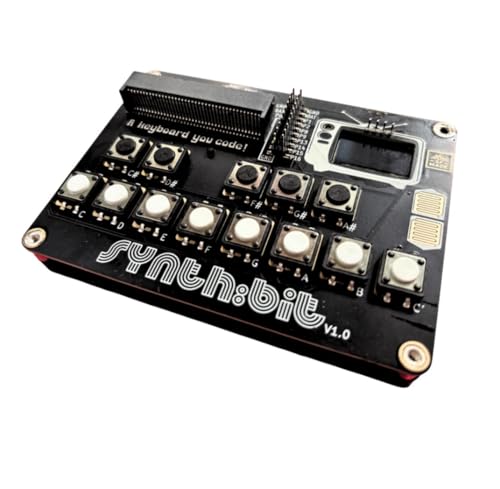
- 16-input keyboard module
- OLED display and battery-powered audio output
- Expandable with MakeCode, Python, and jumper pins
Best For: Beginners and bands creating custom electronic instruments
Best Portable Polyphonic Option

- Four-voice hybrid synthesis
- Vector morphing and analog low-pass filter
- Battery or USB powered with sequencer and arpeggiator
Best For: Small bands needing portable melodic and textural parts
Best Pocket Pick

- Cassette-sized monophonic synth
- Built-in speaker and line out
- Conductive-object keyboard experiments
Best For: Portable practice and creative beginner exploration
Best Compact Sound-Design Option

- Compact 9.21-inch-wide design
- Alloy-steel body
- MIDI connectivity
Best For: Space-conscious MIDI-based setups
Best Polyphonic Choice

- Three-voice analog polyphony
- 27 touch-sensitive keys
- 16-step sequencer and sync I/O
Best For: Compact chord parts and sequenced band arrangements
Best Acid Bass Pick – Donner Essential B1
For small bands that need a focused low-end part, the Donner Essential B1 is a practical choice among synthesizers for small bands. Its fully analog one-VCO design, intuitive step sequencer, and built-in saturation and delay are geared toward warm acid basslines and live pattern performance.
Best For: Bass players, electronic duos, and bands wanting hands-on acid sequences and portable pattern-based performance.
Pros:
- Fully analog signal path with a warm, lower-frequency-focused sound.
- 128 pattern memories plus Song Mode for chaining musical phrases.
- Haptic performance pads, an eight-mode arpeggiator, and onboard saturation and delay.
- USB-C, full-size MIDI I/O, and Sync I/O support hardware and DAW setups.
Cons:
- Its one-VCO architecture is focused on bass rather than broad multi-part synthesis.
- The product notes list a compact control layout but do not specify a built-in keyboard.
The Essential B1 makes the most sense when your small band needs a dedicated, easy-to-program bass voice rather than an all-purpose keyboard. Its pattern memory and live controls can help one performer add a consistent electronic foundation.
Best Experimental Learning Module – Synth:bit Micro:bit Synthesizer
The Synth:bit is a compact, beginner-oriented option among synthesizers for small bands, but it requires a Micro:bit that is not included. Its 16-input keyboard module, OLED display, battery pack, and programmable expansion features suit creative projects, educational setups, and simple experimental parts.
Best For: Beginners, educators, and small groups building custom electronic instruments or adding playful digital textures.
Pros:
- Provides a full-octave-style layout through 16 inputs in a 4×4 matrix.
- Built-in audio jack, battery pack, and OLED display support portable experimentation.
- LEGO-compatible construction and jumper pins allow external keypads and breadboard projects.
- Supports MakeCode, Python, online lessons, and sample code.
Cons:
- A Micro:bit is required and must be purchased separately.
- Its beginner and kid-oriented design may be less suitable for conventional band performance.
- The module is an expandable project platform rather than a complete standalone synthesizer.
Choose the Synth:bit when customization and learning matter more than traditional stage controls. It can bring distinctive home-built sounds to a small band, provided someone is comfortable supplying and programming the required Micro:bit.
Best Portable Polyphonic Option – Behringer Pro VS Mini
The Behringer Pro VS Mini is a strong fit for small bands seeking a compact sound module with more than a basic bass voice. Its hybrid design combines four vector-morphing oscillators per voice, an analog low-pass filter, a 16-step sequencer, and an arpeggiator in a battery- or USB-powered format.
Best For: Keyboardists and electronic performers who need portable melodic, textural, and sequenced parts.
Pros:
- Hybrid synthesis combines vector morphing oscillators with an analog low-pass filter.
- Four-voice operation supports richer parts than a strictly monophonic bass synth.
- Includes a 16-step sequencer, arpeggiator, envelopes, and wavetable synthesis.
- Compact body with battery or USB power and headphone output for portable use.
Cons:
- The supplied notes describe a portable module but do not identify a conventional full-size keyboard.
- Its 16-step sequencer is less pattern-oriented than the Donner’s listed 128-pattern memory.
For a small band, the Pro VS Mini offers a flexible middle ground between a bass box and a larger keyboard synth. Its four-voice hybrid engine and portable power options make it useful for adding chords, evolving tones, and rhythmic sequences without taking much space.
Best Pocket Pick – Synth-a-Sette
For musicians comparing synthesizers for small bands, the MicroKits Synth-a-Sette is an exceptionally compact option for melody lines, experimentation, and portable practice. Its 13-key monophonic touchpad, built-in speaker, line out, octave-up button, and optional vibrato keep the essentials within a cassette-sized enclosure.
Best For: Portable practice, beginner sound exploration, and adding a compact monophonic part to a small-band setup.
Pros:
- Very small, lightweight design with built-in speaker and battery operation.
- Includes line out, octave-up control, and optional vibrato.
- Alligator clips enable conductive-object experiments and custom touch keyboards.
Cons:
- Monophonic 13-key touchpad is more limited than a conventional keyboard.
- Its simplified design may not suit players seeking extensive controls or polyphony.
The Synth-a-Sette stands out when portability and creative learning matter more than a full-featured performance interface. It can work as a playful extra voice, though its monophonic touchpad favors simple parts and experimentation.
Best Compact Sound-Design Option – PHARA-O MINI
The Behringer PHARA-O MINI is a compact synthesizer to consider when a small band needs a space-saving instrument for sound design. Its alloy-steel body measures 9.21 by 6.1 by 2.56 inches, and its MIDI connector supports integration with compatible gear.
Best For: Small setups that prioritize compact sound-design hardware and MIDI connectivity.
Pros:
- Compact footprint for crowded rehearsal spaces or portable rigs.
- Alloy-steel body provides a solid-feeling construction.
- MIDI connector supports connection with compatible equipment.
Cons:
- The supplied notes do not specify polyphony, sequencing, or other performance controls.
- Its 0.65 kg weight is less pocketable than ultra-mini synth designs.
The PHARA-O MINI is a practical shortlist candidate for players who want a compact, metal-bodied synth with MIDI connectivity. Because the supplied specifications provide limited detail about its sound engine and controls, confirm those requirements before choosing it as a primary band instrument.
Best Polyphonic Choice – JT Mini
For synthesizers for small bands that need chords as well as lead parts, the Behringer JT Mini offers three-voice analog polyphony in a compact format. It combines 27 touch-sensitive keys with a state-variable filter, a 16-step sequencer, and 3.5mm sync input/output.
Best For: Small-band players who need compact chord capability, hands-on keys, and basic sequencing.
Pros:
- Three-voice analog polyphony supports simple chords and layered parts.
- 27 touch-sensitive keys offer more playing range than a tiny monophonic pad.
- Includes a state-variable VCF, 16-step sequencer, and 3.5mm sync I/O.
Cons:
- Three voices limit larger chords and dense arrangements.
- Its 8.3-inch width and 1.2-pound weight are compact but not the smallest available.
The JT Mini is the most performance-oriented option in this group for players who want chords, sequencing, and synchronization without a full-size keyboard. Its three-voice limit is worth keeping in mind, but the feature set is well suited to compact arrangements and live creative parts.
How We Picked the Best Synthesizers for Small Bands
We focused on compact synthesizers that can contribute a distinct musical role in a band rather than simply offering novelty sounds. Our comparison considers sound engines, available voices, hands-on controls, sequencing, portability, connectivity, and how easily each instrument can fit into a rehearsal or live setup.
Because small bands often share limited stage space and transport gear, we also considered footprint, power requirements, and whether a synth can provide useful sounds without extensive menu diving. The six selections cover several needs, including bass, pads, leads, experimental textures, and quick sketching.
Quick Comparison
| Type | Best Use | What to Look For |
|---|---|---|
| Analog bass synth | Driving bass lines and sequences | Filter control, pattern memory, effects |
| Hybrid digital synth | Versatile leads, chords, and textures | Voice count, oscillator variety, presets |
| Compact poly synth | Chords and layered parts | Polyphony, keyboard feel, sound shaping |
| Mini analog synth | Portable leads and sound design | Controls, outputs, power options |
| Experimental micro synth | Creative textures and DIY setups | Inputs, compatibility, portability |
Key Buying Factors for Synthesizers for Small Bands
Sound Role and Voice Count
Start by deciding what the instrument must add to your band. A monophonic bass synth can strengthen the low end, while a three- or five-voice instrument is more useful for chords, pads, and layered accompaniment. If the keyboard will cover several roles, prioritize flexible oscillators, filters, modulation, and effects.
Hands-On Control
For rehearsals and live performance, dedicated knobs and switches are often more valuable than deep menus. Look for accessible controls for cutoff, resonance, envelope shape, pitch, and modulation. Fast access makes it easier to react to a song’s arrangement or create transitions between sections.
Sequencing and Connectivity
A built-in sequencer can let one player create repeating bass lines or rhythmic patterns while concentrating on another instrument. Check pattern storage, step length, sync options, MIDI support, audio outputs, and headphone connectivity. Confirm that the connections match your mixer, interface, amplifier, or pedal setup.
Size, Power, and Reliability
Measure the available stand or tabletop space before buying. Battery operation can be useful for portable sessions, while USB or standard power supplies may be more convenient on stage. Also consider sturdy controls, clear displays, and whether the synth can be packed and unpacked quickly without losing settings.
Who Should Buy Which Synthesizers for Small Bands?
Choose a dedicated bass-focused model if your band needs tighter low-end movement and repeatable patterns. A hybrid five-voice synth is a stronger all-purpose choice for players who need broad sound variety in one compact instrument. A three-voice analog poly synth suits chordal parts and warm, immediate sound shaping.
For the smallest rigs, a mini synth is ideal when portability matters more than extensive controls. Creative experimenters may prefer a micro-format instrument with unusual inputs or building-system compatibility. Finally, a cassette-sized analog synth makes sense for musicians seeking simple, distinctive textures and an especially compact creative tool.