
Choosing the right DJ mixer for turntables can shape your entire setup, from vinyl playback and scratching to digital vinyl systems and home recording. The best option depends on your turntable connections, preferred mixing style, and need for features such as phono inputs, effects, USB, or Bluetooth.
We compared 10 mixers across entry-level, scratch, performance, and multi-channel categories to help you find a practical match for your gear and budget.
Best 10 Dj Mixer for Turntables Picks for 2026
Best Club-Style Starter

- Two-channel club-style workflow
- Includes rekordbox DVS unlock
- Magvel Fader and channel filters
Best For: Beginners building a home turntable setup
Best Budget Scratch Mixer

- Two phono/line switchable inputs
- Replaceable slope-adjustable crossfader
- Rack-mountable with mic input
Best For: Budget turntable practice and basic scratching
Best Effects and DVS Upgrade

- Beat FX and Sound Color FX
- Includes rekordbox DVS unlock
- Built-in USB sound card
Best For: Home DJs wanting effects and software integration
Best Full-Kill EQ Value
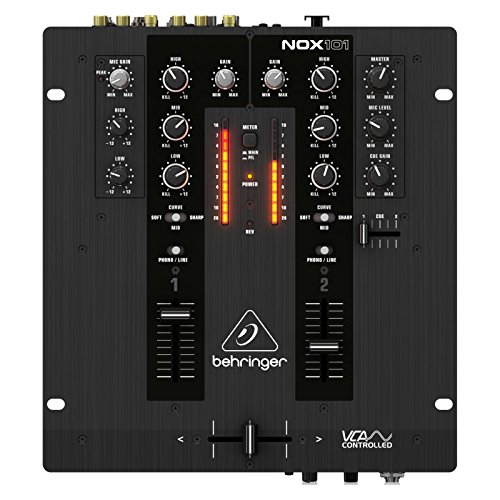
- Three-band full-kill EQ filters
- VCA control and Ultraglide crossfader
- RCA, TRS, and XLR connectivity
Best For: Simple two-channel setups needing flexible outputs
Compact USB Value
Rockville RDJ2 2-Channel Mixer
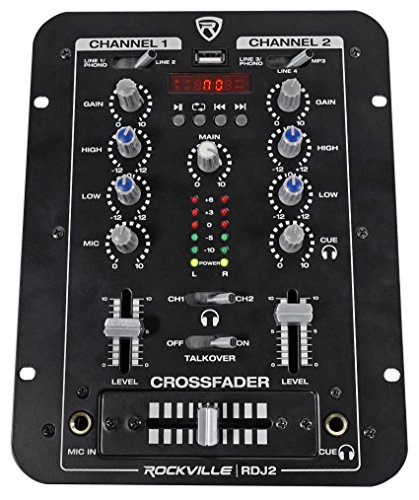
- Four RCA line inputs for flexible source connections
- Built-in USB MP3 player with LCD display
- Compact metal design with cue monitoring
Best For: Home DJs and mobile setups needing simple USB playback
Classic BPM Control
Behringer DX626 3-Channel DJ Mixer

- Three dual-input stereo channels
- Dual auto-BPM counter for beat-matching help
- Long-life Ultraglide crossfader
Best For: DJs wanting traditional multi-channel mixing controls
Scratch-Ready Bluetooth
Gemini MXR-01BT 2-Channel Mixer

- Bluetooth playback plus RCA audio input
- Adjustable, reversible crossfader curve
- Dedicated mic and headphone controls
Best For: Scratch practice and compact live setups with wireless playback
Effect-Focused Choice
Behringer DJX750 5-Channel DJ Mixer

- Five channels for flexible setups
- Auto-BPM counter with beat sync display
- Digital effects and VCA crossfader
Best For: DJs who prioritize effects and channel capacity
Turntable-Ready Value
Pyle PMX8BU 3-Channel DJ Mixer

- Built-in phono inputs for two turntables
- Bluetooth and USB/MP3 playback
- Dual mic controls with talkover
Best For: Portable DJ and karaoke setups
USB Recording Pick
Behringer DJX900USB 5-Channel Mixer
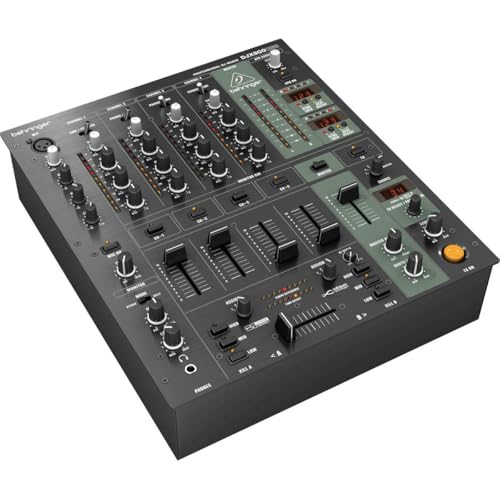
- USB interface for recording and playback
- Five channels with 24-bit effects
- Optical VCA crossfader with adjustable controls
Best For: DJs combining turntables with computer audio
Best Club-Style Starter – Pioneer DJM-250MK2
The Pioneer DJM-250MK2 is a practical dj mixer for turntables when you want to learn a club-style workflow without a complicated layout. Its two-channel design, dedicated filters, rekordbox DVS unlock, and smooth Magvel Fader suit home practice and separates-based setups.
Best For: Beginners building a home turntable setup and learning beatmatching or light scratching.
Pros:
- Two-channel club-style layout supports standard booth-style mixing.
- Includes a rekordbox DVS unlock for mixing digital files with turntables or media players.
- Dedicated Sound Color FX Filter on each channel provides hands-on control.
- Magvel Fader is designed for smooth blends and light scratching.
Cons:
- Two channels may limit more complex multi-source setups.
- Its straightforward feature set may feel basic to advanced DJs seeking a larger effects section.
The DJM-250MK2 keeps the learning curve manageable while adding useful DVS capability. It is a strong fit if you want a reliable, focused mixer for turntables and gradual skill building.
Best Budget Scratch Mixer – Numark M2
The Numark M2 is a versatile dj mixer for turntables with essential controls for practice, parties, and basic scratch work. It combines two phono/line switchable inputs, three-band EQs, a replaceable crossfader, and a microphone input in a portable, rack-mountable design.
Best For: Budget-conscious DJs who need flexible turntable connectivity and straightforward scratch controls.
Pros:
- Two phono/line switchable RCA inputs support turntables or line-level sources.
- Replaceable crossfader includes reverse and slope controls.
- Three-band EQs and crossfader-style cueing provide essential mix control.
- Rack-mountable, portable design includes a microphone input.
Cons:
- It does not list built-in effects or DVS functionality in the supplied details.
- RCA master output may be less suitable for setups requiring XLR output.
The M2 focuses on core mixing rather than software or effects. Its switchable phono inputs and replaceable crossfader make it a sensible entry-level choice for turntable practice and basic scratch techniques.
Best Effects and DVS Upgrade – Pioneer DJM-450
The Pioneer DJM-450 is a dj mixer for turntables aimed at users who want a compact club-style setup with more creative tools. It pairs Beat FX and Sound Color FX with rekordbox DVS, a built-in USB sound card, XLR output, and the durable Magvel Fader.
Best For: Home DJs who want turntable-based mixing with software integration and hands-on effects.
Pros:
- Club-oriented two-channel layout provides a familiar professional workflow.
- Beat FX and Sound Color FX add hands-on transition and performance options.
- Includes a rekordbox DVS unlock for digital-file control through turntables or media players.
- Built-in USB sound card supports recording sets and running software directly.
Cons:
- Two channels may not accommodate larger multi-deck configurations.
- The feature set may be more than needed for users seeking only basic analog mixing.
The DJM-450 is the more capable Pioneer option here for effects and computer-assisted workflows. Choose it when DVS, USB operation, and club-style controls matter as much as traditional turntable mixing.
Best Full-Kill EQ Value – Behringer NOX101
The Behringer NOX101 is a practical dj mixer for turntables when you want a two-channel analog-style control surface with flexible connections. Its three-band full-kill EQ filters, VCA control, Ultraglide crossfader, and RCA, TRS, and XLR connectivity cover essential mixing needs.
Best For: DJs seeking affordable two-channel mixing with full-kill EQ controls and broad output connectivity.
Pros:
- Three-band EQs include full-kill filters for stronger frequency cuts.
- Full VCA control and an Ultraglide crossfader support hands-on mixing.
- Offers RCA, TRS, and XLR connectivity for flexible system integration.
- Compact two-channel format keeps the setup straightforward.
Cons:
- The supplied details do not list DVS, USB audio, or built-in effects.
- Two channels may be restrictive for expanded performance setups.
The NOX101 concentrates on core control and connection flexibility instead of software features. It is worth considering for a simple two-turntable setup where full-kill EQ and multiple output formats are priorities.
Compact USB Value – Rockville RDJ2 2-Channel Mixer
The Rockville RDJ2 is a practical dj mixer for turntables when you want a compact, straightforward setup with RCA connectivity, hands-on EQ controls, and USB playback. Its two-channel layout supports turntables, CD players, and other line-level sources, while the cue monitor and crossfader help with transitions.
Best For: Home DJs, mobile setups, and beginners who want USB MP3 playback in a compact mixer.
Pros:
- Four RCA line inputs with selectable source switches.
- Separate gain, bass, and treble controls on each channel.
- Built-in USB MP3 player with LCD display.
- Compact metal housing with cue monitoring and a crossfader.
Cons:
- Only two channels are available.
- USB playback is provided, but the listed outputs and inputs are RCA-based.
The RDJ2 focuses on essential mixing controls rather than advanced effects or a larger channel count. Its small footprint and 3.1-pound weight make it easy to place in a home booth or carry to a small mobile setup.
Classic BPM Control – Behringer DX626 3-Channel DJ Mixer
Behringer Pro Mixer Dx626 Professional 3-Channel Dj Mixer With Bpm Counter, Black
Check Price On AmazonThe Behringer DX626 is a suitable dj mixer for turntables for DJs who value a traditional multi-channel layout, dedicated EQ shaping, and BPM assistance. Its three dual-input stereo channels provide room for multiple sources, while the crossfader and PFL monitoring support hands-on mixing.
Best For: DJs who want three-channel flexibility, auto-BPM counting, and a durable crossfader for routine mixing.
Pros:
- Three dual-input stereo channels for connecting multiple sources.
- Dual auto-BPM counter assists with beat-matching decisions.
- Three-band kill EQ offers substantial frequency cuts.
- Ultraglide crossfader is rated for up to 500,000 life cycles.
Cons:
- The supplied information lists RCA audio input and output connections rather than dedicated digital inputs.
- Its larger 14.9-inch depth may require more booth space.
The DX626 is built around conventional DJ workflow: select sources, monitor through PFL, shape the channels with EQ, and use the crossfader for transitions. It is a better fit for a roomier setup than a compact travel rig.
Scratch-Ready Bluetooth – Gemini MXR-01BT 2-Channel Mixer
The Gemini MXR-01BT combines turntable-friendly RCA connections with Bluetooth streaming, making it a flexible dj mixer for turntables and casual digital sources. Its adjustable crossfader curve, reverse switch, dedicated microphone controls, and headphone level give scratch-focused and live DJs useful hands-on control.
Best For: Bedroom DJs, mobile performers, and scratch practice setups that need Bluetooth and mic control.
Pros:
- Bluetooth connectivity supports wireless playback from compatible devices.
- Adjustable crossfader curve and reverse switch suit scratching and transitions.
- Dedicated microphone volume and EQ controls.
- All-metal chassis with RCA and balanced outputs.
Cons:
- It has two channels rather than a larger multi-channel layout.
- Bluetooth adds convenience, but turntable connections still use RCA audio input.
- Its 2.46 kg weight is less lightweight than some compact mixers.
The MXR-01BT stands out when wireless playback and crossfader customization matter as much as basic source mixing. Its small 6-by-11-inch footprint is booth-friendly, while the mic and headphone controls help with live use.
Effect-Focused Choice – Behringer DJX750 5-Channel DJ Mixer
The Behringer PRO MIXER DJX750 is a practical dj mixer for turntables when you need five channels, built-in digital effects, and BPM assistance. Its RCA and USB audio inputs, XLR output, and VCA-controlled crossfader support a flexible booth or event setup.
Best For: DJs who want multiple channels, BPM tracking, and adjustable effects for creative mixing.
Pros:
- Five-channel layout supports larger, more flexible setups.
- Dual auto-BPM counter includes time and beat sync display.
- Includes advanced digital effects and an adjustable XPQ stereo surround effect.
- VCA-controlled crossfader is designed for smooth, reliable performance.
Cons:
- It is a relatively large, 11.9-pound mixer for portable setups.
- The supplied specifications do not confirm a dedicated phono preamp.
Choose the DJX750 if effects and channel capacity matter more than minimizing size. Confirm your turntable signal requirements before purchase, particularly if your decks need built-in phono amplification.
Turntable-Ready Value – Pyle PMX8BU 3-Channel DJ Mixer
The Pyle PMX8BU is a compact dj mixer for turntables with built-in phono inputs on channels 1 and 2, so compatible turntables can connect directly without an external preamp. Bluetooth, USB/MP3 playback, cue monitoring, and dual mic controls make it versatile for mobile DJ and karaoke use.
Best For: Mobile DJs, karaoke hosts, and beginners who need direct turntable connections plus wireless and microphone features.
Pros:
- Built-in phono preamps support direct connection of turntables on channels 1 and 2.
- Bluetooth, USB/MP3 playback, and 3.5mm AUX expand source options.
- Dual balanced mic inputs include independent gain and talkover controls.
- Cue headphone monitoring allows channel pre-listening before the master output.
Cons:
- Three channels provide less expansion than the five-channel Behringer models.
- The 3.5mm headphone output may be less convenient for some DJ headphones.
The PMX8BU stands out when straightforward turntable connectivity and event-friendly features are the priority. Its lighter, 2-pound design is also well suited to portable rigs, though advanced DJs may want more channels.
USB Recording Pick – Behringer DJX900USB 5-Channel Mixer
The Behringer PRO MIXER DJX900USB is a dj mixer for turntables and digital sources when USB recording and playback are important. It combines five channels, 24-bit digital effects, an auto-BPM counter, and a contact-free optical VCA crossfader with adjustable tension and fader curve.
Best For: DJs who want a five-channel mixer with USB computer connectivity and a durable-feeling crossfader design.
Pros:
- Built-in USB interface supports recording and playback with a PC or Mac.
- Five channels provide room for multiple sources.
- 24-bit digital effects offer advanced parameter control.
- INFINIUM optical VCA crossfader has adjustable tension and fader curve.
Cons:
- The supplied notes do not specify dedicated phono inputs or a phono preamp.
- USB connectivity is listed, but the supplied specifications do not detail all analog input options.
The DJX900USB is the strongest fit here for computer-based recording and playback alongside a traditional multi-channel workflow. Verify the mixer’s turntable signal compatibility if your decks output phono-level audio.
How We Picked the Best Dj Mixer for Turntables
We focused on features that matter in real turntable setups: dedicated phono inputs, channel count, crossfader feel, cue monitoring, connectivity, effects, and overall usability. We also considered whether each mixer suits vinyl mixing, scratching, DVS, beginner practice, mobile performance, or larger multi-source rigs.
Because these models cover a wide price and feature range, the list includes both straightforward two-channel mixers and more advanced units with USB connectivity, digital effects, BPM tools, or additional microphone and line inputs.
Quick Comparison
| Best For | What to Look For |
|---|---|
| Basic vinyl mixing | Two phono channels, reliable EQ, cue controls, and a clear layout |
| Scratching | Adjustable crossfader curve, sharp cut-in, and durable fader construction |
| DVS setups | Computer integration, compatible software support, and suitable audio interfaces |
| More sources | Three or five channels for multiple turntables, media players, or instruments |
| Home and mobile use | USB, Bluetooth, talkover, microphone inputs, and flexible output options |
Key Buying Factors for a Dj Mixer for Turntables
Phono Inputs and Grounding
Turntables with moving-magnet cartridges generally need phono inputs because their signal is quieter and requires preamplification. Check the rear-panel layout and confirm that the mixer provides enough phono channels for your decks. Traditional turntables may also need ground wires connected to reduce hum.
Channel Count
A two-channel mixer is usually sufficient for two turntables and straightforward transitions. Choose three or five channels if you expect to add a media player, sampler, microphone, drum machine, or additional deck. Extra channels provide flexibility but can make the mixer larger and more complex.
Crossfader and EQ Controls
For scratching, prioritize a responsive crossfader with an adjustable curve and a layout that keeps controls within easy reach. For long blends, smooth channel faders and effective three-band EQ are more important. Consider replacement-fader availability if you perform frequently.
USB, DVS, Effects, and Wireless Features
USB can simplify recording or computer-based playback, while DVS compatibility depends on the mixer, audio interface, software, and licensing—not simply the presence of a USB port. Built-in effects are useful for performance, but they should not replace solid fundamentals such as clean phono preamps and dependable cue monitoring. Bluetooth is convenient for casual playback, though it is usually less central to traditional turntable mixing.
Who Should Buy Which Dj Mixer for Turntables?
Beginners: Start with a simple two-channel model that has phono inputs, clear controls, and a usable headphone cue section. Avoid paying for advanced effects you may not use.
Scratch DJs: Choose a mixer with a responsive, adjustable crossfader and durable construction. A compact two-channel layout is often easier to work with.
Vinyl-focused DJs: Prioritize clean phono stages, dependable EQ, solid gain controls, and a practical layout over wireless extras.
DVS and hybrid performers: Look for verified software and interface compatibility, USB connectivity where appropriate, and enough channels for both turntables and digital sources.
Mobile or small-event DJs: Additional microphone inputs, talkover, USB playback, Bluetooth, and flexible outputs can be more valuable than specialized scratch features.
Before buying, confirm the mixer’s exact phono, line, USB, and output connections against your existing equipment. A well-matched two-channel mixer is often better than a feature-heavy model that does not fit your turntables or workflow.