
A reliable KVM extender can place your laptop or connected computer in one location while sending video, keyboard, and mouse signals to a more convenient workstation. The right model helps reduce cable clutter, extend control across a room, and support everything from home offices to control rooms.
Our 2026 roundup covers 4K and 1080p HDMI units, Ethernet-based designs, long-range options, USB peripheral extension, and features such as loop-out, audio, IR, and multi-screen support. Use the guide below to narrow the choices by distance, resolution, connectivity, and setup requirements.
Best 10 Kvm Extenders for Laptops Picks for 2026
Best Long-Range 4K Control

- 4K@30Hz HDMI over up to 230 feet
- USB keyboard and mouse extension
- HDMI loop-out and PoC power
Best For: Long-distance workstation and control-room setups
Best for Networked Video Walls
TESmart 1080p HDMI KVM Extender

- Up to 393 feet over Cat5/6/7
- Supports up to 32 TX and 32 RX units
- Single- or four-screen video-wall modes
Best For: Scalable control-room and monitoring installations
Best 4K60 Installer Pick
- 4K@60Hz with 4:4:4 color
- 230-foot HDMI and USB extension
- Compact chassis with mounting brackets
Best For: Fixed professional 4K installations
Best for HDR and Audio Flexibility
- 4K@60Hz up to 230 feet
- Supports HDR10+, Dolby Vision, and HLG
- Receiver-side 3.5mm audio output
Best For: Flexible laptop, projector, and home-AV setups
Best for IP-Network Integration

- 4K@30Hz video up to 390 feet
- KVM control over existing Ethernet networks
- Supports up to 16 paired extender sets
Best For: Server rooms, control centers, and distributed workstations
Best for Flexible AV Control
4K HDMI KVM Extender with Loop Out

- 4K@30Hz transmission up to 393 feet
- Local HDMI loop out for dual-view setups
- Adds audio extraction and IR remote control
Best For: Conference rooms, classrooms, and home theaters
Best for Simple 1080p Setups

- 1080p@60Hz transmission up to 164 feet
- Remote keyboard-and-mouse control via USB
- Local HDMI loop out with one-adapter POC power
Best For: Classrooms, conference rooms, and home gaming setups
Long-Range VGA Pick
TESmart 984ft USB VGA KVM Extender

- VGA support up to 1920×1200 at 60Hz
- Transmits video, keyboard, and mouse over CAT5e/6
- Rated for runs up to 984 feet
Best For: Long-distance VGA laptop and computer installations
4K Office Choice

- 1080p at 60Hz up to 230 feet
- 4K at 30Hz up to 130 feet
- Receiver includes two USB Type-A ports
Best For: Remote HDMI workstations and office displays
Flexible Full HD Pick

- 1080p at 60Hz up to 164 feet
- Supports Cat5e, Cat6, and Cat7 cable
- Dual USB 2.0 ports for keyboard and mouse
Best For: Full HD home, gaming, and media setups
Best Long-Range 4K Control – AV Access 4K KVM Extender
For buyers comparing kvm extenders for laptops, this AV Access model combines 4K video, USB keyboard-and-mouse control, and 230-foot transmission over Cat6/6A/7 cable. Its HDMI loop-out and EDID controls also suit setups that need local monitoring alongside a remote display.
Best For: Mission-critical workstations, control rooms, classrooms, and security monitoring systems needing long-distance 4K KVM control.
Pros:
- Extends HDMI and USB signals up to 230 feet with zero-latency operation.
- Supports 4K at 30Hz with 4:4:4 color and HDCP 1.4.
- Includes HDMI loop-out, multichannel audio support, and EDID management.
- PoC allows both units to run from one power adapter.
Cons:
- Video output is limited to 4K at 30Hz rather than 60Hz.
- USB extension is specified as USB 1.1 for keyboard and mouse use.
This is a practical choice when reach and responsive remote control matter more than high-refresh 4K. The plug-and-play design and broad Windows, macOS, and Linux compatibility simplify deployment.
Best for Networked Video Walls – TESmart 1080p HDMI KVM Extender
This TESmart unit stands out among kvm extenders for laptops when a single point-to-point link is not enough. It sends 1080p video and USB control up to 393 feet over Cat5/6/7 and supports routed point-to-multipoint configurations for larger installations.
Best For: Control rooms, security centers, monitoring systems, and AV deployments using multiple transmitters, receivers, or video-wall screens.
Pros:
- Supports 1080p at 60Hz over distances up to 393 feet.
- Offers point-to-point through multipoint-to-multipoint network configurations.
- Supports up to 32 transmitters and 32 receivers.
- Includes single-screen and four-screen video-wall modes plus receiver audio output.
Cons:
- Maximum resolution is 1080p rather than 4K.
- Both the transmitter and receiver require power adapters.
Choose this model for scalable distribution and long reach rather than maximum image resolution. Its network-oriented design is especially useful where several displays or sources must be managed centrally.
Best 4K60 Installer Pick – AV Access 4K60 KVM Extender
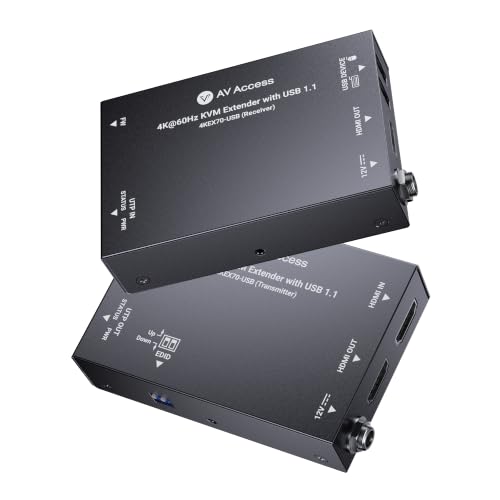
For laptop users who want smoother 4K output, this AV Access extender sends 4K at 60Hz plus USB keyboard-and-mouse signals up to 230 feet over Cat6/6A/7. Its compact chassis, mounting brackets, and single-adapter PoC design make it convenient for fixed installations.
Best For: Classrooms, kiosks, industrial PCs, security stations, conference rooms, and media desks requiring smooth 4K video.
Pros:
- Supports 4K at 60Hz with 4:4:4 color and HDCP 2.3.
- Extends HDMI and USB control up to 230 feet over one network cable.
- Passes Dolby Atmos, DTS:X, and PCM 7.1 audio formats.
- Compact design, mounting brackets, and bidirectional PoC simplify installation.
Cons:
- USB extension is specified for USB 1.1 keyboard and mouse signals.
- The package includes one power adapter, so placement should account for the PoC arrangement.
This is the stronger AV Access option when 4K60 smoothness is important. It offers the same long-distance KVM concept as a 4K30 extender while adding modern HDCP support and installer-friendly hardware.
Best for HDR and Audio Flexibility – OREI 4K HDMI KVM Extender
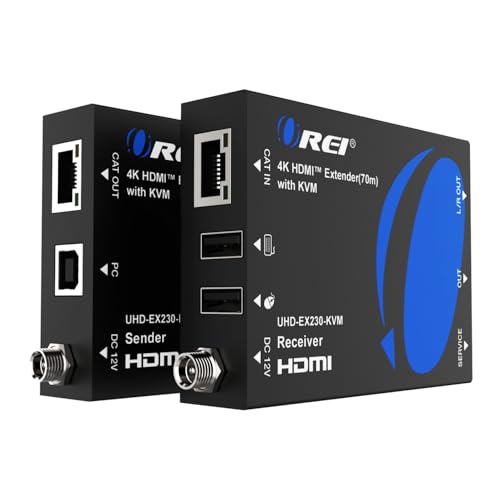
This OREI model is a versatile option among kvm extenders for laptops, providing 4K60 HDMI and remote USB keyboard-and-mouse control across up to 230 feet of Cat6/7 cable. HDR format support, HDMI loop-out, EDID pass-through, and analog audio extraction add flexibility for mixed AV setups.
Best For: Laptop, projector, television, gaming, and presentation systems that need 4K60 video, HDR compatibility, and receiver-side audio output.
Pros:
- Supports 4K at 60Hz over up to 230 feet with low-latency transmission.
- Compatible with HDR, HDR10, HDR10+, Dolby Vision, and HLG.
- Provides USB KVM control, HDMI loop-out, and EDID pass-through.
- Includes a 3.5mm stereo audio output at the receiver.
Cons:
- Only one power adapter is listed in the package contents.
- Its USB KVM extension is specified as USB 1.1.
Consider the OREI when display compatibility and audio routing are as important as distance. Its broad HDR support and receiver-side analog output make it particularly adaptable for presentation and home-AV environments.
Best for IP-Network Integration – 4K HDMI USB KVM Extender
For buyers comparing kvm extenders for laptops, this AV Access model is a strong fit when long-distance 4K video, USB control, and existing network infrastructure matter. It sends HDMI, audio, and USB signals up to 390 feet over compatible Cat5e-or-better cabling and works without additional drivers.
Best For: Remote workstations, server rooms, control centers, and distributed offices that need KVM control over an Ethernet network.
Pros:
- Supports 4K at 30Hz and 1080p at 120Hz over distances up to 390 feet.
- Uses existing IP network infrastructure and supports keyboard, mouse, and other USB peripherals.
- Works with Windows, macOS, and Linux without driver installation.
- Supports up to 16 extender sets through its 4-pin DIP-switch pairing system.
Cons:
- Requires compatible Ethernet cabling and, for networked installations, a Gigabit switch.
- 4K operation is limited to 30Hz.
- The feature set may be more than needed for a short, simple laptop-to-monitor connection.
This is the most installation-oriented option in the group. Its IP-network support, long range, multi-set pairing, and rack-friendly construction make it suitable for scalable professional deployments rather than basic desk setups.
Best for Flexible AV Control – 4K HDMI KVM Extender with Loop Out
This HDMI KVM extender suits laptop and PC users who want remote keyboard-and-mouse control while retaining local video monitoring. It extends 4K HDMI up to 393 feet over Cat6-or-better cabling and adds audio extraction, IR control, and a transmitter-side HDMI loop out.
Best For: Conference rooms, classrooms, home theaters, surveillance systems, and setups that need both local and remote displays.
Pros:
- Extends HDMI signals up to 393 feet and supports resolutions up to 4K at 30Hz.
- HDMI loop out allows a local monitor to operate alongside the remote display.
- Remote KVM control supports keyboard and mouse operation from the receiver side.
- Provides independent 3.5mm audio outputs at both the transmitter and receiver.
Cons:
- 4K refresh rate is limited to 30Hz.
- Requires separate Cat6, Cat6a, or Cat7 cabling for the advertised range.
- Its IR, audio, and loop-out features may be unnecessary for a straightforward remote-monitor setup.
The loop out is the key advantage here: you can keep a local view of the source while sending video and USB control across the room. It is a versatile choice when remote access and flexible AV routing are both priorities.
Best for Simple 1080p Setups – 164ft HDMI KVM Extender
For a shorter-distance laptop or PC installation, this 1080p HDMI KVM extender keeps the setup relatively simple. It sends HDMI video and USB keyboard-and-mouse signals up to 164 feet over one Cat5e/6/7 cable, with a transmitter-side loop out and power over the cable.
Best For: Classrooms, conference rooms, gaming areas, home theaters, and other single-computer setups within a 164-foot range.
Pros:
- Supports 1080p at 60Hz with stated zero latency and synchronized audio and video.
- Extends HDMI and USB KVM signals up to 164 feet over one network cable.
- Two USB 2.0 ports on the receiver support remote keyboard and mouse control.
- POC design uses one power adapter at the transmitter, and no drivers are required.
Cons:
- Resolution is limited to 1080p at 60Hz rather than 4K.
- The supplied notes specify support for one personal computer.
- The transmitter must connect to the PC with the included USB-B cable for proper operation.
This model is a practical value-oriented option when 1080p is sufficient and the source and display are within 164 feet. Its local loop out and single-adapter power design add convenience without requiring the longer reach or network scalability of the other options.
Long-Range VGA Pick – TESmart 984ft USB VGA KVM Extender
For buyers seeking kvm extenders for laptops with VGA output, this TESmart model focuses on exceptionally long cable runs. It sends VGA video plus keyboard and mouse data over a single CAT5e or CAT6 cable, reaching up to 984 feet when installed according to the stated cable standard.
Best For: Remote control of a VGA-equipped laptop or computer across a large building, office, classroom, or control area.
Pros:
- Supports up to 1920×1200 at 60Hz.
- Transmits keyboard and mouse data for remote PC control.
- Includes 8KV ESD protection and smart gain control.
- Backed by a one-year hardware warranty and lifetime technical support.
Cons:
- Uses VGA rather than HDMI.
- Requires a properly wired CAT5e or CAT6 cable following EIA/TIA 568B.
- Its long-distance capability may be unnecessary for smaller setups.
This is a specialized choice for legacy VGA systems where distance matters most. Confirm that your laptop or source device has compatible VGA and USB connections before buying.
4K Office Choice – SIIG HDMI USB KVM Extender
This SIIG unit is a practical option among kvm extenders for laptops when you need HDMI video and remote USB control. It carries HDMI and USB signals over Cat6, offering 1080p at 60Hz up to 230 feet and 4K at 30Hz over shorter distances.
Best For: Office, classroom, and workstation setups that need remote HDMI viewing with keyboard-and-mouse access.
Pros:
- Extends HDMI and USB over Cat6 with zero latency.
- Supports 1080p at 60Hz up to 230 feet.
- Supports 4K at 30Hz up to 130 feet.
- Two USB Type-A ports are provided on the receiver.
Cons:
- 4K transmission is limited to 30Hz and a shorter distance.
- Requires a laptop or source with HDMI output and USB connectivity.
- Designed specifically around Cat6 cabling.
With plug-and-play setup, automatic cable parameter adjustment, and a metal housing for heat dissipation, this is a well-rounded choice for a remote display and input station. Choose it when HDMI compatibility and 4K support matter more than maximum range.
Flexible Full HD Pick – 164ft HDMI USB KVM Extender
For straightforward home-office, gaming, or media setups, this HDMI model is one of the more flexible kvm extenders for laptops. It sends 1080p video, keyboard, and mouse signals up to 164 feet over Cat5e, Cat6, or Cat7 cable, with USB 2.0 ports for remote control.
Best For: Full HD laptop, gaming, streaming, and home-theater setups where simple installation and broad cable compatibility are priorities.
Pros:
- Supports 1080p at 60Hz with zero-latency video transmission.
- Works over Cat5e, Cat6, or Cat7 Ethernet cable.
- Includes dual USB 2.0 ports for remote keyboard and mouse control.
- Supports Windows, macOS, and Linux.
Cons:
- Maximum supported resolution is 1080p at 60Hz.
- Long Cat5e/Cat6 runs may require transmitter-only or dual power for reliable operation.
- Wired or 2.4GHz peripherals are recommended instead of 5.8GHz wireless devices.
This extender offers useful compatibility for everyday Full HD systems and includes a USB cable to help with setup. Pay close attention to the power guidance for longer runs, especially when using Cat6 toward the stated maximum distance.
How We Picked the Best Kvm Extenders for Laptops
We compared these Kvm Extenders for Laptops by examining video resolution and refresh-rate support, stated transmission distance, cable compatibility, USB peripheral extension, and installation flexibility. We also considered practical extras such as HDMI loop-out, audio connections, IR support, power-over-cable designs, HDCP compatibility, and whether a product uses a direct point-to-point connection or an IP-based network architecture.
Specifications can vary by source device, cable quality, and installation environment. Treat maximum distance figures as best-case ratings and verify the manufacturer’s requirements before purchasing.
Quick Comparison
| Best For | What to Prioritize | Typical Choice |
|---|---|---|
| 4K office or media workstation | 4K resolution, 60Hz support, HDR, HDCP compatibility | 4K HDMI and USB extender |
| Long cable runs | Stated distance, Cat6 or better cabling, stable power | Long-range Ethernet or IP model |
| Basic remote control | 1080p at 60Hz, USB keyboard and mouse extension | 1080p HDMI KVM extender |
| Multi-display or networked systems | IP support, screen-count compatibility, network design | IP-based KVM extender |
Key Buying Factors for Kvm Extenders for Laptops
Resolution and Refresh Rate
Choose a 4K model if your laptop, monitor, or application requires detailed text, high-resolution media, or a modern desktop workflow. Confirm whether 4K is available at 60Hz; some units support 4K only at lower refresh rates. For office documents, remote administration, and surveillance, 1080p at 60Hz may be sufficient and often supports longer distances.
Distance and Cabling
Most products here use Cat5e, Cat6, Cat6A, or Cat7 cable rather than standard HDMI cable for the long run. Cat6 or better is a sensible choice for demanding 4K links. Measure the complete route, including slack and wall routing, and leave margin below the advertised maximum. IP models may reach farther but can introduce network configuration requirements.
USB, Audio, and Signal Features
Check the number and type of USB ports if you need a keyboard, mouse, touch device, storage, or other peripherals. HDMI loop-out is useful when the local display must remain active. Audio ports, IR control, HDR, and HDCP support matter when extending media equipment, displays, or protected content.
Installation and Compatibility
Confirm the transmitter and receiver power requirements, connector layout, included adapters, and operating-system compatibility. A direct extender is generally simpler for one source and one remote display. Choose an IP-based model when you need network distribution or multiple endpoints, but plan for switches, bandwidth, and network isolation where appropriate.
Who Should Buy Which Kvm Extenders for Laptops?
Choose a 4K60 model for a high-resolution desk, editing setup, or detailed productivity work. A 4K30 option can be a practical compromise when image quality matters more than smooth motion. Select a 1080p unit for routine remote access, conference-room control, or budget-conscious installations. For the longest runs, prioritize a purpose-built long-range model and high-quality cabling. Buyers needing multiple displays or flexible routing should consider an IP-based extender, while anyone wanting a simpler installation should choose a direct HDMI-over-Cat connection.