
Choosing the right bench power supply for computer repair can make troubleshooting faster, safer, and far less frustrating. The best units give you clean, adjustable power for motherboard diagnostics, component testing, and bench experimentation.
In this roundup, we focus on models that balance precision, protection, and everyday usability so you can match the supply to the kind of repair work you do most.
Best 10 Bench Power Supply for Computer Repair Picks for 2026
Precision Bench PSU

- 4-digit LED readout for V/A/W
- Auto CV/CC switching
- Compact with multiple safety protections
Best For: Compact repair benches needing precise adjustable DC output
High-Current DC Converter

- Fixed 13.8V regulated output
- 30A capacity for heavier loads
- Screw terminals with cooling fan and protection
Best For: Fixed-voltage powering and testing where high current matters
Encoder-Control Bench PSU

- Encoder knob for precise adjustment
- Output enable/disable button
- 4-digit display with OCP and USB fast charge
Best For: Careful repair work that needs precise control and safe output switching
Compact Repair Bench PSU
SKY TOPPOWER PS305H 0-30V 0-5A

- Backlit 4-digit display
- Coarse/fine adjustment with CV/CC
- Broad protection suite for repair work
Best For: Small benches and moderate-current electronics troubleshooting
Precision Linear Control
X-Tronic PX-70 30V 5A Bench Supply

- 30V 5A linear output with precise coarse/fine tuning
- Output on/off, lock/unlock, and 3 memory presets
- Includes leads, work mat, and illustrated instructions
Best For: Computer repair technicians who want precise control and included accessories
Versatile Lab Pick
UNI-T UTP1306 32V 6A Bench Supply

- 0-32V and 0-6A output with 10 mV / 1 mA resolution
- 4-digit display with one-key recall for 3 stored profiles
- Quiet, single-output design with an independent switch
Best For: Repair benches that need a straightforward programmable supply
Compact High-Current Option
Kungber 30V 10A Compact Bench Supply

- 30V 10A output with up to 300W maximum power
- Intelligent charging mode with full-charge cutoff
- OCP alarm plus thermal, overload, and short-circuit protection
Best For: Technicians who want compact size and higher current for repair and charging
Programmable Precision Pick
OWON SPS3051 0-30V 0-5A Bench Supply
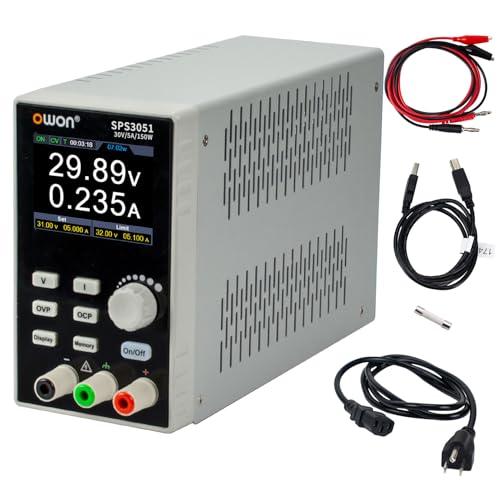
- 0-30V, 0-5A output with 10mV/1mA accuracy
- Waveform monitoring with 1-minute recording
- USB SCPI control and fanless quiet design
Best For: Repair techs who want programmable control and waveform monitoring
High-Current Repair Choice
WANPTEK TPS-C3010 30V 10A Bench Supply

- 0-30V, 0-10A output for more repair headroom
- 3 memory presets plus digit-by-digit encoder control
- Output switch, OCP, and key lock for safer use
Best For: Repair benches that need 10A output and quick preset recall
Simple Safe Value
NICE-POWER 30V 10A Bench Supply

- 4-digit LED shows V/A/W in real time
- Output switch plus multiple safety protections
- Built-in 5V/2A USB charging port
Best For: Anyone wanting a clear, protected bench supply for routine repair work
Precision Bench PSU – Jesverty SPS-3010 0-30V 0-10A
If you want a bench power supply for computer repair that can handle voltage-sensitive testing without taking up much desk space, the Jesverty SPS-3010 is a practical option. Its 4-digit display shows real-time voltage, current, and power, while the coarse and fine controls make it easier to dial in the output you need for troubleshooting and component checks.
Best For: Repair benches that need compact, adjustable DC power with clear readouts.
Pros:
- 4-digit LED display shows V, A, and W in real time.
- Auto switches between constant-voltage and constant-current modes.
- Compact, lightweight design fits small workspaces.
- Includes short-circuit, overload, grounding, and thermal fan protection.
Cons:
- Included test leads are described as a giveaway, not heavy-duty leads for long-term high-current use.
- May be more bench PSU than many computer repair jobs strictly require.
For general diagnostic work and controlled power-up testing, this model offers the core features most computer repair users look for: adjustable output, clear feedback, and built-in protection. The compact footprint is another plus if your bench is already crowded.
High-Current DC Converter – Pyle PSV300 13.8V 30A
For a bench power supply for computer repair that emphasizes simple fixed-output DC delivery, the Pyle PSV300 is aimed at straightforward powering and testing tasks. It converts AC to regulated 13.8V DC with screw-type terminals, so it can be useful when you want a stable source for accessories, components, or equipment that runs on that voltage.
Best For: Users who need a fixed 13.8V DC supply with higher current capability.
Pros:
- Regulated AC-to-DC converter with 13.8V DC output.
- Up to 30A current rating for demanding loads.
- Screw-type terminals support hardwired connections.
- Includes overload and short-circuit protection plus a cooling fan.
Cons:
- Fixed-output design is less flexible than a variable bench PSU.
- More suited to a constant DC source than precision voltage tuning.
If your workflow centers on powering equipment rather than sweeping through adjustable voltage ranges, this unit offers a simple and rugged setup. The tradeoff is flexibility, but the high current rating and protection features make it a solid utility choice.
Encoder-Control Bench PSU – NANKADF 30V 10A Black
This bench power supply for computer repair is built around precise control, with an encoder knob that lets you select digits and adjust values more accurately than a standard dial. The output enable/disable button is especially handy on a repair bench, since it helps prevent accidental power delivery while you set up or disconnect devices.
Best For: Repair work that benefits from precise setting control and quick output shutoff.
Pros:
- Encoder knob allows digit-by-digit voltage and current adjustment.
- Output enable/disable button helps prevent accidental output.
- 4-digit LED display shows voltage and current with CV/CC modes.
- Includes overcurrent protection, buzzer alert, and an 18W USB fast-charging port.
Cons:
- Rated for 115V input only, which may limit compatibility by region.
- More control-oriented than simpler plug-and-play supplies.
For troubleshooting tasks where repeatable settings and safe output control matter, this model stands out. The added USB charging port is a useful extra for keeping phones or repair devices powered while you work.
Compact Repair Bench PSU – SKY TOPPOWER PS305H 0-30V 0-5A
If you need a bench power supply for computer repair that is compact but still offers the basics for diagnostics, the SKY TOPPOWER PS305H is worth a look. It provides adjustable 0-30V, 0-5A output with a bright 4-digit display, and its CV/CC auto-conversion makes it easier to test circuits and components under changing load conditions.
Best For: Smaller repair benches and electronics troubleshooting with moderate current needs.
Pros:
- Accurate 4-digit display with backlight for low-light use.
- Coarse and fine knobs allow precise adjustment.
- Automatic CV/CC switching supports different loads.
- Includes safety features like leakage, thermal, overload, short-circuit, and reverse protection.
Cons:
- 5A output is lower than higher-current bench supplies.
- May be better for testing and repair than for heavy power-hungry loads.
This unit makes sense when space is limited and your repair tasks focus on phones, computers, components, and similar electronics. The protection set is broad, which adds confidence during everyday troubleshooting and teaching use.
Precision Linear Control – X-Tronic PX-70 30V 5A Bench Supply
If you want a bench power supply for computer repair with fine control and strong protection features, the X-Tronic PX-70 is built for careful troubleshooting. Its linear design, output on/off control, memory presets, and lock/unlock functions make it easier to work on sensitive boards without constantly redoing settings.
Best For: Computer repair technicians who want a feature-rich linear supply with precise adjustments and included test leads.
Pros:
- 30V 5A range with coarse and fine adjustment down to 0.01V and 0.001A
- Output on/off, lock/unlock, 3 memory presets, and adjustable USB output
- Includes multiple lead sets, magnetic work mat, and illustrated instructions
- Built-in protections include overcurrent, OTP, OPP, and a 5V limit switch
Cons:
- 110/120V, 60 Hz only; no 220V version available
- More feature-heavy than a basic repair bench supply
This is a strong choice if you value control, included accessories, and protection modes over simplicity. For bench troubleshooting where precision matters, the PX-70 is especially practical.
Versatile Lab Pick – UNI-T UTP1306 32V 6A Bench Supply
The UNI-T UTP1306 is a practical bench power supply for computer repair when you need a quiet, easy-to-use variable source with clear readout and stored settings. It offers a 32V 6A range, one-key recall for three saved profiles, and an independent output switch for faster bench workflows.
Best For: Repair benches that need a straightforward programmable supply with a readable display and memory recall.
Pros:
- Wide 0-32V, 0-6A output with 10 mV / 1 mA resolution
- 4-digit EBTN LCD display that is easy to view from any angle
- Three groups of one-key recall for stored voltage/current data
- Independent output switch and low-noise operation
Cons:
- Single output only
- Output cables and adapter are included, but it is less compactly accessorized than some kits
For computer repair shops that want a dependable bench unit with simple recall functions and a clean display, the UTP1306 fits well. It emphasizes usability and versatility more than extra accessory bundles.
Compact High-Current Option – Kungber 30V 10A Compact Bench Supply
The Kungber 30V 10A model is a compact bench power supply for computer repair when you want more current headroom in a smaller desktop unit. It adds intelligent charging mode, overcurrent detection, and multiple safety protections, which can be useful for repair workflows that involve batteries and power testing.
Best For: Technicians who want a compact high-current supply with charging features and strong protection behavior.
Pros:
- 30V 10A output with up to 300W maximum power
- Intelligent charging mode with charging power display and full-charge cutoff
- OCP short-circuit detection and alarm for safer testing
- Includes USB 18W output plus thermal, overload, leakage, and grounding protections
Cons:
- Plastic enclosure may be less rugged than metal-bodied alternatives
- Smaller size means fewer built-in extras than accessory-heavy kits
If your bench work includes battery charging, device testing, and general repair tasks, this Kungber unit gives you a lot of output capability in a compact frame. It is a good fit when safety features and higher current matter more than a large bench footprint.
Programmable Precision Pick – OWON SPS3051 0-30V 0-5A Bench Supply
If you want a bench power supply for computer repair that is quiet, precise, and easy to monitor, the OWON SPS3051 brings several features that help with troubleshooting and device testing. Its 0-30V, 0-5A range, waveform monitoring, and PC remote control support make it a strong fit for repair work where repeatability matters.
Best For: Technicians who want a compact, programmable supply with waveform monitoring and fine adjustment for repair and diagnostics.
Pros:
- Encoder knob allows digit-by-digit voltage and current adjustment with up to 10mV/1mA accuracy.
- Waveform monitoring and 1-minute online data recording help spot abnormal behavior during testing.
- USB communication with SCPI support enables PC programming and remote control.
- Fanless, ultra-thin design helps keep operation quiet and reduces fan-related wear.
Cons:
- Output tops out at 5A, which may be limiting for higher-current repair jobs.
- Only 4 memory shortcut parameters are available for saved setups.
- Best suited to users who value monitoring features more than simple manual operation.
This OWON unit stands out when you need more than basic voltage control. For repair benches that benefit from waveform visibility, protection features, and remote management, it offers a capable balance of precision and convenience.
High-Current Repair Choice – WANPTEK TPS-C3010 30V 10A Bench Supply
For a bench power supply for computer repair that needs more current headroom, the WANPTEK TPS-C3010 offers 0-30V and 0-10A output with practical controls for day-to-day troubleshooting. The digit-by-digit encoder, memory presets, output switch, and key lock make it easy to use on a busy repair bench.
Best For: Repair shops and lab users who want a 10A bench supply with presets, safety controls, and compact desktop sizing.
Pros:
- 0-30V and 0-10A output gives more current capacity than smaller repair-focused supplies.
- Three memory presets let you save and recall frequently used settings quickly.
- Output switch, OCP protection, and key lock help reduce mistakes during repairs.
- USB port and compact horizontal design add convenience on a crowded bench.
Cons:
- The included test leads are described as light-duty and not ideal for heavy use.
- Users in the U.S. must set the rear 115V/230V switch correctly before operation.
- Noise alert behavior may require disabling the beep if you prefer silent operation.
Overall, this WANPTEK model is a practical choice when you want more output current and quick recall of common settings. It fits repair workflows well, especially when safety features and a straightforward front panel matter.
Simple Safe Value – NICE-POWER 30V 10A Bench Supply
If you need a bench power supply for computer repair that focuses on clear readouts and straightforward operation, the NICE-POWER 30V 10A model covers the essentials well. Its 4-digit LED display, output switch, and built-in protection features make it a sensible option for routine bench testing and troubleshooting.
Best For: Users who want a readable, easy-to-control bench supply with strong protection and USB charging support.
Pros:
- High-resolution display shows voltage, current, and power in real time.
- Output switch lets you set values before enabling power, which improves control and safety.
- Multiple protections include over-voltage, over-current, over-load, over-temperature, and short-circuit protection.
- Built-in 5V/2A USB port is handy for charging devices during repair work.
Cons:
- It is limited to 110V input and does not support 220V input.
- Cooling relies on a fan and heat sink, so it is not fanless.
- Its feature set is simpler than programmable supplies with waveform monitoring or PC control.
This NICE-POWER supply is a good fit if you want a dependable, easy-to-read unit without extra complexity. For repair benches that prioritize visibility, protection, and simple output control, it offers solid everyday utility.
How We Picked the Best Bench Power Supply for Computer Repair
For a Bench Power Supply for Computer Repair, we prioritized adjustable voltage and current ranges, stable regulation, readable displays, and protection features that help prevent accidental damage. We also considered practical extras like output enable switches, memory presets, encoder controls, USB outputs, and easy-to-read front panels.
We favored supplies that are versatile enough for laptop boards, desktop motherboard work, peripheral diagnostics, and general electronics repair. A good bench supply should be simple to set, predictable under load, and built for repeated use.
Quick Comparison
If you mainly need compact bench testing power, a 0–30V, 0–5A or 0–10A adjustable unit is usually enough for most repair bench tasks. If you want more headroom for heavier loads, battery-style charging, or broader lab use, a 30V 10A model can be more flexible. Linear supplies tend to be popular for low-noise work, while switching supplies usually offer better efficiency and compact size.
Key Buying Factors for Bench Power Supply for Computer Repair
Voltage and Current Range
Look for a range that covers common repair scenarios, especially low-voltage testing and current-limited startup checks. More amps do not automatically mean better performance, but extra headroom can be useful if you test larger boards or accessory loads.
Protection and Control
Over-voltage, over-current, and over-temperature protection matter because repair work often involves uncertain faults. Current limiting is especially important when powering a suspect board for the first time.
Display and Adjustability
A clear digital display helps you set precise output values quickly. Encoder knobs, fine-adjust controls, and output on/off buttons make it easier to avoid mistakes when making small adjustments.
Noise, Size, and Workflow
If you work on sensitive electronics, lower-noise operation may matter. If bench space is tight, compact switching units can be easier to live with. If you value simplicity and ruggedness, a straightforward interface may be better than extra modes you will rarely use.
Who Should Buy Which Bench Power Supply for Computer Repair?
Beginner repair users should choose a straightforward, protected adjustable supply with a clear display and easy current limiting. Shop technicians and regular hobbyists may prefer a higher-current model with memory presets and output switching for faster workflows. If your repair bench includes mixed electronics, a versatile 30V bench power supply with strong protections is usually the safest all-around choice.
For the most common computer repair jobs, the best option is the one that gives you precise control, reliable protection, and enough output range without adding unnecessary complexity.