
Choosing the right monitor can make a noticeable difference when you are mixing, producing, or simply trying to hear recordings more accurately. Front-ported designs are especially useful when speakers must sit close to a wall or on a compact desktop.
This roundup compares 10 options across affordable, midrange, and professional categories, including compact 4-inch models, flexible Bluetooth speakers, and larger monitors built for more demanding production work.
Best 10 Studio Monitors with Front Port Design Picks for 2026
Balanced Desktop Choice
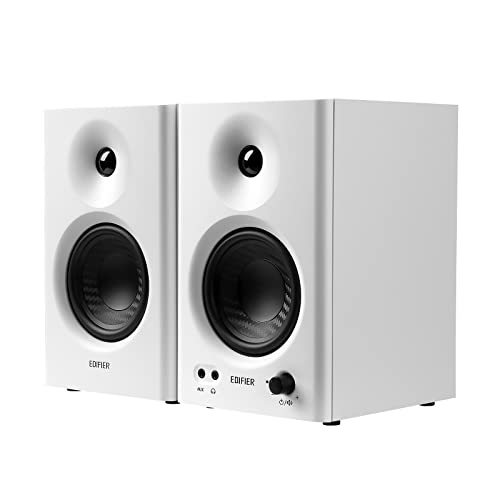
- Near-flat tuning for monitoring
- Front headphone output and simple controls
- Balanced TRS, RCA, and AUX inputs
Best For: Home music creators and compact desktop setups
Versatile Starter Pair

- 4.5-inch Kevlar woofers
- Front headphone and AUX access
- Includes cables, feet, and MPC Beats
Best For: Content creation, podcasting, gaming, and beginner production
Advanced Calibration Pick

- 80W RMS bi-amped stereo output
- XLR, TRS, RCA, AUX, and Bluetooth
- App-based EQ and room compensation
Best For: Producers and hi-res listeners needing flexible tuning
Compact Connected Monitor

- 3.5-inch carbon-fiber woofer
- USB DAC, Bluetooth, RCA, and AUX
- Balanced TRS and front headphone output
Best For: Small desktop studios and mixed wired/wireless use
High-Resolution Choice

- Detailed U-ART tweeter and HPS waveguide
- DSP high- and low-shelf room filters
- Multiple analog connection options
Best For: Producers and home studios prioritizing detail and room adjustment
Compact Desk Upgrade

- Pair of monitors with 4.5-inch woofers
- Front-panel Tone knob
- Includes isolation pads and cables
Best For: Desktop users wanting fuller sound and a ready-made stereo pair
Front-Ported Mixing Pick

- Front-firing acoustic port
- 80-watt Class AB bi-amplification
- XLR, 1/4-inch, and RCA inputs
Best For: Nearfield mixers needing front-port placement flexibility
Compact Yamaha Choice
HS3 Powered Studio Monitor Pair

- Compact 3.5-inch two-way monitor pair
- XLR/TRS, RCA, and stereo mini inputs
- Includes cables and anti-slip pads
Best For: Desktop setups and compact rooms
Front-Port Performance Pick
Kali Audio LP-6 V2 6.5-inch Monitor

- Front port minimizes airflow turbulence
- 80 watts with 115 dB maximum SPL
- XLR, TRS, RCA, and boundary EQ
Best For: Home and professional recording studios
Feature-Rich Pair
KRK ROKIT 5 Generation Five Pair

- Matched pair with 5-inch drivers
- DSP-driven room tuning
- Includes isolation pads and combo inputs
Best For: Production setups needing room-tuning flexibility
Balanced Desktop Choice – Edifier MR4
The Edifier MR4 is a practical entry point for shoppers seeking studio monitors with front port design-style convenience, especially in a compact desktop setup. Its 4-inch composite woofers, silk-dome tweeters, MDF construction, and near-flat tuning are aimed at clear monitoring, while the front controls and headphone output keep everyday operation simple.
Best For: Home music creators, desktop listeners, and users who want flexible wired connections.
Pros:
- Near-flat tuning is intended for music production and monitoring.
- Includes balanced TRS, RCA, AUX, and a front headphone output.
- Separate high- and low-frequency controls plus monitor and music modes.
- MDF construction helps reduce cabinet resonance.
Cons:
- The 4-inch woofer may provide less low-end presence than larger monitors.
- Connections are wired rather than wireless.
The MR4 is a straightforward choice when accurate desktop playback and easy front-panel access matter more than advanced room calibration or wireless streaming.
Versatile Starter Pair – M-AUDIO BX4
The M-AUDIO BX4 is a flexible wired pair for shoppers comparing studio monitors with front port design-style desktop convenience. Its 4.5-inch Kevlar woofers, silk-dome tweeters, bi-amplified design, and MDF cabinets target clear nearfield sound, while front headphone access suits late-night work.
Best For: Content creators, podcasters, gamers, and beginner music producers needing broad input compatibility.
Pros:
- 4.5-inch Kevlar woofers offer punchy low-frequency response.
- Front-panel headphone and AUX access supports private monitoring.
- Rear 1/4-inch, 1/8-inch, and RCA inputs accommodate varied equipment.
- Includes cables, foam feet, and MPC Beats software.
Cons:
- High and low EQ controls are located on the rear.
- The supplied notes emphasize wired operation despite a listed wireless specification.
The BX4 is a convenient all-purpose pair for a desktop studio, particularly if you need several analog connection options and included setup accessories.
Advanced Calibration Pick – Edifier MR4.5
The Edifier MR4.5 suits buyers who want studio monitors with front port design-style accessibility plus more advanced tuning options. This bi-amped 80-watt pair combines 4.5-inch mid-bass drivers, silk-dome tweeters, DSP processing, Bluetooth 6.0, and room compensation for a more adaptable desktop or nearfield system.
Best For: Producers, mixers, and hi-res listeners who want flexible inputs and room-adjustment features.
Pros:
- 80W RMS bi-amped output with a stated 50Hz–40kHz response.
- Balanced XLR, TRS, RCA, AUX, and front headphone connections.
- Bluetooth 6.0 with LDAC and multipoint pairing adds wireless flexibility.
- App-based EQ and room compensation support placement adjustments.
Cons:
- More controls and calibration options may be unnecessary for basic listening.
- Its larger feature set may require more setup than a simple desktop pair.
The MR4.5 is the strongest fit here for users who want monitoring flexibility beyond basic analog inputs, particularly when room placement and wireless playback both matter.
Compact Connected Monitor – Ortizan C7
The Ortizan C7 is a compact option for shoppers seeking studio monitors with front port design-style access and broad connectivity. Its 3.5-inch carbon-fiber woofer, silk-dome tweeter, stated flat-response tuning, USB DAC, Bluetooth 5.3, and front headphone output make it suitable for small creative and entertainment spaces.
Best For: Compact desktop studios, casual monitoring, gaming, and users who switch between wired and wireless sources.
Pros:
- Balanced 6.35mm TRS input supports compatible professional equipment.
- USB input with a 24-bit DAC is designed to reduce conversion signal loss.
- Bluetooth 5.3, RCA, AUX, and front headphone output provide connection flexibility.
- Flat-response tuning targets balanced reproduction across frequencies.
Cons:
- The 3.5-inch woofer may not deliver the low-end reach of larger monitors.
- The supplied specifications list inconsistent product details, including unit weight.
The C7 is a useful small-space choice when connectivity is a priority, though users needing stronger bass or more established studio specifications may prefer a larger monitor pair.
High-Resolution Choice – ADAM Audio T5V
The ADAM Audio T5V is a revealing nearfield monitor for recording, podcast editing, guitar tracking, and mixing. Its detailed U-ART tweeter and HPS waveguide make it a strong option for listeners seeking studio monitors with front port design alternatives, though its bass reflex port fires from the rear and requires thoughtful placement.
Best For: Home studios and producers who want detailed high-frequency monitoring with room-adjustment controls.
Pros:
- U-ART tweeter and HPS waveguide deliver detailed high-frequency sound.
- High- and low-shelf DSP filters help adapt the monitor to difficult rooms.
- Multiple analog connections support soundcards and home audio devices.
- Compatible with the matching ADAM Audio T10S subwoofer.
Cons:
- The rear-firing port may require more care near walls than a front-ported design.
- Sold as one monitor, so a stereo setup requires two units.
The T5V is a flexible, detailed monitor with useful acoustic adjustments. Choose it when high-frequency clarity and room tuning matter more than front-port placement.
Compact Desk Upgrade – Mackie CR4.5
The Mackie CR4.5 monitors are a practical pair for desks that have room for 4.5-inch woofers. They offer fuller low end than smaller 3.5-inch monitors, plus front-panel controls and a location switch that make them useful for general desktop listening and studio work. They are not identified in the supplied notes as front-ported studio monitors.
Best For: Desktop setups needing a complete monitor pair with convenient controls and included accessories.
Pros:
- Sold as a pair for a ready-to-use stereo setup.
- 4.5-inch woofers provide fuller low end without requiring a subwoofer.
- Front-panel Tone knob enables quick voicing adjustments.
- Includes isolation pads and all required cables.
Cons:
- The one-year limited warranty is shorter than some competing options.
- Its bass correction switch offers adjustment, but the supplied notes do not specify a front-firing port.
The CR4.5 is a convenient, accessory-rich choice for a compact desk. It makes sense for buyers who value an included stereo pair and simple controls over specialized front-port placement.
Front-Ported Mixing Pick – PreSonus Eris E5
The PreSonus Eris E5 is a particularly relevant choice for shoppers seeking studio monitors with front port design. Its front-firing acoustic port supports bass-frequency reproduction, while the 5.25-inch woven composite woofer, 80-watt Class AB bi-amplification, and acoustic tuning controls suit nearfield mixing.
Best For: Home-studio mixers who need front-port placement flexibility, strong nearfield output, and connection versatility.
Pros:
- Front-firing acoustic port supports bass reproduction and convenient placement.
- 5.25-inch woofer delivers solid low end with minimal bass distortion.
- 80-watt Class AB bi-amplification provides volume and headroom.
- Balanced XLR and 1/4-inch inputs plus unbalanced RCA support varied setups.
Cons:
- The supplied notes list a one-year warranty.
- Sold as a single monitor, so a stereo pair requires two units.
The Eris E5 is the clearest match for this roundup’s front-port requirement. Its port design, acoustic controls, and flexible inputs make it a capable option for space-conscious mixing environments.
Compact Yamaha Choice – HS3 Powered Studio Monitor Pair
The Yamaha HS3 is a compact pair of powered monitors for desktop production, editing, and everyday studio monitoring. Its 3.5-inch woofer, front-friendly compact format, and multiple input options make it a practical option for listeners seeking studio monitors with front port design, though the supplied specifications do not explicitly confirm a front port.
Best For: Desktop setups, compact rooms, and entry-level music production.
Pros:
- Sold as a stereo pair for immediate left-right monitoring.
- Includes XLR/TRS combo, RCA, and stereo mini inputs.
- Room control and high-trim response controls help tailor the sound.
- Includes speaker cable, stereo mini-to-RCA cable, and anti-slip pads.
Cons:
- The 3.5-inch woofer and 70 Hz lower frequency rating provide less low-end extension than larger monitors.
- The supplied notes do not confirm a front port design.
- At 26 watts, it is aimed more at compact listening spaces than high-output applications.
The HS3 stands out as a space-conscious stereo solution with useful connectivity and basic acoustic controls. Choose it when convenience and a small footprint matter more than deep bass or maximum volume.
Front-Port Performance Pick – Kali Audio LP-6 V2 6.5-inch Monitor
The Kali Audio LP-6 V2 is a single 6.5-inch powered monitor built for accurate production and recording work. Its front port is specifically designed to reduce turbulence, making it a strong candidate for buyers comparing studio monitors with front port design, especially when placement near a wall or on a desk is important.
Best For: Home studios, professional production, and placement-flexible monitoring.
Pros:
- Front port helps air exit at uniform velocity to minimize turbulence.
- Updated DSP system is designed for a flat frequency response.
- 80-watt bi-amplification and 115 dB maximum SPL provide substantial output.
- Offers XLR, TRS, and RCA connectivity plus boundary EQ adjustments.
Cons:
- This listing is for one monitor, so a stereo setup requires two units.
- Its 6.5-inch cabinet takes more space than compact desktop monitors.
- It is corded and has no listed wireless communication technology.
The LP-6 V2 is the clearest match here for front-port-focused buying. Its combination of front-ported airflow, placement controls, low-noise improvements, and strong output suits a serious single-monitor purchase or a planned stereo pair.
Feature-Rich Pair – KRK ROKIT 5 Generation Five Pair
The KRK ROKIT 5 Generation Five is a powered 5-inch monitor pair with DSP-driven room tuning and Class D amplification. It is worth considering alongside studio monitors with front port design, but the supplied notes do not identify a front port; its main strengths are tuning features, isolation accessories, and compatibility with professional audio setups.
Best For: Producers and engineers who want a matched pair with room-tuning features.
Pros:
- Includes two monitors for a complete stereo setup.
- DSP-driven room tuning supports adjustment for the listening environment.
- Class D amplifiers are designed for audio integrity and reduced operating temperature.
- Includes acoustic foam wedge isolation pads and an XLR/1/4-inch TRS combo input.
Cons:
- The supplied notes do not confirm a front port design.
- The molded-plastic enclosure may appeal less to buyers seeking wood cabinets.
- At 5 inches, it may not deliver the low-end reach of a larger monitor.
The ROKIT 5 Generation Five is a practical matched pair for users who value onboard processing and setup support. It offers more room-management features than a basic monitor, although front-port performance cannot be verified from the supplied specifications.
How We Picked the Best Studio Monitors with Front Port Design
We selected these monitors based on the features that matter most in real home-studio and near-field setups: frequency response, woofer size, amplification, cabinet design, connectivity, adjustment controls, price, and overall suitability for mixing or casual listening. We also considered how practical each model is for desktop placement, small rooms, and setups where rear-panel clearance is limited.
Not every speaker here is identical in port placement or acoustic tuning, so confirm the manufacturer’s specifications before installation. A front port can make placement more forgiving, but it does not eliminate the need for reasonable spacing, isolation, and room treatment.
Quick Comparison
| Best For | What to Prioritize | Shortlist Examples |
|---|---|---|
| Small desks and bedrooms | Compact cabinet, low listening fatigue, simple inputs | Edifier MR4, M-AUDIO BX4, Yamaha HS3 |
| Affordable everyday production | Balanced response, useful controls, reliable amplification | Edifier MR4.5, Mackie CR4.5, PreSonus Eris E5 |
| More bass and headroom | Larger woofer, higher output, wide listening area | ADAM T5V, KALI LP-6 V2, KRK ROKIT 5 G5 |
| Wireless convenience | Bluetooth alongside wired connections | Ortizan C7 |
Key Buying Factors for Studio Monitors with Front Port Design
Size and Bass Response
Four-inch monitors are easier to fit on a desk and can work well in small rooms, but their low-end extension is limited. Five- to 6.5-inch models generally provide more bass and volume, though they need more space and may excite room modes more strongly.
Connections and Controls
Check whether you need balanced TRS or XLR inputs, unbalanced RCA or AUX connections, Bluetooth, or a convenient front-panel volume control. Balanced inputs are preferable for longer cable runs and reducing unwanted noise.
Placement and Acoustic Adjustment
Front-ported monitors can be easier to position near a wall because the bass outlet is not directly behind the cabinet. Still, leave clearance around the speaker, aim the tweeters toward ear level, and use isolation pads or stands. High- and low-frequency trim controls are valuable when the room or desk produces excessive brightness or bass.
Output and Listening Distance
Near-field monitors are designed for close listening, not for filling a large room. Choose enough power for clean peaks at your normal distance, but do not select a larger monitor solely for louder playback. Accurate, comfortable listening is more important than maximum output.
Who Should Buy Which Studio Monitors with Front Port Design?
Choose a compact Edifier, M-AUDIO, or Yamaha pair if desk space is limited or you work in a small room. The Mackie, Edifier MR4.5, and PreSonus models suit buyers seeking an affordable step up for editing, production, and general listening. For deeper bass, greater headroom, and more revealing monitoring, consider the ADAM, KALI, or KRK options. The Ortizan C7 is the practical choice when Bluetooth convenience matters as much as wired playback.
Whichever model you choose, prioritize placement and calibration. A well-positioned, appropriately sized monitor will usually outperform a more powerful speaker used too close to a wall or in an untreated, resonant corner.