
The best studio monitors help you hear recordings more honestly, making it easier to balance vocals, bass, drums, and effects without relying on guesswork. This roundup covers compact desktop speakers, affordable near-field pairs, and larger monitors for serious home-studio work.
Consider your room size, listening distance, connection needs, and low-frequency requirements before choosing. A well-matched pair will usually outperform a larger, more powerful speaker placed poorly.
Best 10 Studio Monitors Picks for 2026
Compact Yamaha Control

- Pair of compact 4.5-inch 2-way monitors
- Room Control and high-trim adjustments
- XLR/TRS, RCA, and stereo-mini inputs
Best For: Small music-production and video-editing desks
Wide Sweet Spot JBL Reference

- Pair of 5-inch 2-way active monitors
- Image Control Waveguide for broad imaging
- Boundary EQ and HF Trim controls
Best For: Music production, podcasting, and sound design
Flexible Desktop Listening
PreSonus Eris E4.5 Monitor Pair

- 50-watt Class AB amplification
- Balanced, RCA, and auxiliary inputs
- Front headphone output and tuning controls
Best For: Home production and versatile multimedia desktops
Premium Compact Desktop Detail
ADAM Audio D3V Desktop Monitors
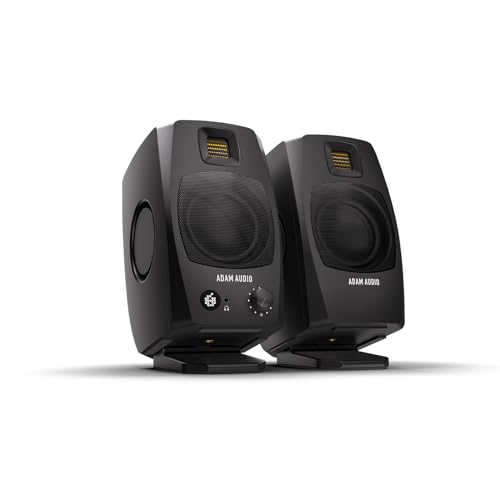
- USB-C and balanced 1/4-inch connectivity
- 3.5-inch woofers with D-ART tweeters
- 80-watt amplification and 45 Hz extension
Best For: Computer-centered production and desktop listening
Compact All-Rounder

- 50-watt stereo pair with compact 3.5-inch woofers
- TRS, RCA, auxiliary, and headphone connections
- High- and low-frequency acoustic tuning controls
Best For: Small desks, home studios, gaming, and everyday multimedia
Balanced Creator Pick
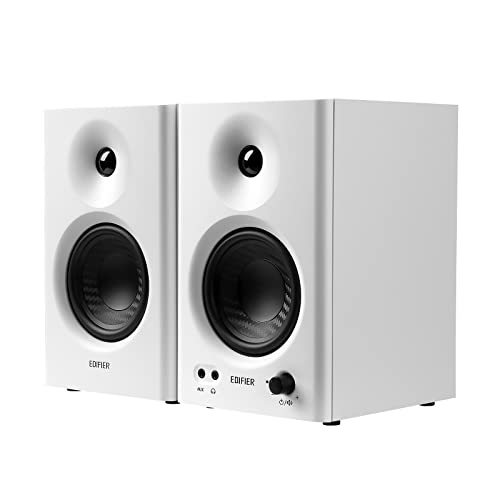
- Near-flat response for music production
- 4-inch woofers with 1-inch silk-dome tweeters
- Switchable monitor and music modes
Best For: Creators who also want speakers for relaxed daily listening
Desk-Friendly Mixing Option

- Compact stereo pair for home studios and desks
- Tone knob provides quick voicing adjustment
- Location switch and isolation pads aid placement
Best For: Small home studios and multimedia desks
Wide-Sweet-Spot Detail

- 6.55-inch woofer for deep lows
- Wide EBM waveguide for broad listening
- Acoustic controls for room tuning
Best For: Home studios needing flexible, detailed monitoring
Uncolored Reference Pair
Yamaha HS5 Studio Monitor Pair

- Two speakers for stereo monitoring
- 5-inch woofer and 1-inch tweeter
- 70W bi-amplified design
Best For: Music production and near-field studio monitoring
Connected Compact Monitoring
Edifier MR3 Powered Studio Monitor

- Bluetooth plus balanced TRS input
- Monitor, Music, and Custom modes
- 18W per channel with 3.5-inch drivers
Best For: Compact home studios and flexible desktop listening
Compact Yamaha Control – HS4 Powered Studio Monitors
The Yamaha HS4 is a compact pair of studio monitors for music production, video editing, and other desktop audio work. Its 4.5-inch woofer, dome tweeter, room-control settings, and multiple wired inputs make it practical for smaller workspaces.
Best For: Desktop creators who want compact Yamaha studio monitors with flexible analog connectivity.
Pros:
- Includes a pair of 2-way powered monitors with 4.5-inch woofers.
- Room Control and high-trim response controls help adapt the sound to the space.
- Offers XLR/TRS combo, RCA, and stereo-mini inputs.
- Includes speaker and stereo-mini-to-RCA cables plus anti-slip pads.
Cons:
- The 26-watt output is more suited to compact setups than high-volume applications.
- The speakers are corded and do not provide wireless connectivity.
- The listed frequency response begins at 60 Hz, so a subwoofer may be useful for deeper bass.
The HS4 focuses on practical desktop monitoring in a small enclosure. It is a sensible choice when input flexibility and room adjustment matter more than maximum output or extended low-end reproduction.
Wide Sweet Spot JBL Reference – 305P MkII 5-inch Monitor Pair
The JBL 305P MkII pair is designed for creators who want a more powerful set of studio monitors for music production, podcasting, and sound design. Its 5-inch woofers, Image Control Waveguide, and room-adjustment controls support detailed listening across a broad sweet spot.
Best For: Producers, podcasters, and sound designers seeking wide imaging and stronger output from 5-inch studio monitors.
Pros:
- Includes two active 5-inch 2-way monitors.
- Image Control Waveguide is designed to provide precise imaging and a wide sweet spot.
- Dual 41-watt Class-D amplifiers support dynamic output and deeper bass from the Slip Stream port.
- Boundary EQ and HF Trim help tailor response to the room.
Cons:
- Connectivity is limited to XLR and 1/4-inch TRS inputs.
- The larger cabinets may require more desk or stand space than compact models.
- They are corded monitors without wireless audio connectivity.
The 305P MkII is a strong fit when accurate stereo imaging, room correction, and additional headroom are priorities. Its professional input set makes it better suited to audio interfaces and studio-focused setups than casual consumer sources.
Flexible Desktop Listening – PreSonus Eris E4.5 Monitor Pair
The PreSonus Eris E4.5 pair combines near-field monitoring with convenient connections for music production, multimedia, gaming, and everyday listening. The 4.5-inch woven-composite woofer, silk-dome tweeter, tuning controls, and front-panel headphone output suit a versatile desktop setup.
Best For: Home producers and multimedia users who need studio monitors with consumer-friendly connections and headphone access.
Pros:
- 50 watts of Class AB amplification provides 25 watts per side.
- Includes balanced 1/4-inch TRS, RCA, and front-panel 1/8-inch stereo auxiliary inputs.
- High- and low-frequency controls allow basic room and placement adjustments.
- Front-panel volume control, headphone output, and headphone amplifier add convenience.
Cons:
- Only one speaker in the pair is active; the other is passive.
- The listed frequency response does not specify a lower bass limit.
- Bluetooth is listed in the specifications, but the supplied connection details primarily describe wired inputs.
The Eris E4.5 is a practical all-rounder for users who move between production, gaming, and general media. Its front-panel controls and wide selection of inputs make it especially convenient for a shared desk.
Premium Compact Desktop Detail – ADAM Audio D3V Desktop Monitors
The ADAM Audio D3V is a compact active desktop pair built for songwriters, producers, and listeners who want direct computer or mobile-device connectivity. USB-C input, D-ART tweeters, passive radiators, DSP switches, and angled stands give these studio monitors a feature-rich desktop focus.
Best For: Desktop producers and music lovers seeking compact studio monitors with USB-C connectivity and detailed high frequencies.
Pros:
- USB-C connectivity enables direct connection to computers and mobile devices.
- Each pair uses 3.5-inch aluminum woofers, dual passive radiators, and 1.5-inch D-ART tweeters.
- 80 watts of amplification and a stated low-frequency extension to 45 Hz support substantial output for the size.
- Includes angled monitor stands, a headphone socket, volume knob, and balanced 1/4-inch inputs.
Cons:
- The 3.5-inch woofers may not provide the same scale as larger 5-inch monitors.
- The compact desktop design offers fewer traditional consumer inputs than models with RCA or auxiliary connections.
- Advanced placement features may be more than a casual listener needs.
The D3V stands out for a modern computer-centered workflow. It is a compelling option when USB-C convenience, compact placement, and ADAM’s ribbon-tweeter design are more important than a larger cabinet or broad analog input selection.
Compact All-Rounder – PreSonus Eris 3.5
If you need versatile studio monitors for a desk, the PreSonus Eris 3.5 delivers a complete stereo pair with 3.5-inch woven-composite woofers, 1-inch silk-dome tweeters, and 50 watts of built-in amplification. Its acoustic tuning controls and broad connection options make it practical for music production, gaming, movies, and everyday listening.
Best For: Desktop users who want compact studio monitors for mixed audio, music production, and gaming.
Pros:
- Complete stereo pair with 50 watts of built-in amplification.
- Woven-composite woofers and silk-dome tweeters aim for clear, balanced sound.
- Includes TRS, RCA, auxiliary, and front headphone connections.
- High- and low-frequency controls help tailor the sound to your room.
Cons:
- The 3.5-inch woofers are better suited to compact spaces than large-room listening.
- These are corded speakers and are not water resistant.
The Eris 3.5 is a flexible entry point for a small studio or multimedia desk. It stands out when connectivity, compact size, and basic room adjustment matter as much as studio-oriented sound.
Balanced Creator Pick – Edifier MR4
The Edifier MR4 is a practical choice for creators seeking studio monitors with a near-flat responsive curve. Its 4-inch composite woofers, 1-inch silk-dome tweeters, MDF structure, and separate high- and low-frequency controls support both music production and relaxed everyday listening.
Best For: Music creators who want flexible near-field monitors with separate monitor and music modes.
Pros:
- Professionally fine-tuned near-flat response is intended for music creation.
- 4-inch woofers and silk-dome tweeters provide clear, smooth sound.
- Monitor and music modes accommodate production and casual listening.
- Offers balanced TRS, RCA, auxiliary, and front headphone connections.
Cons:
- The supplied details list the enclosure as plastic despite the product notes also describing an MDF structure.
- The listed package information identifies one item, so buyers should verify the included pair configuration before ordering.
With its dual listening modes and versatile inputs, the MR4 can serve as both a production tool and a general-purpose desktop speaker. Its 4-inch drivers may also appeal to users wanting more scale than compact 3.5-inch monitors.
Desk-Friendly Mixing Option – Mackie CR3.5
The Mackie CR3.5 is a compact pair of studio monitors designed for home studios, audio production, and multimedia setups. Its 3.5-inch woofers, tone knob, location switch, and included isolation pads make it easy to adapt the speakers to a small desk or changing placement.
Best For: Home-studio users who want compact studio monitors with simple physical voicing and placement controls.
Pros:
- Sold as a pair and sized for desks and small studios.
- Tone knob adjusts the voicing directly from the desk.
- Location switch helps correct bass for wall-adjacent or free-standing placement.
- Includes isolation pads and the cables needed to get started.
Cons:
- 3.5-inch woofers are intended for compact setups rather than large spaces.
- The supplied warranty is limited to one year.
The CR3.5 focuses on straightforward setup and useful desk-level adjustments instead of complicated menus. It is a sensible fit for a small production or multimedia station where included accessories and placement flexibility are valuable.
Wide-Sweet-Spot Detail – PreSonus Eris E7 XT
PreSonus Eris E7 XT 2-Way Active Studio Monitor with EBM Waveguide (Pack of 1)
Check Price On AmazonThe PreSonus Eris E7 XT is a strong choice for studio monitors when you want extended low-end response and a forgiving listening position. Its 6.55-inch woven-composite woofer, silk-dome tweeter, and EBM waveguide are designed for detailed monitoring, while the acoustic controls help tailor the speaker to your room.
Best For: Home studios and producers who want a wide sweet spot, solid imaging, and room-tuning flexibility.
Pros:
- 6.55-inch woofer supports deep lows.
- 100° horizontal by 60° vertical waveguide creates a wide sweet spot.
- Level, high-pass, LF trim, HF trim, and acoustic-space controls support room matching.
- Includes Studio One Prime and the Studio Magic plug-in suite.
Cons:
- This listing includes one monitor, so a stereo setup requires two units.
- Its larger 6.5-inch format may be more speaker than compact desks need.
Choose the Eris E7 XT if mixing position flexibility and low-frequency reach matter more than minimizing desk space. Its broad waveguide and tuning controls make it adaptable, but remember to budget for a second monitor for stereo work.
Uncolored Reference Pair – Yamaha HS5 Studio Monitor Pair
The Yamaha HS5 pair is a practical studio monitors option for creators who prioritize a straightforward, uncolored presentation. Each speaker combines a 5-inch woofer with a 1-inch dome tweeter and bi-amplification, giving this matched pair a focused near-field monitoring setup.
Best For: Music production and studio monitoring where a pair of balanced, front-of-you reference speakers is the priority.
Pros:
- Includes two HS5 studio monitors for stereo monitoring.
- Designed to emphasize sonic purity without coloring the original sound.
- Bi-amplified 70-watt system combines 45W LF and 25W HF amplification.
- Balanced or unbalanced signals are supported through XLR and TRS inputs.
Cons:
- The 5-inch woofer offers less low-end reach than larger monitors.
- The listing describes a wired setup rather than wireless studio connectivity.
The HS5 pair makes sense when you want a conventional two-speaker monitoring foundation with clear signal connections and a deliberately uncolored approach. Consider a larger monitor if deep bass extension is a central requirement.
Connected Compact Monitoring – Edifier MR3 Powered Studio Monitor
The Edifier MR3 brings studio monitors features to a flexible desktop speaker system. With balanced TRS, RCA, AUX, Bluetooth, and a headphone output, it can handle production, editing, and everyday listening while offering Monitor, Music, and Custom modes for different uses.
Best For: Home studios and desktop users who want monitoring tools plus convenient Bluetooth and multi-device connectivity.
Pros:
- Hi-Res Audio certified with a stated 52Hz–40kHz flat response.
- Balanced TRS, RCA, AUX, Bluetooth, and headphone connections offer flexibility.
- Monitor, Music, and Custom modes support different listening tasks.
- EDIFIER ConneX app enables detailed adjustments and personalized EQ.
Cons:
- Its 18W-per-channel RMS output is more modest than larger studio monitors.
- The 3.5-inch mid-low drivers may provide less low-end authority than 5- or 6.5-inch alternatives.
The MR3 is a versatile pick for a compact workstation where production and general listening share the same speakers. Its connectivity and app controls are compelling, though users focused exclusively on high-volume mixing may prefer a larger, more powerful monitor.
How We Picked These Studio Monitors
We selected these models based on practical factors that matter in home studios and desktop setups: frequency response, driver size, amplifier design, cabinet footprint, connection options, adjustment controls, and overall value. The list includes compact speakers for bedrooms and workstations, balanced near-field monitors for mixing, and larger options suited to rooms with more space.
We also considered how easily each pair can fit a real workflow. Features such as front-panel controls, Bluetooth, tone adjustment, acoustic tuning, and multiple inputs can be useful, but accuracy and appropriate placement remain more important than convenience features alone.
Quick Comparison
| Best For | Recommended Type | What to Prioritize |
|---|---|---|
| Small desk or bedroom studio | 3- to 4.5-inch monitors | Compact size, near-field clarity, and low listening fatigue |
| General home recording | 5-inch monitors | Balanced response, useful output, and room-friendly tuning |
| More accurate low-end monitoring | 6.5- to 7-inch monitors | Extended bass, placement flexibility, and acoustic controls |
| Music, gaming, and casual listening | Monitors with tone controls or Bluetooth | Convenient inputs and adaptable voicing |
Key Buying Factors for Studio Monitors
Room Size and Listening Distance
Near-field monitors are designed to be heard from a short distance, typically at a desk or small mixing position. Larger speakers can produce more bass and volume, but they may overwhelm a small untreated room. Choose a size that suits the room rather than simply selecting the biggest woofer.
Driver Size and Bass Extension
Smaller drivers generally offer a smaller footprint and controlled presentation, while 5-inch and larger woofers usually provide more low-end information. If you produce bass-heavy music, leave room for a subwoofer later or choose a model with enough extension for your work.
Connections and Controls
Check whether the monitor accepts balanced TRS or XLR connections from your audio interface. RCA and auxiliary inputs can be useful for consumer devices, while Bluetooth adds convenience but is not essential for critical mixing. Rear-panel level and acoustic controls help compensate for placement and room behavior.
Placement and Room Treatment
Set the speakers as an equal-sided triangle with your listening position, aim the tweeters toward your ears, and place both monitors at the same height. Stands or isolation pads can reduce desk vibration. Basic absorption and avoiding corner placement often improve results more than upgrading speakers.
Who Should Buy Which Studio Monitors?
Choose a compact 3- or 4.5-inch pair if desk space is limited, you work at moderate volume, or you need versatile speakers for a small room. A 5-inch model is the safest all-purpose choice for many home producers because it balances detail, bass response, and manageable size.
Move to a 6.5- or 7-inch monitor if your room is large enough and you need stronger low-frequency monitoring. For mixed-use setups, models with Bluetooth or tone controls can be more convenient, but prioritize accurate near-field performance when mixing is the main goal. Whatever you buy, budget for solid placement and a suitable audio interface; those choices have a major effect on what your Studio Monitors can deliver.