
Portable fiber optic testers help technicians verify signal levels, locate breaks, and troubleshoot fiber links without carrying a full-size test bench. The right handheld unit can make FTTH, CCTV, CATV, and telecom service calls faster and more consistent.
We compared these 10 models by testing functions, connector compatibility, portability, power options, and practical field usability so you can choose a tester that matches your workflow and budget.
Best 10 Portable Fiber Optic Testers Picks for 2026
All-in-One Field Tester

- Combines OPM, VFL, and RJ45 testing
- Supports eight standard wavelengths
- FC/SC/ST interface with user calibration
Best For: Technicians wanting several basic test functions in one tool
Compact FTTH Pick

- Combines OPM, VFL, and LED lighting
- Supports 10 wavelengths and -70 to +10 dBm
- Stores up to 500 measurement sets
Best For: Portable FTTH and data-center testing
Rechargeable Precision Option
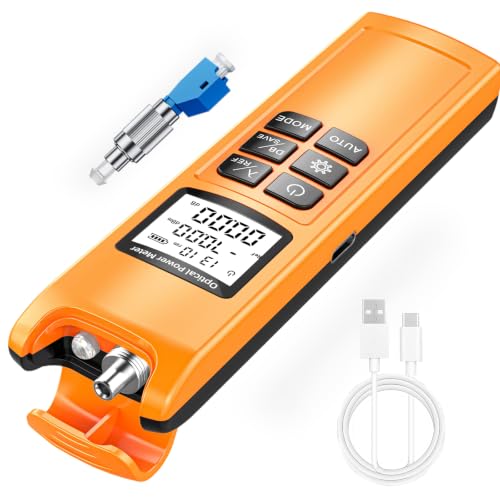
- USB-C rechargeable 400 mAh battery
- Automatic detection of three signal frequencies
- Includes FC/SC/ST and FC-to-LC connectivity
Best For: Field technicians prioritizing rechargeable operation and signal detection
Four-Function Workhorse

- Adds RJ45 testing and LED lighting to OPM and VFL
- Supports 10 wavelengths from 850 to 1650 nm
- Stores up to 500 sets with user calibration
Best For: Mixed fiber and network service calls
Best All-in-One Choice
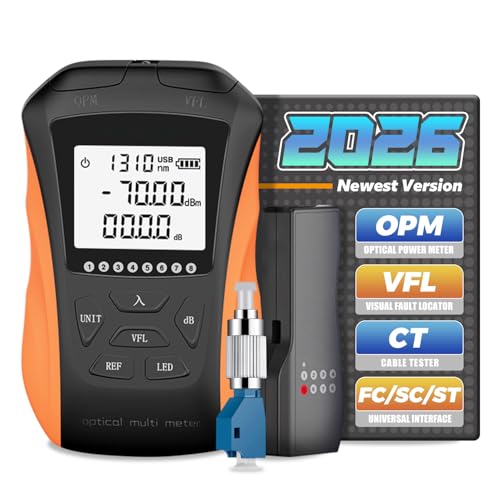
- Combines OPM, VFL, and LAN cable testing
- -70 dBm to +10 dBm range with multiple wavelengths
- Rechargeable battery and LCD status display
Best For: Fiber and LAN troubleshooting in one compact tester
Best for Field Portability

- OPM, 2 mW VFL, and LED lighting
- Eight standard wavelengths with -70 dBm to +6 dBm range
- Compact fall-resistant body with hanging rope
Best For: Portable FTTH and data-center checks
Best Compact Budget-Style Option
Mini 4-in-1 Optical Power Meter

- OPM, 650 nm VFL, and network-cable testing
- Eight calibration wavelengths with dBm or milliwatt display
- SC, FC, and ST support; LC requires an adapter
Best For: Compact routine fiber and cable checks
Versatile Pocket Tester
5-in-1 Fiber Optic Cable Tester

- Eight wavelengths with -70 dBm to +6 dBm range
- FC/SC/ST and RJ45 testing in one device
- Backlight, data storage, and Type-C power support
Best For: Portable fiber, fault-location, and RJ45 checks
Field-Ready Meter
Portable FTTH Fiber Optical Power Meter

- Seven calibrated wavelengths for common fiber work
- SC, FC, and ST interface compatibility
- Backlit display with protective cover and low-battery alert
Best For: FTTH, CATV, CCTV, and telecom power testing
Fault-Finding Combo
Portable OPM-VFL Fiber Optic Tester
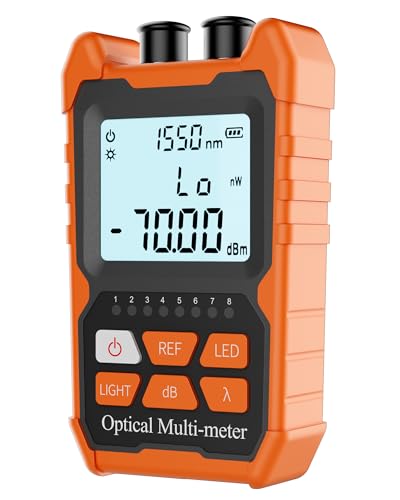
- 2 mW red-laser visual fault locator
- OPM supports up to eight wavelengths
- FC/SC/ST and RJ45 testing included
Best For: Fiber troubleshooting and mixed network diagnostics
All-in-One Field Tester – OPM-VFL-1 Fiber Cable Tester
This compact option is one of the more versatile portable fiber optic testers for technicians who want optical power measurement, visual fault locating, and basic RJ45 testing in one device. It supports eight common wavelengths, a broad -70 to +6 dBm test range, and FC/SC/ST interfaces.
Best For: Field technicians who need a combined fiber and RJ45 tester with universal connector support.
Pros:
- Combines OPM, VFL, and RJ45 testing in one handheld unit.
- Supports eight wavelengths from 850 to 1650 nm.
- Includes backlight selection, wavelength memory, user calibration, and automatic shutdown.
Cons:
- Two AA batteries are required but not included.
- Its maximum positive measurement level is +6 dBm, lower than some alternatives.
Choose this model when reducing the number of tools in your kit matters. Its integrated functions and FC/SC/ST compatibility make it practical for general installation and troubleshooting work.
Compact FTTH Pick – 3-in-1 OPM and VFL Tester
For portable fiber optic testers aimed at everyday FTTH and data-center work, this 3-in-1 unit combines an optical power meter, 1 mW visual fault locator, and LED light. It covers 10 wavelengths, stores up to 500 data sets, and has a stated measurement error below 0.2 dB.
Best For: FTTH and data-center users who want a lightweight tester with extensive wavelength coverage and data storage.
Pros:
- Measures 10 wavelengths across common fiber applications.
- Offers -70 to +10 dBm testing and user calibration.
- Stores up to 500 sets of data and shuts down after 10 minutes of inactivity.
Cons:
- Two AAA batteries are needed and are not included.
- Does not include the RJ45 testing function listed on some competing models.
This is a strong practical choice when measurement range, record keeping, and portability matter more than having network-cable testing built in. Its hanging rope and fall-resistant design also suit mobile work.
Rechargeable Precision Option – Fot-100 Fiber Tester
This rechargeable model stands out among portable fiber optic testers for its USB-C charging, automatic frequency detection, and stated 0.01 dBm logarithmic resolution. It measures -70 to +10 dBm across 10 wavelengths and includes FC/SC/ST connectivity plus an FC-to-LC adapter.
Best For: Field users who prefer a rechargeable tester with frequency recognition and a compact illuminated display.
Pros:
- Built-in 400 mAh battery supports approximately 3,200 uses per charge.
- Automatically detects 270 Hz, 1000 Hz, and 2000 Hz modulated signals.
- Includes self-calibration, 40-record storage, LED backlight, and flashlight.
Cons:
- Its listed storage capacity is smaller than models that store 500 sets.
- The supplied details list a 9-volt operating specification, which buyers may want to clarify before use.
This tester is a good fit for technicians who value less battery swapping and quick signal identification. The FC-to-LC adapter and pocket-sized design add flexibility for field installations.
Four-Function Workhorse – M70-10 OPM and VFL Tester
This M70-10 is among the most feature-rich portable fiber optic testers in the group, combining an optical power meter, 10 mW VFL, RJ45 wiring-sequence test, and LED light. It covers 10 wavelengths, measures from -70 to +10 dBm, and includes an FC-LC adapter.
Best For: Network and fiber technicians who want fiber testing, RJ45 checking, and lighting in one pocket-sized tool.
Pros:
- Provides four functions: OPM, 10 mW VFL, RJ45 test, and LED lighting.
- Supports 10 standard wavelengths with measurement error below ±0.2 dB.
- Stores up to 500 data sets and supports user calibration.
Cons:
- Two AAA batteries are required but not included.
- Automatic shutdown and backlight settings may add setup considerations during extended testing.
Consider this model when connector flexibility and broader tool coverage are priorities. Its compact, fall-resistant design and included FC-LC adapter make it particularly useful for mixed network and fiber service calls.
Best All-in-One Choice – Y8 Optical Power Meter
For shoppers comparing portable fiber optic testers, this Y8 model combines optical power measurement, a visual fault locator, and LAN cable testing in one compact unit. Its broad wavelength support, rechargeable battery, and readable LCD make it suited to everyday fiber and network troubleshooting.
Best For: Technicians who want one tester for fiber-power checks, visible fault finding, and basic LAN cable continuity testing.
Pros:
- Combines OPM, VFL, and cable tester functions.
- Measures across multiple wavelengths, with a -70 dBm to +10 dBm test range.
- Uses a rechargeable 1100 mAh Li-ion battery and USB charging.
- LCD shows power loss, wavelength, frequency, and battery status.
Cons:
- The included function set may be more than needed for simple power measurements.
- Its LAN testing feature is useful for continuity checks but is not described as a full network analyzer.
This is the most versatile option in the group, especially for users who regularly switch between optical-fiber and LAN troubleshooting. The built-in flashlight and rechargeable design add practical value for field work.
Best for Field Portability – 4-in-1 Fiber Tester
Among portable fiber optic testers, this orange unit emphasizes easy carrying and straightforward field use. It pairs an optical power meter with a 2 mW visual fault locator and LED lighting, while supporting eight standard measurement wavelengths and automatic shutdown.
Best For: FTTH and data-center users who need a lightweight tester with basic illumination and fault-location functions.
Pros:
- Supports optical power measurement, a 2 mW VFL, and LED lighting.
- Covers eight wavelengths from 850 nm through 1650 nm.
- Offers backlight selection, wavelength memory, user calibration, and automatic shutdown.
- Compact, lightweight, fall-resistant design includes a hanging rope.
Cons:
- Requires two AAA batteries, which are not included.
- Its stated power range ends at +6 dBm, lower than some broader-range testers.
This model is a practical pick when portability and simple controls matter most. The memory, calibration, and auto-shutdown features make repeated field measurements more convenient, though buyers should plan to supply the AAA batteries.
Best Compact Budget-Style Option – Mini 4-in-1 Optical Power Meter
This mini tester is a convenient choice for portable fiber optic testers when a small, multifunction device is the priority. It combines optical power measurement, a 2 mW visual fault locator, and network-cable testing, with support for FC, SC, and ST connectors.
Best For: Users who need a small tester for optical-fiber networks, basic power readings, visible fault checks, and network-cable testing.
Pros:
- Combines OPM, 650 nm VFL, and network-cable test functions.
- Supports eight calibration wavelengths from 850 nm to 1650 nm.
- Displays readings in dBm or milliwatts with stated 0.01 dBm logarithmic resolution.
- Accepts SC, FC, and ST connectors; LC use is possible with an adapter.
Cons:
- Requires two AA batteries.
- The supplied notes specify that an SC male-to-LC female connector is needed for LC connections.
- The listed power range is -70 dBm to +6 dBm.
Its small format and broad connector compatibility make it useful for routine checks and service calls. If LC connections are part of your workflow, remember to account for the required adapter.
Versatile Pocket Tester – 5-in-1 Fiber Optic Cable Tester
If you need portable fiber optic testers for mixed fiber and network-cable checks, this 5-in-1 optical power meter offers a practical feature set. It supports eight wavelengths, FC/SC/ST connections, RJ45 testing, and visual fault-location functionality in a compact, pocket-friendly design.
Best For: Technicians who want one portable tester for optical power, basic fiber fault checks, and RJ45 testing.
Pros:
- Measures eight wavelengths from 850 to 1625 nm with a stated range of -70 dBm to +6 dBm.
- Combines OPM, fiber light, RJ45 testing, and FC/SC/ST support.
- Includes backlight, auto shut-off, data storage, and simultaneous linear/nonlinear readings.
Cons:
- Requires two AAA batteries, which are not included.
- Its many functions may be more than needed for simple power measurements.
This is a strong all-around choice when portability and multifunction testing matter. Type-C power connectivity adds flexibility when batteries are unavailable, while saved readings can be useful during repeated measurements.
Field-Ready Meter – Portable FTTH Fiber Optical Power Meter
For straightforward portable fiber optic testers used in FTTH, CATV, CCTV, and telecom work, this battery-powered optical power meter emphasizes a compact build and broad connector compatibility. Its large backlit display and user calibration features make it approachable for field measurements.
Best For: Fiber technicians and installers working with SC, FC, or ST connections across CATV, CCTV, and telecommunications systems.
Pros:
- Supports seven calibrated wavelengths from 850 to 1625 nm.
- Works with SC, FC, and ST interfaces and provides linear and logarithmic display resolution.
- Large screen, LED backlight, protective cover, auto shutdown, and low-battery indication support field use.
Cons:
- It is an optical power meter rather than a combined OPM/VFL tester.
- The listed design is focused on SC/FC/ST interfaces and does not mention RJ45 testing.
This meter suits buyers who prioritize familiar fiber connectors, readable measurements, and durability-oriented features over an all-in-one tester. Its 260 g portable form is practical for carrying between installation jobs.
Fault-Finding Combo – Portable OPM-VFL Fiber Optic Tester
Among portable fiber optic testers, this OPM-VFL model is designed for quick signal measurements and visible fault checks. It combines an optical power meter with a 2 mW visual fault locator, supports up to eight wavelengths, and adds RJ45 testing for mixed fiber and copper-network diagnostics.
Best For: Installers and troubleshooters who need optical power readings plus red-laser fault detection in one compact tester.
Pros:
- Combines OPM measurement with a bright red 2 mW visual fault locator.
- Supports up to eight wavelengths and measures in dBm and mW.
- Includes FC/SC/ST interfaces and RJ45 testing for broader network diagnostics.
Cons:
- Requires non-rechargeable batteries.
- The supplied notes do not specify the supported wavelength list or measurement range.
- Its broader testing functions may be unnecessary for users who only need an OPM.
This is the most troubleshooting-oriented option of the three. The integrated VFL can help identify breaks and connector or splice issues visually, while OPM and RJ45 functions cover routine fiber and network installation checks.
How We Picked the Best Portable Fiber Optic Testers
We focused on the features that matter during real installation and maintenance work: optical power measurement range, visual fault locator output, supported connector interfaces, network-cable testing, display readability, battery convenience, and overall portability. Models with integrated OPM and VFL functions received particular attention because they cover the two most common diagnostic tasks in one handheld tool.
We also considered whether each tester is rechargeable, supports common FC, SC, or ST connections, and offers useful extras such as RJ45 testing, LED illumination, or included adapters. Because specifications and accessories can vary by seller, confirm the listed wavelength range, power limits, and connector configuration before ordering.
Quick Comparison
| Feature | Why It Matters |
|---|---|
| Optical power meter | Measures received optical power and helps identify weak or unstable links. |
| Visual fault locator | Uses visible red light to find breaks, bends, poor terminations, and connector problems. |
| RJ45/network testing | Adds basic copper-cable troubleshooting for mixed fiber and Ethernet jobs. |
| Rechargeable battery | Reduces disposable-battery costs and is convenient for frequent field use. |
| FC/SC/ST support | Improves compatibility with common patch cords, panels, and test adapters. |
Key Buying Factors for Portable Fiber Optic Testers
Measurement Range and Accuracy
Check the dBm range and supported wavelengths first. A wider range is useful when testing both short indoor links and longer telecom or FTTH runs. If certification-grade accuracy is required, compare calibration information and stated measurement tolerances rather than relying only on the feature list.
VFL Power and Operating Modes
A 1 mW VFL is often sufficient for basic continuity and fault tracing, while a 2 mW option may provide better visibility over longer or harder-to-trace sections. Look for continuous and pulsed modes, which can make the signal easier to identify in busy environments.
Connectors, Adapters, and Usability
FC, SC, and ST compatibility is valuable, but some setups require LC support through an adapter. Consider the screen size, button layout, protective caps, auto power-off, and whether the unit can be operated comfortably while wearing gloves.
Battery and Durability
For service work, USB charging and a replaceable or long-lasting battery can be more useful than a slightly lower purchase price. A compact, protected housing and included carrying case also help the tester survive regular transport between job sites.
Who Should Buy Which Portable Fiber Optic Testers?
Choose a basic OPM/VFL combination if you mainly need quick continuity checks, signal verification, and occasional fault location. A rechargeable model is a better fit for technicians who test several links per day. If your work includes Ethernet alongside fiber, choose a unit with RJ45 testing to reduce the number of tools in your kit.
For FTTH, CATV, CCTV, and telecom contractors, prioritize a broad optical measurement range, common connector support, readable results, and dependable battery life. Users performing formal certification or troubleshooting high-value networks should treat these compact testers as service tools and verify whether a calibrated professional meter or additional light source is also required.